Dr. Rebecca Morrison had spent fifteen years decoding the past, but nothing prepared her for the moment her blood ran cold. The photograph was unremarkable at first—a faded wedding portrait from 1903, donated anonymously to the Atlanta Historical Archive. A white man in a dark suit, a Black woman in a white gown, their hands clasped between them. But as Rebecca zoomed in on the bride’s fingers, her breath caught. The thumb and index finger were deliberately positioned—a subtle, unmistakable distress signal.
In 1903 Georgia, interracial marriage was illegal, a criminal offense under anti-miscegenation laws. Yet here was photographic evidence of what appeared to be exactly that. Rebecca’s training screamed that something was wrong. This wasn’t a union of love; it was a silent scream frozen in time, waiting 120 years to be heard.
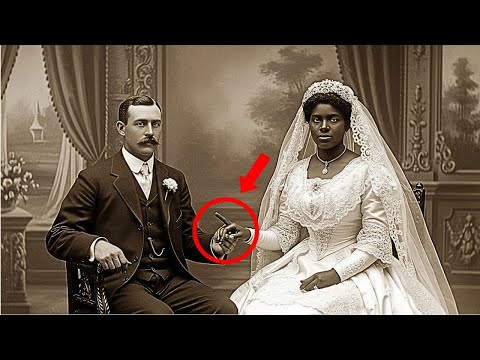
She called Dr. Marcus Williams, a specialist in African-American history. When he arrived that evening, he studied the image without a word, his expression darkening. “This shouldn’t exist,” he finally said. “Unless this wasn’t actually a legal marriage—unless this photograph documents something else entirely. Coercion, captivity, or worse.” He pointed to the bride’s face. “That’s not a bride’s expression. That’s terror being barely contained.”
The notation on the back read only: “Mr. Charles Whitfield and servant.” Not wife, not bride—servant. The word hung between them like a curse. Marcus’s voice was quiet. “He didn’t even try to hide what she was to him. This photograph was never meant to document a marriage. It was meant to document ownership.”
That night, Rebecca couldn’t sleep. She kept seeing the woman’s face, her carefully positioned fingers. Who was she? What had happened to her? And most haunting of all—had anyone seen her signal at the time, or had it remained invisible until now, far too late to save her?
The next morning, they began at the Georgia State Archives. The archivist, Mrs. Dorothy Hayes, tensed at the name Charles Whitfield. “That’s a name that still carries weight in certain circles,” she said slowly, “though not the kind anyone should be proud of.” She disappeared into the records room and returned with several boxes. The Whitfield family had been prominent in Atlanta from the 1870s through the 1920s, their fortune built on cotton and textiles. Charles Whitfield inherited the business in 1898. The 1900 census showed him living in a large house on Peachtree Street with substantial wealth and numerous servants—all Black women and girls, ages ranging from 14 to 30.
One entry caught Rebecca’s attention: Louisa, age 16, domestic servant, literate. Marcus found property records showing Whitfield owned a textile factory where dozens of workers, mostly Black women and children, labored in brutal conditions for minimal wages. Newspaper articles praised him as a progressive employer and pillar of the community. The disconnect was nauseating.
They needed to identify the woman in the photograph. Mrs. Hayes suggested checking city records for missing persons reports. After two days of searching, Marcus found a police report from September 1903—brief and dismissive. Report filed by Henry and Martha Johnson regarding their daughter, Louisa Johnson, age 19, employed in the household of Charles Whitfield. Family claims she’s not been seen in over a month. Mr. Whitfield states Miss Johnson is fulfilling her contracted duties and is in good health. No evidence of wrongdoing. Case closed.
Rebecca cross-referenced the name with the 1900 census. There she was: Louisa Johnson, age 16, living with her parents and three younger siblings near Auburn Avenue. Her father, Henry, was a carpenter; her mother, Martha, a laundress. The family was literate and owned their small home—part of Atlanta’s striving Black middle class, trying to build something despite the crushing weight of Jim Crow.
Marcus found more records. In 1902, Henry Johnson had been injured in a construction accident and could no longer work. The family fell into debt. A church charity record showed they had appealed for help in early 1903. “This is how it happened,” Marcus said, his voice heavy with anger and sorrow. “Whitfield saw an opportunity—a family in desperate circumstances, a young woman with no options. He offered employment, probably promised good wages.”
Then they found a letter in the church records, written by Martha Johnson to the pastor in July 1903. “We have not seen our Louisa in three weeks. Mr. Whitfield says she’s well and working hard, but he will not let us visit her. He says it would disrupt the household routine. Reverend, my heart tells me something is wrong. My daughter writes to us every week without fail, but we have received no letters. When I went to his house, the servants would not look at me. Please, can you help us?”
The pastor’s response was noted in his journal: “Spoke with Mr. Whitfield regarding the Johnson girl. He assured me she is healthy and content, simply busy with her duties. I’m inclined to believe him. The Johnsons must trust in God’s providence and not make trouble for a prominent gentleman who has shown them Christian charity.”
Rebecca tracked down the Morrison and Wright Portrait Studio records through the Georgia Historical Society. The studio had operated from 1895 to 1910, and some materials had been preserved by the photographer’s descendants. She contacted James Morrison, the great-grandson of William Morrison, the studio’s founder. James invited them to his home in Decatur, where he maintained an extensive archive. “William Morrison photographed Atlanta society for fifteen years,” James explained. “He kept detailed journals about his clients. He was also quietly an abolitionist’s son who struggled with photographing the uglier aspects of Southern society.”
He pulled out a leather journal from August 1903 and opened to a page marked with a faded ribbon. “August 17th, 1903. Today I performed perhaps the most disturbing task of my career. Charles Whitfield commissioned a wedding portrait, but there was no wedding. The young Negro woman he brought to the studio was clearly not there of her own will. She wore an expensive gown that didn’t fit properly, and her eyes held such profound fear that I nearly refused the commission.” The entry continued: “Whitfield insisted on posing them as a married couple with their hands joined. The woman—he never used her name, only called her ‘girl’—began to tremble when he grabbed her hand. I noticed bruising on her wrists. When I looked into her eyes, I saw a desperation there. She was trying to tell me something, but with Whitfield watching her every movement, she couldn’t speak.”
James turned the page, his voice strained. “As I prepared the exposure, I noticed her fingers moving slightly, repositioning themselves into what appeared to be a deliberate pattern—a signal perhaps. I said nothing, but I made sure to capture it clearly. I took three exposures. After they left, I felt physically ill. I knew what I had photographed wasn’t a wedding. It was evidence of something criminal. But what could I do? Report it to the police? They would laugh at me for suggesting a white man of Whitfield’s standing had done anything wrong.”
Rebecca’s heart raced. The photographer had seen it too—the silent scream, the desperate signal. But it hadn’t been enough to save Louisa then. Now, a century later, it was up to them to uncover the rest of her story.
Marcus expanded the investigation to examine Whitfield’s history more comprehensively. Through court records, property documents, and newspaper archives, a disturbing pattern emerged. Between 1899 and 1905, at least six families had filed complaints about daughters who had gone to work for Whitfield and subsequently disappeared from contact with their families.
Each case followed a similar trajectory: a Black family facing economic hardship, a young woman usually between sixteen and twenty hired as domestic help, initial letters home that suddenly stopped, family members turned away when they tried to visit, police reports filed and immediately dismissed. In two cases, the young women eventually reappeared months later, refusing to speak about their experiences, their spirits visibly broken.
Rebecca found testimony from a woman named Sarah, who had worked for Whitfield in 1901. She had given a statement to a Black community organization documenting abuses by white employers—a record that existed outside official channels because official channels refused to hear such complaints. “Mr. Whitfield kept three of us in the house. We were never allowed to leave. He told us if we tried he would have our families arrested for theft or our fathers lynched. He did whatever he wanted to us. We were his property in everything but name.”
The testimony continued: “There was a girl there when I arrived. Couldn’t have been more than sixteen. She was in a room on the third floor and we weren’t allowed to speak to her. I heard her crying at night. After a few weeks, she disappeared. Mister Whitfield said she had stolen from him and run away. But I knew better. She wouldn’t have left. She was too afraid of what he would do to her family.”
Marcus found records showing that Whitfield had connections to local law enforcement and city officials. He made regular donations to political campaigns and hosted social gatherings for Atlanta’s elite. “He had complete immunity,” Marcus said bitterly. “The system protected him. The police worked for him. The courts deferred to him. And Black families had absolutely no recourse.”
Despite the darkness of what they were uncovering, Rebecca remained focused on Louisa herself. The photograph showed more than victimization. It showed resistance. The hand signal captured forever in that image was an act of defiance, a refusal to let her captivity go unrecorded. “She knew,” Rebecca said, studying the photograph again. “She knew that photograph might be the only evidence, so she left a message.”
Through Martha Johnson’s letters to various organizations and churches, they traced the family’s desperate attempts to find their daughter. In October 1903, Henry Johnson, despite his injuries, tried to force his way into Whitfield’s house. He was arrested for trespassing and disturbing the peace, spending two weeks in jail. The incident made the newspapers, but the coverage was entirely sympathetic to Whitfield: Prominent businessman harassed by deranged former employee’s relative.
Martha wrote to the NAACP’s Atlanta chapter, newly formed in 1903. “My daughter is being held against her will by Charles Whitfield. She came to his home as an employee and is now his prisoner. I’ve not seen her in four months. She would never abandon her family voluntarily. Please, someone must help us. We have exhausted every legal avenue and no one will listen because we are Negro and he is white and wealthy.”
The NAACP responded, but their investigation hit the same walls. Their lawyer, a Black man named Robert Foster, attempted to obtain a writ of habeas corpus. The judge refused to issue it, stating there was no evidence of illegal detention and suggesting the Johnson family was making wild accusations against a respected member of society in an attempt to extort money. Foster documented the case but could go no further without risking his own safety and career.
Then Marcus found something unexpected: a letter dated December 1903 from a white woman named Eleanor Hartwell, who had been Whitfield’s neighbor. She wrote to her sister in Boston: “There is something deeply troubling happening next door. Charles Whitfield has a young Negro woman in his house whom he claims is a servant. The situation appears far more sinister. I have seen her only once, looking out from an upper window. Her face was bruised. I attempted to speak with her when Charles was away, but the other servants refused to let me in, clearly frightened. I am considering reporting this to someone, but I fear no one will believe me or care.”
The trail of Louisa’s story went cold after December 1903, and Rebecca feared the worst. But then Marcus found something in an unexpected place—the records of the Freedmen’s Hospital in Washington, DC.
In March 1904, a woman named Louisa was admitted with severe injuries—broken ribs, lacerations, signs of prolonged abuse. “Patient has indicated she escaped from somewhere in Georgia, but will not provide details, stating, ‘He will kill my family if I tell.'” A social worker, Katherine Wells, helped her heal and contact her family through coded messages. Louisa’s mother learned her daughter was alive—but the world had to believe she was dead.
A newspaper reported a fire at Whitfield’s home. One servant perished, the body too badly burned to identify. But the Atlanta Independent told another story: witnesses had seen a young woman fleeing weeks earlier. Whitfield had staged the death to hide her escape. He could never admit she had gotten away.
Louisa built a new life in Washington—a seamstress, then a nurse, a wife, a mother of four. In 1925 she testified anonymously: “I survived. I want my story on record so that someday, when the world is ready to hear it, people will know what happened to women like me.” Rebecca traced her descendants to Dr. Michelle Foster, who had preserved everything. “Someday someone will find that photograph,” Louisa had written. “I pray they understand.”
The exhibition Silent Testimony opened with the 1903 photograph beside one of Louisa at seventy-six, serene and strong. Her silent scream was finally heard. But how many other signals are still waiting in old photographs for someone to look closely enough to see?
Report this article
Select a reason for reporting:






