Laughter came first. It always does when a room full of people thinks they know the limits of a legend. Johnny Carson leaned back behind his desk, a mischievous grin spreading across his face, and pointed at the grand piano on the stage. “Elvis, I don’t think you could sit down at that piano and play a real song if your life depended on it.” The studio erupted. Even the orchestra musicians smiled. And Elvis Presley, the man who had made millions scream, stood there in the bright lights, quiet. Not angry. Not embarrassed. Just… still.
Then he spoke, and the laughter began to die. “Never argue with a man who’s waiting to see you fail,” Elvis said softly. “You let the music answer for you.” The audience applauded, but Elvis didn’t move. He looked toward the orchestra. “No band. No help.” A strange silence fell. Johnny’s smile weakened. He had expected a joke. Instead, Elvis was walking toward the piano, his shoes clicking against the polished floor, and something in his face had changed.
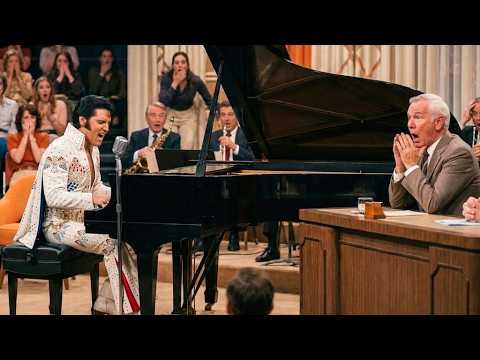
He sat down slowly, carefully, and placed both hands above the keys. For a long moment, he didn’t play. His eyes lowered, and the confident superstar seemed to disappear. Johnny stopped smiling. “You haven’t rehearsed this,” he said. “You’re really going to do it alone?” Elvis gave a faint smile. “That’s what you wanted, isn’t it?” Then one finger touched a key. A single note floated through the studio, soft and fragile. Another followed. The beginning of a melody appeared, simple at first, then warmer, deeper. And then Elvis began to sing.
His voice was not the stadium roar people expected. It was quiet, close, as if he were singing to someone who was no longer there. A woman in the front row covered her mouth. Johnny’s eyes narrowed. The joke was gone now, completely gone. Elvis’s fingers moved carefully, every note exposed, nothing hidden by an orchestra. If he made a mistake, everyone would hear it. If his voice trembled, everyone would know. He had nowhere to hide. And somehow that made it even more powerful.
Then his voice changed. It grew stronger. The piano followed. The melody climbed, and the quiet man at the keys disappeared. The music exploded, not with noise, but with emotion. Several people gasped. Johnny slowly stood from his chair. This was not Elvis proving he could play a few notes. Something else was happening. Then Elvis stopped. Silence crashed into the studio. His hands remained above the keys, his head lowered. “It was written for someone I promised I would never forget,” he whispered. Johnny’s face changed. “Johnny, I wasn’t planning to play this. But your joke reminded me of something.” He placed his fingers back on the keys. “Sometimes people laugh because they don’t know what a person has been carrying.”
Johnny stepped closer, his eyes beginning to shine. “Who was it for?” he asked. Elvis didn’t stop playing. “Someone who believed in me before I had anything to prove.” The audience became even quieter. Elvis took a breath. “A man named Samuel.” Nobody recognized the name. Elvis smiled faintly. “He had an old upright piano. Missing a few keys. Half the time it sounded like it was ready to fall apart. But Samuel loved that piano. He taught me how to sit at it. Not like a teacher. He wasn’t a famous musician. He couldn’t read a room full of notes.” Johnny took another step closer. “Then who was he?” Elvis stopped playing. The silence was immediate. “He was the one who told me, ‘Don’t be afraid when people laugh at you. People laugh at dreams when they can’t see them yet.'” Johnny lowered his eyes.
Elvis continued, his voice dropping. “Samuel got sick. And when I left to chase music, I promised him I would come back. I told him I would come back and play for him. And I meant it. I really meant it.” He looked at the piano. “But the world got bigger. Shows, travel, records, movies, crowds, contracts. Everything I used to dream about. I kept telling myself I would go back tomorrow. Then next week. Then after the next show.” Johnny’s face filled with regret. “Do you know what happens when you keep telling yourself you have time?” Elvis asked. “One day, you find out you were wrong.” The room seemed to stop breathing. “Samuel died before I came back.” A woman in the front row began crying. Johnny turned away. “I wasn’t there,” Elvis whispered, his voice cracking. “I had spent years trying to become somebody. And the one person who had believed in me before I was anybody—I wasn’t there when he needed me.”
He raised his hands toward the keys again. “After he was gone, I went back to his house. The piano was still there. Covered in dust. And sitting on top of it was a piece of paper. Samuel had written a melody. But he never finished it. Under the notes, he had written my name. And beneath my name, seven words: ‘Finish it when you are ready to remember.'” The audience broke. People cried openly now. Johnny lowered his head. Elvis turned back to the piano. “For years, I couldn’t play it. I knew the melody. I remembered every note. But I couldn’t finish it. Every time I tried, I remembered that I had promised him. And every time I remembered the promise, I remembered that I broke it.”
Johnny walked toward the piano, stopping only a few feet away. Elvis continued playing, the music becoming stronger, more desperate, more alive. Then he stopped in the middle of the melody. His hands froze. The audience gasped. “Johnny,” he said through tears. “Maybe Samuel was right. Maybe I wasn’t ready to remember until tonight. Maybe I needed someone to laugh first.” Johnny’s face collapsed with emotion. He shook his head. “Elvis, I—” But Elvis raised his hand. “No. You didn’t hurt me. You reminded me.” Johnny could no longer hide his tears. The audience was crying with him. Elvis placed both hands over the keys. And for the first time, he moved past the place where the unfinished melody had always ended.
A new sequence of notes emerged. Elvis had never played this part before. At least not in front of anyone. The melody rose, softly at first, then with incredible power. His voice returned, but now he wasn’t singing about pain. He was singing through it. Every note seemed to carry the apology he never got to make. Johnny stood beside the piano, tears running freely down his face. The audience began to rise. Not to applaud. Not yet. They were too stunned. They simply stood. Listening. And then Elvis reached the final section—the one Samuel had never written, the one Elvis had never been able to complete. His fingers moved. His voice grew. The melody climbed toward something beautiful. Something final. Something that felt like goodbye.
But just as Elvis prepared to play the final chord, a voice suddenly came from the darkness behind the stage. “Stop!” Elvis’s hands froze above the keys. Johnny turned around. The audience gasped. A man was standing near the backstage entrance. He was older, his face pale, and in his hands he held a small, worn envelope. He stared directly at Elvis, then raised the envelope and said, “Elvis, Samuel told me to give you this only after you finally finished the song.” Elvis stopped breathing. Johnny Carson looked at him in shock. The entire studio fell into absolute silence. Because whatever was inside that envelope had been waiting for Elvis for years.
The old man stepped closer to the light, and Elvis finally saw his face clearly. “Thomas?” he whispered. The name seemed to come from somewhere buried deep. Thomas had once been Samuel’s closest friend—the quiet man who used to sit in the corner of that little house, drinking coffee from a chipped cup while Samuel played. Elvis had not seen him in years. Too many years.
“What are you doing here?” Elvis asked. Thomas looked at the envelope, then back at him. “I heard you were going to be on television tonight. So I came.” Johnny Carson remained completely still. The cameras kept rolling. Nobody in the control room dared cut away. Something bigger than television was happening now.
Thomas raised the envelope. “Samuel gave me this. He made me promise I wasn’t to give it to you until you finished the song.” Elvis looked back toward the piano, then at Thomas. “But I haven’t finished it.” Thomas shook his head. “Yes, you have. You went beyond the last note tonight. Samuel was waiting for you to stop being afraid of the last page.”
Elvis slowly reached toward the envelope, but before his fingers touched it, he stopped. “What is inside?” Thomas smiled sadly. “Something Samuel thought you would need one day.” Elvis took it. His hands were trembling. Across the front, his name was written by hand—old-fashioned, uneven. He recognized it instantly. “Oh God,” he breathed. Thomas nodded. “His handwriting.”
Elvis carefully opened the envelope. There was one folded sheet inside. And something else—a small brass key. He pulled it out first, staring at it. “Do you remember that key?” Thomas asked. Elvis shook his head. “You will,” Thomas said. Elvis unfolded the letter. His eyes moved across the first line, then stopped breathing.
Johnny asked quietly, “Would you like to read it privately?” Elvis shook his head. “No. I’ve kept this part of my life quiet for too long.” He looked down at the paper and began to read. “My dear boy, if Thomas is giving you this letter, then you finally finished the song. And if you finished it, that means you finally forgave yourself.” Johnny closed his eyes. Elvis’s face tightened. The letter shook in his hands.
He swallowed hard and continued. “You will spend many years believing you failed me because you did not come back. But listen to me carefully. You did not fail me.” A tear ran down Elvis’s face. “I watched you leave because I knew you had somewhere to go. I never taught you music so you would stay beside my old piano forever. I taught you music so one day you could carry it farther than I ever could.” The audience began crying openly. Johnny turned away, pressing his fingers against his eyes.
Elvis read on. “One day you will become so busy that you will blame yourself for not coming back sooner. And when that day comes, remember this: a promise is not always broken because someone forgets. Sometimes life takes us farther than our hearts planned to travel. But if you ever remember me when you play—then my boy, you came back.”
The letter slipped slightly in Elvis’s hands. He looked toward the audience. “And please don’t spend the rest of your life punishing yourself for giving the world the gift I always knew you had.” The studio seemed to collapse beneath the weight of those words. Elvis looked at Thomas. “Why didn’t you give this to me?” Thomas’s face twisted with pain. “I tried. After Samuel died, I went looking for you. Everywhere I went, they told me the same thing—too busy.”
Elvis closed his eyes. Thomas’s voice grew stronger. “I told myself I would find you after the next show.” Elvis suddenly looked at him. The words struck like a blow. Tomorrow. After the next show. The same excuse. Thomas nodded as if he understood. “And then one year became another. I carried this envelope for longer than I should have. Because I made the same mistake you did.”
Elvis slowly walked toward him. Thomas looked nervous. Then Elvis opened his arms. The old man froze—and Elvis embraced him. The audience erupted into tears. Johnny Carson covered his face. The applause began softly, then grew. Not the loud applause of a television show. The sound of hundreds of people responding to something human. Something real. “You should have come sooner,” Elvis whispered. Thomas laughed through tears. “So should you.”
For the first time that night, Elvis laughed. A real laugh. Small, broken, but real. Then Thomas pointed toward the brass key still resting in Elvis’s hand. “You still don’t remember, do you?” Elvis looked down. “No.” Thomas smiled. “Samuel’s piano. That key opens the bottom drawer. He locked it years before he got sick, and he never told me what was inside. But on the day he died, he looked at me and said, ‘When my boy is finally ready to finish the song, he’ll know where to find the rest of it.'”
Johnny Carson stared at Elvis. The audience gasped. Elvis slowly turned toward the piano on the Tonight Show stage, then back toward the brass key. “What rest of it?” Thomas shook his head. “I don’t know.” Elvis looked at Samuel’s letter again. There was still more writing beneath the last line—he had been too emotional to notice. His eyes moved downward. Then his face suddenly froze.
Johnny saw it. “What is it?” Elvis didn’t answer. He stared at the paper. “Elvis?” Finally, Elvis spoke. “There is one more message. ‘Go home. The song you played tonight was never the song I wrote for you. There is another song.'” Nobody moved. Thomas stared in disbelief. Elvis looked at the piano, then at the small brass key, and finally at Thomas. The melody he believed was unfinished had only been the beginning. The real song was still waiting, locked inside an old piano drawer in a house filled with memories.
Johnny slowly walked toward him. “What are you going to do?” Elvis looked down at the key. His answer came without hesitation. “I’m going home.” The audience rose to its feet. But nobody knew that Elvis’s journey home would reveal something even more heartbreaking—because inside that old piano, Elvis would discover why Samuel had made him wait all these years.
The drive was silent until the city lights thinned into country dark. Thomas spoke first. “I stood outside that house once, after Samuel died. I couldn’t go in.” Johnny asked why. “Because opening the door meant accepting he wasn’t coming back.” Elvis stared through the window. “Memories don’t stay where you leave them.”
The house was smaller than he remembered. Dust covered everything; a clock stood frozen. Then he saw the old upright piano—same scratches, same cracked corner. He knelt and slid the brass key into the drawer beneath the keyboard. It stuck. Johnny placed his hand over Elvis’s, and together they turned it. Click.
Inside lay yellowed sheet music and a photograph of a young Elvis laughing beside Samuel. Beneath it, in faded ink: “The boy doesn’t know it yet, but one day the world will listen.” Elvis pressed it to his chest. Then he sat down and played Samuel’s finished song—simple, imperfect, like home. When the final chord faded, he whispered, “I came back.”
Johnny, weeping, said, “The greatest artists don’t prove what they can do. They reveal what they survived.” Elvis smiled. “You were right, Johnny. I couldn’t play that piano if my life depended on it. But maybe I could play it because someone else’s life once believed I could.”
So—what song have you been afraid to finish, and who believed in you before you had anything to prove? Tell us in the comments.
Report this article
Select a reason for reporting:






