In the summer of 1941, the British Air Ministry tested an American fighter and delivered its verdict in a single word: unfit. The plane had a massive, drooping chin beneath its nose, like a jaw that had been broken and set wrong. When it stood next to a Spitfire, it looked like a butcher standing beside a ballerina. Above 15,000 feet, its engine began to choke. Textbooks settled on one word to describe it—obsolete. They used that word for 80 years.
Six months after that verdict, a group of American pilots who had quietly resigned their commissions took those rejected planes into the skies of southern China and faced the Japanese Army Air Force. The Japanese had been bombing that city for four years without opposition. After that morning, they stopped coming.
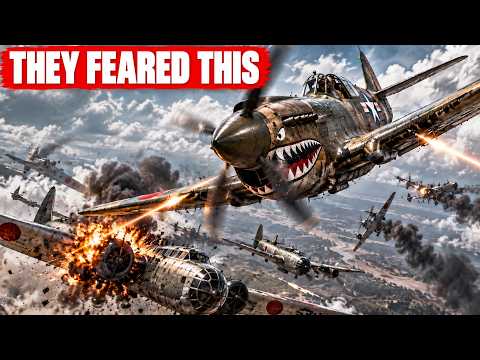
Over the next four years, the same plane defended Egypt. It defended Darwin, New Guinea, and the frozen airstrips of Alaska. More than 200 men from seven countries became aces flying it. Then it faded from the story. The Mustang got the statues and the legend. The broken-jawed fighter got a footnote.
There’s a reason for that, and it has almost nothing to do with the plane. It has to do with a general in Ohio who secretly owned a parts company, an engine plant that faked its inspection reports, and a half-deaf captain the U.S. Army had thrown away.
Before we begin, I hope you’re having a good day. How old are you, and where are you watching from?
The doctor didn’t look up when he said it. It was spring 1937 in a U.S. military base hospital, and the man sitting across the desk was an Army captain named Claire Lee Chennault. He was 43 years old. His face looked like a saddle left out in the rain, full of creases and hard wrinkles, and his voice was gravelly from 20 years of flying open cockpits and smoking unfiltered cigarettes. He was, by the assessment of anyone who flew against him, one of the best fighter pilots the U.S. Army had.
The doctor told him his hearing was deteriorating—partial, permanent deafness, incompatible with flying duties. On April 30, 1937, Chennault left the Army Air Corps with the rank of captain, the same rank he’d held for most of a decade. No promotion ever came. No command ever came. He walked out of that building, and the Army didn’t seriously try to stop him. Because the truth was, that deafness was convenient for them.
For six years, Chennault had been the loudest dissenting voice in American military aviation. At the Air Corps Tactical School in Alabama, where future Air Force generals were made, the official doctrine was simple and beautiful to the point of holiness. The bomber will always get through. Heavy bomber formations, flying high and tight, cannot be stopped. Fighters were a sentimental legacy of the last war—useful for reconnaissance and air shows, and nothing more.
Chennault considered this madness, and he wrote so plainly. In 1935, he published a manual titled The Role of Defensive Pursuit. In it, he laid out with patient, humble detail how fighters could be directed from the ground, via radio and a network of observers, to intercept bomber formations before they reached their target. It was, in almost every detail, a description of how to win the Battle of Britain five years later.
His superiors ignored it. Some mocked it. One officer on the other side of that argument was a man named Henry Arnold, who would soon lead the entire Air Force and would spend the war years deciding which planes American boys would fly.
So Chennault took his bad ear, his manual, and his notes, and he left. Within weeks, he was in China drawing a salary from the government as an air advisor, at a time when the Japanese Army was crawling south and the Chinese Air Force was being wiped out squadron by squadron.
He spent the next four years doing the one thing no one in Washington had bothered to do. He watched. He sat on hillsides with a stopwatch. He recorded the turn rates of Japanese fighters. He timed how long their engines took to weaken in a climb. He interrogated surviving Chinese pilots and wrote everything down in handwriting that grew smaller as his notebooks filled.
He learned that Japanese fighters could out-turn anything on earth. He also learned they were built incredibly light, with weak armor and fragile structures—so light that a steep dive could tear their wings off. And he built something that existed nowhere else in the world. Across hundreds of miles of southern China, he set up a network of observers, village telephones, radios, and men on bicycles, so that if a Japanese formation crossed a river 300 miles away, the man in Kunming knew within minutes.
Chennault didn’t need a plane that could out-climb the enemy. He needed one that was already above him when he arrived. What he didn’t have was the planes.
In 1941, through a web of political connections, Chinese money, and a president willing to look the other way, he finally got some—100 of them. The reason he could get them was that no one else wanted them. They rolled out of the Curtiss factory in Buffalo, New York, and they were called the P-40.
The man who designed it was a Curtiss engineer named Donovan Berlin, 42 years old, blunt, gifted, and quietly fed up with his company. Berlin had taken an old radial-engine fighter and rebuilt its entire nose around a liquid-cooled Allison engine. That change gave the plane extra speed. It also created a massive radiator and oil cooler that had to be hung somewhere, and the only place left was directly under the chin. That one engineering decision gave the plane a face it could never live down. Seen from the front, it looked like a fighter with a broken jaw, heavy in the nose, hunched forward, ugly in a way that was almost threatening.
The Army bought it anyway, and in numbers never seen before. In April 1939, the Air Corps ordered 524 of them, the largest fighter order in American history to that day. Not because it was the best design anyone had submitted, but because it was the only modern fighter American industry could build in quantity at that moment while Europe was burning.
And buried in that decision was the flaw that would define the plane’s reputation for the next 80 years. The Allison engine used a single-stage, single-speed supercharger. At low altitudes, the engine was powerful. As the air thinned, it began to struggle, and by 20,000 feet it was gasping. Everyone knew this. The Army knew it well, and the Army had a plan. They poured money into General Electric-built turbochargers, which worked brilliantly but were so huge they only fit in a twin-engine airframe. Single-engine fighters would simply have to wait for the technology to shrink. So the P-40 went to war with inadequate lungs. Not because its designer failed, but because the men who bought it had already spent the money elsewhere.
The British were the first to find out. In summer 1941, the British Air Ministry evaluated the plane, which they called the Tomahawk, against the one requirement that mattered to them: could it climb to 25,000 or 30,000 feet over the English coast and engage German fighters up there? It could not. The verdict came back: unfit. And for Britain, the verdict was correct.
But a verdict written for one sky was quietly applied to every sky. ‘Unfit for Britain’ became ‘unfit.’ ‘Unfit’ became ‘poor.’ And ‘poor’ became the word that has followed this plane through every book written about it since.
The British contract was diverted. 100 Tomahawks, already wearing British desert camouflage and stamped with British serial numbers, were loaded onto ships bound for Burma instead. The men who would fly them were arriving at the same time, and they were not what the picture magazines would later claim. They were Navy, Marine, and Army pilots who had resigned their commissions, most in their twenties, recruited through a private company with a deliberately dull name. The pay was $600 a month—more than three times a Navy lieutenant’s salary—with a $500 bonus for every Japanese plane confirmed destroyed. Some came for China. Most came for the money. The honest ones admitted it for the rest of their lives.
Among them was a 26-year-old Texan named David Lee Hill, nicknamed ‘Tex,’ the son of a Presbyterian missionary who had been flying dive bombers off American carriers and was bored. Another was Robert Neale, 27, quiet, unhurried, and the best natural shot in the group.
They reached the docks at Rangoon, headed north to a moldy airfield near Toungoo, and saw what they had signed up for. The planes didn’t have broken or outdated gunsights—they had no gunsights at all. Mechanics in Burma hand-made crude rings and posts from scrap and mounted them on the engine cowling. The radios worked only when they felt like it. Spare parts arrived in no particular order or not at all. They spent their first weeks in humid heat that rotted boots and fabric, disassembling engines under open-sided tents while dysentery swept through the barracks like weather.
Then Chennault put them in a classroom and refused to let them fly. For weeks, he lectured them. He drew Japanese fighters on a blackboard and told them, drawing on four years of stopwatch data behind every word, exactly what those planes could and couldn’t do. Then he gave them the one rule everything else depended on. Never turn with them. Not even once. Not for sportsmanship. Not to finish a strafing run. Never. The Japanese fighter could out-turn a P-40 at any speed and any altitude, and anyone who tried would die. But the P-40 was heavier, and heavy things fall faster. So you attack from above. You dive through the formation. You make one pass. You keep every bit of your speed. You climb away, and you come back. You fly in pairs, and you never chase anyone.
Half the room hated it. These were men raised on the idea that a fighter pilot proved himself in a turning fight. And here was a soft-spoken civilian with a Louisiana accent telling them that every art they had trained in was simply a way to die. Some argued. Some packed their bags and went home. Chennault didn’t budge an inch. He had spent four years watching these people. He knew exactly what they were good at, and he had no intention of meeting them on their terms.
By the first week of December 1941, the group was barely ready. The planes were held together by improvisation. The pilots had never fired a shot in real combat. The entire project was an informal, semi-legal arrangement that the U.S. government could disavow in a single sentence if things went wrong.
Then, on the morning of December 7, on the other side of the Pacific, the Japanese Navy brought six aircraft carriers into range of Hawaii. And everything informal became the only thing standing in the way.
The phone rang in the operations shack in Kunming mid-morning on December 20, 1941. It had been 13 days since Pearl Harbor. Somewhere beyond the Chinese border, an observer counted engines and passed the number down the line, and the number moved through wires and radio and runners for 300 miles across mountain terrain until it reached Chennault’s map table. 10 bombers, Japanese Army planes, twin-engine, heading northeast from Hanoi. No fighter escort. No escort, because for four years there had been no reason to bring one. Kunming had been bombed again and again by men who had never faced serious opposition. They flew in daylight, in formation, at a comfortable altitude, and went home.
Chennault had his pilots in the air and climbing long before the Japanese crossed into Chinese airspace. That was the entire point of four years of telephone wire. When the bombers finally appeared, the P-40s were already thousands of feet above them with the sun at their backs.
What happened next lasted only minutes. The Americans dove from above in pairs, the same way the deaf man in the classroom had drilled them until they hated the sound of his voice. One pass. Fire, keep your speed, keep diving, pull up, and climb away. No turning. No chasing. The bomber formation fell apart. Some crews jettisoned their bombs early and fled for the border. By the records you look at, three or four of those bombers never reached the ground intact. Not one American was lost.
Chennault had told his pilots something before they fired a single shot. Scatter enough formations and hurt them badly enough on the first attempt, and the Japanese would reconsider whether Kunming was worth the trip. He was right. They didn’t come back.
It’s worth pausing on what that meant to the people below. Kunming was a city that had learned the sound of engines the way other cities learn the sound of church bells. For four years, the warning had come, and people had fled to hills and trenches and cellars, then returned to count what was lost. Schools, markets, families. There had been nothing in the sky to stop the bombers, and after a while the city stopped expecting anything.
That morning, they heard a different sound. Not the steady drone of bombers, but a sudden ripping sound above it. Engines at full power in a dive, then formations coming apart in the air like something dropped on a stone. Chinese civilians came out of the shelters into the open to watch. Some cheered until they couldn’t stand. When the American pilots landed, men who spoke not one word of English carried them on their shoulders. These pilots had been in the country a few weeks. Most had signed their contracts for money. None of them ever forgot that morning.
Three days later, the bill came due. On December 23, the Japanese hit Rangoon, and this time the bombers came with fighters. A small number of American P-40s and a handful of RAF Hurricanes went up against a force many times their size over a city already burning. The Americans claimed several kills. But they also lost two men, Henry Gilbert, who was 22, and Neil Martin. They were the first of the group to fall in combat, and they died in a fight no one could call even.
This is the part of the story the legend usually omits. Over about seven months of operations, the American Volunteer Group was officially credited with destroying 296 Japanese aircraft. That number went out in newspapers, from newspapers into history books, and has been repeated ever since. Decades later, a historian named Daniel Ford went back and did what no one had done before. He read the surviving Japanese records and compared them to the American claims. He found that both sides, as air forces always do, had inflated their numbers. Ford’s careful accounting put the real figure closer to 115. It sparked a private war among veterans, and some never forgave him. But Ford’s own conclusion, after all the subtraction, was this. Even at the most honest minimum, the record those few men achieved remains unmatched in the history of aerial warfare, and they paid for it. 14 pilots were lost in combat. Others died in crashes on dirt runways, in training accidents, and from disease. Men flew with malaria. Tires blew on unpaved strips and killed pilots who never saw a Japanese plane. Wrecks were cannibalized for parts because there were none. In the end, planes were kept running with components taken from other planes kept running the same way.
By then, they had also become the most distinctive fighters on earth, for a reason that had nothing to do with performance. In November 1941, before any of them had seen combat, a pilot named Charles Bond was flipping through a magazine in Burma. It was the November 2 issue of the Illustrated Weekly of India, and it had a picture of a British P-40 in the Egyptian desert with a huge shark mouth painted on it. Teeth, a staring eye, and that ugly chin turned into a jaw. Bond showed the picture to the others. Within days, every plane in the group had a similar paint job.
The irony history never bothered to mention is where the British got it. No. 112 Squadron RAF had started painting those mouths on their Tomahawks in Egypt in summer 1941, and they had borrowed the idea from an enemy. The twin-engine German fighters of Zerstörergeschwader 76 had been wearing shark mouths since 1940, and the men of 112 Squadron had seen them up close over Greece while on the losing side. So the most famous nose art of the American war was copied from the British, who copied it from the Germans, and painted on a plane the British had rejected. The idea worked because the P-40’s one flaw in its shape—that protruding lower chin—looked exactly like a jaw. Engineers had been apologizing for that design since 1938. The pilots turned it into a threat.
On July 4, 1942, the American Volunteer Group was dissolved and folded into the U.S. Army Air Forces. Most of the pilots who were offered commissions refused and went home. They had watched the Army treat Chennault as an embarrassment for years, and they didn’t trust it now. Chennault himself put the uniform back on, and the service that had let him leave as a captain in 1937 eventually made him a general. He spent the rest of the war fighting the Japanese in the air and his superiors on the ground, often with equal intensity, and usually with better results against the Japanese.
But by then, the plane had outgrown him, and the strangest part of the P-40’s reputation was already taking shape on the other side of the world. Because the same RAF that had tested this fighter and written ‘unfit’ on the report had already made it the backbone of an entire air force elsewhere. In North Africa, the British weren’t fighting at 30,000 feet. They were fighting over open desert at low altitude in support of a ground war that swung back and forth across a thousand miles of sand between Egypt and Tunisia, and there, in the altitude band where the war in Africa was actually decided, the American fighter with the broken jaw replaced the Hawker Hurricane as the primary fighter of the Desert Air Force. Not for lack of an alternative, but because it was the best.
One verdict, one air ministry, one plane, and two opposite answers. The only variable that changed was the altitude above the ground where the question was asked.
In fact, the desert had beaten everyone to it. Months before any Flying Tiger fired a shot over China, this plane was killing Germans over Libya. One of the men who did it was an Australian named Clive Caldwell. He was 30, flying with No. 250 Squadron RAF, and he had a habit the other pilots found strange enough to talk about. Air combat in 1941 was mostly a matter of hope. Deflection shooting—the art of firing not where the plane is but where it will be—was poorly taught or not taught at all, and most pilots went months without a hit because they simply couldn’t hit anything.
Caldwell solved the problem himself. He would fly low over the open desert and fire at his own shadow as it raced across the sand, watching where the bullets kicked up dust, then correct and fire again, hour after hour, against a target that was always moving and exactly the size of the thing he wanted to destroy. By the end of that summer, he could shoot better than almost anyone in Africa.
On August 29, 1941, he needed every bit of that skill. He was northwest of Sidi Barrani when two German fighters dove on him out of the sun. They were Messerschmitts of the German fighter wing operating in the desert, and one was flown by a young lieutenant named Werner Schröer, a man who would survive the war with more than 100 victories.
The first burst tore into Caldwell’s plane and into Caldwell himself. Bullets punched through his back, his left shoulder, and his leg. The second burst put a round through the cockpit, driving shattered glass into his face and neck. Two cannon shells passed through the fuselage just behind his seat and tore the right wing. Blood was running into his eyes. His plane was coming apart around him.
He didn’t go down. He turned into them, aimed the shot he had spent a summer teaching himself to make, and blew the wing off Schröer’s fighter. Then he hit Schröer hard enough that the German broke off and headed for home. Caldwell flew his plane back to base and landed safely. When the ground crew examined the plane, they counted over 100 machine-gun holes and five 20mm cannon strikes.
Imagine the conditions these men kept these planes flying in. The desert ate aircraft. Fine sand worked its way into everything—into the oil, into the cylinders, into the gun mechanisms, and into the eyes of the mechanics who lay under the wing in 120-degree midday heat. Engines designed to run for hundreds of hours wore out in a fraction of that time. Crews fitted huge sand filters over the air intakes, which cost the plane speed it desperately needed, because the alternative was an engine full of gravel. They lived in tents that filled with dust when the wind blew, ate food that tasted of dust, and flew from runways that were just a patch of desert smoothed by a truck. Flies covered everything. Water was rationed. Men developed sores that wouldn’t heal.
And in that environment, the broken-jawed plane kept working and kept taking off. It had a reputation among ground crews as a machine you could abuse, repair badly, and fly again—which was not a small feature in the desert. It was the whole war. A fighter that was supposed to be obsolete took all of that punishment, kept flying, and brought a badly wounded man home.
Caldwell finished the war as the most successful pilot ever to fly the type, and he never had a bad word to say about it. Neither did the men around him. One leading Australian pilot called it a friend and said it more often than not kept you out of trouble. Another said it would take an enormous amount of punishment from violent maneuvering and from the enemy without any noticeable vices.
The desert produced a second story that took 30 years to complete. On June 17, 1942, a young Canadian from a Saskatchewan farm, 21 years old, named James Edwards and nicknamed ‘Stocky,’ was flying with No. 260 Squadron over Tobruk. He got into a fight with a German fighter, hit it, and watched it go down trailing smoke, then lost sight of it. Being an honest young man who didn’t care about padding his record, he logged it as a probable, not a confirmed kill—just a maybe.
Many years later, German records were opened and matched. The plane Edwards shot down that day was flown by Otto Schulz, who had 51 victories and was one of the most dangerous fighter pilots Germany had in Africa, and he did not survive the crash. A farm boy from the prairies, in a plane the textbooks call poor, killed one of the Luftwaffe’s best and went to sleep that night believing he might have missed.
Then came a Sunday in April. By spring 1943, the German and Italian armies in Tunisia were dying of thirst. Everything they had left—fuel, ammunition, food, and men—was arriving by air, in huge three-engine transports flying low over the Mediterranean to avoid radar. The Allies planned an entire operation to cut that lifeline. On April 18, 1943, late in the afternoon, P-40s of the U.S. 57th Fighter Group were sweeping the sea off Cape Bon, with a squadron of Spitfires above them as top cover. Below them, hugging the water, were about 90 German transports in three huge formations, returning from Tunisia.
What followed lasted about a quarter of an hour. The transports were slow, unarmored, and packed. Their escort was weak. The P-40s fell on them and broke through the formations again and again at low altitude, so low that pilots later described seeing the wakes of their propellers cutting white lines across the sea. Transports went into the water intact. Others staggered toward the African shore, burning. The American pilots claimed 59 transports, 14 German fighters, and two twin-engine fighters destroyed. They lost six P-40s. The Germans later disputed the numbers, and honesty requires mentioning that. Their records suggest a large portion of those planes, perhaps 35, crash-landed rather than being shot down. It made little difference to the outcome. By that evening, the air bridge to Tunisia was finished, and with it, the Afrika Korps shortly after.
If you set aside the famous names, the records tell the same story wherever this plane went. Take the 325th Fighter Group, the unit that painted checkered tails on their planes. They flew their first combat mission on April 17, 1943, escorting bombers over Tunisia. By the end of the Sicilian campaign four months later, they had flown 110 missions and more than 3,200 sorties. They shot down 128 enemy aircraft against 26 of their own lost. But that’s not the number that should stop you. In that same period, they escorted nearly 1,100 American bombers, and not one of those bombers was lost to enemy fighters. Not one. Every crew that took off under those checkered tails came home safely—which was the only measure of escort that mattered to the ten men in the back of a B-25.
In China, the math was harder to argue with. The China Air Task Force, the organization that succeeded Chennault’s, lasted nine months. During that time, it was credited with destroying 149 Japanese aircraft, with 85 more probables, against 16 P-40s lost. 16. Against an enemy that outnumbered them in every engagement, at the end of a supply line that ran over the Himalayas by air because there was no other way to get there. From that task force’s creation in July 1942 to the end of May 1945, American air forces in China destroyed 2,348 Japanese aircraft. For most of that period, the plane doing the work was the same one the British had rejected.
New Zealanders flew it in the Solomons. Australians flew it over Darwin and New Guinea. South Africans flew it over Italy. Canadians, British, Chinese, Soviets, and Americans. By the end of the war, more than 200 men from seven different countries became aces in this plane—a strange distinction for an aircraft history would classify as obsolete. And it was cheap. That mattered more than it sounds. A nation that had to arm itself and 11 allies at once and in a hurry could buy large numbers of P-40s for the price of a luxury fighter and put them in the hands of pilots who were still learning in places where nothing else was available at any price. General Henry Arnold, the same man who had stood on the opposite side of Chennault’s argument in the 1930s, was quoted after the war with complete clarity: ‘Without the P-40, the Japanese would have reached Australia.’
This is not a eulogy for a failure. It is an assessment of a plane that held the line for two years when the United States had no ready alternative and no time to wait—which brings us back to the word ‘inferior.’ Here is the plane’s real, plain weakness, stated clearly because it was real. Above about 15,000 feet, the Allison engine began to lose its breath. At 20,000 feet, the plane was struggling. At 25,000 feet, almost everything else in the sky outperformed it. That was true and documented, and no pilot who flew it would claim otherwise.
Now look at where this plane actually fought. The war in North Africa was fought at low and medium altitude. So was the war in China, Burma, and India. So was the war in New Guinea and the Solomons. The Aleutians, where American P-40s took off from frozen gravel strips to meet the Japanese in fog, was a low-altitude war. Darwin in northern Australia, where Japanese bombers crossed the Timor Sea expecting no resistance, was also a low and medium-altitude war.
Below 16,000 feet, the numbers tell a completely different story than the common reputation. The early P-40’s top speed was about 345 miles per hour. The Spitfire of the same period did 346. The Messerschmitt did 348. The Japanese Navy’s famous fighter did 331. The Hurricane did 327. This is not an obsolete plane. It is right in the middle of the competition in the altitude band where most of the actual fighting happened. And in a diving attack, it had no equal among its opponents. The Japanese fighter was built light for range and maneuverability, with a structure that could not take the loads the P-40 could take in a steep dive. Chennault had measured that gap precisely on a Chinese hillside with a stopwatch in 1938. And he built an entire school of tactics on it. The P-40 didn’t need to be better. It just needed to be heavier, stronger, and pointed downward.
The last piece of evidence came from the place no one in Washington expected to look. The Soviet Union received more than 2,000 of these fighters through Lend-Lease. And unlike Western air forces, the Soviets didn’t treat it as a second-rate plane. A Soviet fighter pilot named Nikolai Golodnikov, interviewed long after the war, rated the early version as equal to the German Messerschmitt of its time, and the later version as slightly better. The difference, he explained, was not in the plane. It was in how it was used. Western air forces flew it by the book, literally, within every limit the manual set. The Soviets exploited everything the machine could give. They stripped guns from the wings to save weight. They ran the engines at power settings the manual forbade, accepting that they would wear out faster, because a worn-out engine with a living pilot was better than a new engine with a dead one. Same airframe, same engine, two completely different results.
Which raises the only question that really matters. If this plane was good enough to do all of that, in every theater of the war, for every ally America had, why did it enter the history books as a failure? The answer is not in the cockpit. It’s in an office building in Dayton, Ohio.
Wright Field in Dayton, Ohio, was where American air power was decided. Every fighter plane the United States bought passed through it. Every test, every specification, every contract, every decision about which engine went into which airframe and how many of each would be built. If you want to know why an American pilot in 1942 was flying the plane he was flying, you don’t look at the factory. You look at Dayton.
The second most powerful man in that building for most of the war was a major general named Bennett Meyers. He sat near the top of the organization responsible for procurement, with oversight of contracts worth tens of billions of dollars. His job, simply put, was to get the Army the best planes at the best price. What he was actually doing was running a side business. Meyers secretly owned a stake in a small aircraft parts company in Dayton called Aviation Electric. He was, in effect, sitting on both sides of the same deal, steering federal contracts toward manufacturers while quietly profiting from the spare parts that flowed underneath. When a Senate committee began asking questions, Meyers didn’t just lie. He arranged for someone else to lie for him. A man named Blairio Lamar testified that the general had no financial interest in the company, that the Cadillac the general bought was actually the company’s, and that his apartment furniture was a gift. All of it was false, and Lamar eventually admitted it. On March 15, 1948, Bennett Meyers was convicted in federal court on three counts of subornation of perjury. On July 16 of that year, President Harry Truman dismissed him from the service of the United States.
Now, here is the honest limit of this story. There is no court record proving that Meyers personally delayed any specific fighter. What is documented, and what the men flying and dying in 1942 could not have known, is that the officer who held one of the most powerful procurement posts in American aviation was betting his own money on the outcome. And there is another documented fact that sits uneasily beside it. The P-51 Mustang, the plane that would eventually eclipse everything the P-40 did and more, first flew in 1940. British test pilots were enthusiastic almost immediately. The U.S. Army was not. For a long time, Wright Field showed remarkably little interest in a plane designed to a British requirement by a company that had simply refused to build P-40s under license. Lieutenant Colonel Tommy Hitchcock, assistant air attaché in London, summed up the problem in a sentence that outlived everyone involved. The Mustang, he wrote, was sired by the English out of an American mother, and there was no father at Wright Field to appreciate its strong points and push them. Whatever the reason, the delay was real, and the men who paid for it were flying older planes.
Then there was the other scandal, and this one went straight to the factory floor. In January 1943, Army inspectors working inside the Wright Aeronautical engine plant in Lockland, Ohio, went over their superiors’ heads and complained directly to a Senate committee chaired by Harry Truman. In April of that year, the committee held hearings in Cincinnati, and what came out was not mere negligence. It was faked tests, destroyed records, forged inspection reports, tolerances quietly adjusted to pass parts that should have been scrapped, and inspection steps skipped entirely. Army inspectors inside the plant were bribed to make the paperwork match the story. Defective aircraft engines were built, certified, and delivered to the U.S. government in the middle of a war, and young men climbed into planes running on them. The Justice Department sued the company and named eight of its executives. The lawsuit was never pursued to its end. Three Army Air Forces officers were court-martialed for dereliction of duty and sent to the federal prison at Leavenworth, and those three men are essentially all the accountability there was.
Stop and consider how that came to light, because it didn’t come from a general. It came from Army inspectors, ordinary men in a Lockland factory whose only job was to put their initials on a sheet certifying that an engine was sound. They watched tests being faked around them. They watched official papers being thrown into a furnace. They were pressured, and some men who worked beside them gave in. Then a few of them did something that required a kind of courage no one pins a medal on. They went over their own chain of command in wartime and told a Senate committee what was happening inside an American war plant. Every one of them understood exactly what it would cost. They were right, and it was proven, and the government sued the company that did it and then quietly let it be. There is no monument to those inspectors. There is no movie about them. But somewhere, there are aircrews who came home on sound engines because a few men in an Ohio factory refused to sign their names to a lie.
If any of this sounds familiar, there’s a reason. Arthur Miller built a play around exactly this—a father who sold defective aircraft parts to the Army during the war while other men’s sons paid the price. The play won the Pulitzer Prize. And the story it was drawn from was not merely a metaphor. The company at the center of it was the parent company of Curtiss, the company whose name the P-40 carried. So the plane inherited a reputation it did not earn.
The last part is the saddest because there is no villain in it at all. Donovan Berlin, the engineer who designed the P-40, spent 1941 asking his company for permission to build the next model. He wanted to develop the design properly, fix the altitude problem, and move on. Curtiss was run at that point by men from the world of finance who understood profit margins far better than they understood airplanes, and they saw no reason to spend money developing a replacement for something the government was already buying by the thousands. In December 1941, the same month the United States entered the war, Berlin resigned. He went to the Fisher division of General Motors and designed a new fighter there, the P-75 Eagle. To save time, he built it from parts that already existed. The tail of a Navy dive bomber, the landing gear of a Corsair, and eventually the outer wing panels of his own P-40. The P-75 was a disaster. The program was canceled in October 1944 after 14 aircraft were built, and it is classified today on most lists as one of the worst wastes of American taxpayer money of the entire war. The genius who left Curtiss because they wouldn’t let him build something better didn’t build something better. He built one of the great failures. And after he left, Curtiss never produced another successful fighter. Design after design was canceled, reworked, or abandoned. The company that built more military aircraft than almost any other in America exited the fighter market entirely at the end of the war, sold its aviation assets, and disappeared from the sky.
But there remains one last plane to consider, and it settles the argument. Late in the war, Curtiss built a prototype called the XP-40Q. Same basic airframe, bubble canopy, clipped wings, and an Allison engine with a two-stage supercharger and water injection. In tests, it reached 422 miles per hour at 20,500 feet. That is Mustang territory. That is what this airframe could always have done if the right engine had been put in its nose, but it arrived too late. The plane was never the problem. The men who bought its engine were the problem.
As for the deaf captain, the Army had one last lesson for him. In July 1945, with the Japanese Empire weeks from collapse, Claire Chennault was eased out. The doctrine he had spent his life defending was once again unfashionable to his superiors, and his talent for making enemies had never improved. He resigned on July 31, 1945, and it was accepted without objection.
When the Japanese surrender was signed aboard the USS Missouri, Chennault was not invited. The man who had controlled the skies over China for eight years watched the end of the war from the outside, just as he had watched its beginning.
Congress made him a lieutenant general on July 18, 1958. He died of lung cancer nine days later.
Now compare two dates and the whole argument collapses. December 20, 1941: P-40s over Kunming, 13 days after Pearl Harbor. April 7, 1945: 108 P-51 Mustangs take off from Iwo Jima. Three years and three and a half months separate those two mornings. By the time the Mustang reached Japanese skies, the veteran core of Japanese fighter pilots had already been bled dry—and much of that bleeding was done at low altitude by the broken-jawed plane.
David Lee Hill lived until 2005. Late in life, he said what every man who flew it already knew. In the hands of a skilled pilot, the P-40 could exceed the limits of its potential. It was tough, durable, and easy to handle. He never thought it was an inferior fighter.
Two hundred fighter pilots from seven countries agreed. So did the numbers. So, eventually, did the historians.
It took 80 years to say out loud. The plane didn’t fail. The men who chose its engine failed it, the company that owned its name failed it, and a history written from 30,000 feet above Germany failed a war that was fought mostly near the ground.
So here’s my question for you: if the P-40 had been given the right engine from the start, would we still be calling the Mustang the plane that won the war—or would we be telling a very different story?
Report this article
Select a reason for reporting:






