April 1945. The war was supposed to be over for the wealthy citizens of Gotha. Their streets were pristine, their suits immaculate, their hands—they believed—clean. But General George S. Patton was about to teach them a lesson in truth that would shatter their comfortable world forever.
The American tanks rolled into the quiet German town, expecting fierce resistance. Instead, they found an untouched illusion—clean cobblestone streets, well-fed civilians, and an arrogant mayor named Albin Kobis, dressed in a tailored wool suit, ready to surrender with a smile. He politely asked the Americans to move their noisy vehicles so his town could return to normal. He believed his wealth and position insulated him from the horrors his nation had committed.
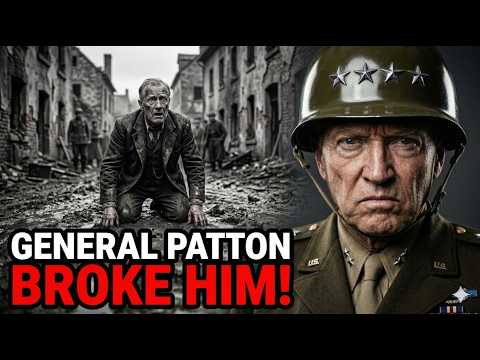
But Patton was not interested in pleasantries. He stepped out of his command car, his ivory-handled revolvers gleaming, and sniffed the air. Something was wrong. Beneath the diesel fumes, a sickening, sweet stench drifted from the nearby forest—the smell of rotting flesh and burning hair. The mayor waved it off as a chemical factory. Patton knew better. He had smelled that horror in the trenches of France. He ordered his men to lock down the town and march into the woods.
What they found was Ohrdruf, the first concentration camp liberated by the Western Allies. Bodies stacked like firewood, execution trenches, and the stench of industrialized murder. Patton, the hardened warrior, walked through the carnage—and vomited. But when he wiped his mouth, his shock turned to cold, volcanic rage.
He returned to Gotha with a single command: bring every wealthy citizen to the camp. The mayor and his wife, still in their fine clothes, were dragged from their homes and forced up the muddy road. They protested, cried, and complained about their ruined shoes. But American rifles silenced them.
At the camp, the civilians were ordered to bury the dead with their bare hands. No shovels. No gloves. Just their soft, manicured fingers and the rotting corpses. The mayor, once so arrogant, vomited as he dragged a body into a shallow grave. His wife’s silk scarf was soaked in blood and mud. For hours, they toiled, their minds breaking under the weight of the truth they had ignored for twelve years.
When it was over, Patton released them. They stumbled back to their pristine town, but the illusion was dead. The next morning, the mayor and his wife were found hanging in their mansion, a suicide note nearby: “We honestly didn’t know what was happening in the forest.”
Patton read the note and felt no remorse. His only regret, he said, was that he couldn’t hang the mayor himself. The story of Ohrdruf and the mayor of Gotha remains a chilling testament to the power of truth—and the brutal justice of a general who refused to let anyone hide behind clean hands and expensive suits.
The note was passed around the officers’ mess that evening, and the reactions were as varied as the men themselves. Some of the younger lieutenants stared at the elegant handwriting and felt a flicker of something like pity—the man had, after all, taken his own life rather than face a tribunal. But the older veterans, the ones who had walked through the camp’s gates and seen the stacked bodies, simply shook their heads. “He didn’t kill himself out of guilt,” one grizzled sergeant muttered over his tin cup of coffee. “He killed himself because he couldn’t stand knowing we knew.”
Patton, for his part, had already moved on. He had a war to finish. The Third Army was still rolling eastward, and the discovery at Ohrdruf was only the first of many horrors waiting in the German heartland. But he made one quiet decision before he climbed into his command car the next morning: he ordered a detachment of military police to remain in Gotha for a full week, with strict instructions to document everything—every grave, every body, every testimony from the few surviving prisoners who had been too weak to be evacuated by the fleeing SS.
The townspeople, still shaken and hollow-eyed, watched the Americans work from behind their lace curtains. They did not speak to the soldiers. They did not offer help. But they also did not complain anymore about the noise of the diesel engines.
Three days later, a young Jewish-American chaplain named Captain David Stern arrived in Gotha with a small team of photographers and a truckload of supplies. He had been assigned to conduct religious services for the survivors and to oversee the proper burial of the dead. He was a gentle man, soft-spoken, with wire-rimmed glasses and a quiet faith that had somehow survived the carnage of the Normandy campaign.
But when he walked through the gates of Ohrdruf and saw the lime pits, the execution blocks, the piles of emaciated bodies that the townspeople had been forced to bury, something inside him cracked. He stood in the center of the camp for a long time, his lips moving silently. Then he turned to his sergeant and said, “Bring me the mayor’s wife’s suicide note. I want to read it myself.”
The sergeant hesitated. “Sir, it’s in German. We’ve got the translation—”
“I read German,” Stern said quietly. “Bring it.”
The note was delivered, and Stern read it slowly, his fingers trembling slightly. When he finished, he folded the paper carefully and placed it in his breast pocket. He did not say anything for a long moment. Then he looked at the sergeant and asked, “Where is the mayor’s house?”
The sergeant pointed toward the town below. Stern nodded and walked back down the muddy road alone, his chaplain’s cross swinging gently against his chest.
He found the mansion easily enough—it was the largest house on the square, with a heavy oak door that had been hastily repaired after the American soldiers kicked it in. The house was empty now, sealed off by military police tape, but Stern ducked under the tape and walked inside. The living room was still immaculate. The kitchen still smelled faintly of coffee. Upstairs, in the hallway, the two ropes still hung from the ceiling beam, swaying slightly in the draft from the broken door.
Stern stood beneath them for a long time. Then he reached into his pocket, pulled out the suicide note, and read it aloud—not in German this time, but in English, his voice steady and clear in the empty house.
“We honestly didn’t know what was happening in the forest.”
He paused. Then he said, quietly, “You knew. You just didn’t want to.”
He folded the note again and placed it on the small wooden table where the sergeant had found it. Then he turned and walked back down the stairs, out the door, and into the bright April sunlight. He had burials to conduct. He had survivors to comfort. He had a war to finish.
But before he left Gotha, Captain Stern made one final stop. He walked to the edge of the town square, where a small group of German civilians had gathered to watch the American soldiers load supplies onto trucks. He did not preach to them. He did not lecture them. He simply stood in front of them and said, in flawless German, “The camp in the forest is gone. But the truth of what happened there will never be gone. You will tell your children. You will tell your grandchildren. And you will never, ever pretend you didn’t know.”
Then he climbed into his jeep and drove away, leaving the people of Gotha standing in silence beneath the clean, bright sky.
That evening, as the sun set over the Thuringian hills, a strange thing happened. One by one, the townspeople began to walk toward the forest. They carried no shovels, no tools—just their bare hands and their heavy hearts. They walked up the muddy road their mayor had been forced to climb just days before, and they stood at the edge of the camp, staring at the freshly turned earth where the dead now lay buried.
They did not speak. They did not cry. They simply stood there, in the fading light, and let the truth wash over them.
And somewhere down the road, General George S. Patton’s command car rolled eastward toward the next town, the next camp, the next horror. The war was not over yet. But for the people of Gotha, the real battle—the battle against their own comfortable lies—had only just begun.
Captain Stern’s words did not fade with the sunset. They lingered in the town square like the smoke from a dying fire, and the people of Gotha found they could not shake them loose. The next morning, a schoolteacher named Frau Weber opened the doors of the town’s small grammar school and, for the first time in twelve years, taught her students a lesson that had not been approved by Berlin.
She told them about the forest. She told them about the bodies. She told them what their parents had chosen not to see. The children went home that afternoon and asked questions their mothers and fathers could not answer.
Some of the parents were furious. Some wept. But a few—a very few—began to talk. They talked in kitchens and cellars, in hushed voices, about the trains that had passed through the valley, about the smoke that had drifted down from the trees, about the prisoners who had once been marched through the square and never seen again. “We knew something,” one old farmer admitted to his neighbor. “We just told ourselves it wasn’t our business.”
That confession spread like a crack in a dam. Within a week, a dozen citizens of Gotha had walked to the American military government office and volunteered to give statements. Not because they were forced. Not because Patton’s soldiers dragged them from their homes. Because Captain Stern had planted a seed that would not stop growing.
Patton heard about it, of course. Reports crossed his desk in the weeks that followed—brief notes from intelligence officers, chaplains, and military governors. He read them without comment. But one evening, as his command car rolled through another shattered German town, he turned to his aide and said something that surprised the young officer.
“You know what the difference is between a soldier and a civilian?” Patton asked. The aide shook his head. “A soldier knows what he did. A civilian spends his whole life trying to forget.”
He lit a cigar and stared out the window at the ruins. “That chaplain—Stern. He did more in one afternoon than I did with a thousand rifles. I made them see. He made them speak.”
The aide was quiet for a moment. Then he asked, “Do you think it will last, sir? The speaking?”
Patton did not answer right away. The car rumbled over a bridge, and in the distance, the first lights of another town flickered in the dusk. Finally, he said, “It’ll last as long as they’re afraid of the silence. The moment they get comfortable again, they’ll start lying to themselves. That’s what people do.”
He tapped the ash from his cigar. “But maybe—maybe a few of them won’t. Maybe a few of them will remember the smell of that forest every time they close their eyes. And maybe that’s enough.”
The war in Europe ended three weeks later. Patton lived only a few months more—he died in December 1945, from injuries suffered in a car accident in Heidelberg. He never returned to Gotha. He never spoke publicly about the mayor who hanged himself or the citizens who dug graves with their bare hands.
But the people of Gotha remembered. They remembered the general with the ivory-handled revolvers who had refused to shake their mayor’s hand. They remembered the chaplain who had read the suicide note aloud in an empty house. And they remembered the forest—always the forest—and the truth that had been buried there.
Years later, a small stone monument was erected at the edge of the Ohrdruf camp. It bore no names, no grand inscription. Just a single sentence, carved in German and English:
“We saw. We knew. We will not forget.”
It stands there still, in the quiet Thuringian hills, beneath the dark pine trees. And every April, when the wind blows down from the forest and carries that faint, sweet smell of decay, the people of Gotha close their windows and remember.
But the question remains—the one that has haunted historians and ordinary people alike for nearly eighty years. Was Patton’s justice the only language these people could understand? Or did he cross a line that no soldier, no matter how righteous his cause, should ever cross?
What do you think? Was the forced march and the bare-handed burial a necessary act of brutal truth—or a violation of the very principles America claimed to fight for? Tell us in the comments below.
Report this article
Select a reason for reporting:






