The jungle breathes in the pre-dawn darkness of Phuoc Tuy Province, South Vietnam. The canopy drips with condensation. Each leaf, each vine, each root system alive with moisture. The sound of water falling from one level of vegetation to another. Drip. Pause. Drip. In this cathedral of green, five men move like ghosts through terrain that should be impossible to navigate silently.
Their boots, carefully wrapped in cloth, make no sound on the jungle floor. Their weapons, shortened L1A1 rifles with flash hiders removed, hang across their chests on locally made slings. Their faces, blackened, hands painted in alternating patterns of green and black. Not camouflage in the traditional sense, but broken light, broken shadow, broken human form.
This is 1967. These are not Americans. They wear no flag. They carry no identification beyond a simple number stamped on a metal disc. According to official Australian Defence Force records maintained at the Australian War Memorial, these men belong to 1 Squadron, Special Air Service Regiment, and they are hunting.
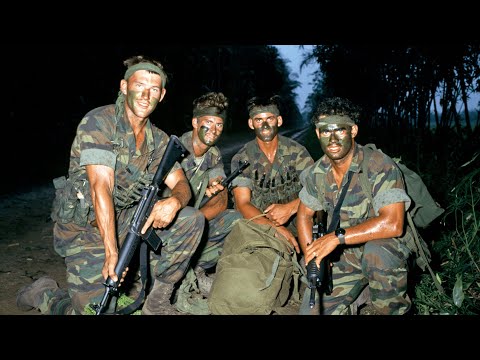
The patrol leader raises his fist. The four men behind him freeze mid-step, weight balanced on their forward foot, utterly still. A sound 50 meters ahead. Movement through the undergrowth. The leader’s hand signals. Two fingers. Then a sweeping motion to the left. Enemy moving parallel.
The patrol doesn’t engage. Not yet. They’re here to watch, to count, to report. The Viet Cong call them Ma Rung, the Phantoms of the Jungle. The name appears in captured enemy documents analyzed by Australian military intelligence in 1968. Documents that describe Australian SAS patrols as invisible soldiers who kill without being seen. The Viet Cong have learned to fear the silence before the storm.
But this story doesn’t begin in the jungle. It begins 6,000 miles away in Swanbourne, Western Australia, in 1957, when a company of men was formed and modeled on the British Special Air Service. Men who would learn to operate in small groups behind enemy lines, gathering intelligence and striking where conventional forces could not reach.
By 1964, according to official SAS historical records compiled by the Australian SAS Association, this company had expanded to a full regiment with three sabre squadrons, a training squadron, and headquarters. They had proven themselves in Borneo during the Indonesian confrontation, conducting secret cross-border operations that would remain classified for decades. But Vietnam would be different. Vietnam would test everything they thought they knew about jungle warfare.
In February 1966, the advanced party from 3 Squadron arrived at Nui Dat, the Australian base in Phuoc Tuy Province. The main body followed in March. Their mission, as documented in operational reports held by the Australian War Memorial, was to serve as the eyes and ears of the 1st Australian Task Force, conducting reconnaissance patrols, observing enemy movement, and when necessary, conducting offensive operations deep in territory controlled by the Viet Cong and North Vietnamese Army.
Small patrols, five men, sometimes four, never more than six. They would be inserted by helicopter into areas where larger units could not operate, areas beyond the range of friendly artillery, areas where being discovered meant almost certain death. The mathematics of their war would become legendary.
As recorded in official SAS operational statistics compiled by the Special Air Service Historical Foundation, between 1966 and 1971, Australian and New Zealand SAS units conducted nearly 1,200 patrols in Vietnam. They confirmed 492 enemy killed with an additional 106 classified as possibly killed. 47 wounded, 10 possibly wounded, 11 captured. Their own losses according to records maintained at the Australian War Memorial: one killed in action, one died of wounds, three accidentally killed, one missing in action, one death from illness. 28 wounded. 580 men served in the SAS in Vietnam during those six years.
The kill ratio by any military standard was extraordinary. In the calculus of war, the numbers spoke for themselves. But numbers don’t capture the night in 1967 when a five-man patrol from 1 Squadron set an ambush along a trail network in the Nui Thi Vai hills.
The patrol leader, we’ll call him Sergeant Collins—his real name remains protected by Australian military privacy protocols—had positioned his men in an L-shaped kill zone. Claymore mines, M18A1 anti-personnel devices containing 700 steel ball bearings and 1.5 pounds of C4 explosive, were placed at precise intervals along the trail. The mines, as described in US Army field manuals from the Vietnam era, could project those steel balls in a 60-degree arc out to 50 meters with lethal effect.
The plastic casings marked ‘FRONT TOWARD ENEMY’ were aimed chest high at the expected path of enemy movement. The detonation wires ran back to the patrol’s position where Collins held the firing clackers—simple electrical initiators that when squeezed would send current down the wire and detonate the blasting cap.
The patrol had been in position for 14 hours. They had not moved, had not spoken, had not eaten. Each man carried five days’ rations, but eating meant movement, movement meant sound, sound meant discovery. According to training protocols documented in SAS instructional materials from the period, patrols could remain motionless in ambush position for up to 72 hours if the situation required it. The human body’s need for food, water, sleep—these became secondary to the mission.
Collins watched the trail through the natural gap in the vegetation they’d selected for this position. His number two, positioned three meters to his left, watched the back trail. His scout, 10 meters forward, served as early warning. His signaler and medic completed the patrol, maintaining radio silence unless enemy contact was initiated or intelligence of immediate tactical value needed to be transmitted.
At 2 a.m., movement on the trail. Collins counted: 1, 2, 5, 10, 20, 30—a full platoon-strength element. Viet Cong main force, judging by their equipment and movement discipline. They moved in single file, spacing between soldiers approximately five meters. Standard doctrine for movement through areas where ambush was possible. But they were talking—quietly, but talking. A violation of their own tactical procedures. Probably because they believed themselves safe this deep in their operational area.
Collins waited. Let them enter the kill zone. Let them commit. The lead element passed the first Claymore. Then the second, then the third. When the center of mass of the enemy formation was directly in front of his position, Collins squeezed both clackers simultaneously.
The night erupted.
According to after-action reports filed with 1 Squadron headquarters and preserved in Australian Defence Force archives, the Claymore detonations killed or wounded approximately 23 enemy soldiers in the initial blast. The surviving Viet Cong, disoriented and unable to determine the direction of the attack in the darkness, returned fire wildly into the jungle.
Collins and his patrol were already moving—withdrawal drills practiced hundreds of times. Move, fire, move, cover, bound back. Their rifles, as noted in technical specifications from the period, had been modified specifically for SAS use. The standard L1A1 self-loading rifle, the Australian variant of the FN FAL, was shortened. The flash hider was removed. Why remove the flash hider? Because the muzzle flash in the darkness made each rifle look like a .50 caliber machine gun. It created a momentary psychological effect on the enemy—a sense that they were facing a much larger force. Every tactical advantage, no matter how small, was exploited.
The patrol moved 200 meters, then went to ground. Radio call. Contact. Grid coordinates. Enemy strength. Casualties inflicted. Own status. Artillery fire mission requested. Within seven minutes, as documented in fire support coordination records, 105mm howitzer shells from the New Zealand 161st Battery at Nui Dat were impacting the contact area.
The patrol extracted under the cover of the artillery barrage, moving to their pre-designated emergency landing zone. Helicopter pickup at first light. Back to base. Mission debrief. Intelligence report filed. Body count confirmed by reconnaissance aircraft at dawn: 18 dead enemy soldiers visible from the air in the kill zone.
This was the pattern. Small patrols, careful planning, precise execution, overwhelming violence applied at the exact moment of maximum enemy vulnerability, then immediate withdrawal before the enemy could mass forces to counterattack. As historian Michael Corfield noted in his 2007 analysis, ‘The Vietnam Years: From the Jungle to the Australian Suburbs,’ published by Hachette Australia, the Australian SAS approach in Vietnam differed fundamentally from American long-range reconnaissance patrol doctrine.
The Americans tended to call in air strikes or artillery and remain in position to assess damage. The Australians initiated contact, inflicted maximum casualties, and vanished. They understood that their greatest weapon was not firepower, but invisibility.
The jungle remembers. It remembers the men who moved through it like whispers, who learned its rhythms and spoke its silent language. It remembers the ambushes sprung in darkness, the crack of rifles, the smell of cordite mingling with damp earth. It remembers the names never spoken, the faces never shown, the stories never told.
After the last patrol, after the final extraction, the soldiers returned to a world that could not understand them. They carried no medals for the missions that never happened, no recognition for the kills that were never confirmed. They carried only memories—of brothers who fell, of enemies who died, of a jungle that became both home and hell.
“We were ghosts,” one veteran recalled decades later, his voice barely a whisper. “We haunted the jungle, and then the jungle haunted us.”
The statistics remain: 1,200 patrols, 492 enemy confirmed killed, a kill ratio that defied belief. But the numbers cannot measure the courage of men who walked into the unknown, who trusted each other with their lives, who faced death in a thousand silent moments. They cannot measure the weight of a nation’s gratitude, often unspoken, often forgotten.
The Phantoms of the Jungle faded into history, but their legacy endures—in the training of those who followed, in the quiet pride of a regiment, in the stories that still echo through the archives. They were the best of their generation, and they asked for nothing but the chance to serve.
What drives a man to walk into the darkness, to face the unseen enemy, to become a phantom himself?
Report this article
Select a reason for reporting:






