On March 2, 1944, a Focke-Wulf 190 fell from the sky over eastern France, carrying one of Germany’s deadliest aces to his death. Egon Mayer—the first pilot to score 100 victories entirely on the Western Front, the man who taught the Luftwaffe how to tear American bombers apart with head-on attacks—never saw the fighters that killed him. They came from above. It was his own signature move.
Two years earlier, this same aircraft had so terrified the British that they drew up plans for a commando raid to steal one. The plane itself had barely changed. But the seven moves its pilots trusted above all else had stopped working. Why?
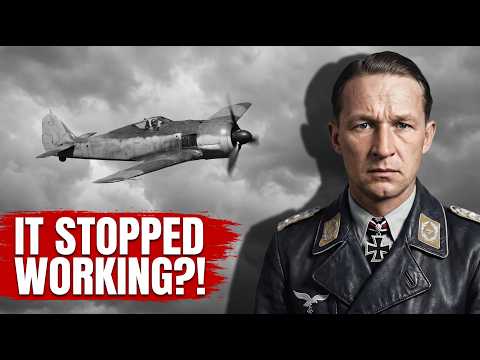
To understand what broke, you first have to see how terrifyingly well it worked in the beginning. In the fall of 1941, RAF Spitfires were sweeping over occupied France almost daily, trying to drag the Luftwaffe into a fight. Then pilots began returning with reports of something new—a short, stubby fighter with a massive radial engine up front. Some early reports guessed it was a captured French Curtiss Hawk. It was far worse.
The Spitfire V, the best the Fighter Command had in numbers, was outclassed in climb, turn, dive, and speed. Losses mounted so badly that Fighter Command cut cross-Channel operations between November 1941 and March 1942, then cut them again in June. Think about what that means. An air force that had just won the Battle of Britain was backing off because of one aircraft.
So where did this machine come from, and why did it fight the way it did? The answer starts with a man who designed aircraft and then climbed into the cockpit to test them himself: Kurt Tank, chief designer at Focke-Wulf in Bremen. Before he ever drew an aircraft, he was a cavalryman in World War I. That detail might sound minor. It isn’t. It represents the entire philosophy of the Fw 190.
Tank explained it clearly later. The Bf 109 and the Spitfire were like racehorses—fast, beautiful, fragile. Give them a perfect runway, skilled pilots, careful mechanics, and they would beat anything. Tank wanted something else. In his own words, he didn’t want a racehorse; he wanted a Dienstpferd—a cavalry horse. A work animal.
Every major design choice followed from that. Wide-track landing gear that folded inward so the plane could survive rough field airstrips, where the narrow-track Bf 109 constantly tipped and broke. A big air-cooled radial engine that could take hits and keep running. An aircraft built for pilots with barely any training, maintained by ground crews with little experience either. Tank wasn’t designing for Germany’s best pilot. He was designing for the average one.
Keep that in mind. It will come back in a way Tank never expected.
The prototype first flew on June 1, 1939. The Fw 190 entered service in August 1941 with fighter units on the Channel coast—first JG 26, then JG 2. Within months, the British were desperate to fly one. By June 1942, a plan was being prepared to send special forces into France to steal an Fw 190 right off a German airfield. On the very day that proposal was submitted, the problem solved itself.
June 23, 1942. Lieutenant Armin Faber was an adjutant with III./JG 2 in Brittany—mostly a desk job. That day he got special permission to fly a combat sortie with 7./JG 2. After a dogfight with Spitfires over the water, Faber lost his bearings. He looked down, saw a stretch of sea and coastline, and thought he was home. He had mistaken the Bristol Channel for the English Channel. He was over Wales.
He spotted an airfield, waggled his wings in a victory gesture, lowered his landing gear, and touched down. It was RAF Pembrey. It was a training base, and the pilots who rushed toward the plane had no suitable weapons at hand. According to the popular account, one of them jumped onto the wing and captured Faber with a flare pistol. The British had just acquired the most feared fighter in Western Europe, intact and undamaged.
Testing began at Farnborough on July 3. The aircraft was flown 29 times over the next seven months, and for the first time, the RAF stopped guessing. What they found was a playbook of combat techniques. Seven moves built into the airframe that German pilots trusted with their lives.
And here is the strange part of this story. Every one of those moves was real. Every one of them worked. And by 1944, every one of them had become a way to die.
The first two moves were twins, because German pilots used them together. The first was the roll. Spitfire pilots of that era were trained to fight in turning circles, tightening the turn until they could bring their guns to bear on the enemy’s tail. British test flights showed the Fw 190 had a phenomenal roll rate, and—crucially—its ailerons stayed light at high speed while the Spitfire’s went heavy. So when a Spitfire pilot committed to the turn, the German pilot didn’t follow. He rolled the other way, reversed direction in a fraction of a second, and left the Spitfire circling empty sky.
The second move was the escape. If things went wrong, an Fw 190 pilot could roll inverted and dive away. Tests confirmed the Fw 190 accelerated in a dive far faster than the Spitfire V. The BMW engine’s fuel injection kept running when the pilot shoved the nose down hard, at a time when many British carbureted engines stumbled under that kind of negative pressure. The 190 could always leave. You never had to win, because you could always run.
But the tests revealed the hidden price too. The 190 would stall violently if pulled too hard in a tight turn, snapping suddenly and sometimes spinning. Fortunately, its pilots rarely needed to.
Both moves worked only against an enemy who wanted to maneuver. Remember that, because the next enemy didn’t want to maneuver at all.
By 1943, American P-47 Thunderbolts were arriving over Europe. Massive fighters, weighing about one and a half times the 190. In a turning fight, that weight was a burden. In a dive, it was a weapon. The P-47 accelerated downward like a falling safe. Its pilots learned quickly: don’t dogfight the 190. Bounce from above, fire, and use the speed to climb back up.
Now watch what happens to the second move. The 190 pilot rolls inverted and dives away, just as trained. Against a Spitfire V, that’s an escape. Against a Thunderbolt, it’s a race he will lose, with the bigger plane plunging down right behind his tail. The move that saved lives in 1942 was now leading German pilots into a fight they couldn’t win.
The RAF wasn’t idle either. It clipped the wingtips of some Spitfires to speed up their roll rate, eroding the first move too.
The third move had been fading since the summer of 1942, and Faber’s aircraft was the proof. The 190 was at its best at medium altitudes, from low level up to about 20,000 feet. That’s where the Channel fighting usually happened, and where the BMW 801 engine with its single-stage turbocharger was at its strongest. The supercharger compresses thin air into the engine so it can breathe at height. Above that band, the 190 struggled to breathe.
In July 1942, as Farnborough testing began, the first squadron of Spitfire IXs entered service. From the outside, it looked almost identical to the Spitfire V. Inside, it had a new Merlin engine with a two-stage supercharger designed to keep breathing at towering altitudes. And the Farnborough tests carried bad news with hard evidence. Above roughly 25,000 feet, the Spitfire IX outperformed the Fw 190.
This might sound like a minor technical change. It wasn’t. It meant the 190 owned the sky only as long as the war stayed within its altitude band. And the Americans were about to move the entire war upstairs, flying their bombers at 25,000 feet and higher, where the cavalry horse struggled to breathe.
So the plane began to lose its dominance of the high sky. But down low, near the waves, it still seemed invincible. And that gave the Germans their fourth move.
Beginning in March 1942, Fw 190 fighter-bombers began crossing the Channel at wave-top height to slip under British radar. They would appear suddenly over a coastal town, drop a single bomb on a gasworks or a rail yard or a harbor, strafe the streets, and race home before defending fighters could scramble. The British called the tactic “hit and run.” It worked because of everything we’ve discussed. At low level, the 190 was as fast as almost anything Britain had. And once the bomb was gone, it reverted to a fighter again.
In the first month of the campaign, JG 2 flew forty-nine sorties and JG 26 flew seventeen. By April 1942, British intelligence had logged 156 raids. And it wasn’t just coastal villages. On January 20, 1943, during a daylight raid on London, a bomb from an Fw 190 fell on Sandhurst Road School in Catford. Thirty-eight children and six teachers were killed. This wasn’t a theoretical tactical exercise. The plan worked, and real people paid for it.
The British response was a fighter that was actually a disappointment. The Hawker Typhoon was poor at high altitude and suffered engine troubles, but it was very fast down low—exactly the band the 190s were coming from. So the RAF did something simple and exhausting. It put Typhoons on the south coast and ran continuous patrols over the sea about five miles off the shore between Beachy Head and the Needles. Pairs of fighters every hour from dawn to dusk on standby. Spitfire XIIs with Griffon engines joined them. The raiders began falling on their way in.
In April 1943, the Jabos were folded into SKG 10 and part of the effort shifted to night attacks over England, where the Fw 190 proved unsuited. RAF night-fighting Mosquitoes inflicted heavy losses, and in a repeat of the Faber incident, several Fw 190 pilots who lost their way in the dark that spring and summer landed at English airfields by mistake. On May 25, 1943, a raid on Folkestone was intercepted, and the Fw 190s never reached their target. After an attack on Eastbourne on June 6, the daylight tip-and-run campaign simply stopped. Fifteen months later, the fourth move was over.
But the most important battle was now being fought somewhere else. Over France and Germany, against American bombers.
When the US Eighth Air Force began its daylight bombing of occupied Europe, German pilots faced a problem. The B-17 Flying Fortress bristled with heavy machine guns, and the bombers flew in tight formations so their guns could cover each other. The natural fighter approach—from behind—meant flying straight into tail, waist, and top-turret fire. The attackers paid dearly.
This is where Egon Mayer enters the story, along with his friend and fellow JG 2 pilot Georg-Peter Eder. They noticed that the bombers’ defensive fire was arranged mainly to deal with attacks from behind and above. The nose was a weak point. So they tried something that sounded insane. Fly straight at the bombers, head-on.
On November 23, 1942, during an American raid on Saint-Nazaire, Mayer led his group directly into the front of the formation. They claimed two B-17s and a B-24. The head-on attack—the fifth move—became the standard Luftwaffe method for attacking bombers.
Now imagine what that maneuver actually demanded. A bomber at 160 miles per hour, a fighter at over 300 in the opposite direction. Closing speeds approaching 500 miles per hour. The pilot had a window of a second or two to fire before breaking away under or over the bomber, at a range close enough to see the crew. If you hit the target, a single burst could kill the pilots and bring the whole bomber down. If you missed by even a fraction, you collided.
The plan worked. Mayer’s score climbed. He became commander of all of JG 2 in July 1943. But the maneuver had two weaknesses, and the first was obvious. The Americans could add guns to the nose. Crews fitted extra machine guns to the sides of B-17s in the field. Then, by late 1943, the new B-17G arrived with a powered chin turret carrying two heavy machine guns aimed at the source of a head-on attack.
The second weakness was quieter, and in the end, worse. The fifth move required elite pilots. It required a leader capable of placing an entire formation miles ahead of the bombers and turning at exactly the right moment. And pilots with the nerve and skill to hold that collision course until the last second. Remember, the head-on attack was not a maneuver for average pilots. It was a maneuver for men like Mayer, and men like Mayer were running out.
Yet in 1943, the Germans had a move that made all of this work. The sixth move was the simplest of all. Waiting.
American bombing doctrine said heavy bombers in tight formation could defend themselves. They couldn’t. They needed escort. But British Spitfires didn’t carry enough fuel to penetrate deep into Europe. American P-47 escorts began in the spring of 1943 and got drop tanks in July. But even then, they could only reach roughly the German border. German fighter controllers could track bomber streams by radar from the moment they formed over England. So the 190 pilots learned patience. Let the escorts fly with the bombers until their fuel gauges forced them home. Then hit the formations with everything they had. Head-on attacks, rockets, heavy cannon, wave after wave, all the way to the target and back.
August 17, 1943. The Americans sent bombers deep into Germany against Schweinfurt and Regensburg. Sixty bombers were lost. October 14, 1943. Black Thursday. Another raid on Schweinfurt. Of 291 B-17s launched, 60 were shot down and many more returned badly damaged. Six hundred men lost in a single afternoon. The official US history later admitted that the Eighth Air Force lost air superiority over Germany at that time. For the rest of 1943, the Eighth kept its targets mostly within escort range. The sixth move was winning.
And that is exactly why the Americans had to break it. They didn’t break it with one heroic invention. They broke it by moving the line where escorts had to turn back further and further east. Bigger drop tanks, long-range P-38s, then the P-51 Mustang with its Merlin engine, which flew its first escort missions in December 1943 with the 354th Fighter Group. Each improvement pushed the point where escorts turned for home deeper into Germany. By March 1944, Mustangs were escorting the bombers all the way to Berlin. There was no longer any place over Germany to simply wait until the escorts went home.
At this point, many people reach for the easy explanation. The Fw 190 was obsolete. Its design dated from 1939. The Allies built better aircraft. End of story. And you can see why. The losses were appalling. The A-model really did suffer at high altitude, and the later A-8 was heavier than the aircraft Faber had handed over at Pembrey.
But look at what actually happened. The roll that had terrified Spitfire pilots never disappeared. The airframe stayed rugged. And starting in September 1944, units began receiving the Fw 190 D-9, known as the “Dora,” with a long liquid-cooled Jumo engine instead of the radial. In expert hands, it could meet the Mustang or the late Spitfire marks on equal terms. Tank himself saw it as an interim solution, but it was not a failed design.
So the aircraft was not the core problem. The core problem was that every maneuver the aircraft was built around depended on conditions the Allies could change. An enemy willing to engage, a war fought at medium altitude, low-level defenses that couldn’t keep up, bombers with weak noses, and escorts that couldn’t go the distance. One by one, those conditions evaporated.
And that left the seventh move, the oldest maneuver in fighter combat, the one German pilots had built everything on. The surprise attack.
In 1942, the 190 pilot’s best weapon wasn’t any trick in the airframe itself. It was choosing the moment. Climb above the enemy, wait, slash down from the sun at high speed, fire, and climb away before he knew what happened.
And there was a silent bonus. The fight happened on your terms, near your own airfield. When it was over, you went home, landed, and rested. The enemy faced a long ride back across the sea.
In January 1944, a new commander arrived to lead the Eighth Air Force: Jimmy Doolittle, famous for the Tokyo raid. During a visit to his fighter chief, William Kepner, he noticed a sign on the wall. It said the first mission of Eighth Fighter Command was to bring the bombers home safely. Doolittle told Kepner to take it down. The new sign read that the first mission of Eighth Fighter Command was to destroy German fighters.
It might sound like a slogan. It was a revolution. American fighters were no longer leashed to the bombers, flying beside them, waiting to be attacked. Now they could range far ahead, hunting German formations as they climbed and assembled, and chase them. Kepner’s boss, Carl Spaatz, deliberately used the bombers as bait. The Luftwaffe had to come up to defend its factories, and later its oil, and every fighter that took off could be shot down.
Do you see what that did to the seventh move? Now the Americans were the ones doing the surprising. German fighters, slowly forming up in big attack formations, became the targets. And on the way home, American fighters dropped low and strafed the airfields. The safe base, the place where you landed and recovered, became a hunting ground. A 190 pilot could be killed during takeoff or landing, wheels down, at his slowest and most helpless.
So the Germans adapted, and their answer was the purest version of the cavalry horse Tank had designed. If you can’t dodge the bomber’s fire, armor your plane and fly through it. The idea began with Sturmstaffel 1 under Major Hans-Günter von Kornatzki, who flew its first missions in January 1944. Its pilots pledged to press their attacks to zero distance, ramming bombers if necessary.
Then it grew into full Sturmgruppen flying a specialized version, the Fw 190 A-8/R2, nicknamed the Sturmbock—the battering ram. Look at what they bolted on. Fifty millimeters of armored glass in the windscreen, thick armored glass on the cockpit sides, steel plates around it, and two 30mm cannon in the wings whose few shells could tear a B-17 apart. According to one wartime Focke-Wulf document, the armor alone weighed roughly 250 kilograms—double what the early A-8 carried. Crews often stripped the nose machine guns to recover some weight, and it worked against the bombers. The Sturmbocks went back to attacking from behind, closing in hard, taking the gunners’ fire on their armor and glass, and firing from very close range.
But now remember the first move. Remember what made the 190 dangerous in 1942. The roll, the acceleration, the ability to escape. The Sturmbock sacrificed much of that. Heavy and slow, it could barely survive a fight against Mustangs. So the armored 190s needed bodyguards—lighter Bf 109s flying above to keep the American escorts busy while the rams went after the bombers.
That is the paradox at the heart of this whole story. Tank designed a workhorse because he didn’t trust racehorses. By 1944, the workhorse had become so heavy it needed a racehorse to protect it.
It wasn’t the aircraft that were in short supply. This is the part people miss. German fighter production actually rose during 1944, as factories dispersed and other aircraft types were cut back. During the war, Germany built more than 20,000 Fw 190s. What Germany could not produce was pilots.
During the spring of 1944, historians examining German loss records found that the day-fighter force was losing close to a fifth or more of its pilots every month. Big Week, with six days of intensive raids in February 1944, was a genuine trap for the German fighters, and the attrition didn’t stop afterward. Experienced leaders died faster than they could be replaced. Training was cut, then fuel crises cut it again. New pilots reached the front with far fewer flying hours than the Americans they were about to fight.
And now Tank’s philosophy comes back with a completely different meaning. He designed the Fw 190 so average pilots could fly it. By 1944, average pilots were almost all that was left. Young men with only a few hours in fighters, sent into skies full of Mustangs flown by far better-trained pilots.
And it was never just aircraft against aircraft. The Allies had more planes, more fuel, better-trained crews, plus radar and codebreaking. The Mustang and Thunderbolt were very good, but they weren’t the whole explanation. A pilot without enough training, flying a heavy aircraft, when attacked from above by an enemy who knows his tactics, doesn’t need the enemy’s machine to be superior. He only needs to be surprised.
And that brings us back to March 2, 1944. By then, Egon Mayer was the man the entire defense system relied on. He was the first pilot to reach one hundred confirmed kills on the Channel Front, a feat he achieved on February 5, 1944. His entire record was against the Western Allies. Twenty-six four-engine bombers, fifty-one Spitfires, and twelve P-47s. Some of those victories were in 1942, when the Fw 190 was the hunter and the Spitfire was the prey.
That morning, he led his formation against an American bomber stream over the Ardennes and northeastern France. And here the accounts conflict, and honesty requires saying so clearly. In the most common version, Mayer led a group of fourteen Fw 190s to attack the bombers near Sedan and failed to spot the escorting fighters—twenty-nine P-47s—five thousand feet above him. The history of JG 2, drawn from the unit’s own records, tells it slightly differently. Mayer lost the other three fighters in his formation and was left alone in a single Fw 190, shot down by P-47s of the US 365th Fighter Group near Mouzon-Sedan. What both versions agree on is the ending. Heavy fighters coming from above surprised Mayer’s Fw 190 A-6. The cockpit and nose were hit, and the aircraft fell. He was twenty-six years old. Germany announced he had been awarded the Swords to the Knight’s Cross on the same day he was killed.
Look at the circle closing. The surprise attack from above was the method JG 2 had used against Spitfires in 1941 and 1942. The P-47 was what turned the Fw 190’s dive-away escape into a death trap. And the man who made the head-on attack so dangerous to bombers in 1943 was killed by the escorts that had finally learned to leave the bombers behind and hunt.
Kurt Tank survived the war. He designed jet aircraft in Argentina, then a fighter in India, and eventually returned home to Germany to work as a consultant for Messerschmitt-Bölkow-Blohm, the company that had succeeded his old rival. He died in 1983. The Fw 190 Faber had stolen was struck off charge in September 1943 and scrapped. What remains of it is a piece of armored windscreen and part of the instrument panel, kept in a small museum in Shoreham.
And that is the real answer to what happened to those seven moves. In 1942, the British feared the Fw 190 so much they planned to send commandos into France to steal one. It turned out they didn’t need the aircraft itself. They needed to understand it. The roll, the dive, the medium altitude, the low-level raid, the head-on attack, the waiting game, and the surprise attack from above. Every one was real. Every one worked. And none of them kept working once the enemy learned them. The Fw 190 never stopped being a good aircraft. Its enemies simply stopped fighting the way it was built to fight.
So here’s a question for you: if a weapon is only as good as the enemy’s willingness to play by its rules, was the Fw 190 ever truly superior—or was it just the last to realize the game had changed? Let me know in the comments.
Report this article
Select a reason for reporting:






