December 17, 1944. The frozen ridge outside Bastogne, Belgium. Staff Sergeant Michael Hargrove of the 101st Airborne watched his 12-man squad begin digging foxholes into the iron-hard earth—and immediately stopped them. “Wrong direction,” he said quietly. The men stared, disbelief cutting through the bone-deep cold. Every manual, every training exercise, every veteran of North Africa and Italy had drilled the same doctrine: dig facing the enemy. Orient your fire toward the threat. Protection behind you.
Hargrove was ordering the opposite.
“Sergeant, the Germans are that way,” Private Collins protested, pointing northwest toward the advancing Panzer columns. “We dig facing them, right?” Hargrove shook his head, his breath clouding in the subzero air. “You dig facing southeast. Away from them.”
The exhausted paratroopers exchanged glances. They’d been encircled for two days. Ammunition was low. German artillery had already found their range. Now their leader was telling them to expose their backs to direct fire. But Hargrove had seen something in Italy—something the manuals didn’t cover. Something that separated the soldiers who made it home from the ones who didn’t.
Over the next six hours, as German shells began the most concentrated barrage this sector of the Ardennes had yet endured, Hargrove’s decision would be tested by over 300 artillery rounds. What happened next would challenge everything the US Army taught about defensive positions—and prove that sometimes survival requires ignoring every rule you’ve been taught.
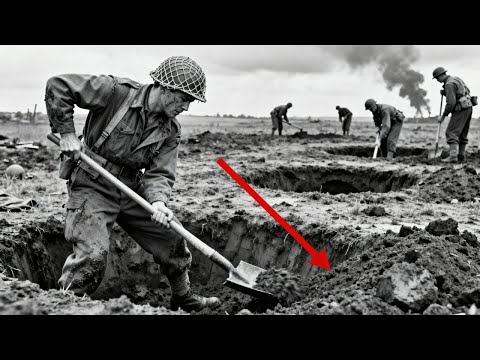
By mid-December 1944, the Allied advance across Europe had stalled along a 75-mile front stretching through the Ardennes Forest. The 101st Airborne Division, still recovering from Operation Market Garden’s brutal casualties two months earlier, had been pulled back for rest and refit near Reims, France. The men had been promised their first real break since jumping into Normandy on D-Day.
They got 48 hours.
On December 16th, three German armies—over 200,000 troops—smashed through thinly held American lines in what would become known as the Battle of the Bulge. The 101st received emergency deployment orders. By the evening of December 17th, Hargrove’s regiment had been trucked to Bastogne, a critical road junction the Germans needed to sustain their westward offensive.
What made this defensive mission particularly devastating was the tactical reality American forces faced. German artillery doctrine had evolved significantly since 1942. The Wehrmacht had perfected techniques for concentrated fire. Using forward observers equipped with improved radio equipment and detailed terrain maps, a single spotter could coordinate fire from multiple batteries simultaneously, bringing down what soldiers called “steel rain” with terrifying precision.
The statistics backed up the terror. Of all American combat casualties in the European theater, artillery caused approximately 60% of wounds and deaths. Small arms fire—the rifles and machine guns soldiers trained endlessly to combat—accounted for less than 30%. The real killer wasn’t what you could shoot back at. It was the shells you heard screaming in from positions miles away.
Standard US Army doctrine for defensive positions had been developed largely from World War I experience and refined during training in the United States. Field Manual 7-40, the infantry bible, was explicit: “The fighting position will be oriented toward the most likely avenue of enemy approach. Primary field of fire will cover assigned sector to the front.” The manual included detailed diagrams showing foxholes dug with the deepest protection to the rear, a forward-facing parapet, and sandbag or log reinforcement, creating a V-shaped opening toward enemy territory.
This doctrine made perfect tactical sense for defending against infantry assault. It gave soldiers maximum visibility and firing angles against advancing troops. It allowed grenades to be thrown forward without obstruction. It concentrated defensive firepower where it mattered most.
But it was designed for a different kind of warfare.
Lieutenant Colonel John Davies, battalion commander for the 506th’s 2nd Battalion, would later write in his after-action report: “Our men had been trained to fight infantry. They understood small unit tactics, fire and maneuver, establishing interlocking fields of fire. What they hadn’t been prepared for was the reality that in this war, you were far more likely to die from a shell you never saw coming than from a German rifleman you could actually engage.”
The German artillery observers surrounding Bastogne held the high ground. They had clear sight lines to American positions—and they had ammunition. Lots of it. In the offensive’s opening days, German forces had committed their strategic artillery reserves, knowing this attack represented their last chance to force a negotiated peace before Allied industrial production made further resistance impossible.
For the paratroopers of the 101st, this created an impossible equation. Dig in facing the enemy and you could fight effectively against infantry assault. But when the artillery started—and it would start—your position became a trap. The orthodox foxhole design, with its rearward protection and forward opening, funneled blast effects and shrapnel directly into the hole when shells landed in front of your position, which is exactly where German forward observers were directing them.
Hargrove had watched men die in foxholes in Italy. Not from direct hits—those were usually unsurvivable regardless of position design—but from near misses. Shells landing 10, 15, 20 feet away. Distances that should have been survivable. The shrapnel had found them anyway, following the geometry of their own defensive positions straight down into the hole.
He’d started thinking about artillery differently—not as random death from above, but as a physics problem with a geometric solution.
The German artillery observers watching the American positions through their scissors telescopes were confident. Oberleutnant Friedrich Bauer, coordinating fire for the 18th Volksgrenadier Division’s attached artillery battalion, had directed barrages against British positions at Caen, American positions in the Hürtgen Forest, and Soviet positions outside Warsaw. He knew how American paratroopers fought. They were aggressive, well-trained, and dangerously effective in close combat. But they were also predictable. American doctrine was standardized across all units. They dug the same positions, established the same defensive patterns, responded to artillery the same way every time.
This made them vulnerable.
“They will dig facing us,” Bauer told his forward observers on the morning of December 18th. “When the barrage begins, they will shelter in their holes. We will bracket their positions with ranging shots, then walk the barrage across their line. Standard procedure.”
What German artillery commanders had learned was that the American foxhole design—while excellent for small arms defense—created a predictable vulnerability envelope. High-explosive shells detonating in front of a forward-facing foxhole would drive shrapnel downward and backward directly into the occupied space. The blast wave would follow the same path of least resistance, channeling through the opening the defenders needed for visibility and fire.
The Wehrmacht had tested captured American field manuals extensively. They understood the doctrine better than many American officers. When you knew exactly how the enemy would position themselves, you could calculate precise firing solutions. You didn’t need direct hits. You just needed to drop shells in the predicted zone—15 to 20 feet in front of their positions. The foxholes themselves would do the rest of the work.
For the men of Hargrove’s squad, the fear was tangible. Private Eddie Morrison had survived Market Garden by pure luck—the German 88 shell that landed next to his foxhole had been a dud. Private First Class Robert Chen had watched his best friend die in a perfectly constructed position near Eindhoven when a near miss drove a fist-sized chunk of shrapnel through the opening. Everyone had stories. Everyone knew someone who’d been killed in their hole.
They’d been trained that proper technique would protect them. Dig deep enough, reinforce properly, maintain overhead cover. But the mathematics of high-explosive artillery didn’t care about proper technique. The shells found you anyway.
Then came Hargrove’s order. Dig backwards. Face southeast, away from the German lines.
“Sarge, this is insane,” Corporal Davis said. “We won’t see them coming. We can’t cover our sector.”
“We’ll set up observation posts,” Hargrove replied. “Rotating watch. Two men forward at all times with a field phone. When they report movement, we move to fighting positions outside the holes. And when the artillery starts—then you’ll understand why I’m doing this.”
By dusk on December 17th, every man in the squad had a foxhole facing the wrong direction. And the German observers had taken note.
The barrage began at 0445 hours on December 18th. Hargrove was awake when the first shells screamed in. The sound started as a distant freight-train rumble, building to a howling shriek that made your teeth ache. Six seconds of warning. Then the world exploded.
The first salvo walked across the ridgeline 300 yards to their left, where Easy Company had dug in using standard doctrine. Orange fireballs erupted from the frozen ground. The concussion waves hit like physical blows. Snow and dirt and shattered pine trees fountained into the pre-dawn darkness.
“Into the holes!” Hargrove shouted. “Everyone down now!”
The two men on forward observation, Collins and Morrison, sprinted back from their concealed position and dove into their foxholes. Hargrove dropped into his own position—facing southeast, his back to the German lines. Every instinct, every hour of training screamed at him that he was doing this wrong.
The second salvo adjusted 300 yards closer. The German forward observers were walking the barrage methodically across the American defensive line. This was textbook counter-infantry fire: start beyond the target, adjust based on observed impacts, then maintain sustained fire across the confirmed enemy position. Each 105mm shell contained approximately 4.8 pounds of TNT and fragmented into roughly 15,500 pieces of lethal shrapnel. At a range of 30 feet, every fragment was deadly. At 50 feet, most were still dangerous. At 75 feet, you were in what artillery officers called the wounding zone.
The third salvo landed 200 yards to their left. Through the chaos, Hargrove could hear screaming. Easy Company was taking casualties. Men in properly constructed forward-facing foxholes were being killed by shells that never directly hit their positions. The geometry was betraying them.
The fourth salvo landed 100 yards away.
“Sergeant!” Davis shouted from the next hole over. “They’re ranging us!”
Hargrove pressed his face into the frozen dirt at the rear of his foxhole. His men were doing the same—trusting his judgment, their backs to the enemy they’d been trained to face. He could feel the impacts through the ground now, rhythmic hammer blows that made the earth shudder.
The fifth salvo landed 50 yards to their left. Then the German artillery found their sector.
The first shell landed 23 feet in front of Corporal Davis’s foxhole—exactly where a German forward observer would expect the opening of a standard American defensive position to be. The 105mm high-explosive round detonated on impact. The explosion created a crater four feet deep and eight feet across. The blast wave expanded spherically from the detonation point, but the shrapnel—those 15,500 lethal fragments—followed ballistic trajectories determined by physics and geometry.
In a standard foxhole facing forward toward the enemy, Davis would have been directly in line with the primary fragmentation cone. The shrapnel would have swept through the opening of his position like a shotgun blast. The blast wave would have channeled down through the same opening, creating overpressure that ruptured lungs and eardrums.
Instead, the shrapnel and blast wave hit the rear wall of Davis’s foxhole. The reinforced earth and logs absorbed the energy. Davis, facing away from the explosion, was protected by two feet of frozen dirt and the fundamental geometry of his reversed position.
“I’m okay!” he shouted. “I’m okay!”
The barrage intensified. Over the next 45 minutes, German artillery dropped an estimated 300 shells across their sector. The forward observers had marked their position accurately. Shells landed in precise patterns—20 feet to the left, 20 feet to the right, 20 feet in front, 20 feet behind. The German artillery doctrine called for saturating a target zone with a grid pattern, ensuring no position within the target area could avoid the effects.
But the geometry was working against them.
Private Chen’s foxhole took a near miss 17 feet to the front. He felt the impact through his entire body, his vision going white from the flash. Dirt and shrapnel rained down on his helmet. When his hearing returned, he realized he was uninjured. The blast had been channeled over and past his position. Morrison’s hole took three near misses—two in front, one to the left. Each time, he pressed himself against the rear wall, letting the earth absorb what would have killed him in a conventional position.
The German shells were landing exactly where they were supposed to. The problem was that American soldiers weren’t where German doctrine said they should be.
At 0537 hours, the barrage shifted. The German artillery began walking their fire farther south, seeking other American positions. In the sudden relative silence—broken only by ringing ears and distant explosions—Hargrove’s squad began checking in.
“Davis intact.”
“Chen here.”
“Morrison good.”
“Collins, check.”
One by one, all 12 men reported in. Some had minor wounds from debris and blast concussion. Private Rodriguez had a bleeding cut on his forehead where a piece of wood from overhead cover had struck him. Corporal Jackson had burned his hand grabbing a shell fragment that landed in his foxhole, still glowing red-hot. But they were alive. All of them.
Hargrove pulled himself out of his foxhole and looked left toward Easy Company’s sector. Medics were already moving through the positions. He could see at least four men being carried on stretchers. The smoke and smell of high explosive hung over everything.
Lieutenant Barnes, the platoon leader, appeared out of the smoke and snow. His face was gray with shock.
“Hargrove, why the hell aren’t you bleeding?”
“Different geometry, sir,” Hargrove said quietly.
Barnes stared at the squad’s backwards foxholes, then back toward the casualties in the adjacent sector. His expression shifted from confusion to understanding to something like horror at the implications.
“Get your men ready,” he finally said. “The Germans will be coming behind that barrage.”
But the artillery had revealed something more important than immediate tactical success. It had demonstrated that three years of accepted doctrine might be killing soldiers who should have survived.
Within six hours, word of Hargrove’s backwards foxholes had reached battalion headquarters. By the afternoon of December 19th, as German infantry probes tested the American defensive line around Bastogne, three officers from division intelligence arrived to examine the positions.
Captain Edward Sullivan, a former engineering instructor from West Point who’d been attached to the 101st as a defensive tactics consultant, spent 30 minutes measuring blast patterns and examining the geometry. He walked between Hargrove’s intact positions and the damaged foxholes in adjacent sectors. He photographed the shell craters. He documented the shrapnel impact patterns on the rear walls of the reversed positions.
“The manual assumes the primary threat is direct fire,” Sullivan said, kneeling in one of Hargrove’s foxholes. “Small arms, machine guns, maybe direct-fire anti-tank weapons. The doctrine optimizes for visibility and fire return against those threats.” He pointed at the cratered ground in front of the position. “But in modern warfare, indirect fire is the killer. We’ve known this statistically since 1943, but we haven’t adapted our defensive doctrine to match the actual threat profile.”
What the testing revealed was a fundamental mismatch between training and reality. The standard foxhole design created what Sullivan called a fragmentation funnel. When high-explosive rounds detonated in the forward zone—where German observers naturally aimed—the position’s own geometry directed blast effects and shrapnel into the occupied space.
The physics were elegant and brutal. A 105mm shell detonating 20 feet in front of a forward-facing foxhole would project its primary fragmentation cone at an angle that swept directly through the position’s opening. The blast wave, seeking the path of least resistance, would channel through the same opening with tremendous force. Soldiers taking cover in the deepest part of their foxhole—doing exactly what training prescribed—were placing themselves in the optimal zone for those effects to reach them.
Reverse the geometry, and the physics reversed too. With the opening facing away from the likely impact zone, the same shell detonating 20 feet away would drive its shrapnel and blast into the reinforced rear wall. The soldier facing toward that reinforced wall was protected by the earth itself. The fragmentation couldn’t bend around corners. The blast wave dispersed against solid mass rather than channeling through an opening.
Most critically, Sullivan wrote in his report to division headquarters, “This configuration does not significantly compromise defensive capability against infantry assault. Soldiers can maintain observation posts forward of their protective positions and move to fighting positions when direct-fire threats materialize. The artillery threat, which arrives with warning, and the infantry threat, which provides visual cues, occur on different time scales, allowing defenders to optimize for each separately.”
The revelation was being distributed through informal channels even as Sullivan documented it officially. Sergeants were talking to sergeants. Men who’d survived Hargrove’s barrage were explaining the technique to men in other companies. By December 20th, scattered squads across the 101st’s defensive perimeter were experimenting with modified foxhole orientations.
The Germans noticed the change, though they couldn’t immediately understand its significance. Forward observers reported American positions that seemed incorrectly oriented, but the implications weren’t clear until artillery strikes against these modified positions proved less effective than expected. Bauer, the artillery coordinator, adjusted his firing solutions, attempting to compensate for what he assumed was confusion or poor training among American infantry. But you couldn’t adjust for physics.
The lesson was spreading beyond Bastogne. An infantry intelligence bulletin was being prepared for distribution across all American forces in Europe. Field Manual 7-40 wasn’t being officially revised—the bureaucracy of military doctrine moved too slowly for battlefield innovations—but a supplement was in development: Protection Against Indirect Fire: Alternative Defensive Position Configurations. One sergeant’s observation, made under fire, was being systematically analyzed and distributed through the largest military organization in American history. The question was whether it would reach other units before those units faced their own artillery barrages.
Hargrove’s squad remained in defensive positions outside Bastogne until December 27th, when Patton’s Third Army broke through the German encirclement. During those ten days, they endured seven more sustained artillery barrages. Each time, the backwards foxholes protected them. Each time, the casualty reports from adjacent units using standard doctrine confirmed the difference geometry made.
Final statistics from the Bastogne defensive period revealed a stark contrast. In sectors where modified foxhole designs had been implemented, artillery-caused casualties dropped by approximately 40% compared to sectors using standard configurations. This didn’t account for improved survival from other factors—medical treatment, supply availability, shell quality—but the correlation was significant enough that by January 1945, the technique was being unofficially adopted across multiple infantry divisions.
Hargrove himself survived the war. He was awarded the Bronze Star for his actions at Bastogne, though the citation focused on exemplary leadership under fire rather than specifically mentioning the foxhole innovation. He was promoted to technical sergeant and finished the war with the 506th in Austria. After returning home to Pennsylvania, he worked as a high school mathematics teacher, rarely speaking about his military service.
The official recognition came slower. The Infantry School at Fort Benning incorporated modified defensive position designs into training curriculum in late 1945 after extensive testing at the school’s artillery impact range. The revised doctrine acknowledged that orientation of protective positions should account for the most likely threat vector—which in modern combat frequently originates from indirect fire rather than direct assault.
Post-war analysis by Army historians calculated that if modified foxhole techniques had been implemented across all infantry divisions from December 1944 onward, approximately 2,300 lives might have been saved during the final six months of combat in Europe. That number was speculative—battle conditions varied enormously—but it represented a conservative estimate based on observed casualty reduction rates.
The lesson influenced more than just American doctrine. British forces examining after-action reports from the Ardennes began experimenting with similar modifications to their defensive positions. The technique appeared in tactical manuals distributed during the Korean War, though the different terrain and combat conditions required further adaptation.
What made Hargrove’s innovation particularly significant was that it emerged from observation rather than theoretical analysis. He wasn’t an engineer or a tactics instructor. He was a sergeant who’d watched his men die and asked a simple question: “What if we’re optimizing for the wrong threat?”
The answer saved lives.
In 1989, military historians from the US Army Center of Military History interviewed Hargrove, then 68 years old, for an oral history project documenting infantry innovations from World War II. When asked about the backwards foxholes, he was characteristically modest.
“I just paid attention,” he said. “The shells were killing more men than the bullets. Seemed logical to protect against what was actually doing the killing.”
That simple observation—that you should defend against the threat that exists, not the threat your training prepared you for—became a case study in military adaptation that’s still taught at the Infantry School today.
War reduces survival to fundamental questions. Not courage or ideology or tactical brilliance, but basic physics and geometry. The angle of a shell’s trajectory, the density of frozen earth, the direction a soldier faces when the world explodes around him. Hargrove’s innovation worked because he understood that doctrine serves soldiers, not the other way around. When the manual becomes more important than the mission, when following procedure matters more than coming home alive, you’ve lost the ability to adapt. And adaptation is what separates armies that win from armies that just fight hard before losing.
The backwards foxholes weren’t about being clever. They were about paying attention—about noticing that the biggest killer on the battlefield wasn’t the one everyone trained to fight. About having the courage to reject three years of institutional knowledge because the evidence in front of you demanded it.
Every military in history has faced this tension between standardization and adaptation. Standard doctrine exists for good reasons. It allows massive organizations to coordinate. It preserves lessons learned by previous generations. It prevents every unit from reinventing basic tactics. But doctrine can also become a trap—especially when battlefield conditions evolve faster than the manuals do.
One squad. Twelve foxholes. Three hundred artillery shells. Zero fatalities.
Sometimes survival requires facing the wrong direction. Sometimes the most important thing you can do is trust what you’ve seen with your own eyes, even when it contradicts everything you’ve been taught. And sometimes the difference between coming home and being buried in Belgium comes down to which direction you’re facing when the shells start falling.
Hargrove’s story doesn’t end at Bastogne. The technique he pioneered—digging away from the threat—was quietly adopted across the European theater, then codified into training that shaped generations of soldiers. But the deeper lesson outlived the foxholes themselves.
In 1989, the old sergeant told historians he’d simply paid attention. “The shells were killing more men than the bullets,” he said. “Seemed logical to protect against what was actually doing the killing.”
That quiet logic—questioning doctrine when the evidence demands it—remains the rarest kind of courage. Armies train soldiers to follow orders. Hargrove trained his to survive by breaking them.
One squad. Twelve foxholes. Three hundred shells. Zero graves.
So here’s the question worth asking yourself: what “manual” in your own life are you still following—even when the evidence in front of you says it’s killing you?
Report this article
Select a reason for reporting:






