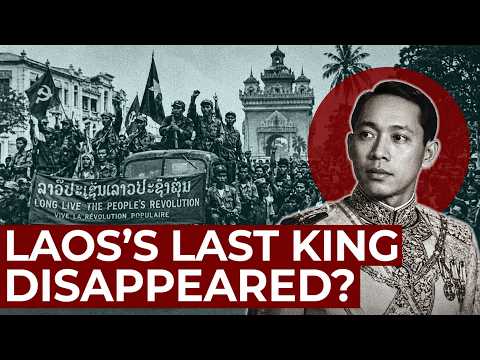
There is a country in Southeast Asia where a king vanished without a trace. No funeral. No grave. No official word for over a decade. The government still refuses to say what happened to him. This is the story of Sisavang Vatana, the last monarch of a 600-year-old dynasty—a man who was stripped of his crown, separated from his people, and erased from history inside a remote jungle prison camp. His name was never officially acknowledged after his death, and the circumstances of his disappearance raise questions that the Lao government still won’t answer.
To understand how a king could disappear so completely, you have to go back. Way back. Before modern borders, before the Cold War, before the bombs fell—back to the land of a million elephants.
Long before Laos existed on any map, the banks of the Mekong River cradled one of Southeast Asia’s most powerful kingdoms: Lan Xang, the Land of a Million Elephants. Founded in 1353 by the warrior prince Fa Ngum, it stretched across modern Laos and into parts of Thailand, Vietnam, and Cambodia. Fa Ngum brought with him a golden Buddha called the Phra Bang, which became the sacred symbol of the Lao people. He made Theravada Buddhism the state religion and built his capital in Luang Prabang, a city so beautiful and ancient that it still carries the weight of that history today.
For roughly 350 years, Lan Xang endured—fighting wars with the Burmese, Vietnamese, and Siamese. Its kings commanded standing armies of 150,000 men and an elephant corps that was the envy of every neighbor. But by the early 1700s, internal power struggles fractured the kingdom into three rival states: Luang Prabang in the north, Vientiane in the center, and Champasak in the south. Divided and surrounded by stronger neighbors, these Lao kingdoms became easy prey. The Siamese moved in, and for much of the 18th and 19th centuries, the Lao kingdoms existed as vassal states under Siamese authority. Lao kings paid tribute. Lao people were relocated. Lao culture was suppressed. It was a humiliating period that left deep scars.
Then came the French. In 1893, after a tense standoff with Siam, France forced the Siamese to cede all Lao territories east of the Mekong. Just like that, Laos became part of French Indochina. The French weren’t particularly interested in Laos—compared to Vietnam, it was a backwater. They saw it mainly as a buffer zone, a quiet stretch of jungle and mountains separating their valuable Vietnamese colonies from Siam. Under French rule, the kingdom of Luang Prabang became the principal Lao monarchy. The king who would guide Laos through most of the colonial era was Sisavang Vong, educated in France and remarkably adept at navigating between colonial authority and Lao tradition. He ascended to the throne in 1904 and would hold it for over 50 years—one of the longest reigns in Southeast Asian history.
During World War II, everything changed. Japan occupied French Indochina, and in March 1945, the Japanese launched Operation Bright Moon, overthrowing the French colonial administration across the region. King Sisavang Vong was pressured to declare Lao independence from France under Japanese supervision. His son, Crown Prince Sisavang Vatana, was sent to Saigon to protest the Japanese actions directly at their headquarters. It was a brave and somewhat defiant act, and it showed the young prince’s willingness to confront power, even when the odds were hopeless.
But the Japanese occupation was short-lived. After Japan’s surrender in August 1945, a burst of nationalism swept through Laos. A movement called Lao Issara—Free Laos—briefly united the three old Lao kingdoms under an independent government. For a fleeting moment, it seemed like Laos might chart its own course. But the French returned in early 1946, and with British support, they reoccupied the country. The Lao Issara government collapsed and its leaders scattered into exile in Thailand.
Now, here is where the seeds of everything that would follow were planted. Among those Lao Issara exiles was a prince named Souphanouvong. He was a member of the royal family, a half-brother of another prominent prince named Souvanna Phouma. But Souphanouvong was different from the rest of the royals. He was a trained engineer who had spent years in Vietnam and had become deeply sympathetic to the communist cause. While in exile, Souphanouvong traveled to Vietnam and met with Ho Chi Minh. He returned to Laos with a new purpose, and in 1950 he helped establish the Pathet Lao—a communist revolutionary movement that would spend the next 25 years fighting to seize control of the country.
So from the very beginning, the conflict in Laos was a family affair. On one side you had the royal government led by Prince Souvanna Phouma and backed by the monarchy. On the other side you had his own half-brother, Prince Souphanouvong, leading a communist insurgency. Brothers from the same royal house tearing their country apart from opposite ends of the political spectrum. And hovering above all of it was the king, Sisavang Vong, growing old and increasingly frail, watching his country descend into a civil war he was powerless to stop.
In 1947, France granted Laos a degree of autonomy with a new constitution. And in October 1953, France officially recognized Lao independence. The 1954 Geneva Conference, which ended France’s war in Vietnam, reaffirmed Laos as an independent and neutral nation. But neutral is a dangerous word in a region that was rapidly becoming the front line of the Cold War.
On October 29, 1959, King Sisavang Vong died. His son, Sisavang Vatana, informally ascended to the throne. And I say informally because here is a haunting detail that tells you everything about the state of his kingdom: Sisavang Vatana was never officially crowned. He kept deferring his coronation, saying he would hold the ceremony only when peace returned to Laos. That peace never came. He spent his entire reign as an uncrowned king, wearing the weight of a crown that was never placed upon his head.
Sisavang Vatana was 51 years old when he became king. Educated in France, fluent in French, he was known as a thoughtful, deeply Buddhist man who took his responsibilities seriously. He was not a firebrand or a warmonger. By all accounts, he was a quiet, dignified figure who genuinely cared about his people. But he inherited a kingdom being pulled apart by forces far more powerful than anything he could control.
To the east, North Vietnam was using Lao territory as a supply corridor. The infamous Ho Chi Minh Trail—the network of jungle paths and roads that funneled soldiers, weapons, and supplies from North Vietnam to the south—ran directly through eastern Laos. For the North Vietnamese, Laos was not a sovereign country to be respected. It was a highway.
To the west, the United States was terrified that Laos would fall to communism and trigger a domino effect across the region. Under the domino theory, if Laos fell, Thailand would be next, then Burma, then India—and the entire balance of power in Asia would shift irreversibly toward the communist bloc. And so the Americans decided to fight, but not openly. The 1962 Geneva Accords had declared Laos neutral and prohibited foreign military presence. Sending American troops would have been a blatant violation of international law. So instead, the Central Intelligence Agency launched what became known as the Secret War.
Starting in the early 1960s, the CIA began recruiting soldiers from the Hmong ethnic minority, a highland people who lived in the mountains of northern Laos. The man they chose to lead the secret army was a young Hmong military officer named Vang Pao, who had already been fighting alongside the French and the Royal Lao Army. Vang Pao was charismatic, brave, and ruthless. Under CIA direction, he assembled a guerrilla force that eventually grew to an estimated 40,000 fighters. These soldiers fought the Pathet Lao and the North Vietnamese on the ground, disrupted supply lines along the Ho Chi Minh Trail, rescued downed American pilots, and gathered intelligence. They were in every sense America’s proxy army in a war that officially did not exist.
Meanwhile, the skies above Laos were being torn apart. From 1964 to 1973, the United States Air Force conducted approximately 580,000 bombing missions over Laos. They dropped more than 2 million tons of ordnance on this small landlocked country. To put that in perspective, that is more tonnage than was dropped on Germany and Japan combined during the entirety of World War II. It works out to roughly one plane load of bombs every eight minutes, 24 hours a day, for nine consecutive years. Laos, a country roughly the size of Utah, became the most heavily bombed nation per capita in the history of the world.
And the king sat in his palace in Luang Prabang, powerless.
Think about the impossible position Sisavang Vatana was in. His country was being bombed into rubble by one foreign power while being infiltrated by another. His own half-uncle was leading the communist insurgency against him. His government was propped up by American money and American weapons, but the Americans wouldn’t even publicly acknowledge their involvement.
Coalition governments formed and collapsed. Military coups and counter-coups reshuffled the political deck every few years. And through it all, the king tried to hold the center together, tried to maintain some semblance of Lao sovereignty and dignity in a situation where sovereignty was a fiction and dignity was a luxury nobody could afford.
Sisavang Vatana was not naive. He understood what was happening. He made numerous attempts to broker peace, to bring the warring factions together, to find some middle ground between the communists and the right-wing military factions. But the forces arrayed against him were simply too powerful. This was not a Lao war anymore. This was a Cold War battlefield. And the Lao people were caught in the middle of a struggle between Washington and Moscow, between capitalism and communism, between superpowers that viewed this tiny country as nothing more than a square on a geopolitical chessboard.
And then in 1973, the game changed. The United States signed the Paris Peace Accords, ending its direct involvement in Vietnam. As part of the agreement, America pulled out of Laos. Just like that, the lifeline was cut. The Royal Lao government, which had depended on American support for its very survival, was left exposed. The Hmong fighters, who had sacrificed tens of thousands of their men and boys in America’s secret war, were abandoned. General Vang Pao and some of his closest supporters were airlifted to Thailand. But most of the Hmong—and most of the Lao people who had supported the royalist side—were left behind to face whatever came next.
What came next was the Pathet Lao. With North Vietnamese military support and without American opposition, the Pathet Lao moved quickly. By the spring and summer of 1975, they advanced across the country, taking one province after another. On August 23, 1975, a contingent of 50 Pathet Lao women symbolically entered Vientiane, the administrative capital, marking the end of royalist control. There was no dramatic final battle, no last stand at the palace gates. The kingdom simply dissolved quietly and almost anticlimactically, like a candle being snuffed out in a dark room.
On December 1, 1975, a Pathet Lao–organized body called the National Conference of People’s Representatives voted to abolish the monarchy. The next day, December 2, King Sisavang Vatana was forced to abdicate. The Kingdom of Laos, which traced its lineage back 600 years to the founding of Lan Xang, ceased to exist. In its place, the Pathet Lao proclaimed the Lao People’s Democratic Republic, a one-party communist state. Prince Souphanouvong, the king’s own relative and the figurehead of the revolution, was installed as president. The real power, however, belonged to a man named Kaysone Phomvihane, who became prime minister—the true architect of the communist movement for decades.
Now, you might expect that this is where the story of the king ends. Abdication, exile, perhaps a quiet life in France or Switzerland like so many deposed monarchs before him. But the Pathet Lao had something very different in mind.
Initially, the new government appeared to treat the former king with a degree of respect—or at least the appearance of it. They gave him the hollow title of supreme adviser to the president. He was allowed to remain in the royal palace in Luang Prabang. He continued to draw a monthly salary. To the outside world, it looked like the transition had been remarkably smooth, even civilized.
But behind the facade, something much darker was taking shape. In April 1976, the king was quietly moved out of the main palace and relocated to the former royal residence at Hong Siengthong. It was a downgrade, a signal that his status was changing. Then came the re-education camps—a chillingly bureaucratic term for what were essentially forced labor and political indoctrination centers scattered across the remote northern provinces.
In March 1977, fearing the former king might escape or become a rallying point for resistance, the Pathet Lao authorities arrested Sisavang Vatana. He was not arrested alone. His wife, Queen Khamphoui, was taken. His eldest son, Crown Prince Vong Savang, was taken. They were spirited away by helicopter to a place known simply as Camp Number One, near the town of Sop Hao.
The conditions were horrific. Food was scarce. Prisoners were forced to grow their own rice, clear jungle, and perform manual labor from dawn until dusk. Medical care was virtually non-existent. Diseases like malaria and dysentery were rampant. The king, the queen, and the crown prince were not given any special treatment. They labored alongside the other prisoners, growing weaker with each passing month.
According to eyewitness accounts, Crown Prince Vong Savang died on May 2, 1978. He was 46 years old. Eleven days later, on May 13, King Sisavang Vatana himself died. The cause of death, according to eyewitness testimony, was starvation. He was 70 years old. Queen Khamphoui survived longer, but not by much—she reportedly died on December 12, 1981, also in the camp, also of starvation and neglect.
According to eyewitnesses, all three were buried in unmarked graves outside the camp’s perimeter. No funeral rites were performed. No Buddhist ceremonies were conducted. No family members were notified. The last king of Laos, his queen, and his heir were put into the ground like they were nobody, in a place where nobody would ever find them.
And the Lao government said nothing. Absolutely nothing. For years, the fate of the royal family was one of the most closely guarded secrets of the communist regime. The government neither confirmed nor denied that the king was dead. When foreign journalists or diplomats asked about the royal family, they were met with evasion, deflection, or outright silence. The king had simply vanished.
It wasn’t until December 1989—more than a decade after the king’s death—that the truth slipped out. And even then, it was almost accidental. During a visit to France, Prime Minister Kaysone Phomvihane was asked about the former king. In an off-hand remark, an innocuous aside buried in a longer conversation, Kaysone confirmed that the king had died. He attributed the death to old age. No further details were provided. No apology was offered. No explanation was given for why the government had kept this information secret for over ten years.
It was treated as if it were the most ordinary thing in the world—as if a king dying in a jungle prison camp were simply a footnote in history. Barely worth mentioning. The world barely noticed. By 1989, the Cold War was ending. The Berlin Wall was about to fall. The Soviet Union was on the verge of collapse. Nobody was paying attention to a small, impoverished country in Southeast Asia and the quiet death of its deposed monarch.
But for the Lao diaspora—for the hundreds of thousands of Lao and Hmong refugees who had fled the country after the communist takeover—the confirmation of the king’s death was devastating. Many of these refugees had settled in France, the United States, Australia, and Canada. They had carried with them the hope, however faint, that the monarchy might one day be restored, that the king might still be alive somewhere, that the old Laos—the Laos of golden temples and Buddhist monks and the gentle rhythms of the Mekong—might somehow return. That hope died with Kaysone’s casual admission.
Now, let me step back for a moment and put all of this in a broader context, because the story of Laos’s last king is not just a story about one man or one family. It is a story about what happens when small countries get caught between great powers. It is a story about the human cost of the Cold War—a cost that is still being paid today.
Consider the numbers. During the Secret War, approximately 10% of the entire Lao population was killed. Roughly a quarter of the population became refugees. Two million tons of bombs were dropped on a country of fewer than three million people at the time—amounting to roughly one ton of ordnance for every man, woman, and child. Approximately 270 million cluster munitions were dropped on Laos. And roughly 30% of them failed to detonate. That means approximately 80 million unexploded bomblets are still scattered across the Lao countryside, buried in rice paddies, tangled in tree roots, half-submerged in rivers. More than 50 years after the bombing ended, people are still being killed and maimed by these weapons—roughly 300 casualties per year, many of them children who mistake the small ball-shaped bomblets for toys. At the current rate of clearance, it will take centuries, possibly thousands of years, to fully decontaminate the country.
This is the legacy of a war that was never declared, never debated in the United States Congress, and for decades was never even publicly acknowledged by the American government. The CIA did not officially confirm its involvement in the Secret War until 1994.
And what about the people who fought the war on America’s behalf? The Hmong, who sacrificed an estimated 30,000 soldiers—many of them teenagers, boys as young as 13—were largely abandoned when the Americans withdrew. Over 100,000 Hmong fled to Thailand after 1975, making the dangerous journey through jungles infested with Pathet Lao patrols and across the Mekong River, often at night, often with children on their backs. Many drowned. Many were shot. Those who made it to Thailand were placed in refugee camps where they languished for years, sometimes decades, before being resettled in third countries. Approximately 200,000 Hmong remained in Laos, where they faced persecution, forced relocation, and in some cases continued military operations against them that lasted well into the 1990s and beyond.
The king knew all of this was coming. There are accounts from the final days of the monarchy suggesting that Sisavang Vatana could have escaped. He could have fled to Thailand or France. He had the means and the connections to leave. But he chose to stay. He told those around him that a king does not abandon his people. Whether this was noble or naive, brave or foolish depends on your perspective. But it is undeniably true that by staying, he sealed his own fate.
There is a particularly poignant detail from the abdication ceremony that speaks volumes. When the Pathet Lao demanded that the king hand over the royal regalia—the symbols of the monarchy—Sisavang Vatana complied. But reportedly when it came to the Phra Bang, the sacred golden Buddha that had been the spiritual heart of the Lao kingdom since the days of Fa Ngum in the 14th century, the king hesitated. The Phra Bang was not just a political symbol. It was the soul of the nation. Handing it over meant handing over something that could not be measured in political terms. But he had no choice. The Phra Bang was taken. And today it is kept in Luang Prabang, inside a temple on the grounds of what was once the royal palace—which the communist government converted into a national museum. Tourists visit it every day. Most of them have no idea what happened to the king who once lived there.
The Royal Palace Museum in Luang Prabang is one of the most visited sites in the country. It is a beautiful building, a blend of French colonial and traditional Lao architecture set on the banks of the Mekong with views of misty mountains in every direction. Inside you can see the throne room, the royal bedrooms, the ceremonial halls. The king’s personal effects are still there—his photographs, his gifts from foreign dignitaries, his library. It is preserved as if the royal family simply stepped out one afternoon and never came back. Which, in a sense, is exactly what happened. But you will not find any exhibit or plaque or informational panel in that museum that tells you what happened to the king.
The Lao government has never erected a memorial. There is no official acknowledgement of his death beyond Kaysone’s brief 1989 remark. The unmarked graves outside Camp Number One have never been officially identified, and the government has refused requests from the surviving royal family to locate and repatriate the remains.
Several members of the royal family survived, scattered across the globe in exile. Prince Saravong Savang, the king’s youngest son, escaped to France, where he lived until his death in 2018. The king’s grandson, Prince Soulivong Savang—son of the deceased crown prince Vong Savang—became the titular head of the royal house of Laos in exile. He lives in Paris. He was born in 1963 in Luang Prabang and was only 12 years old when the monarchy was abolished. His father, the crown prince, was arrested and died in the camp when Soulivong was just 14 or 15. He has spent his entire adult life in exile, carrying a title that has no country attached to it.
These surviving royals, along with members of the broader Lao diaspora, have called for the government to acknowledge what happened, to allow the family to recover the remains of the king, the queen, and the crown prince, and to provide some measure of closure. So far, those calls have gone unanswered. The Lao People’s Democratic Republic, which still operates as a one-party communist state, has shown no interest in revisiting this chapter of its history.
There’s a reason for that, and it goes beyond mere stubbornness or ideological rigidity. The legitimacy of the current Lao government rests in part on the narrative that the communist revolution was a liberation—that the monarchy was a corrupt and backward institution that had to be swept away for the good of the people. Acknowledging what happened to the royal family—admitting that the king, the queen, and the crown prince were starved to death in a jungle prison—would undermine that narrative. It would raise uncomfortable questions about the nature of the revolution and the regime that emerged from it. And so, the silence continues.
But history has a way of speaking even when governments try to keep it quiet. In recent years, there has been a quiet but growing reverence for the monarchy among ordinary Lao people, particularly in Luang Prabang. Older residents still remember the king. They remember his kindness, his dedication to Buddhism, his quiet dignity. In the temples and monasteries of Luang Prabang, monks still chant prayers that echo the traditions maintained by the monarchy for centuries. And among the younger generation, there’s a growing curiosity about the royal past—a desire to understand what was lost and what the country might have become if history had taken a different turn.
The story of Sisavang Vatana is in many ways a microcosm of the entire Lao experience in the 20th century. A small, peaceful country rich in culture and history but poor in military and economic power, caught between empires and ideologies that had nothing to do with the lives and aspirations of its people. The French used Laos as a buffer. The Americans used it as a bombing range. The North Vietnamese used it as a highway. The Soviets and Chinese used it as a chess piece. And when the game was over, the players walked away. And the people of Laos were left to pick up the pieces.
The king was one of those pieces. He could have saved himself. He chose not to. And for that choice, he was rewarded with starvation, an unmarked grave, and decades of official silence.
Today, Laos remains one of the poorest countries in Southeast Asia. It is a single-party state with limited press freedom and a government that maintains tight control over political expression. But it is also a country of extraordinary beauty—where Buddhist monks in saffron robes still collect alms at dawn, where the Mekong River flows wide and slow through limestone valleys, and where the ancient temples of Luang Prabang still stand as monuments to a civilization that stretches back more than six centuries.
The Phra Bang is still there. The palace is still there. The memory of the monarchy is still there—kept alive in whispered conversations, in the prayers of monks, in the stories that grandparents tell their grandchildren when they think nobody else is listening.
And somewhere outside a crumbling camp in the mountains of Houaphanh province, in an unmarked patch of earth that no one has ever been allowed to visit, lies the last king of the land of a million elephants. His name was Sisavang Vatana. He was never crowned. And the world has largely forgotten him.
But now you know his story. And maybe that is a small kind of justice—in a world where justice is often the last thing to arrive.
What do you think—should the Lao government finally acknowledge what happened to King Sisavang Vatana and allow his family to recover his remains? Share your thoughts in the comments below.
Report this article
Select a reason for reporting:






