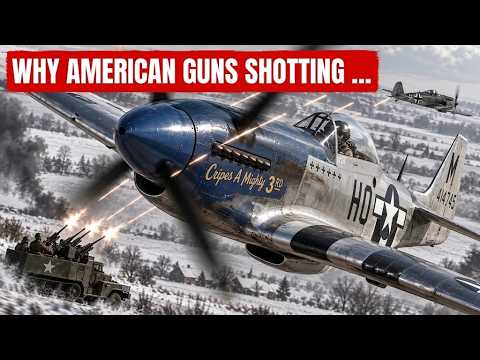
The frozen farmlands of Belgium, Christmas morning 1944. A lone Focke-Wulf 190 screams over the treetops, its propeller blast kicking snow off fence posts. Three American P-51 Mustangs close in on its tail. The lead pilot is the greatest Mustang ace America ever produced—25 years old, 26 confirmed kills, a squadron commander whose name is in newspapers from North Carolina to California. In minutes, he will be dead in a snow-covered field, and the German fighter he’s chasing will fly away without a single bullet hole.
There was no Luftwaffe ace good enough to kill George Preddy that morning. No Messerschmitt cannon shell. No veteran German pilot ambushing from the sun. The bullets that tore through his cockpit were American .50-caliber rounds, fired by American soldiers from an American gun because of a phone call that never came.
The night before, the largest tent at a muddy Belgian airfield called Asch was the warmest place in the Ardennes—which wasn’t saying much. Ground crews had hung light bulbs from the main pole. Someone found a crate to use as a table. Outside, the temperature was well below freezing, and the taxiways had turned into frozen ruts that could snap a plane’s tail if a pilot got careless.
Inside, a pair of dice bounced across an ammunition box. A young major with a North Carolina drawl leaned over them and called out the same two words he always said when the dice left his hand. “Cripes almighty.” He said it the way men say prayers. The pilots gathered around that box had heard it so often they’d painted it on the nose of his plane.
He was winning. By the time the game ended, he’d earned nearly $1,200 from the men in his squadron. Real money in 1944. Enough to buy a car back home. He told them he planned to invest every dollar in war bonds the next time someone handed him a form.
His name was George Earl Preddy Jr., and he commanded the 328th Fighter Squadron. He was 25 years old, and on that particular night, he had shot down more German aircraft from the cockpit of a Mustang than any other living pilot.
His group had been at Asch for just two days. They’d been rushed from England because the German Army had broken through the Ardennes forest eight days earlier in a snowstorm, punching a hole in the American lines. The weather had been too bad for the Allied air forces to be of any use ever since. The men on the ground were fighting without eyes and without air cover.
Asch was a Ninth Air Force field—primitive, crowded, and close enough to the fighting that pilots could hear the artillery rumble at night. It wasn’t England. No brick buildings, no warm mess hall, no village pub. Just tents, frozen mud, cold rations, and the constant awareness that the front line was a short drive east.
No one in that tent would have expected that in less than a day, the man rolling dice would be lying dead in a snow-covered field in Germany.
To understand why his death hit so many Americans so hard, you have to understand how unlikely it was that he’d ever reached a cockpit at all. He came from Greensboro, North Carolina—a mill and tobacco town where families knew each other across three generations. He wasn’t a big kid. He was thin, narrow-shouldered, the type who looked younger than his actual age.
When he walked into a U.S. Navy recruiting office wanting nothing in the world more than to be a naval aviator, the doctors took one look at his file and turned him down. He didn’t argue. He went home, then came back. They rejected him a second time. He returned a third time, hoping a different doctor on a different day might read the same numbers differently—or miss what they kept finding. The answer didn’t change. Three separate times, the U.S. Navy examined George Preddy and told him his body wasn’t fit enough to fly an airplane.
Think about what that does to a young man. Not one rejection—which any man could shrug off—but three, each confirming the last. Each written on an official form by a doctor in uniform. Three times told, in the politest possible terms, that his body had disqualified him from the only thing he wanted to do.
So he went to work instead. He spent time in a cotton mill, in air thick with lint, listening to the machinery roar and wondering if that sound would follow him for the rest of his life. He spent two years at Guilford College. He watched other boys from his hometown leave to earn the wings he’d been denied and read their names in the local paper while he stayed in Greensboro.
Then, in September 1940, he walked into an Army Air Corps office instead. The Army’s standards weren’t the Navy’s. The Army said yes.
He waited months for a training slot to open. He learned to fly through the spring and summer of 1941. And on December 12, 1941—five days after Japanese planes appeared out of the morning sun over Pearl Harbor and dragged the United States into war—George Preddy pinned on his wings at Craig Field, Alabama.
His first combat assignment sent him as far from Germany as possible. He sailed to Australia and joined the 9th Fighter Squadron of the 49th Fighter Group, defending Darwin on the continent’s empty northern coast against Japanese raids coming down from the islands. His plane was a Curtiss P-40 Warhawk—a heavy, straightforward machine that was thoroughly outclassed. It could dive and take punishment. What it couldn’t do was maneuver with a Japanese Zero or chase one in a climb. Every pilot in that squadron knew it.
The flying was long and unrewarding. Hours over open water with nothing in the windscreen but glare. Scramble missions that launched too late to intercept anything at all. Patrols where the enemy appeared above them already holding the advantage, made one pass, and vanished before the Warhawks could lift their noses. Men died in that squadron from weather, from engine failure, from running out of fuel over the sea, and from an enemy who in those early months was far better equipped and far better trained.
George Preddy flew those missions for months. He fired his guns in anger over Australian dirt and water. And through all of it, he came out of the Pacific war without a single confirmed victory to his name. Not one.
The man who would one day lead all American fighter pilots in Europe in aerial kills spent his entire first combat tour learning what it felt like to be in the slower airplane.
Then, in mid-1942, the Pacific nearly killed him—and it had nothing to do with the Japanese. It happened on a routine flight. Two Warhawks, 12,000 feet over Australia, practicing the kind of maneuvers squadrons ran every week to stay sharp. The other plane was flown by a second lieutenant named John Super. Somewhere in that clear-sky maneuvering, with no enemy within hundreds of miles, the two aircraft collided. Super was killed. Preddy fell with his plane breaking apart around him. He managed to get out and hit the ground hard. By the time rescue reached him, he had a broken leg, deep lacerations, and not much left.
He spent about three months flat on his back in a hospital, staring at the ceiling, listening to footsteps in the corridor, and running the calculations every wounded pilot runs. The ward was hot and still. The air was heavy with disinfectant and the smell of sun on canvas curtains, and the sound coming through the open windows was the sound of other men flying. Engine noise working in a distant field, formations passing overhead in the middle of the day. He could identify each one by ear without turning his head, and every one of them was a reminder that the war was going on without him, that a friend had been buried while he lay there unable to stand.
The leg would heal. The hip would not heal right, and it would hurt him for the rest of his life every time he pulled hard on the stick or sat strapped into a freezing cockpit for five hours straight. There were doctors who doubted he’d ever fly a combat mission again. He had now been medically disqualified by two different military services on two different continents.
So consider the shape of this young man’s war to that point. Three Navy rejections. A year of dangerous, unglamorous flying in a plane that couldn’t match the enemy’s, with no achievements to show for it. A midair collision that killed another pilot and left him broken. A hip that would ache every remaining day of his life.
Any reasonable man would have accepted a medical discharge and gone home to Greensboro as a veteran, mostly healthy and with a clear conscience. But he asked to return to combat, and this time the Army didn’t send him to the Pacific.
In the fall of 1943, he arrived in England at a muddy grass field in Norfolk called Bodney and reported to the 352nd Fighter Group. He was older than most of the men around him, a veteran of a front none of them had seen, and he walked with a limp he never talked about.
The aircraft parked on the pads were Republic P-47 Thunderbolts—8-ton fighters carrying eight heavy machine guns in their wings. Within months, the group began painting the spinners and engine cowlings of their fighters dark blue, and that paint gave them a name that stuck for the rest of the war and all the years after. The Blue-Nosed Bastards of Bodney.
The men who’d told George Preddy his body wasn’t fit to fly had made exactly one mistake. They’d measured the wrong part of his body.
In the fourteen months that followed, he became the deadliest Mustang pilot in the sky and the most famous fighter ace in the entire U.S. Army Air Forces in Europe. In those same fourteen months, he was also shot down by ground fire twice. The first time nearly killed him. The second time did.
On December 25, 1944, Preddy led ten Mustangs off the frozen runway at Asch. For three hours, nothing happened. Then the radio crackled: a fight near Koblenz. He found a swirling low-altitude brawl and shot down two Messerschmitt 109s. Those were his last two kills—his 26th and a fraction, the highest score of any Mustang pilot in the war.
Almost immediately, the radio called again. A Focke-Wulf 190 was strafing American troops south of Liège. Preddy turned toward it, his wingman Gordon Cartee and a third Mustang flown by James Bouchier in formation. They dropped low, chasing the German over the treetops, and crossed into Germany near the village of Langerwehe.
American anti-aircraft crews there had been told to hold fire. But the order never reached every gun. A half-track crew saw three shapes racing over the trees at 350 miles an hour and did what they’d been doing for a week. They opened fire.
A single .50-caliber round punched through Preddy’s canopy and severed his femoral artery. The Mustang lurched left, flipped, and went down in a snow-covered field. The German fighter flew away without a scratch.
His brother William, also a Mustang pilot, was killed by ground fire four months later. They lie side by side today in the Lorraine American Cemetery in France.
The Navy doctor who sent George Preddy home was wrong about his body. No German pilot ever shot him down. It took four American machine guns, a clear winter sky, and a phone call that never came. What do you think—was Preddy’s death a tragic accident of war, or a failure that should have been prevented?
Report this article
Select a reason for reporting:






