The morning of June 6, 1944, broke gray and cold over the English Channel. Beneath the low clouds, the largest armada in human history churned through the mist—5,000 ships, 20,000 aircraft, and 160,000 men waiting to storm the beaches of Normandy. In Berlin, no one dared wake Adolf Hitler. Across occupied Europe, coded telegrams began to spread, triggering chaos.
But far to the south, in a quiet town called Montauban, the war seemed a distant rumor. The soldiers of the 2nd SS Panzer Division Das Reich—the most feared unit of the Waffen-SS—slept late. They had seized the finest houses, and the locals cooked their meals and washed their uniforms. For these veterans of the Eastern Front, the war had paused.
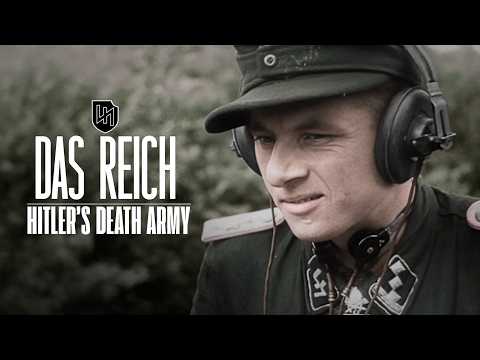
Then, on the morning of June 8, the telegrams arrived. Engines roared to life. Armored vehicles rumbled into formation. The column rolled out of Montauban, heading north. Destination: Normandy.
To understand what that order meant, you have to understand what Das Reich was. It was not a normal military unit. It was an institution, an armed cult. Born in 1925 as Hitler’s personal bodyguard, the SS had grown into a state within a state—with its own rules, its own hierarchy, and its own morality, or complete lack of it. The Waffen-SS divisions were the firemen of the front. Whenever a line broke, Das Reich was sent to put out the fire.
Their loyalty was not to the regular army but to Heinrich Himmler, the architect of the Holocaust. And by 1944, after years of brutal fighting in the Balkans, the Soviet Union, and the killing fields of Belarus, Das Reich had become a weapon forged by war and something darker still.
On April 11, 1944, Himmler personally inspected the division in Montauban. The officers presented 69 Iron Crosses—men who had survived the Russian winter. At their head stood Heinz Lammerding, a trained engineer and a Nazi from the very beginning. On paper, a technician. In reality, a hunter. He had led extermination units in Belarus and the Baltics—groups that did not fight armies; they murdered civilians.
But the Eastern Front had taken its toll. By 1943, Das Reich was no longer the same. The rapid advance of 1941 had vanished, replaced by a slow, bleeding war of attrition. Entire regiments ceased to exist. Experienced officers were replaced by inexperienced recruits. When the division returned to France in 1944, half of its 15,000 men were new—young Hungarians, Romanians, and Alsatians who had never fired a shot in anger.
Among them was 17-year-old Elmar Schneider. When he appeared before the Waffen-SS review board, an officer looked at his physique and asked if he had flat feet. “No,” Schneider said. The officer smiled. “Besides, you’ll get the stamp anyway.” Schneider didn’t understand until he held his military booklet, approved for service. He had signed nothing. There was no voluntary enlistment document. But to the bureaucracy of the Reich, he was a volunteer. The stamp said so.
By 1944, 1,000 to 2,000 Alsatians had been incorporated into Das Reich. These young men spoke French at home and were sent to die for a Germany that was not their own.
On June 8, as the column left Montauban, most of the division’s equipment was obsolete. Tanks that needed maintenance, vehicles pieced together from spare parts. Yet Das Reich was a real threat: 15,000 armed soldiers, armored, led by an experienced killer, moving toward Normandy. If they arrived in time, they could turn the tide. They could push the Allies back into the sea.
The German generals knew it. The Allied generals knew it. And so did the 20,000 resistance fighters waiting in the fields and forests. On the night of June 6, Charles de Gaulle’s voice came over the radio with a simple, final order: “Set Europe ablaze.” Sabotage, blown bridges, destroyed rail lines. Das Reich was advancing through a region that had become a trap.
And what would happen in the next 72 hours would change history—and punish innocent civilians who had never taken up arms.
On the night of June 7, four parachutes opened silently over the Limousin. Philippe Lévêque, a Jewish resistance fighter since 1940; Albert Maloubier, a veteran soldier; Jean-Claude Guillemot, a radio operator; and Violette Szabo, code name Louise—23 years old, half English, half French. Her husband had died in North Africa. Her two-year-old daughter Tania waited for her in London. Szabo was one of the most valuable assets Britain had in occupied France.
The mission was to make contact with Colonel Goringe, head of the Maquis in Limousin. The Maquis was the communist wing of the resistance, operating with military discipline but refusing orders from London; it made its own decisions without consultation. And that night, as the four agents struggled to orient themselves in the dark, someone made a mistake that would change everything.
At dawn on June 7, an irregular FTP squadron attacked the town of Tulle. The aim was to drive out the Germans and plant the flag of the resistance in a real town. No one asked permission. No one calculated the consequences. The operation succeeded in the narrowest sense. By the end of June 7, Tulle was effectively in resistance hands.
The next morning, elated, some FTP members left the town. None of them knew that 130 kilometers to the south, Das Reich had split into three columns, and one was heading straight for them. The order was clear: any area they crossed, terrorist groups were to be eliminated. 7,500 Waffen-SS soldiers with armored vehicles and machine guns were advancing through a region that already knew what they meant.
Two months earlier, at Mesa de Cercs, soldiers had executed 15 civilians in reprisal for sabotage in Fresnes. Three women were hanged from a balcony. Ten men were shot. The village was set on fire. On June 7 at Argan, a battalion killed ten guerrillas and seven civilians in a single day. Commander Adolf Diekmann was advancing on the left flank. He had fought in the East. He knew the unwritten rules. A show of force had to come before anyone dared question. And he knew that any punitive measure would be taken under orders from above—not on instinct, but because of official policy.
In February 1944, the Marshal responsible for the Western Front had issued a written order: any attack was to be met with immediate retaliation. No disciplinary action would be taken for excessive severity. Diekmann could do as he pleased.
At Grosac, fighters opened fire. Twelve resistance members were killed. At Ruffiac, another group tried to hold a bridge. Diekmann ordered the local inhabitants gathered in a restaurant and had 16 civilians and two resistance fighters executed. The bodies were doused with petrol and burned. Among the dead were women and children.
The battalion at the head of the column reached Briard, where a corpse was tied to the hood of a car—Maurice Vern, a resistance fighter, a victory sign. For everyone watching from the windows, it was a warning.
On the morning of June 9, Tulle changed hands again. Das Reich‘s reconnaissance battalion, 500 men and 100 machine guns, retook the town under cover of darkness. The FTP, exhausted and out of ammunition, fled. All men aged 16 to 60 were taken from their homes. More than 2,000 people were marched to the courtyard of the ammunition factory. Posters signed by General Heinz Lammerding announced that 40 German soldiers had been killed. In reprisal, 120 would be hanged. The bodies would be thrown into the river. 120 for 40—three for one.
Soldiers asked the inhabitants for ropes—ropes to be tied to lampposts, balconies, and trees. The task was given to the pioneer company, Eastern Front soldiers who had done this before. In Kiev, Minsk, and Kharkov, hanging was deliberately chosen—more humiliating than shooting, a slow death, a prolonged mockery.
Mayor Pierre Trouillé negotiated all morning. He secured the release of doctors, officials, and emergency workers—a small victory. Walking through the Abbeza Espinas courtyard, he pleaded with Walter Schmald, who granted a few pardons. Trouillé went to Oral Kovac to request a stay of execution. Kovac replied that in Russia he had grown accustomed to hanging people—a hundred thousand had been hanged between Kharkov and Kiev, so this was nothing to him. He was not exaggerating.
At 3:30 in the afternoon, the first group of ten was taken to the Place Souillac. The inhabitants were forced to watch. From the balcony of Café Tivoli, people drank. A gramophone played. A soldier sketched the hanging. When death took too long, the condemned were shot. Then the next group was called. At 7 p.m., the executions stopped—not by order, not by mercy. They had run out of rope. 98 were hanged. One was shot trying to escape. The remaining 500 were sent to Limoges; half would be deported to Dachau.
That night, young men of the Vichy paramilitary took the bodies down from the posts. They dumped them in the municipal rubbish heap. The dead were between 17 and 46 years old—students, plumbers, accountants, barbers, printers, dairy workers, engineers. Only two were resistance members. The other 97 died because they were in the wrong town on the wrong day at the wrong age.
Seventy-five kilometers north of Tulle, an empty car stood by a rural road. Major Helmut Kämpfe was missing. Commander of the 3rd Battalion of the Der Führer Regiment, a decorated veteran, a personal friend of Lammerding and Diekmann. His comrades called him “Golden Mouth”—a man who stood out in any room, yet was nowhere to be found. Hours earlier, the regiment had been ambushed at Combe V. Thirty-one guerrillas were captured and tanks rolled over their bodies. The immediate suspicion was that the Ginguoin Maquis had abducted him in reprisal.
Not far away, Violette Szabo and Jacques Dufour were moving toward Pompadour to coordinate with the Gaullist secret army. Neither knew that Waffen-SS forces were combing the area inch by inch. Near Salon-la-Tour, a motorcyclist appeared around a bend. Behind him was a detachment of Das Reich. It was too late to retreat. Violette stumbled. Her ankle twisted. Unable to run, she stayed behind and spent all her magazine’s bullets to clear Dufour’s escape. He got away. Violette was captured.
That same day, Lieutenant Karl Gerlach reappeared. He had escaped from a resistance stronghold and confirmed Das Reich‘s suspicions. A German officer had been held hostage—probably Kämpfe. The coordinates he gave pointed to a general area. Diekmann opened the map and pointed to a village called Oradour-sur-Glane. There was no evidence linking Oradour to Kämpfe. No record of resistance activity in the village. But Diekmann announced with the certainty of a man who owed no explanation to anyone: this required ruthless suppression.
To understand what happened next, you need to understand who received the order. Otto Khan commanded the 3rd Company. He had joined Das Reich in 1940—a professional soldier who had built his life on SS rank and discipline. Heinz Barth was his direct subordinate. He had joined the SS at 18 through the Hitler Youth, which functioned like an ideological assembly line, transforming teenagers into instruments of the Nazi state before they were old enough to question anything. Barth was an Eastern Front veteran. He had fought the Soviets. He had served in rebellion-suppression units in Czechoslovakia. He had come through the 3rd SS Panzer Division Totenkopf—the Skull Division, whose reputation needed no explanation.
But what truly made Barth and Khan distinct individuals was not only their deeds in the Soviet Union, but also their deeds in Central Europe. In May 1942, two Czechoslovak SOE agents parachuted by British intelligence assassinated Reinhard Heydrich, Reich security chief in Prague. Hitler, without any evidence, blamed the village of Lidice solely on suspicion that it had sheltered resistance fighters. On June 10, 1942—exactly two years before what was about to happen at Oradour—Heinz Barth took part in the operation to surround Lidice. Under his leadership, 184 men aged 16 and over were shot. The women were deported to Ravensbrück concentration camp. The children were sent to extermination camps or to Hitler’s Aryan utopia nurseries, the Lebensborn program. The houses were burned and then blown up with dynamite. A work detail of German laborers ground the remaining ruins into the earth. Lidice ceased to exist. No trace remained.
These were the men advancing toward Oradour-sur-Glane on the afternoon of June 10, 1944. Before resuming the march, Barth turned to his soldiers and said, “Today you will see blood flow.” It was not a promise. It was an order.
Oradour-sur-Glane was not a guerrilla village. It was an ordinary village of ordinary people in a region that had been largely spared from the war. A 15th-century church, small shops, farms, a tram line connecting the village to the nearest town, a market square. That Saturday, the population had nearly doubled. Spanish refugees, Alsatian families, Jews hiding beyond the reach of deportation—all living alongside the permanent residents on a morning that began like any other. In the square, men lined up for tobacco distribution. At the gates of three municipal schools, children gathered for medical examinations.
That day, Robert Hébras was 19 years old. He had come home on leave to see his family. At 2:00 p.m., Diekmann’s armored vehicles and trucks stopped at the entrance to the village. Soldiers dismounted. Orders were shouted. Everyone was to assemble immediately in the market square.
What happened over the next few hours was described by the two survivors who saw enough to tell it. Robert Hébras remembered the moment men and women were separated in the square. His mother tried to hold on to him. He was 19—too old, by the soldiers’ criteria, to stay with the women. The age limit was 14. Women and children were taken to the church. The men were divided among barns and sheds around the village. Hébras stayed with the group of men. Beside him was an Alsatian friend who spoke German. As they waited, the friend heard something. He turned to Hébras and began to say, “Look, they’re here.” He never finished the sentence. The machine guns opened fire.
The burst tore the group apart. Hébras was hit but survived. He lay motionless among the bodies. He watched as soldiers moved through the area after the shooting, checking each body, finishing off anyone still moving with a single shot. Then came the straw and wood. Then came the fire. When the flames rose, Hébras was trapped beneath the dead. He managed to crawl out. Five men survived from the barns of Oradour. Five out of hundreds.
Marcel Darth was in another barn. His account: “We felt the bullets that knocked me to the ground. I threw myself down. Everyone fell on top of me and they kept firing. Cries and screams could be heard. A friend lying on top of me was writhing in pain. And then it was over. No more gunfire. And they came toward us and stepped on us. With a rifle they fired the last shot. They fired the last shot into my friend on top of me. I could feel when he died. None of us moved until the Germans left.”
Inside the church, Marguerite Rouffanche was 47 years old. She saw soldiers entering with a large box. She told the person next to her that it looked like a bomb. The other woman told her not to say such things. The box exploded. The interior filled with smoke. People suffocated. Nothing could be seen. Cries echoed off the 15th-century stone walls. Then the soldiers came with their weapons. They fired through the windows and doors. Then they set fire to wood, benches, everything inside. Marguerite Rouffanche jumped through a sacred window. Three bullets hit her body as she fell. She hid in the bushes outside, bleeding, until the Germans left. Her youngest daughter was killed by a bullet. Her older daughter burned alive. Her older daughter’s baby—whether the child was alive or dead when the fire reached it, Marguerite never knew. She was the only survivor from inside the church of Oradour-sur-Glane.
That night, as the village still burned, Das Reich soldiers spread across the area. Khan took a blue purse from one of the inhabitants and went to a cashier at a nearby supermarket in Nule, a few kilometers from the smoking ruins. The SS took over a school. They drank, celebrated, and stayed up late into the night.
The next day, June 11, the German General Staff updated their maps. They drew a circle around the area of the massacre and wrote in red ink: 500 dead. The actual number was 642. In a village with no documented connection to armed resistance, 642 people were killed in a single day.
There is one thing Diekmann never failed to note in his internal reports. Oradour served not only as a reprisal. It also served as an initiation. The youngest recruits of Das Reich—Alsatians conscripted by official decree, Hungarians, Ukrainians—who had never before been in contact with blood, took part in that day’s massacre. After Oradour, none of them could claim innocence. They had seen it. They had participated. They had been inside it. It was a method the SS had refined over years in Belarus. In this way, 628 villages were destroyed, burned along with their inhabitants. During four years of occupation, one village was destroyed every two days; women and children were gathered in barns or churches, men were executed outside, and then fire was set. It was no coincidence. It was the same method transferred from one continent to another, from an extermination war to occupied France. Italy, Belgium, Greece—wherever SS divisions arrived from the East, the pattern repeated, because the people were the same. The orders came from the same place. And the logic was identical: the civilian population is not neutral. Either they are with us, or those against us must pay the price.
Das Reich continued its advance toward Normandy. Kämpfe was never found. There is no definitive record of what happened to him—whether he was captured, killed in battle, or simply disappeared in the chaos of those days.
The village of Oradour-sur-Glane was preserved exactly as it was on that June 10, 1944. Burned walls, rusted cars in the streets, sewing machines melted inside the houses. The French government built a new village of the same name nearby. The ruins were left as they were, so that what Das Reich did that Saturday afternoon could never be forgotten—when children waited at the school gates for medical examinations and men stood in line in the market square to buy tobacco.
Before the smoke had cleared, Diekmann demanded silence. The order was passed down: nothing of what happened that day was to be mentioned. If anyone asked, it would be said that weapons of the resistance were hidden in the village. That was the official version.
The next day, a unit returned to erase the traces. The barns were swept. The burned bodies were removed from the church and buried in a mass grave. And the division continued its journey north to Normandy.
The same logic that gave birth to Oradour would produce similar massacres across Western Europe. In Italy, on August 12, 1944, a battalion of the 16th Panzer Division, led by Eastern Front veteran Walter Reder, gathered the inhabitants of Sant’Anna di Stazzema. 560 were executed before the village was burned. A few weeks later near Bologna, the same unit repeated the method at Marzabotto. 955 killed.
The pattern spread with the soldiers. As Das Reich regrouped, the French resistance increased the pressure. Philippe Lévêque ordered the Gaullist secret army to intensify sabotage against German lines. The response was immediate. Power to the submarine base at Rochefort was cut. The Paris-Limoges railway was blown up in multiple places. At Salon-la-Tour, Lévêque and Maloubier derailed two trains. It took the Germans two months to restore the line. By June 13, 91% of the planned 1,055 rail sabotage operations had been completed. Under André Malraux’s direction, Allied bombers blocked Das Reich‘s tanks at Angoulême. The division that had left Montauban to change the course of the war was arriving in pieces.
Violette Szabo did not arrive with them. After her capture, she was handed over to the Gestapo in Limoges. The interrogation was assigned to Oral Kovac, who had overseen the hangings in Tulle. The SOE did not give up. A rescue operation was planned for June 16. Twice a day, two policemen took her, without handcuffs, on a 200-meter walk to Gestapo headquarters. Maloubier waited in the back seat of a car to pull her out. The day came. The operation failed. That morning, Violette had been transferred to Paris.
On June 18, Das Reich reached the Normandy front. The Allies were consolidating their landing. German defenses were at their last line. The Americans were advancing toward Cherbourg. Montgomery was pressing to hold. Das Reich was sent to fill a gap in a defensive line that was already collapsing.
On June 29, Hitler ordered a counterattack. Four SS panzer divisions, including Das Reich, were sent to retake Caen. At the front, Lammerding sent the 1st Battalion of the Der Führer Regiment—the same soldiers who had been at Oradour 19 days earlier. It lasted two days. The regiment lost 600 men. The next day, 250 RAF bombers attacked Das Reich‘s positions. Throughout July, the division was moved from one point to another on the front, always where the line threatened to break, but never with enough men to hold anything for long. Successes were isolated. The balance shifted daily in the Allies’ favor. Delayed by resistance ambushes, rail sabotage, and Allied air attacks, Das Reich arrived in Normandy too late, and now paid the price of a division that had spent its accumulated energy on atrocities along the way and arrived exhausted for the real battle.
On July 24, Operation Cobra began. 4,000 tons of bombs fell on Normandy—the largest display of mass bombing in the entire Second World War. General Lammerding himself was wounded by a bomb during an attack and was removed from the front. Then began a race: Coutances, Avranches, Granville. One town after another was liberated by the Americans within four days. The German rear was collapsing.
A military SS judge was sent to hear Khan’s account of what happened at Oradour-sur-Glane. Khan followed the script Diekmann had created before his death: weapons of the resistance were hidden in the village. The repression was justified. Six months later, the SS judge issued a ruling consistent with that version and closed the case internally.
Reaction outside the German structure was different. The Apostolic Nuncio and the Prefect of Limoges visited the ruins of Oradour and submitted a formal protest to Pierre Laval’s collaborationist government. Marshal Pétain, head of the Vichy regime, sent a statement to the German government expressing deep distress at the atrocities committed against the people of Oradour. According to the documents, the village was known for its restraint and peaceful character. He demanded an explanation. The protests were sent to the Führer. A special envoy in Paris refused to bring the matter to Hitler. He considered it so trivial that it was not worth bothering the Führer, who was busy with the disaster in Normandy at that moment. 642 deaths. The regime considered this number too small to bother the Führer.
Not all Germans remained silent. On June 17, Field Marshal Erwin Rommel, responsible for the defense of the Western Front, was summoned by Adolf Hitler to his headquarters near the Swiss border. During the meeting, Rommel deviated from the predetermined agenda. He said he needed to speak about what had happened at Oradour. He requested permission to punish Das Reich for what he called an unacceptable act of reprisal. He said such actions dishonored the German uniform. Hitler gave no answer. Rommel returned to the front. Three weeks later, he was seriously wounded in an Allied air attack. In October, after being accused of involvement in the July plot against Hitler, he was forced to choose between suicide and a public trial. He chose suicide.
The only voice that demanded accountability from Das Reich—but the same machine that created Oradour silenced Das Reich.
On June 12, resistance fighters entering Oradour filmed the ruins. Burned bodies, collapsed walls, cars melted in the streets. The footage was sent to London along with a detailed report based on the testimony of Robert Hébras and Marguerite Rouffanche and the conclusions of forensic experts. The world learned what had happened. Das Reich did not know—or rather, they knew and did not care.
In early August, Hitler decided that the final counterattack would be at Mortain. Its purpose was to push the Allies back into the sea. The unit chosen to lead this attack was the 2nd SS Panzer Division Das Reich. The Royal Air Force thwarted the plan within hours. The bombers stopped the advance before it could gain any momentum. It was another failure. Schneider was removed from the front to have his wounded leg amputated. Das Reich had left Montauban with over 200 operational tanks. When the battle of Normandy ended, 15 remained.
Elmar Schneider described the final days so precisely, as if he had given up trying to understand what was happening. “Mortain, Dambfront, Arienctan, Falaise. These names remind me of events I can no longer remember clearly. When we were starving, we climbed apple trees and ate the apples, but they were always too green. Everything here was too green—the soldiers, the officers, even the weapons. We couldn’t test them beforehand because there was no ammunition. There were so many dead and wounded that one more or one less made no difference, unless we were talking about comrades.”
Even in the face of collapse, the division did not stop. On August 13, 1944, 18 civilians were killed in Torte and part of the town was set on fire. American prisoners of war were summarily executed. The documented reason: they looked like Jews.
There was no longer any doubt about Germany’s defeat. A hundred thousand soldiers were being ground to dust. The Falaise Pocket… the end. What had once been the pride of the Waffen-SS was now a retreating army, burning whatever it could find, shooting anyone it encountered, falling back.
Das Reich had left Montauban to save Normandy. It arrived late. Along the way, it killed hundreds of civilians. And it arrived at the front destroyed from within. But for those who survived all this, the story was not over. And for the families of Oradour, Tulle, and Ruffiac, it would never be over.
On August 14, 1944, the Wehrmacht High Command signed a document confirming the obvious: a general retreat. No general dared speak its true name. They used euphemisms—strategic repositioning, consolidation of the line—words that fit on a page without damaging the report. But the numbers did not hide behind fine phrasing. In July, 28,000 prisoners and 12,000 dead. The Falaise Pocket added another 10,000. Bodies and 50,000 prisoners. In an open grave between the Seine and the Loire, the army that had dominated Europe for three years left behind a field of corpses the size of a city.
The prisoners crossed the Seine in handcuffs, in the opposite direction of the 1940 invasion, and were sent to camps built for French patriots. The irony was extreme. Das Reich crossed the Seine like a shadow at Elbe. Of the more than 200 tanks that had left southern France, only 15 remained. Of 15,000 soldiers, only a tiny fraction could still fight.
On August 15, the landing in Provence opened a second front. Any illusion of a German turnaround was canceled that day. On August 25, Paris was liberated. But where Violette Szabo was, Paris was not. As the capital celebrated in the streets, she was being loaded onto a cattle train at Gare de l’Est. In the Paris prison, she had met two other women: Denise Bloch, 28, whose Jewish family had been arrested in 1942 and who had continued her work; and Lilian Rolfe, 30, a half-British, half-Russian radio operator arrested in a police raid. Three women, three stories that the war bent to the same point. Violette promised them the nightmare was nearing its end. She needed to believe it. In reality, the Gestapo was emptying Paris, and its most valuable prisoners were being sent to their destination: Ravensbrück.
The camp, 90 kilometers from Berlin, was for women only. By 1944, it was packed with forced laborers, resistance fighters, political prisoners, Jews, Roma—all the human categories the Reich had decided to consume. The three were assigned to the Torgau armaments factory. The conditions there were not labor conditions; they were planned exhaustion. The purpose was not production. The purpose was to destroy the body within a timeframe the system had learned to estimate with industrial precision. Inside Torgau, the war was an abstract concept. What existed was the next day, and the next, and the cold calculation of how much longer the body could last.
Outside the camps, the war was not over. In September, American paratroopers tried to break the Dutch front at Arnhem. They failed. In October, Canadians fought a grueling battle for the port of Antwerp. Germany conceded but did not collapse.
Hitler had a plan. He always had a plan. In winter, the Ardennes mountains were considered impassable. Hitler had spent the autumn quietly strengthening them. The goal was not to win the war—that question had already been answered. The goal was to reach Antwerp, create a supply crisis, and force a separate negotiation on the Western Front. It was a gambler’s last throw, with no chips left, and at the center of this plan was Das Reich.
Elmar Schneider, the Alsatian youth who had received the SS stamp without signing anything, turned 18 in Rosenbeck. For the first time in months, he slept in a bed. The division’s numbers were growing—Hungarians, young Germans, new recruits who had never seen Tulle or Oradour.
At dawn on December 16, 1944, hundreds of German artillery batteries opened fire simultaneously across 80 kilometers. The attack was completely unexpected. Heinz Lammerding had returned to command. On the 23rd, Das Reich entered the battlefield. Schneider described the return without metaphor: “After enjoying life, we became afraid again, terrified of death.”
The division fought to keep the Americans away from Sam Vith and to repel the advance toward besieged Bastogne. For a few days, the momentum seemed real, but then the weather changed. The skies cleared, and the Allied air force returned. Patton turned his armored column 90 degrees north and advanced toward Bastogne at a speed the Germans had not calculated. Within three days, the attack’s momentum was destroyed. On December 26, Das Reich was forced to retreat at Sanvith. Bastogne was liberated. Schneider recorded: the night his company received orders to retake a hill from the Americans, they set out, lost a third of their men, and came back. The Americans were still there.
In the months after the Ardennes defeat, Das Reich was broken up. To try to stop the Soviet advance, the division was split into three separate groups and dispersed among Czechoslovakia, Hungary, and Dresden. It was the final and most impossible mission. Now, in February 1945, what remained of Das Reich was sent south—not to Germany, not to defend Berlin, but to Hungary. The reason was simple and desperate: the Nagykarizsa oil fields were the last important source of fuel under Reich control. Allied bombing had destroyed the synthetic fuel plants. The previous autumn, the Romanian oil fields had fallen to the Soviets. Without that Hungarian oil, German tanks were nothing but metal scrap.
On March 6, Operation Frühlingserwachen—Spring Awakening—began. The last major German counterattack of the war. Das Reich advanced along the eastern bank of the Danube. Through the spring thaw and mud, the panzers carved a path. For a few days, the momentum seemed strong. Then time ran out. The rasputitsa, the mud season that had wrecked German plans before Moscow in 1941, returned to collect its debt. Tanks sank to their turrets. Supply trucks could not advance. Within ten days, the attack stopped. And then the fuel ran out—not because of battle, but because of arithmetic. The German supply system could no longer sustain armored operations. Tanks were abandoned on the roads, not destroyed by the enemy, but left without petrol. Their crews burned their own vehicles so the Soviets could not capture them and continued on foot. It was the symbolic end of everything. The division that had crossed Europe in 1940 with some of the world’s most advanced war machines was now abandoning its armored vehicles as broken junk because there was nothing left to put in their engines.
The retreat became a rout. On March 27, Das Reich reached the southern outskirts of Vienna. For a couple of weeks, it fought house to house on the outskirts of the Austrian capital, holding the bridges over the Danube until April 9. Against the Red Army—which had learned to fight from the ruins of Stalingrad and was now applying that lesson—it was urban warfare: tanks under infantry cover, relentless shelling, Katyusha rockets pulverizing stone strongholds. The defenders were skilled. But it no longer mattered. Oral Kovac, the intelligence officer who had overseen the hangings in Tulle, the same man who had told the mayor that a hundred thousand dead between Kharkov and Kiev was nothing, died in those final battles of spring 1945. The Soviets had not forgotten what Waffen-SS units had done in their cities. The price was paid in the open.
On May 5, 1945, the people of Prague built barricades in the streets. The war was ending everywhere. The Czech capital would not wait for the Soviets to liberate it. It would liberate itself. This was the last battle of Das Reich. The remnants of the division were crossing the city, trying to escape west. Civilians fired from windows. Children threw Molotov cocktails from rooftops. The narrow streets of the historic center became a corridor of death for the soldiers who had marched down grand avenues as occupiers in previous weeks. It was the same urban scene the SS had created in other cities, but now reversed. In Warsaw, Kharkov, Stalingrad, the Germans had moved through streets and fired from windows. There, in Prague, the equation was flipped. The division that had erased the Czech village of Lidice from the map three years earlier in reprisal for Heydrich’s assassination was now fleeing through Czechoslovakia, leaving behind abandoned vehicles and dead comrades on the very streets where people knew inch by inch what the SS had done.
Those who made it across marched west and surrendered to the Americans. They had calculated correctly that the Soviet alternative was no option at all.
On May 8, 1945, Germany surrendered. General Jodl and Grand Admiral Dönitz signed the unconditional surrender of all German land, naval, and air forces in Europe. With this surrender, they capitulated to the Allied Expeditionary Force and simultaneously to the Soviet High Command. Lammerding, whose last duty had been the defense of Berlin, managed to escape the Allied encirclement. He crossed the chaos of the Reich’s collapse without being captured. He reached West Germany as a civilian. Violette Szabo did not see May 8. Three months before the surrender, in February 1945, she was taken behind the crematorium at Ravensbrück. Denise Bloch and Lilian Rolfe went with her. They were shot. Of the 130,000 women deported to Ravensbrück, 40,000 survived forced labor and medical experiments. 90,000 never returned. In London, Violette’s daughter Tania waited for her mother, not yet three years old. Later, she received posthumous honors from the British and French governments—what a state can give to someone who is no longer alive to receive it.
In 1946, the names of Tulle and Oradour reached the post-war court at Nuremberg. The prosecution tried to identify who gave the orders. Das Reich‘s officers were not present. Even up to Lammerding, the chain of command remained technically unproven. The question remained unresolved for seven years.
In January 1953, the trial of Oradour began in Bordeaux. Robert Hébras and Marguerite Rouffanche appeared to tell what they had seen. Of the 21 defendants, 14 were Alsatians. Their defense was simple and partly true: they had been forced into service—malgré nous, against our will. The verdict was received as an insult: a single death sentence, some forced labor. The following year, everyone was amnestied. The official reason was national reconciliation. It required a united Europe. 642 people had died. They were amnestied for geopolitical considerations. At the entrance to the ruins, the families carved the names of the 319 parliamentarians who had voted for the amnesty. And for 14 years, they did not allow any representative of the French Republic to attend a memorial ceremony. They did not let any response from Oradour go beyond a plaque. The French government built a national mausoleum for the ashes of the dead. It was a formal monument with flags, ceremonies, and speeches. The families’ association refused to transfer the remains. The dead would stay in the village cemetery, far from the honor of a state that had amnestied their killers. The living of the village cemetery sent back the medals they had received. They refused honors. They refused official invitations. It took decades for a French president to be allowed to attend a memorial ceremony. The first was François Mitterrand. Before him, no representative of the state had set foot in those ruins on an official date. It was the villagers’ way of saying that the justice they had received was not justice. In exchange for geopolitical compromise, the French state had lost its legitimacy in their eyes—a legitimacy it had forfeited with the bodies of 642 people. The plaque with 319 names stood at the entrance for 14 years. But that silent morning lasted much longer. In 1953, during the Bordeaux trial, the plaque had been at the entrance for four years. Lammerding did something no one expected. From his home in Düsseldorf during the Bordeaux trial, he wrote a letter for the defense of the German defendants. The content was direct: the men in the dock should be acquitted because they had only followed orders. There was no trace of remorse. No acknowledgment of what had happened. It was a legal document drafted by a man who still considered himself an officer—a senior officer protecting his subordinates from an accusation he, as an officer, considered unjust. The defense lawyers read the letter. They decided not to submit it in court. They knew its impact would be devastating. A letter from Lammerding—the man who had signed the reprisal orders in Tulle, the man living peacefully in West Germany while the court tried him in absentia—would only remind everyone who should really be in the dock. The court tried him in absentia. The letter was filed away. Lammerding went on with his life. His trucks kept running. The letter was filed away. Lammerding went on with his life. He died in 1971. Former SS comrades attended his funeral. He died in 1971. Former SS comrade Otto Khan, the commander of Oradour, who after the massacre went to buy groceries at a supermarket, died in 1977. He never answered for anything. Heinz Barth lived longer, and this time history caught up with him. In 1983, in East Germany, he was formally charged with crimes against humanity. In 1983, he crossed the border to testify again. Barth spoke to the corps in his own words. He was an unhappy SS member who had committed atrocities out of ambition for promotion. He was sentenced to life imprisonment and released in 1997. He died in 2007.
Of the 15,000 who left Montauban, only a few were ever held accountable. Death sentences were commuted. Life sentences were amnestied. The excuses came in layers: reconstruction, reconciliation, the Cold War. He said there was a matter of honor involved. He said the Waffen-SS was not composed of murderers.
In Oradour-sur-Glane, the ruins still stand. Burned walls, rusted cars, sewing machines melted inside the houses—preserved not as a monument but exactly as they were. As evidence. In 2010, two organizations of Alsatian malgré-nous descendants sued Hébras for defamation because in a book about the massacre he had described the soldiers of the 3rd Company as “so-called forced recruits.” The word “so-called” was the offense. The Strasbourg court dismissed the case. Hébras won. In the weeks that followed, he received anonymous letters. One said he did not deserve his French identity card. When Alsatians were fighting to be French again and paying in blood, Hébras was 19, lying motionless under the bodies of his neighbors in a barn. He testified in Bordeaux in 1953. In 1983, he testified again against Heinz Barth in East Germany. He gave interviews until the end of his life. Sixty-six years after the massacre, when he was in his nineties, he was still receiving anonymous hate mail. The reason was a single word in a book.
The war ended in 1945. For him, it never ended. Because the story of that Saturday afternoon is not just about 1944. It is about every moment when a power decides that innocent civilians are acceptable currency in the equation of force. And as long as the ruins stand, that account remains unsettled. The equation of force. And as long as the ruins stand.
At some moment that afternoon, before every soldier of the 3rd Company pulled the trigger, before the petrol was poured, before the door of the burning church was closed, there was a fraction of a second. A fraction of a second when the act had not yet been committed, when stepping back, hesitating, or deliberately missing the shot was possible. In other uniforms, in other eras, in other forces, some men chose exactly that. At Oradour, no one did. That part of the story no court can try. The law reaches the act, the killing, the order, the chain of command, the institutional structure. But it does not reach that fraction of a second when every single person individually decided that obedience mattered more than refusal. That is where the real question of Oradour lies. It is not a question about Hitler, or about the Reich, or about 1944. It is a question about the moment when someone receives an order, looks into the face on the other side, and decides what to do.
And that question has no final answer, only a recurring one. In Oradour, the ruins remain as the only witness that refuses to look away. The burned sewing machines, the rusted cars, the empty church—they do not ask for revenge. They ask for memory.
Robert Hébras died in 2023, the last of the men pulled from the barns. He spent his final years speaking to schoolchildren, warning them that “the monster is not dead, it only sleeps.” His voice is gone now, but the question he carried remains.
So here is what we are left with: when the order comes, when the face on the other side is looking at you, what will you do?
Tell us in the comments—because that answer is still being written, every generation, every time.
Report this article
Select a reason for reporting:






