Sergeant Gavin Shaw has not moved in 11 minutes. One boot hovers above a stream in Phuoc Tuy province, July 1967. His right arm is raised in the freeze signal, and 20 meters uphill, something has moved in the canopy—twice. He is deep inside Viet Cong territory, four men behind him, no extraction close. If whatever is in those trees heard him cross that water, none of them walk out. His regiment is supposed to be the one enemy in this war the Viet Cong cannot hear. What happens in the next two minutes will prove whether that claim holds or shatters.
Three kilometers away, a Viet Cong cadre sits by a small fire in a base camp he has used for two years. He is not afraid. He knows the sounds of this jungle—the distant thump of American helicopters, the rattle of infantry gear, the voices of men who believe the trees will keep their secrets. But something has changed. Men from his network have vanished. No shots, no bodies, no warning. The survivors have started calling it Ma Rong—forest ghosts.
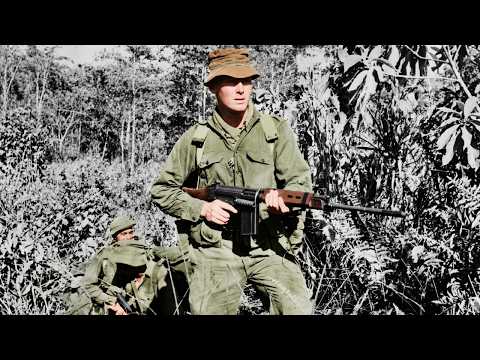
Between 1966 and 1971, the Australian Special Air Service Regiment completed over 1,400 patrols across Vietnam and Borneo. They surveilled more than 5,600 enemy fighters, killed over 500, and achieved the highest kill ratio of any Australian unit in the war. They did it by moving slower than any other unit—so slow it barely registered as movement.
The Australians fought with intelligence, not firepower. The SASR worked from a corner of the Nui Dat base that most of the task force barely knew existed. The question buried in this story is not a history lesson. It is about what a man must become inside himself to be impossible to hear in a jungle someone else has called home for twenty years.
These men did not stumble into that capability. They built it deliberately over a decade, starting in a Perth suburb the rest of the army barely cared about. They proved it in the worst terrain of Borneo before Vietnam had ever heard their name. And they paid for it in ways that never showed up in any document their country was willing to discuss.
Back at the stream, Shaw’s boot is still above the water. Twelve minutes now. The signal has not dropped. Four men are exactly where they were, watching his back, trusting the signal, trusting him. Whatever moved in the trees has not moved again. Shaw does not read that as safety. He reads it as information that needs more time. He waits.
This is what the Viet Cong could not understand. These men were patient in a way that broke the basic rules of how soldiers were supposed to move through a war. Before we can understand what built that patience, we have to go back fourteen years to a barracks in Perth that the Australian army barely wanted to build.
The Australian army did not want to build the SAS. On July 25, 1957, a new unit was created at Campbell Barracks in Swanbourne, a quiet suburb on the far western edge of Perth. It was called the 1st Special Air Service Company. Major W. Gooch was put in charge. He was given 180 men and a set of barracks the rest of the army was not using. Perth was chosen partly because it was a very long way from Canberra—and the men who ran the army from Canberra were not sure they wanted this unit close enough to argue about.
The official history of the regiment calls the SASR the ugly duckling of the Australian army. That phrase was earned. No one in the upper ranks was excited about what Gooch was building. They gave him a patch of ground in Perth and expected very little. Gooch expected more.
The selection process he designed was built to cut anyone who could not work alone, stay quiet under pressure, carry the full weight of a mission on their own back, and make hard decisions without being told what to decide. It was a test of a particular kind of thinking—the kind that does not panic, the kind that can stay completely still for a very long time and find that acceptable rather than unbearable.
In a war fought by large armies making large amounts of noise, Gooch was selecting for men built on a different principle entirely. In 1954, the Australian army had reopened its jungle warfare training center at Canungra in Queensland. It had been rebuilt to prepare soldiers for Southeast Asian service. Officers and men rotated through courses covering navigation in dense terrain, ambush drills, jungle survival, and patrol formations—practiced until they stopped being things a soldier thought about and became things a soldier simply did.
The SASR men went through Canungra. Then they went to Papua New Guinea, where exercises ran under conditions no training ground at home could replicate. Claymore mines in realistic contact scenarios, four-man patrol drills in actual jungle rather than cleared bush. Every piece of equipment secured against rattle before a patrol went anywhere. Pace reduced to something that felt, to a man trained on conventional infantry speed, almost like standing still. These were not techniques from a manual that got forgotten after the exam. They were drilled until they lived in the body rather than the brain.
Major Jim Hughes learned all of this the hard way from the very beginning. He was a short man, slight in the way that hides a particular kind of toughness. He had won a Military Cross in Korea. After Korea, he had gone to Malaya and served alongside the British during the emergency there—the long campaign against Malayan Communist Party guerrillas that British forces called the CTs, short for Communist Terrorists. The Malayan jungle was dense and hot and full of men who had lived in it for years. The British had already learned what happened when you sent large units crashing through that terrain. The CT guerrillas heard them coming. They slipped away. The unit that could not be heard was the one that could fight.
The British SAS had built that lesson into its doctrine, and Hughes absorbed it standing in the same jungle where it had been written. He would spend time after that instructing at the Royal Military College at Sandhurst in Britain. By the time he came back to Australia and took command of two squadron, he had spent the better part of fifteen years learning a single lesson: In the jungle, the soldier who controls noise controls the war. Not the one with the most men, not the one with the most firepower—the one who cannot be heard.
That inheritance ran back through the British SAS, through the Malayan emergency, through everything the Commonwealth had learned about fighting men who treated the jungle as a home rather than an obstacle. The Australian SASR did not invent jungle stealth. They received it from veterans who had earned it in Malaya, and they built on top of it at Canungra, in Papua New Guinea, and in the slow grinding work of turning raw selection candidates into patrols that moved the way the jungle moved, rather than against it.
The first squadron to take all of that and test it for real had already gone by the time Hughes stood in the yard at Swanbourne watching his own men run their final drill before Borneo. One squadron had deployed eleven months earlier. What they found there would change the regiment in ways no exercises at Canungra could have prepared them for.
One squadron flew into Brunei in February 1965. The men had trained for this. They had done Canungra. They had done Papua New Guinea. They had been through selection and through every drill the regiment had built to prepare them. None of it was adequate.
The jungle along the Sarawak-Kalimantan border in northern Borneo is not like any training ground on earth. The heat does not arrive in the morning and ease at night. It sits on a man all day and all night and does not lift. The humidity is so thick that a small cut on a forearm, left unwatched for forty-eight hours, swells and turns. Leeches work through clothing. Sandflies find the gap between boot and sock. Fire ants build nests at exactly the height a man puts his hand when he steadies himself against a tree in the dark. The canopy closes out the sky so completely that the light inside the jungle at midday is the same gray-green as the light at dusk. A patrol of four men moving in single file can close to within ten meters of another group and not see them until both sides are already in contact.
This was the proving ground. The mission was called Operation Claret. The code name was classified and the men who carried it out were sworn to secrecy for years after it ended. In plain terms, it meant this: The SASR was crossing from Sarawak into Indonesian Kalimantan, going up to ten kilometers inside Indonesian territory, gathering intelligence on Indonesian troop movements, and setting ambushes on routes the Indonesian military used to push forces into Malaysian territory. Doing all of it quietly in the political sense as much as the physical one. If an Australian soldier was captured inside Indonesia, it was not only a military problem. It was a crisis between governments. If an Australian soldier was killed inside Indonesia, the body had to come back. No man could be left. A four-man patrol ten kilometers inside a foreign country, no resupply, no quick extraction, had exactly one option when things went wrong: fix it themselves.
The patrols lasted weeks. Everything went on a man’s back. One patrol during one squadron’s time in Borneo ran for 89 consecutive days. That number does not carry much commentary in the records because the men who did it did not think it required any. It was the mission. They did it.
Lance Corporal Paul Denahy did not die in a contact with the enemy. He was on patrol in the Borneo jungle when a rogue elephant attacked him. The wound was terrible. Denahy survived the initial impact, but the injury was severe, and the jungle does not treat severe injuries gently. He suffered for several days. He died. He was the first member of the Australian Special Air Service Regiment to die on active service. Not an ambush. Not a firefight. An elephant.
That detail matters, and not because it is strange. It matters because it tells something about what the SASR was doing in Borneo that no list of patrol numbers can fully carry. The jungle was not a backdrop for the war. It was a participant in it. The heat, the infection, the weight of eighty-nine days on a man’s back without resupply. The animals that moved in the dark outside of sleeping position. All of it was trying to remove him from the equation at the same time the enemy was. Three SASR soldiers died in Borneo. None of them in direct enemy contact. The jungle took all three in its own way.
What the survivors brought back could not be fully written into a debrief and transferred. It lived in the body. In the reflex that made a man freeze before his conscious mind had processed a sound. In the patience that held a four-man patrol in position for two hours after an Indonesian unit had passed fifteen meters away. In the understanding that the only pace the jungle would allow was the jungle’s own. Move slower than it expects. Make less noise than it makes itself. Become as much as four men with weapons and radio equipment can become something the jungle does not need to report.
Back in Australia, Hughes compared what the Indonesian military had reported against what the SASR had documented. The gap between those two accounts was the proof. The Indonesians were losing men to ambushes set on routes they considered secure. Patrols were appearing in areas not posted as threatened. An enemy was moving through their territory and they were not hearing it until the fire started. It was working. And Vietnam was next.
Three Squadron arrived at Nui Dat in June 1966. They settled into their corner of the task force base and started work. The base sat on a low hill surrounded by rubber plantations with dense jungle running in every direction to the horizon. The first Australian Task Force had responsibility for the entire province. That meant knowing where the enemy was, how he moved, and what he was planning before any of it became a firefight. The SASR was built for exactly that kind of knowing.
Phuoc Tuy had been Viet Cong territory for years before any Australian arrived. The VC moved through its jungle the way a man moves through his own house. Base camps in the hills to the north and east, supply routes through the rubber, political networks working through the villages. They understood the province’s rhythms and its sounds. When a threat came, they heard it coming and they moved. That was how they had survived against the Americans and against the first Australian infantry battalions. The jungle was their alarm system. They trusted it. It had never failed them.
The SASR came at this from a different direction entirely. A patrol inserted by helicopter, usually five men, lifted in by Number 9 Squadron RAAF, whose pilots had built a skill for dropping teams into small clearings at treetop height. Fast approach, men on the ground, helicopter gone within seconds. Then the patrol moved off the landing zone immediately to get clear of the noise the aircraft had made, and then it slowed—not to a cautious infantry pace, slower than that. The patrol covered what another unit might cross in an hour across the better part of a full day. They stopped constantly. They listened. They waited. They moved again. A conventional infantry company in the same terrain would have been past that ground before breakfast. An SASR patrol would still be inside it.
That pace produced one thing. The jungle did not hear them.
At task force headquarters, intelligence sergeant George Arthur Gridley was building a picture that most people on the base did not have access to. Service number 15788. His job was to take what the SASR patrols brought back from the jungle and turn it into something commanders could act on. He briefed every patrol before they went out, standing at the edge of the area the men called Kangaroo Pad, going through the latest intelligence on enemy locations and movement. He knew what the patrols were finding. He also knew what the VC were reporting to their own command structure—and what those VC reports were showing had no category in their intelligence system. Australian patrols were appearing in areas that should have been safe. Men from VC units were vanishing without the explanation their comrades could provide. The accounts from fighters who survived SASR ambushes, where any survived, were consistent on one point. They had heard every other enemy in this war before those enemies reached them. The Americans from a long distance. The South Vietnamese with enough warning to respond. The regular Australian infantry better than most, but still detectable. Still giving some signal before contact arrived. The SASR gave nothing. Not less warning than the others. Nothing at all. They were the only soldiers in the war the Viet Cong could not hear before they arrived.
The Viet Cong named this Ma Rong. Forest ghosts. It would be a mistake to read that as any kind of tribute. It was a warning passed through the VC command structure. A formal designation for a threat their defensive system had no counter for. A guerrilla force in the jungle relies on sound as its first line of defense. You cannot see more than a few meters in dense undergrowth. Sound travels further than sight. Post listening positions, know your terrain, and any approaching enemy will announce himself before he arrives. Every force the VC had faced confirmed this. Normal movement produces normal sound. Normal sound trips a listening screen. The SASR produced neither.
By late 1967, the VC’s freedom of movement across Phuoc Tuy province had narrowed. Not because of artillery or air strikes, but because the knowledge was spreading through their networks that certain parts of the jungle were no longer reliable. The alarm system they had trusted for twenty years was failing, and the men who had trusted their lives to it were paying for that in ways that did not show up as battle contacts.
Major Reginald Beasley took Three Squadron into its second Vietnam tour from February 1969. One of the first things he did on arrival was walk up to the boards where previous squadrons had tallied enemy kills and knock them over deliberately without a long explanation. His message was the same message the patrol technique had been delivering for three years. The point was not the bodies. The point was the knowledge. Not the sound of the firefight, but the absence of sound before it. Those boards measured the wrong thing, and Beasley made sure his squadron knew it.
The intelligence those patrols were building root by root through the hills to the northeast of the province was pointing towards something that would only become visible months later. The enemy moving through the May Tao mountains believed he was invisible. He was being watched by men he would never hear.
The Americans noticed first. In 1967, the United States military was the largest and most powerful force on Earth—more men, more aircraft, more artillery than any army in history had concentrated in one theater. And what their Special Forces community saw watching the SASR work out of Nui Dat was something they did not fully have themselves.
The request came through official channels. The SASR was asked to send instructors to the United States Long Range Reconnaissance Patrol School in Vietnam. American personnel came the other way, out into Phuoc Tuy alongside SASR patrol teams. Not to lead. To watch.
What they watched was pace. A patrol moving at a speed that felt, to any soldier trained on conventional operations, like it was barely moving at all. Hand signals passing down a column of five men without a word. The patrol freezing as routine, not reaction. Every piece of equipment taped against rattle. The American observers had come expecting to watch a technique. What they were watching was a culture.
The Viet Cong adapted in the ways available to them. More observers pushed into the jungle. Listening positions extended. Their own small-team patrols sent to locate Australian insertions before they went deep. None of it closed the gap. You cannot post a listening screen against an enemy that produces no sound above the noise the jungle already makes on its own.
There is a woman who appears in the official documentary history of the regiment, launched by Governor-General Sir Peter Cosgrove at Government House in 2015. She was a member of the Viet Cong during the war. Decades later, she speaks on camera about what fighting the Australians was like. She does not talk about the B-52 bombers. She does not talk about the artillery or the gunships. She says, “We were not afraid of the American GIs, Australian infantry, or even B-52 bombing.” And then she says, “We hated the Australian SAS Rangers because they make comrades disappear.”
She uses that word. Disappear. Not killed in contact, not captured—disappeared. A patrol goes out and does not call in. The jungle gave no warning. It was as if the men had walked into a part of the province that had simply taken them.
Five days after Shaw froze above that stream crossing in July 1967, he climbed into a helicopter at a small clearing in Phuoc Tuy province. The aircraft lifted. Below him, the canopy closed back over the place where his patrol had spent the better part of a week. The jungle looked unchanged. It always did. The SASR left no trace. They had been there and they were gone, and the jungle would tell no one what it had seen.
The Ma Rong designation did not come from one incident. It built across months of operational contact, across report after report filtering up through the Viet Cong command structure. Each one carrying the same description of the same absence. No sound of approach. No warning from the jungle. No time to respond.
David Horner documented it in his official history of the regiment, drawing directly from patrol reports and participant interviews held at the Australian War Memorial. The name was not a translation error and it was not informal slang. It was a formal operational classification. It meant: this enemy cannot be detected by sound. Adjust your assumptions accordingly. The problem was there was no adjustment adequate to the situation.
Every defensive adaptation available to a jungle-based guerrilla force depends at its foundation on the assumption that an approaching enemy will produce detectable sound. Extend your listening screen. Post more observers. Place noise makers on your approach routes. These all work against an enemy who moves at walking pace and makes the sounds a walking man makes. Breathing harder on an incline. Shifting weight on soft ground. A weapon catching the dark. Normal movement produces normal sound. Normal sound can be detected. The SASR produced neither.
They had not simply suppressed the noise of movement. They had replaced the concept of movement with something else. The patrol pace Gridley briefed against before every mission—the pace American observers came to Nui Dat to watch and could not fully believe—was not slow movement. It was becoming part of the ambient sound of the jungle, rather than a disruption of it. Wind in the canopy, animals in the understory, water over rock. The SASR moved within that noise, rather than above it. The VC’s listening screens were built to detect something foreign entering the forest. The SASR gave them nothing foreign to detect.
That is the complete answer to the question this story opened with. The Viet Cong could not hear the SASR because the SASR had rebuilt what moving through jungle meant. They moved like the forest moved, and the Viet Cong named them accordingly.
The intelligence those silent patrols had accumulated by late 1969 eventually produced something visible at a large scale. Beasley’s second tour patrols had spent months inside the May Tao mountains in the northeast of Phuoc Tuy province, walking ground that aircraft reconnaissance could not reach and artillery could not cover. They mapped the VC positions there with a precision no other intelligence source had been able to provide.
At the start of December 1969, the Anzac battalion 6RAR/NZ mounted Operation Marsden, a month-long clearance of those mountains. The operation ran from the 1st to the 28th of December. The Australian War Memorial record of Three Squadron’s operations states the outcome plainly: the operation’s success was a direct result of information gathered from SAS patrols. The clearance force destroyed a major VC hospital complex, captured approximately one and a half tons of pharmaceuticals—the largest single seizure of its kind by Allied forces in the entire war—and dismantled a stronghold the VC had held for years.
Five men at a time, moving slower than anyone had thought an effective patrol could move, had handed a battalion commander a picture of an enemy position that was accurate enough to fight from.
The Americans had more of everything. More men, more aircraft, more artillery, more money, more technology, more logistical capacity than any military force in history had ever concentrated in one theater. They had special forces units that were genuinely excellent. They had their own long-range reconnaissance capability being built further with help from Australian instructors. They could not replicate what the SASR was doing in Phuoc Tuy province. Not because they lacked the courage or the equipment or the training. Because what the SASR was doing was not a technique at that point. It was a culture. Built over a decade in a converted barracks in Perth. Refined in the worst terrain Borneo had. Tested against the most experienced jungle guerrillas in the world. Confirmed by the only judgment that matters in the end: the enemy’s own.
The intellectual answer to this story’s title is now in the open. But the question the story has been building toward is different. It is not what these men could do in the jungle. It is what it meant to carry that home to a country that had not thought much about them when they left.
Jim Hughes came back from Malaya carrying something a classroom could never have given him. He had spent years in jungle the British called bandit country, hunting men who had grown up in it. He had learned the difference between the sound the forest made when it was undisturbed and the sound it made when something that did not belong was moving through it. He had learned patience in the way the jungle teaches it, which is by punishing every soldier who does not have it. Immediately and without sympathy. He brought that knowledge to Korea, then to Sandhurst, then to the regiment at Swanbourne, where it became the foundation of what Two Squadron of Australian soldiers were trained to do.
Without that thread, the SASR that arrived in Borneo in 1965 is a different unit. The CT guerrillas the British had hunted through the Malayan jungle in the 1950s and the Viet Cong who gave Australian soldiers a ghost name in the 1960s were a decade and a thousand kilometers apart. The lesson they taught was identical. The jungle belongs to the soldier who moves quietly enough that the jungle forgets he is there. Hughes understood that before almost anyone else in the Australian army did. His story is not a single dramatic moment. It is fifteen years of knowledge carried from theater to theater and rank to rank, handed to the regiment at exactly the moment the regiment needed it most.
Alongside every Australian SAS squadron that rotated through Vietnam, there was a troop of New Zealand SAS soldiers. One troop attached to each Australian squadron for the full duration. They patrolled the same jungle, moved at the same pace, froze on the same hand signals, and earned the same name from the same enemy. The Ma Rong designation covered the patrols, and the patrols were always trans-Tasman. The NZ SAS troopers who held those freezes above those stream crossings, who came out of the same extraction clearings with the same intelligence, are part of what the Viet Cong could not hear. That detail tends to get swallowed in the broader account. The men who were there did not lose it.
Reginald Beasley came home from his second Vietnam tour in late 1969 and did not talk much about what he had done there. This was not unusual. Most of the men who served in the SASR through the Vietnam years came home and kept what they had done largely to themselves. Some kept it entirely to themselves. The work had built the habit of saying nothing into them long before the homecoming. The classification orders, the sworn secrecy around Operation Claret, the years Borneo had been off the public record—all of it had reinforced the discipline that selection had started.
Beasley had kicked over the kill boards at the start of his tour because he knew what the regiment was actually for. He came home with that understanding intact and with very little that the country around him could see or measure.
There is something worth sitting with in the woman who gave the SASR their clearest public acknowledgement. The former Viet Cong fighter who spoke on camera in the official documentary was not an institution, not a government, not an anniversary ceremony. She was a soldier who had spent years trying to survive against these men, and decades later she sat in front of a camera and said what they had done to her unit’s confidence in the jungle. She had no obligation to say it. She had nothing to gain from it. She said it because it was true and because the truth of it had stayed with her the way things that genuinely frightened you tend to stay. That her voice was the clearest on record acknowledging what the SASR had built tells you something about what the other voices were doing. She named them, and Australia took much longer to find the same words.
David Horner published his history of the Australian Special Air Service Regiment in 1989. The book was called SAS: Phantoms of the Jungle. It was built from patrol reports at the Australian War Memorial and from interviews with the men who had run those patrols. It became a best seller. In 2002, it was updated and published again as SAS: Phantoms of War. It sold again. The regiment it described had last deployed from Vietnam in October 1971. Horner’s first edition came out eighteen years after that departure. Eighteen years during which the story had sat in classified files and in the minds of men trained not to speak, who had kept that training faithfully. Eighteen years is a long time to wait for a country to look at what it sent and ask what happened.
The men who came home from Vietnam in the late 1960s and early 1970s did not receive parades. The public conversation about the war had curdled well before the last units returned. There were protests and organized hostility directed at men in uniform. A political environment had decided the war was wrong and extended that judgment in many cases to the men who had fought it. The SASR soldiers came home into all of that carrying a weight the protesters could not have named even if they had wanted to. They came home carrying Borneo classified for years. They came home carrying patrol reports that could not be discussed. They came home with the full knowledge of what they had done in Phuoc Tuy province—the intelligence gathered, the ambushes sprung, the eighty-nine-day patrols, the ground they had walked in the May Tao mountains before anyone sent a battalion in. They carried it the only way they knew how. Without asking anyone to notice.
In September 2015, Governor-General Sir Peter Cosgrove stood at Government House and launched the documentary series The Australian SAS: The Untold History. It covered the regiment from its founding in 1957 through to operations in Afghanistan. It included veteran interviews, archival footage, and testimony from people who had faced these men across the wire. It was made available through the Australian War Memorial and later on streaming. That event was the closest thing to formal national acknowledgement the men of the Vietnam-era SASR had received. Some of them were old by then. Some were gone. The men who had frozen above stream crossings in Phuoc Tuy in 1967 were in their seventies. The men who had carried an eighty-nine-day patrol on their backs through Borneo were older still, those who remained. The recognition had come late and earned entirely on the regiment’s own terms—not through lobbying or public campaigns, but through the simple weight of a record that was impossible to argue with once anyone looked at it.
More than 1,400 patrols. More than 5,600 enemy fighters surveilled. More than 500 enemy killed. The highest kill ratio of any Australian unit in the Vietnam War. A clearance operation in the May Tao mountains in December 1969 that succeeded because five-man patrols had mapped that stronghold in silence for months, walking ground aircraft could not photograph and artillery could not reach. Those numbers do not belong to a unit that was a lucky accident. They belong to something that was built deliberately at some cost by men who expected very little reward for it and received about that much.
The regiment that produced all of that had started with 180 men and a converted barracks in Perth that the rest of the army had not much wanted to think about. It was handed to a major who expected more than anyone around him expected. It was proven in the worst jungle Borneo had before it was anywhere near ready. It was watched by the most powerful military on Earth, which could not fully replicate what it was doing. And it was named by the most experienced jungle guerrillas on Earth, who could not detect it until it was already too late.
Both things in this story are real. The excellence was real. The silence that surrounded it when these men came home was also real. One does not cancel the other, and neither should be spoken of quietly when there is an audience to tell.
The Viet Cong named the regiment after ghosts because a ghost cannot be heard coming. Because a ghost is already beside you before you know it arrived. Because the jungle, which the Viet Cong had trusted for twenty years to keep them safe, had produced something it could not warn them about. That name is now the title of the regiment’s official history. And it is in this story. And it will outlast every person who appears in it.
A soldier who masters silence as a weapon finds, when the war is over, that silence does not stop at the tree line. The patience that held a boot above a stream crossing for eleven minutes while something moved in the canopy ahead came home to Perth and Brisbane and Sydney and sat in lounges in civilian clothes, saying very little, waiting for someone to ask the right question.
The jungle forgot they were there. For a long time, so did we.
If this story deserves a wider audience, share it with someone who has never heard the name Ma Rong. And tell us—should a nation measure what it owes its quietest soldiers by the noise they made, or by the silence they kept?
Report this article
Select a reason for reporting:






