February 1942. The transport ship groaned as it docked, and the Japanese women prisoners filed onto Australian soil, clutching small bags and bracing for the worst. They had been told the enemy was soft, primitive, barely a real country—a backward land of convicts with no factories, no military, nothing worth fearing. But as they stepped into the blinding sunlight, the world they knew began to crack.
“Where does all this power come from?” one nurse whispered, counting 47 electric poles along just the camp perimeter. She had seen nothing like it in Tokyo.
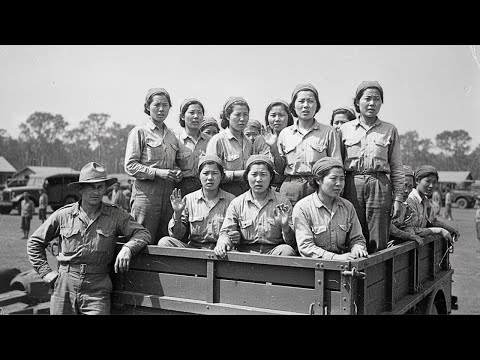
The port was massive—concrete piers, towering cranes, warehouses of steel and brick. Trucks rolled past in endless identical columns, all new, all military green. The women pressed their faces to the bus windows as paved roads stretched smooth into the distance, lined with hundreds of electric poles. Factories pumped thick smoke into the sky. This was not supposed to exist.
They arrived at Tatura Internment Camp Number Three, a fenced compound with guard towers and rows of white barracks. Inside, electric lights hung from the ceiling. Real bulbs behind glass covers. Mako Yamashita, a nurse trained to observe, turned a faucet and gasped as warm water flowed. “Running water, hot and cold, in a prison camp for enemies,” she murmured.
Dinner shattered everything. A thick slice of bread with real butter, boiled potatoes, carrots, and lamb stew with chunks of meat floating in gravy. Mako estimated the meat alone weighed 170 grams—more than her entire family ate in a day back in Tokyo. “Is this real?” whispered Ko Matsumoto, touching the meat as if it might vanish. Another woman cried silently as she ate.
The next morning brought more impossible discoveries: a hospital with an X-ray machine, a kitchen with six gas stoves and three electric refrigerators, a laundry with machines that processed 180 kilograms of laundry per hour. In Japan, only the biggest city hospitals had such equipment. Here, it was for prisoners.
Every week brought new shocks. Red Cross volunteers arrived with parcels—wool, soap, chocolate—donated by Australian families whose sons were fighting in the Pacific. “She gives me gifts while her son fights my people,” Ko wrote in her diary. “What kind of power is this?”
Through the wire fence, the women counted military trucks rolling past—32 on Monday, 28 on Tuesday, 41 on Wednesday. All identical, all new. In Japan, each truck was precious, often ten years old. Here, they moved like fish in a school.
Christmas Day 1943 broke them. A special meal: roasted turkey, 340 grams per person, potatoes, vegetables, plum pudding, and ice cream—real vanilla ice cream, 50 grams per person. The women sat in silence, staring at their plates. Then someone started crying. “We are prisoners. We are enemies. Our soldiers may have killed their sons, yet they feed us like honored guests,” Ko whispered.
That night, Sachiko Tanaka lay in her bunk, thinking. In Japan, they were taught that sacrifice was strength, that going without food showed Japanese spirit. But Australia had so much that it could be generous even to enemies. “We confused necessary poverty with chosen strength,” she wrote. “They measured power in surplus. We lost because we never understood what we were truly fighting against.”
The women kept their diaries hidden, but the numbers they recorded could not be hidden from themselves. Each month Mako tallied the Red Cross parcels—42 in January 1944, 45 in March—and each month the total climbed. In April a dentist arrived and fixed thirty-one prisoners’ teeth for free. In May new wool blankets replaced the worn ones, two per woman. The arithmetic was relentless, and it pointed only one direction.
They began to measure their own country against the camp. Back home, a family of four shared 900 grams of rice for a single meal, if they were lucky. Here, each prisoner received nearly 700 grams of food at dinner alone, with meat and butter and fresh vegetables. “Numbers do not lie,” Sachiko wrote. “We called them soft, and they fed us better than our own government feeds its loyal citizens.”
By the summer of 1945 the war had turned. The women heard the guards speaking in lower voices, saw the trucks passing in even greater numbers. Then, in August, the camp administrator gathered them in the dining hall and read a brief announcement in a flat voice.
“Japan has accepted the terms of surrender,” he said. “The war is over.”
No one spoke. The electric lights hummed overhead as they always had. The women looked at one another, searching for anger, for shame, for relief—and found all three tangled together. Mako felt her hands tremble and pressed them flat against the table. Outside the window, the water tower stood against the blue sky, exactly as it had on the day she arrived.
Nothing changed in the camp. The guards remained polite and distant. The food kept coming. The electricity stayed on. It was as though the war had been a storm that passed over the fence without touching them. But in the world beyond, everything had changed, and they knew that soon they would have to walk out through those gates and see it.
Repatriation began in November. The women packed their few belongings—clothes now carefully washed and mended, knitted items made from donated wool—and lined up for the transport buses just as they had three and a half years earlier. As the bus pulled away, Mako looked back through the rear window at the white barracks with green trim, the electric poles marching along the fence, the water tower tall against the sky.
Part of her was glad to leave. Part of her was afraid of what she would find at home. She had heard rumors—terrible rumors—that American bombs had erased entire cities, that millions were homeless, that there was no food anywhere. Some women worried their families might be dead. None of them spoke of it aloud.
The ship moved slowly across the ocean, wary of mines still drifting in the water. The women were no longer prisoners exactly, but they were not free either—people being sent back to a defeated nation. Mako stood at the rail for hours, watching the gray water, rehearsing what she would say to her parents. She had written letters, but the censors had cut them down to almost nothing. She did not know if her family was alive.
In January 1946 the ship docked near Hiroshima. Mako stepped onto Japanese soil for the first time in almost four years, and then she stopped walking and stood very still.
The port was not damaged. It was destroyed. The concrete piers were cracked and broken, the warehouses reduced to piles of rubble, the cranes twisted into metal skeletons. Everything was gray—gray ruins, gray dust, gray sky. Even the people looked gray, thin shadows drifting through the wreckage like ghosts.
Someone at the port told her not to go into the city. They said there was nothing left. They used a word she had never heard before. They said an atomic bomb had been dropped. One bomb that destroyed everything.
She went anyway. She had to know.
She walked for hours through streets that no longer existed. She recognized nothing. Her childhood home was gone—just burned foundations and scattered bricks. A neighbor who had survived was living in a shelter of sheet metal and wood scraps. The neighbor told her, gently, that Mako’s parents and younger sister had died instantly when the bomb fell. They had not suffered. They were simply gone, turned to ash in a moment.
Mako sat down on a chunk of broken concrete and cried. She cried for her family, for her city, for her country. But somewhere inside the grief was another feeling she could barely admit to herself. The Christmas dinner in Australia kept returning—the 340 grams of turkey, the ice cream, the abundance. Japan had gone to war against nations that could do this. Nations that could build a bomb that ended a city with a single explosion. Nations with so much industrial power that they could spare ice cream for prisoners while building weapons that ended the world.
She thought of the 47 electric poles. The six gas stoves. The trucks rolling past in endless identical columns. And she understood, at last, the full weight of what the camp had been trying to teach her.
Ko Matsumoto returned to Yokohama to find her house still standing but scarred—roof tiles missing, windows broken. Her husband and two children had survived. When she walked through the door, they stared at her as if she were a ghost. Her daughter was nine years old but looked sick, small and fragile after too many years of too little food.
That night the family shared a meal: 180 grams of rice mixed with barley to stretch it further, some pickled radish, and miso soup so thin Ko could see the bottom of the bowl. This was dinner for four people. She thought of the meals in the prison camp—the portions she had sometimes left unfinished because she was full. She had thrown away more food in one week as a prisoner than her family had eaten in a month here at home.
Her husband asked what the Australian camp had been like. He asked if they had treated her cruelly. Ko did not know how to answer. She said no. They had not been cruel. He nodded and said he was glad she had survived, and did not ask more questions. Ko was grateful. How could she tell him the truth—that she had eaten better as an enemy prisoner than he and their children had eaten as loyal Japanese citizens?
Years passed. Japan slowly rebuilt. American occupation brought food and medicine, democracy replaced the old military government, children went back to school, factories opened again. Ko watched her children grow up in a different Japan than the one she had known. They learned English, ate bread and butter, listened to American music on the radio. Sometimes she wondered if this was better or worse. Different, certainly—but maybe necessary.
In 1968 her daughter asked her to tell stories about the war for a school paper on family history. Ko hesitated, then decided to tell the truth. She described the prison camp, the food and electricity and machines, the Christmas dinner with ice cream. Her daughter listened with wide eyes and then asked why Japan had fought against nations so much stronger.
“Because we did not know they were stronger,” Ko said. “We were told sacrifice made us superior. We were told they were soft and weak. We were told we would win because our spirit was pure.”
Her daughter asked what her mother had learned from being a prisoner. Ko thought carefully before answering. “I learned that real power is not soldiers willing to die. Real power is a nation that can be generous to enemies while winning. We measured strength in sacrifice. They measured it in surplus. We lost because we never understood what we were truly fighting against.”
Sachiko Tanaka kept all her diaries from the camp in a wooden box in her closet. In 1982, at sixty-eight, she published them as a book called Lessons from Barbed Wire. One passage became famous, quoted by teachers and memorized by students: “I learned more about war’s reality in an Australian prison camp than in all my years of school. Real power is not about who is willing to suffer the most. Real power is about having so much that you can afford to be kind even to enemies. We thought abundance made nations weak. We were wrong. Abundance made them strong enough to show mercy.”
Most of the women never spoke publicly. They lived quiet lives, raised children, grew old like everyone else. But they remembered. They remembered the 47 electric poles and the six gas stoves and the three refrigerators. They remembered the trucks rolling past in endless identical columns. Most of all, they remembered the ice cream on Christmas Day—50 grams of vanilla that taught them more about power than any battle or bomb ever could.
That was the real lesson. Not that Australia had military power, though it did, but that its power was so great it never needed to show all its strength. So great it could feed its enemies better than Japan fed its own people. So great it could win a war and still treat prisoners with basic human dignity. That was the kind of power Japan had never understood—and by the time these women learned the truth, it was already far too late.
But the question they carried home, and the one they handed down to their children, was never fully answered: if a nation measures its strength by how much it can sacrifice, what happens when it finally meets a nation that measures strength by how much it can spare?
Report this article
Select a reason for reporting:






