The night was ink-black, the kind that swallows sound and hope alike. On a coral ridge a mile south of Henderson Field, roughly 800 exhausted Marines—Raiders and paratroopers—crouched in holes scraped from rock so hard their shovels bent. They were half-starved, riddled with malaria, and down to two meals a day of captured rice. Below them in the jungle, nearly 3,000 Japanese infantry, veterans of China and the Philippines, crept upward with orders to take the airfield by dawn and throw the Americans into the sea. By every number that mattered, the ridge should have fallen that night. It did not. And the thing that saved it was not the rifles on the hill or the courage of the men holding it. It was 12 guns sitting a mile behind the line.
What their crews did that night should not have worked. By morning, it had killed hundreds and saved the campaign. The Japanese were not surprised the Marines had artillery—any soldier knew the perimeter had guns. What no one on Kawaguchi’s side imagined was how those guns would be used. Edson had a forward observer dug in right up in the front line with a telephone wire running back through two switchboards to the gun pits a mile behind. That wire meant one man lying in the grass could watch where the Japanese were massing, speak a correction into a handset, and seconds later the shells would fall where he said. And Edson was willing to call them in almost on top of himself. By the second night, the observer was dropping fire within 200 yards of his own Marines. Later in the fight, shells were landing 75 yards in front of the line. That is close enough to feel the heat of your own artillery on your face. Close enough that one short round would kill the men it was sent to protect.
To understand that night, you have to understand the airfield. When the Marines came ashore on Guadalcanal on the 7th of August, they captured a half-finished Japanese airstrip near the coast. They named it Henderson Field after a Marine pilot killed at Midway. That strip of dirt became the most important piece of ground in the South Pacific. The reason was geography. Any warship caught within about 200 miles of Henderson in daylight could be found and bombed by the planes flying off it. So, the Japanese could only move men and supplies to the island at night in fast destroyers the Marines nicknamed the Tokyo Express. Whoever held the airfield owned the daylight. Whoever owned the daylight owned the campaign.
The field itself was barely a field. Black dust when it was dry, black mud when it rained. Fuel hand-pumped out of drums. Planes patched together from wrecks. Lose it and the whole position on the island came apart. The planes flying off it were already biting. In the weeks before the battle, Marine dive bombers caught Japanese destroyers running the slot and sent one to the bottom with dozens of Kawaguchi’s own men aboard. And they tore apart a barge convoy carrying another of his units. Every soldier Tokyo sent toward that airfield had to run a gauntlet of aircraft first.
Tokyo decided to take it back anyway. The job went to Major General Kiyotake Kawaguchi and his brigade, troops who had already taken Borneo and swept through the southern Philippines. Kawaguchi landed east of the Marine perimeter and began cutting a trail inland through the jungle, meaning to come at the airfield from the south through the back door in the dark. The back door was a ridge. It ran like a spine up through the timber, grass along the top, heavy jungle down both flanks pointing straight at Henderson Field.
The Marine commander, Major General Alexander Vandegrift, did not have enough men to wall off the whole perimeter. The inland side was held by scattered strong points and a lot of empty jungle. The ridge was the loose seam in the line. The man who saw it first was Lieutenant Colonel Merritt Edson. Part of what the Marines knew, they owed to a man who had never left. Martin Clemens was a British colonial officer who stayed behind on Guadalcanal when the Japanese came, living in the hills with a handful of Solomon Islander scouts and a radio. His scouts watched the trails and counted the enemy, and it was their reports, drifting in from the bush around Taivu, that helped point Edson toward Kawaguchi’s base.
A week before the battle, Edson took his raiders on a raid. On the 8th of September, they landed near Taivu Point behind the Japanese and walked straight into Kawaguchi’s rear supply base. They overran field guns firing at point-blank range, called in a strafing run, and burned the place to the ground. They lost two men killed doing it. But the real prize was paper. In the camp, they found stacks of documents and a radio set. The translations told a story nobody wanted to hear. At least 3,000 Japanese troops were already in the jungle moving toward the airfield.
Edson walked the ridge after that raid. He looked at the grass, the timber, the open approach, and he told his officers this was the ground. This was where they would come. So, he moved his men onto it. And the men he moved were running on fumes. The Raiders had fought on Tulagi in August and raided Tasimboko days before. The paratroopers attached to them had been cut to pieces taking a little island called Gavutu. The whole division was down to two meals a day of captured rice. Malaria and dysentery were working through the ranks. One Raider company had shrunk to the size of a platoon. These were the men. Roughly 800 of them all told, Raiders and paratroopers under one commander. That was everything standing between Kawaguchi and Henderson Field.
Edson himself was not a loud man. Marines called him Red Mike for the red beard he had grown years earlier chasing bandits in Nicaragua. He had already won two Navy Crosses. He spoke quietly, almost flatly, and he had a way of standing straight up under fire that men remembered for the rest of their lives. His line on the ridge was thin. He bent it back off the forward slope and anchored it on the high knob near the north end, a hump of coral the maps marked as Hill 123. There was almost no barbed wire. The coral was too hard to dig into. When the shovels hit rock, men scraped out what little cover they could and waited.
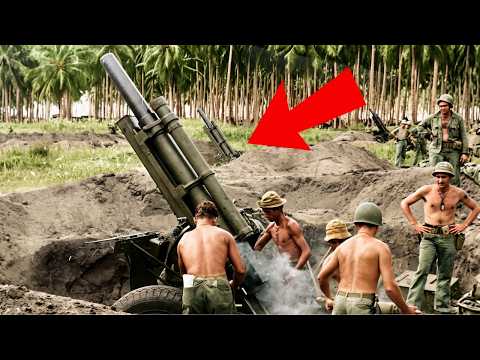
But Edson had one thing Kawaguchi did not. A mile behind the ridge sat the 5th Battalion, 11th Marines. 12 howitzers, each one throwing a shell 4 in across. The 105 mm gun was not glamorous. It never made a magazine cover. What it did was drop a 33-lb shell on a map coordinate from miles away over and over as fast as a crew could feed it. Point that at a slope packed with men in the open and the slope stops being a slope and becomes a killing ground.
Kawaguchi had guns, too. Better guns in some ways, but he had left them behind. They could not be dragged over the jungle trail he had cut. So, his artillery sat miles away by the beach while his infantry walked toward the ridge with rifles, grenades, and bayonets. He also turned down the offer of an extra battalion. He believed he was facing about 2,000 Americans. There were closer to 12,000 on the island.
The first blow came on the night of the 12th. A Japanese float plane the Marines called Louie the Louse droned overhead and dropped green flares. A cruiser and three destroyers offshore opened up and walked their shells across the ridge. A searchlight swept the grass. Most of the naval fire sailed clean over the high ground and some of it came down on Kawaguchi’s own infantry. He had wanted set and ready by the middle of the afternoon. They stumbled clear of the trees hours late, strung out and lost, and his order to hold off never reached the men already moving.
Then the infantry came out of the timber. They hit the Raider company down in the low ground between the ridge and the river. In the dark, the Japanese overran a platoon, took several machine guns, and cut the company into pieces. The Marines fought their way back up to the ridge in the black, steering by muzzle flashes and shouting. And then, the attack came apart on its own. In the same jungle that had hidden them, two Japanese battalions lost each other, got tangled in the dark, and the assault died before it reached the knob. Kawaguchi, somewhere back in the timber, had lost control of his own brigade almost from the first minute. Later, he wrote the most honest line any commander ever wrote about that jungle. In my whole life, I have never felt so disappointed and helpless.
Dawn on the 13th showed Edson what was coming. He pulled his whole line back several hundred yards and tightened it into a horseshoe around Hill 123. Now, any attacker would have to cross open grass to reach him. Late that afternoon, he walked the line and gave his worn out men the plain truth. One more night. Hold one more night and relief would come in the morning. Then, he went to work on the only real advantage he had.
The title promises a secret weapon. The truth is better than that. The Japanese were not surprised the Marines had artillery. Any soldier knew the perimeter had guns. What no one on Kawaguchi’s side imagined was how those guns would be used. Edson had a forward observer dug in right up in the front line with a telephone wire running back through two switchboards to the gun pits a mile behind. That wire meant one man lying in the grass could watch where the Japanese were massing, speak a correction into a handset, and seconds later the shells would fall where he said. And Edson was willing to call them in almost on top of himself. By the second night, the observer was dropping fire within 200 yards of his own Marines. Later in the fight, shells were landing 75 yards in front of the line. That is close enough to feel the heat of your own artillery on your face. Close enough that one short round would kill the men it was sent to protect. That was the thing nobody warned Kawaguchi’s infantry about. It was never the guns themselves. It was the nerve to use them that way.
Night came down on the ridge again on the 13th. No moon. Around 9:00, the ships offshore shelled the high ground one more time. Then Kawaguchi’s main body came on, and this time nobody got lost. The battalions went straight at the horseshoe. The first rush hit the raider company on the right near the swampy ground by the river and drove it back. Some of the Japanese pushed on past into the low ground behind the line, and then they stopped to eat. They had been in the jungle for days with almost nothing in their stomachs, and they had just overrun American ration dumps. So, men paused in the middle of a night attack to tear open cans of food.
They paid for that pause. The forward observer on the ridge watched them cluster and spoke into the handset. **The first salvo landed among the ration dumps and the men eating from them.**
Up on the nose of the ridge, the enemy gathered and made noise—chanting, firecrackers, officers calling cadence. Then the flares went up, and the guns answered. **Every signal rocket became an aiming stake.** The crews laid their fire on the spot the flare marked, then did it again, all night long.
Before it was over, those 12 guns fired 1,992 rounds. A paratrooper said the gunners seemed to be trying to burn out their barrels.
Around 10:00, a dozen guns came down square on Major Tamura’s assembly area. He sent his men up the slope anyway. On the left, the paratroopers gave ground, shells falling closer and closer to their own holes.
Then somebody screamed gas, and men who had thrown their masks away panicked. Some dropped their weapons and drifted back, repeating one word: **”Withdraw.”**
Edson stood up. **”Nobody moves. Just die in your holes.”** Men said if one man held that battalion together, it was him—standing when everyone else was flat in the grass.
Around midnight, Captain Harry Torgerson fixed bayonets and led two companies straight back into the Japanese to retake the left. Edson called that counterattack a decisive factor in the whole fight.
In the small hours, ammunition ran out. Cooks and clerks carried grenades forward by hand. Where the waves reached the holes, it came down to bayonets and fists in the dark.
Around 3:00, Major Kukusho led one last charge at the knob and died there with about a hundred of his men. At 4:00, fresh Marines from a reserve battalion came up the ridge and helped beat back two more assaults before the light.
A little after 1:00 that afternoon, Kawaguchi gave the order he had never imagined giving. **Fall back.**
The ridge had held. Roughly 800 Marines with 12 guns behind them had stopped a force more than three times their size. The Marines counted close to 500 Japanese dead; Edson’s battalions had lost fewer than 60.
Kawaguchi’s retreat was worse than the battle. Of the roughly 500 wounded, few lived. When word reached the Japanese 17th Army, it was the first time in the war a force that size had been beaten. Troops pushing on Port Moresby were ordered to stop and pull back. The little island had begun to pull the whole Japanese war effort down onto itself.
Edson took over a regiment and fought on through the war as a general. Bailey never got the chance—killed along the Matanikau barely two weeks later. Both received the Medal of Honor; Bailey’s after his death.
The correspondents called it Edson’s Ridge. The men who held it called it Bloody Ridge. To this day, young Marines finishing training climb a hill and stand while Edson’s citation is read aloud before they earn the right to call themselves Marines.
Go there now, and it is quiet grass again, with a stone marker where the knob used to be. Stand on it in the dark and it is hard to picture 800 worn-out men, 3,000 coming out of the jungle, and a mile back in the blackness 12 guns firing so close to their own that the men on the hill could feel the heat of the shells meant to save them.
By every number that mattered, the ridge should have fallen. It did not.
**So tell me—if you had been lying in that coral hole, hearing the chanting rise out of the dark, would you have stayed?**
Report this article
Select a reason for reporting:






