In the winter of 1895, deep inside a Tennessee coal mine, a pickaxe struck something that should not have existed. Amos Rutled, a coal loader working 1,400 feet into the Number Three drift of the Breeville mine, felt the jarring impact travel up his arm. It wasn’t rock. It wasn’t a rail. It was iron—and it was buried inside a seam of coal that had been sealed for 300 million years.
What emerged from that black wall would take six men to lift. It was an axe head, but no axe head ever made for human hands. It measured 34 inches from tip to heel, its cutting edge 26 inches long, and the eye where a handle would pass was wide enough to swallow a man’s fist. When placed on the company scale, the needle read 310 pounds.
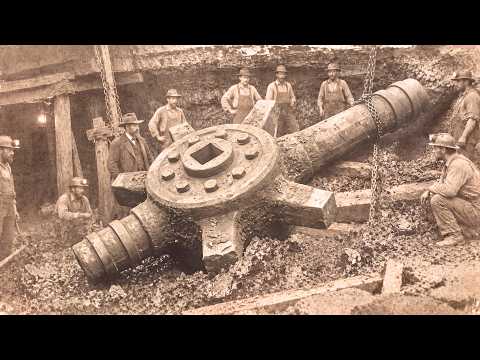
The foreman, a meticulous man named Hyram Stokesbury, recorded every detail in his daybook—including one line that would haunt the story for over a century: the blade faced west. No one records the orientation of scrap iron. Why would he write that?
Two months later, the drift was walled up with stone. The axe vanished into a company warehouse, and the newspaper story that followed omitted the strangest part: that the object had been found inside the coal, not in a tunnel or crevice. The official record closed the case.
But 43 years later, on the other side of the mountains, an 81-year-old Cherokee man who had never seen the axe and could not read English described it to a government interviewer. He said where it had been left, which way its blade was turned, and who had left it. “A cutting tool,” he called it. “A thing for cutting trees.” He spread his arms to show its width. He said it was left inside the black rock—the burning rock—so that one day people would see how small their own hands are.
The Cherokee knew. And their story had been waiting long before Amos Rutled’s pick struck iron.
To understand why that axe should not have been there, the valley has to be understood first. Because Cole Creek wasn’t just an ordinary mining town. It was a place where the coal seams cut through the hillsides like black veins, exposed on the bare rock, and where the first settlers had written of coal showing in the creek bed itself.
The railroad arrived, and the companies followed. The towns of Bryceville and Cole Creek grew—wooden houses and company stores clinging to the mountainside. The mines here were not vertical shafts but drifts: horizontal tunnels dug straight into the mountain, following the seam inward. Some ran a mile deep. The only light came from lanterns. The only air was a cold draft pushed in from the entrance. Coal was loaded into cars by hand and hauled out by mules.
These seams are not young. Geologists date the coal of the Cumberland Mountains to the Pennsylvanian period, roughly 300 million years ago. Back then, warm swampy forests stood where these mountains now rise. Trees fell, mud covered them, and the weight, heat, and passage of time turned that forest into black rock. A coal seam is a kind of sealed book. Nothing enters it afterward. If it does, it leaves a trace—a crack, a waterway, a collapse.
That is a number worth holding on to: 300 million years. Because the axe head was not lying against that rock. It was inside it.
The Number Three drift had opened in 1888. Within seven years, it had advanced more than half a mile into the mountain. A coal loader’s job was simple and brutal. The miner dug beneath the seam. The shot firer set the powder. When the coal came down, the loader shoveled it into the car. Pay was by the car, not by the day. The fuller the car, the more the family ate.
That morning, six people were working at the far end of the Number Three drift. Two pick miners, a shot firer, two loaders, and a thirteen-year-old trapper boy who minded the ventilation door. They were 1,400 feet inside the mine, where the ceiling sloped downward and the men had to work bent over.
Rutled had taken a pick miner’s place that day because that part of the seam had turned hard, and the foreman wanted the face opened by hand before any shot was fired. Without that small change, the axe head would most likely have been blasted apart and shoveled into a car with the coal, and no one would ever have seen it.
And this valley, just three and a half years before the axe was found, was in the midst of a war. In 1891, the Tennessee Coal Mining Company in Bryceville began employing convicts leased from the state in place of independent miners. The miners protested. On July 15, 1891, hundreds of armed miners surrounded the convict camp in Bryceville, forcing the convicts and guards onto a train and sending them to Knoxville. In clashes that lasted over a year, camps were burned, militia units were sent into the valley, and people died. Historians refer to this as the Coal Creek War. Finally, in 1893, the state of Tennessee abolished the convict lease system. The miners had won.
But three and a half years later, the same men would watch the company close a door on them again. So the men working in that drift in the winter of 1895 were not ordinary workers. They were men who did not trust the company, who trusted one another, and who would never forget what they had seen. This is important because in this story, the company’s records and the men’s memories will follow two separate paths.
But that valley also has an even older history. The mountains through which Cole Creek flows were part of a landscape where the Cherokee people hunted, traveled, and named places long before European settlers arrived. The Cherokee historic homeland stretched across eastern Tennessee, western North Carolina, and northern Georgia. Even after the forced removal in 1838, some remained in the mountains. Their descendants live today as the Eastern Band of Cherokee Indians in North Carolina.
Even the state’s name reflects this history. The word Tennessee comes from Tanasi, the name of an ancient Cherokee village on the banks of the Little Tennessee River. In the eighteenth century, European traders referred to the towns along this river as the Overhill Towns—the towns on the other side of the mountains. The Cumberland Plateau and the ridges through which Cole Creek flows served as hunting grounds for these towns. Deer in winter, bear in the fall. People did not live there year-round, but they went there to hunt, and they came back. And they gave those mountains names that everyone who went there knew.
Among the Cherokee stories about these mountains was a tale about things that stood within the Black Rock. No company record mentions this tale, nor does any Cherokee account mention the Tennessee Coal Mining Company. The two threads never crossed paths. One stayed in a company daybook, the other in an interview transcript. Forty-three years and a mountain range lay between them.
This is the story of the giant iron axe found in a coal mine in Tennessee and what the Cherokee knew about that axe. And what makes this story truly unsettling is that the two records point to the same place.
This is not a campfire story, nor is it a newspaper embellishment. The first record of this story is a mining company’s daybook. The shift foreman in the Number Three drift of the Tennessee Coal Mining Company was a man named Hyram Stokesbury. He was fifty-two, born in Anderson County, and he had started hauling coal at age fourteen and had been in these mountains for thirty-eight years. He hadn’t sided with the company during the Coal Creek War, but he hadn’t quit his job either. In town they called him Hyram the Bookkeeper because he wrote everything down. How many cars came out. Which mule was limping. What time a rock fell from the ceiling. Who was late.
Which is why the page he filled on January 14 is so strange. The drift’s daybook survives, the only known copy among the company’s papers from the 1890s. It is a thick clothbound book with pages warped by damp. Most of the entry dated January 14, 1895, is routine. 112 cars. A leak in the Number Two roof. A mule replaced. Then at the bottom of the same page, a single paragraph written in a different ink begins.
The gist of the paragraph is as follows. Around nine in the morning, 1,400 feet inside the mine, Rutled’s pick struck an iron object at the face of the seam. The object was in the center of the coal. There was solid coal above, below, and on both sides of it. No crack, fissure, or watermark was seen in the seam. Six men removed the object, which is in the shape of an axe head, 34 inches from blade to pole. The blade 26 inches. The handle eye an oval 5½ inches by 3. No handle. The eye was packed with coal. The blade faced west. And the final line: 310 pounds on the tipple scale.
That is all Stokesbury wrote. He added no comment, and he did not write strange or unexplained. He did what a foreman would do. He measured it, weighed it, and noted its orientation. But he didn’t have to write that one word. West. Inside a mine, no one records which direction an object is facing. The orientation of a wagon, a mule, or the ceiling matters. The orientation of a piece of scrap doesn’t.
We don’t know why Stokesbury wrote this down. Maybe he was simply meticulous. Or maybe he had noticed something. We’ll come back to this question.
On the next page of the daybook, in the same ink, are the names of those who brought the axe out. A. Rutled. The pick miners Tom and Wiley Sharp, who were brothers. The shot firer Silas Hackworth. The loader Ned Fell. And the trapper boy, entered only as the Queen boy. This list is no coincidence. Stokesbury had done what he always did when there was an accident in the drift. He wrote down the names of whoever was there. According to company policy, the names of witnesses were recorded in the daybook for every unusual incident. In other words, Stokesbury had regarded this incident as at least as serious as an accident.
And what happened when they brought it into daylight made it more serious still. The axe head would not fit in a single car, so the men laid planks across two cars, rolled it onto the planks, and changed mules twice on the way out. By the time they reached the mouth of the drift, it was noon.
Outside, the company blacksmith, Jonah Queen, was waiting. He was the trapper boy’s father, and for thirty years he had been forging pick points, repairing wagon wheels, and shoeing mules. We know what Queen said, not from Stokesbury’s daybook, but from a letter written by Rutled’s brother. According to the letter, the blacksmith scraped away the black crust on the surface of the axe head with a chisel. Beneath it emerged gray, dense, smooth iron.
Then, somewhere near the edge of the blade, he scraped away a little more of the crust and showed the men something. Layers. Thin, even lines lying one over another, like the pages of a book. According to Queen, this iron had not been cast. It had been forged—built up layer by layer, heated, folded, and welded under the hammer, which is the known structure of wrought iron.
But that was not Queen’s real point. According to the letter, the blacksmith said, “In these mountains, in this country, there is no forge capable of forging a piece of iron this size in a single piece. And even if there were, there’s no man strong enough to lift the hammer to forge it.” No one answered him.
The axe head remained that night beside the tipple under a tarp. Stokesbury left two men on watch over it. According to the daybook, the next morning there was frost on the edge of the tarp, but none on the axe head.
By the next evening, the whole valley knew.
On the day the axe head was recovered, the news spread throughout the valley. The miners gathered by the tipple after their shift. Rutled’s brother later wrote that the men took turns inserting their arms into the handle’s hole—a hole deep enough to take a man’s arm up to the elbow.
Five days later, on January 19, 1895, a nine-line article appeared on page 6 of the Knoxville Journal. The headline read, “A Curious Relic at Bryceville.” It reported a large iron axe head of olden times, possibly a relic of early iron working. Weight: 300 pounds. No location. No mention of coal.
Nine lines. It was never followed up on. The story that leaked out in 1895 was a story from which the strangest part had been omitted.
The company’s inspector, J.W. Cardwell, wrote to the state geologist in Nashville. The reply came back polite and brief: most likely a relic from an early iron works, fallen into an old shaft and covered with coal dust. The dimensions were probably hasty measurement. The company had no obligation to turn it over.
A reasonable explanation—with one problem. Stokesbury’s daybook clearly stated there were no cracks, fissures, or traces of old mining in the seam. And the measurements could not have been exaggerated, because it wasn’t a human eye that took them. It was a scale.
Cardwell attached the reply to the correspondence log and added a line beneath it: Matter closed.
In March 1895, the inner section of the Number Three drift was walled up with stone. The axe went into a warehouse. The newspaper story was forgotten. On paper, the case was closed.
But Amos Rutled wasn’t done. He left the Number Three drift that year and continued to recount that morning for the rest of his life. According to his daughter, he repeated the same detail every time. His pick hadn’t gone into the coal. It had struck something inside the coal. And that thing was not cool the way everything inside a mountain is cool. It was not warm either. It simply felt, he said, like it was already there.
That sentence is not a record. It is a memory. And the rest of this story takes place precisely in that gap between record and memory.
The second record does not come from a mining company. It comes from eleven pages written on the porch of a Cherokee home. In 1887, the Bureau of American Ethnology sent a young researcher named James Mooney to the mountains of North Carolina. His mission was to document the language, sacred formulas, and narratives of the Cherokee communities that remained after the removal. The person who helped him most was a knowledge bearer known as Swimmer.
Mooney’s report, published in 1900 as Myths of the Cherokee, remains one of the most comprehensive records ever written on the Cherokee oral tradition. And within that report, there is a giant. His name is Tsul’kalu. Settlers pronounced it Judaculla. According to the legend, he is the master of the hunt, the owner of the game animals. His home is at the top of a high mountain in Jackson County, North Carolina. At the foot of the mountain lies a large soapstone rock covered with hundreds of carved marks. Today it is known as Judaculla Rock and still stands in its place.
According to the account recorded by Mooney, these marks are the imprints left by his hand and fingernails when Tsul’kalu leaped from the mountaintop into the valley and landed on the rock while it was still soft. The imprint of a hand on a rock.
But in Mooney’s report, Tsul’kalu is not alone. The same name in its plural form also refers to a people—the Tsunil’kalu, the people with slanted eyes. According to Mooney’s account, these were a race of giants who once came from the far west to visit the Cherokee. They came from the west and they stayed for a while. What they did before they left is not in Mooney’s report. It surfaces in a different record entirely.
In the fall of 1938, an interviewer named Ruth Oby was sent to the mountains of North Carolina. She was a thirty-four-year-old former schoolteacher from Knoxville who had lost her job in the Depression. She was not looking for giants. She was filling in a form.
One of those interviews took place near the Qualla Boundary with an eighty-one-year-old man from the Eastern Band of the Cherokee. The transcript runs to eleven pages, and the man’s name does not appear in it. Oby wrote only two letters: J.S. She added a note in the margin: Reads and writes in Cherokee syllabary. Does not read English.
The interview took place on October 17, 1938. Oby also noted the location on the first page: the porch of a house overlooking the Oconaluftee River.
The folklore section of the form contained standard questions. Old stories. Folk remedies. Place names. Weather signs. Oby asked them in order, and when the answers did not fit in the blanks, she wrote them down on separate sheets of paper. So J.S. wasn’t asked about the axe. He was asked about old stories.
The first six pages are ordinary records of a mountain life. Childhood. Cornfields. A church. Long walks into town. Short and calm answers to questions.
On the seventh page, the subject changes. Oby asked J.S. about the old stories he’d heard from his grandfather. J.S. begins with Tsul’kalu—the mountain, the rock, the hunt—in a telling very close to what Mooney recorded. Then, according to Oby’s account, he falls silent for a while. And he tells this story.
According to his grandfather, when the people with slanted eyes came from the west, they stayed in the mountains for a long time. They hunted and lived beside the Cherokee. And then one day they decided to go back to the west. But before leaving, in J.S.’s words, they left behind the thing their hands used.
Oby asks where they left it. J.S. replies: west of the mountains where the stream cuts through the black rock. Inside the black rock. Oby added a question mark in parenthesis next to the phrase black rock. Then she wrote down J.S.’s explanation. A burning rock. A rock that burns when thrown into the fire. Coal.
Oby asks what it is they left there. J.S. says a cutter. A thing for cutting trees. And then he spreads his hands to show something. Oby’s note reads: “He spread his arms to the sides. Then he placed one arm over the other to indicate the width. I think he means an axe.”
Oby asks why they left it. And in the transcript, the last two lines of the fourteen-line passage attributed to J.S. are as follows: So that one day people would see how small their own hands are. They turned its mouth the way they were going, the direction they were heading. West.
Oby made no note of this sentence. She moved on to the next question. The rest of the transcript returns to cornfields, a flood, and a wedding. And the interview ended that evening. Nothing else in eleven pages mentions it.
And one detail makes that sentence very hard to explain away. We don’t know if Ruth Oby was aware of the nine-line news article that appeared in the Knoxville Journal in 1895. She probably wasn’t. She hadn’t even been born when that article was published. But we know that J.S. didn’t read that article, because Oby had written it in the margin. He did not read English.
And the words the blade faced west in Stokesbury’s daybook had never been published in any newspaper, any correspondence, or any public record. They stood alone at the bottom of one page of a company daybook, written in a different ink.
Here we need to pause and look only at the numbers. Not the story. Not the telling. Only the numbers, because numbers don’t make judgments.
According to Stokesbury’s daybook, the handle eye was 5½ inches long and 3 inches wide. An axe handle must be thick enough to fit snugly into the hole. So the handle of that axe, even at its narrowest point, had to be approximately 5 inches thick. An adult man’s hand must wrap around roughly half the circumference of the handle to grip it comfortably. A typical axe handle is 1½ inches thick. A hand capable of gripping a 5-inch handle with the same ease would have to be about three times the size of a human hand. Not an interpretation. A ratio.
And the second number is harder still. Weight: 310 pounds. The heads of the heaviest axes used by loggers today weigh between four and six pounds. In other words, this axe head was fifty times heavier than the heaviest known working axe. For an axe to be effective, there must be a balance between the head’s weight and the handle’s length. A balanced handle for an axe with a head of this weight would have to be, by rough estimate, between nine and ten feet long. Nearly twice a person’s height.
The third factor is lifting. According to Stokesbury’s daybook, six men lifted the axe head together. An experienced miner can lift a load of fifty to sixty pounds without straining his back. Six men would lift 310 pounds. The math adds up. But the daybook gives one more detail. A single man had tried first in the drift—Rutled—and he could only lift one end a few inches off the ground. Just one end.
Yet an axe is made to be gripped by the handle, lifted and swung at a tree. And a body capable of swinging that handle along with that head at a tree. The calculation stops here. We’ll stop here too, because the calculation doesn’t provide a conclusion. It merely states that this object was not made to fit the measurements of any hand we know.
And there’s one more problem. This axe begins to disappear from the rest of the story. The 1904 inventory ledger of the company warehouse in Knoxville contains a single line entry among the scrap racks: One iron casting, curiosity, 310 lb. It gives no description and no origin. Only the weight. And that weight matches to the pound what the tipple scale recorded in 1895.
This entry is missing from the 1906 inventory. Whether it was sold, melted down, or moved to another warehouse, the records do not say. In the two years between, the ledgers record scrap sales only as sundry iron, by the ton, never by the piece.
An object vanished from the records within two years. But not entirely. In the company’s 1905 cashbook, there is a sales entry dated March. The buyer is a firm in Knoxville called Abrams and Sons, which buys and sells scrap iron. Sold four tons of mixed iron at seven dollars a ton. Below the entry, in lowercase letters and in a different hand, is a note: curiosity piece held back, see Mr. Cardwell.
This is the last written trace indicating that the axe head was still in the company’s possession in 1905. And the person this trace points to is one person. J.W. Cardwell. The inspector who wrote a letter to Nashville ten years earlier, attached the reply to the correspondence ledger, and noted matter closed.
Cardwell left the company in 1906 and moved away from Knoxville. The last document in the company records mentioning his name is a farewell letter and a receipt confirming he turned in the warehouse keys. The receipt lists the number of keys: four. But the warehouse’s door list shows only three doors. No one has ever explained the fourth key.
Rutled’s brother’s letter also provides a detail from those years. In a letter written in 1907, the brother says that when he last saw the axe head in the winter of 1895, its edge was still true, with no rust and no nick, even though a pick had struck it. Not a mark. He adds that he tried to count the layers the blacksmith pointed out but stopped after the fiftieth layer. Fifty layers. And on it, despite having come from a 300-million-year-old coal seam, there isn’t a single spot of rust.
This letter isn’t an official record. It’s a family letter. But the measurements in it match exactly those in the company daybook.
Meanwhile, the Cole Creek Valley was experiencing its own disasters. On May 19, 1902, an explosion occurred at the Fraterville mine in Cole Creek. More than two hundred men and boys were trapped inside. Rescue teams dug for days. As the air ran out, some miners wrote farewell notes to their families. Fraterville went down in history as the deadliest mining disaster in Tennessee. Many miners who had survived the war perished there.
Nine years later, in December 1911, a second explosion occurred at the Cross Mountain Mine in the valley. Together, the two disasters claimed the lives of 268 men and boys in Cole Creek.
And it was in the aftermath of the second disaster that the axe surfaced one last time on paper. Among the rescue teams that arrived at Cross Mountain were engineers from a federal agency established just a year earlier: the U.S. Bureau of Mines. The fourth account in this story comes from one of them. His name was Lyle Hensley, a thirty-one-year-old mining engineer.
To calculate how ventilation would flow during the rescue efforts, he had to examine maps of the old mines in the valley. This was because the old abandoned tunnels were places where gas could accumulate and kill the rescuers.
Hensley’s field notebook is now in a federal archive among the Cross Mountain documents. On a page dated December 14, 1911, Hensley copied one of the old Tennessee Coal Mining Company maps. He drew a hatched line along the Number Three drift. Next to it, he wrote: Number Three drift, sealed 1895. And below that, in quotation marks, he transcribed exactly a note someone had written in pencil on the map: “Where the big iron came out.”
Hensley added his own commentary to this note. The sealed section poses no gas hazard. The lining is sound. No one has gone inside between 1895 and 1911.
This brief note is the only official trace of the axe that survives outside the company. The original map is lost. But someone at some point had written this in pencil next to that line, and a federal engineer in the midst of the rescue operation deemed it worth copying down. Why? There is no answer in Hensley’s notebook.
Now we have two records that were never meant to meet. The first is an internal company document: an 1895 daybook, a copy of correspondence, an inventory line item, and a pencil note copied by a federal engineer in 1911. None of the people who wrote these records were interested in Cherokee narratives. Stokesbury was counting wagons. Cardwell was trying to settle a liability issue. Puett was answering a letter. Hensley was safeguarding the lives of the rescuers.
The second is a people’s oral tradition: an ethnological report gathered between 1887 and 1890 and published in 1900, and eleven pages written on a mountain porch in 1938. None of those who produced these records had ever seen the Tennessee Coal Mining Company’s daybooks. Swimmer never read a company daybook. J.S. didn’t read English. Neither side could have copied the other.
That is exactly why what follows matters. Let’s place these two records side by side without adding anything.
The company record states the object was inside the coal. The oral record states it was placed inside the black rock—inside the burning rock.
The company record states the object was found at Cole Creek on the western side of the mountains, in the valley where the creek cuts through the black rock. The oral record states: on the western side of the mountains where the creek cuts through the black rock.
The company record states the object is an axe head. The oral record states: a cutting tool, a tool for cutting trees, a width indicated by arms spread out to the sides.
The company record states the handle eye was cut for a handle that only a hand three times the size of a human hand could grip. The oral record states: “So that one day people would see how small their own hands are.”
And the report published by Mooney in 1900 says there is a handprint on the soapstone at the foot of the mountain. A hand left there while the rock was still soft.
Now let’s move on to the last line. The company record—that paragraph Stokesbury wrote in a different ink—says the mouth was facing west. The oral account says they turned the mouth toward the direction they were heading. Mooney’s report states the slant-eyed people had come from the far west. And J.S. says they went back to the west.
That’s it. These two lines have been moving toward each other since the very beginning. One from deep inside a mine. The other from the porch of a mountain village. Between them lay forty-three years, an exile, a war, two mining disasters, and a mountain range. And both converge on the same four details. Black stone. A cutting tool. The span of a hand. And a direction.
But there is one more page of the transcript we haven’t mentioned yet. On the back of page seven of Ruth Oby’s eleven-page transcript, two lines were added later in pencil. They are in Oby’s handwriting, and they are undated. Apparently, after the interview—perhaps that evening, perhaps the next day—she added a detail she had recalled.
The note reads: I asked J.S. about the location behind the long ridge. He said, I asked which ridge. He stretched out his hand like a straight line toward where the sun sets. The long ridge.
The Cole Creek Valley lies at the foot of a mountain ridge that stretches flat and unbroken. This ridge is called Walden Ridge. It is one of the region’s most prominent ridges, running from the northeast to the southwest in eastern Tennessee as if drawn with a ruler. The Coal Creek mines had been dug into the base of this ridge, extending inward toward it.
And when viewed from Tennessee Bald—said to be Tsul’kalu’s home—and from the valley where Judaculla Rock is located, Cole Creek lies to the northwest, beyond the ranges, on the side where the sun goes down.
J.S. didn’t show Cole Creek on any map. He didn’t mention the name Walden Ridge. Oby didn’t connect these two lines to anything either. But the note stands there. The back of the long ridge where the creek cuts the black stone, the direction of the setting sun.
Now there are not four but five details. Black stone. A cutting edge. The span of a hand. A direction. And a long, straight ridge.
And there is still one word left to compare. We won’t say what it means, because the convergence of these two records is not proof. It could be a coincidence. It could also be one narrative blending into another over time.
But we must point out: coincidences usually converge in a single word. These two converge in five details. And one of them—the phrase facing west—appeared in a single line of a company daybook that was never published.
Why did Stokesbury write that phrase? Perhaps he was simply a meticulous man. Or perhaps, as a man who had spent thirty-eight years in these mountains, was born in this valley, and had listened to the ancient tales of these mountains as a child, he had remembered something. That too is unknown. All we have about the rest of Stokesbury’s life is a headstone and a death record dated 1909. The death record lists his occupation as miner. Nothing else.
And then there’s that word. The word that Ruth Oby wrote down exactly as she heard it on page seven, with a question mark next to it. Junel Kaloo. In the report published by James Mooney in 1900, the name of the giant people from the far west is written Tsunil’kalu. Said aloud, it is the same word.
Oby hadn’t read Mooney’s report. If she had, she would have recognized the word and not put a question mark next to it. J.S., however, couldn’t read Mooney’s report. It was in English. The word didn’t make its way from a book to an interview transcript. It passed from a grandfather’s mouth to a grandson’s ear, and from there, thirty-eight years later, to an interviewer’s pen.
In other words, the people J.S. described bore the same name as the people Mooney recorded. And what that community described as having been left behind had the same shape as something that had come out of a coal seam in Cole Creek.
And Amos Rutled? Rutled was working at the Fraterville mine in 1902. He didn’t go on his shift that morning. According to his daughter, he’d had a bad dream the night before. In his dream, he lifted his pick and saw a hand reaching out toward him from inside the coal. Almost none of the men who went down into the Fraterville mine that day ever came back up.
Rutled died in 1941 at the age of seventy-seven. His daughter says the night her father last spoke of the axe was a few months before his death. Rutled told her that axe wasn’t made for anyone to pick it up. They made it so it would be found.
This isn’t a record. It’s a sentence. An old man spoke to his daughter at a kitchen table. But it sounds a lot like a sentence a Cherokee man spoke in 1938.
There is another version of this story, and to be honest, that version is much simpler. Skeptics quite rightly turn first to Puett’s 1895 account. There were indeed iron forges in East Tennessee from the late eighteenth century onward. These forges used large hammers, anvils, and water-driven trip hammer heads. Some of these tools weighed hundreds of pounds. A forging die resembling an axe or a broken sledgehammer head could easily appear to a worker as a giant axe. This explanation is compelling.
Second, coal mines are far more complex than is generally assumed. Even before 1895, there were unregistered small-scale operations in the Cole Creek Valley. An old tunnel, a fissure, or a cave-in might intersect with a later gallery, and filled with coal dust and mud over time, it might come to look like part of a seam. Stokesbury wrote that he saw no cracks in the seam, but in the light of a lantern, in the middle of a morning shift, was it really possible to see everything?
The third objection goes further. It reaches the Cherokee record itself. The narratives become intertwined. This is not a disrespect for the oral tradition. It is a natural consequence of how the oral tradition endures. James Mooney himself notes in his report that Cherokee narratives incorporate new events and objects over time. The story of a giant axe found in Bryceville in 1895 may have circulated among miners at marketplaces and along mountain roads for forty-three years. J.S. may not have read the newspaper, but he might have heard that story from an English-speaking neighbor, a merchant, or a relative.
And fourth, Judaculla Rock. Archaeologists who studied the rock in the 2000s showed that the carvings on its surface were made by indigenous ancestors over a very long period of time. The hand-shaped marks are part of a ceremonial or narrative art form. They are not the footprints or handprints of a giant.
The next objection is sharper still, because it points at the one record this story leans on most. Fifth, and perhaps most importantly, are the WPA transcripts themselves. The Federal Writers’ Project interviews are recognized today as a valuable resource, but historians are well aware of their limitations. Interviewers often took handwritten notes rather than audio recordings. They rewrote what was said in their own words. Sometimes they combined several interviews into a single text. Other times, without realizing it, they incorporated their own expectations into the narrative.
Ruth Oby’s own note is a small example of this. When J.S. spread his arms wide, Oby wrote, I think he means axe. The word axe was Oby’s, not J.S.’s. It is not impossible that a woman who had taught in Knoxville might have heard of an 1895 newspaper article, a family conversation, or a town story, and once she heard it, she might have filled in the gaps of an old man’s outstretched arms with that story. The same can be said for the two lines added later to the back of the transcript. They are undated, and no one knows when they were written.
Sixth, Stokesbury’s daybook. That single paragraph was written in a different ink from the rest of the page. It could be a note jotted down in the heat of the moment. But it could also be a line added days, months, or even years later, after people had begun talking about the axe. The phrase facing west could reflect a foreman’s meticulousness, or it could be a story retroactively written into his own record. And so is the 1911 pencil note: where the big iron came out. We don’t know who wrote this sentence on the map or when. A miner, a clerk, or a curious onlooker.
Each of these records, taken on its own, can be explained. All of these explanations are reasonable. They all remain within the bounds of the known world, and we have no intention of undermining any of them. But each of these explanations accounts for only a part of the story.
What was a forging die doing in the middle of a solid coal seam? How did an old tunnel intersect with a section that a federal engineer said in 1911 no one had ever entered? Where did a story heard from a neighbor get the phrase facing west, which has never been published?
Puett’s letter didn’t ask these questions. No one did. In the official records, there’s a single paragraph about this axe. In the oral tradition, there’s a single sentence explaining why it was there. The gap between the two has remained unbridged for 130 years. This is not the story’s weak point. It is the story itself.
In the winter of 1895, inside a coal mine in Tennessee, a man’s pick struck something buried in the coal. It wasn’t rock.
Today, the inner drift is still walled with stone. Bryceville’s old mines vanished beneath the forest. The warehouse in Knoxville was long ago demolished. No one knows where the axe head is, if it even still exists somewhere.
In 1936, after the Tennessee Valley Authority built Norris Dam, the town of Coal Creek was renamed Lake City, a name taken from the new reservoir that filled the lower valley. The old mine roads are now forest trails. Walden Ridge still stretches out in that same straight line. The stone wall inside the Number Three drift, if it still stands, is somewhere at the foot of that ridge, hidden beneath the trees and fallen leaves.
The records of the Tennessee Coal Mining Company have been scattered. Some were lost in fires. Others were lost during moves. What remains is scattered across different archives in different boxes under different names. Stokesbury’s daybook is one of them. Hensley’s field notebook is another. Ruth Oby’s eleven pages, however, are in a completely different archive, buried among thousands of WPA interviews. Three records. Three separate archives. None of them referencing the others.
But Judaculla Rock still stands in the mountains of North Carolina at the bottom of a valley, bearing the imprint of a hand. And the people of the Eastern Band of Cherokee Indians in these mountains still tell the stories of their ancestors.
A people remembered the hand on a rock. A company weighed the axe inside a coal seam. And in 1938, an old man told an interviewer why that axe had been left there. So that one day people would see how small their own hands are.
Perhaps that day had come when Amos Rutled’s pick struck iron. Perhaps it hasn’t come yet. Because some records lie in a daybook. Others lie inside a mountain.
So we ask you: what do you believe that Cherokee grandfather was remembering?
Report this article
Select a reason for reporting:






