The first thing that hit them was the cold—a cold so deep it felt like a physical weight, pressing against the thin plexiglass that was all that separated two men from the sky. At 25,000 feet over Bavaria, the air outside was fifty degrees below zero. Inside the B-17’s glass nose, bombardier and navigator sat hunched over their instruments, their breath fogging the inside of their oxygen masks, their electrically heated suits the only barrier between them and frostbite. They were officers, not gunners, but on October 14, 1943, they were about to become the first line of defense against a new and deadly tactic: the head-on attack.
The theory behind the Flying Fortress was simple: a tight formation of heavily armed bombers could fight its way through anything. But the theory had a blind spot—right at the front, where a single .30-caliber machine gun poked through a ball socket in the glass. Pre-war tests had concluded that a fighter attacking head-on would have too little time to aim and fire. The Luftwaffe proved them wrong.
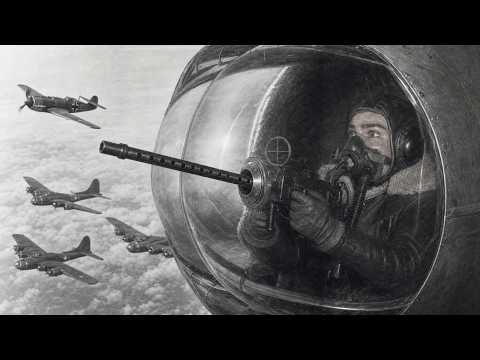
On November 23, 1942, pilots of Jagdgeschwader 2 introduced the head-on attack on a large scale. Coming in from slightly above, slightly angled, they fired a burst and broke away. Why did it work? Because from the front, a fighter faced only the weakest armament on the bomber. And behind that glass, just feet away, sat the pilot and co-pilot. Hit them, and the bomber would leave the formation on its own.
The Americans adapted. Crews and mechanics improvised, adding .50-caliber guns firing through side windows, even bolting heavy machine guns to improvised mounts. In Thorley, Sergeant James C. Green and welder Ben Marcelonus built their own forward-firing mount in about a week. They received commendations, but the fix was partial. The guns had limited arcs, and there were still only two men in the nose—one of whom had to drop bombs.
By October 1943, the Eighth Air Force was bleeding. Between October 10 and 14, it lost 90 bombers. On the morning of the 14th, 291 B-17s took off for Schweinfurt, deep inside Germany. For the men in the nose, the day began long before dawn. There was no galley, no beds—just a breakfast of fresh eggs, a briefing, and the small forward hatch that led into the glass cocoon.
What did it take to survive there? Start with the cold. The B-17 was unpressurized, and the heated suits—now the F-2 model—were supposed to keep them alive. But in 1943, up to 75% of frostbite cases were caused by failures in the electrical clothing itself. A broken wire meant a cold spot or no heat at all. And at fifty below, bare skin froze instantly on contact with metal.
Then there was the air. At altitude, oxygen was essential. But the masks had a weakness: every exhale was warm and moist, and at fifty below, that moisture froze. Ice could block the airflow. One B-24 crewman died in November 1943 when his oxygen mask froze. He wasn’t killed by fire or shrapnel—his own breath cut off his air supply.
And then there was the attack itself. A Fw 190 closing head-on at over 500 miles per hour gave the men in the nose seconds to react. They had to spot the fighter, swing their limited-arc gun, and fire—all while the German pilot was firing at them. Three hours of continuous combat on October 14. Three hours of scanning, reloading, and hoping the next pass wouldn’t come through the glass.
When the bombers finally reached Schweinfurt, the bombardier had to stop defending and start bombing. In that moment, one man had to choose between the mission and the survival of everyone on board. The records show that 60 B-17s were lost that day—over 26% of the attacking force. Of the 2,900 men who flew, about 650 were lost. And for the men in the glass nose, the nightmare was just beginning.
The flight home was its own ordeal. Damaged bombers limped back across France and the Channel, their crews nursing wounded engines and wounded men. For the navigator, the work never stopped. A bomber that drifted out of formation became a lone straggler, and a straggler was exactly what the Luftwaffe wanted. He had to know their position precisely, because a damaged B-17 that wandered off course was a dead one.
Some crews never made it back to England at all. One B-17 landed in Switzerland, interned for the duration. Another came down in the North Sea. When the survivors touched down at Thorley and Chelveston, the counting began. Sixty B-17s gone, and dozens more so badly damaged they would never fly again.
The men in the nose had done their job—and the cost was written in empty bunks.
What did the Eighth Air Force learn? Publicly, General Hap Arnold spoke of the raid in optimistic terms. The damage to the ball-bearing plants was real. But so was the German ability to adapt. After August, Schweinfurt’s production dropped by a third, and the shortfall was covered from stockpiles across Germany. After October, the Germans dispersed bearing production across the country so that no single city would ever carry that burden again.
Inside the Eighth, the conclusion was harder. Deep daylight raids into Germany without fighter cover were suspended. The self-defending formation—the very theory the nose was designed around—had reached its limit over Schweinfurt.
The hardware fix was already coming. The B-17G entered production in July 1943, with a powered chin turret under the nose mounting two .50-caliber guns, operated remotely from the bombardier’s station. The first G models reached Thorley on September 19, less than a month before Black Thursday. So the force that flew to Schweinfurt was mostly F models with improvised forward guns—only a handful of Gs.
There is a pattern worth noticing here. What two sergeants improvised in a workshop became, in a different form, a factory standard. The crews identified the problem in combat. The field fix proved the need. The production line caught up. Once the chin turret appeared, German pilots reportedly found the B-17’s nose a far less attractive target.
But look at what didn’t change. The chin turret was usually operated by the bombardier. So the man who had to stop shooting during the bomb run was now responsible for the best gun in the nose. The compartment was still mostly plexiglass. It still held two officers doing double duty. The cold was the same cold, and the tour was still twenty-five missions.
The real solution to the head-on attack wasn’t a turret—it was range. Long-range escort fighters arrived in early 1944, able to stay with the bombers deep into Germany. Once fighters could intercept the attackers before they began their head-on runs, the idea of the self-defending bomber could finally be set aside.
The crews of the 305th and 306th didn’t get that. They got an airplane built for a war its planners hadn’t fully imagined, and their job was to bridge the gap with their bodies.
So return to that curved sheet of plexiglass. At first it looked like a window. Now you can see what it really was: a compromise. It existed because precision bombing required a man who could see the ground. It was lightly armed because pre-war planners didn’t believe a fighter could attack from the front. It was reinforced piece by piece by crews and sergeants who learned otherwise in combat.
And for two officers in October 1943, it was the only thing between them and an Fw 190 at fifty below zero, breathing from cylinders for more than three hours, with one of them forced to stop shooting at the worst possible moment.
The deeper pattern here isn’t simply that these men were brave, though they were. It’s that the institution built a machine around a mission—dropping precise bombs on a distant target—and the people inside it had to absorb every gap between that design and what a human body could endure. Their warmth came through wires that broke. Their air came through masks their own breath could freeze. Part of their forward defense came out of a workshop, and each depended completely on the other because there was no one else in that compartment.
That gap never disappeared. Combat aircrews today fly pressurized, climate-controlled aircraft, and altitude, oxygen, and cold-exposure training are baseline requirements rather than lessons learned mid-war. But every combat aircraft is still a set of decisions about where to put protection and where to accept risk. There is always someone sitting at the heart of that risk.
The next time you stand in front of the nose of a B-17 in a museum, remember the measurements: a firing window measured in seconds, fifty below zero behind the glass, and a bomb group that sent fifteen or sixteen bombers to Schweinfurt and saw only three reach the target.
The tour was twenty-five missions. Men who flew the glass nose in 1943 did the math in silence and kept flying anyway. They had no way of knowing that the worst day of the Eighth Air Force was also the day that proved them right. Every broken wire, every frozen mask, every improvised gun mount had been a message the institution was slow to read.
What the men in that nose did was not glamorous. It was arithmetic performed at fifty below zero, with seconds to spare and no one else in the compartment to share the load. They were officers doing a gunner’s job because the airplane was built for a war that didn’t exist yet.
So the next time you see a photograph of a B-17 nose—that curved plexiglass with a machine gun poking through—look past the glass. Look at the two men behind it, strapped into heated suits that might fail, breathing through masks that might freeze, watching the sky for a fighter that would come from the one direction they couldn’t fully cover.
They flew anyway. And when the war finally ended, the lesson was written into every aircraft that followed: the crew comes first, the machine comes second, and the gap between design and reality is always paid for by someone sitting at the front.
What would you have done, sitting in that glass nose, knowing the fighter was coming from the one direction you couldn’t defend? Share your thoughts in the comments below.
Report this article
Select a reason for reporting:






