At 11:02 on the morning of August 9, 1945, an American bomb exploded over the Urakami Valley in Nagasaki. Somewhere in that city, inside a concrete cell, sat a prisoner the Japanese had held for more than three years. He was a sergeant in the United States Army. He was twenty-five years old. He came from the high desert of northwestern New Mexico, and the first language he ever spoke was Navajo.
That last fact is the reason this story exists. For three years, Japanese radio monitors across the Pacific had been hearing American Marines speak in a language no one on their side could understand. It was not English. It was not a code their analysts knew how to break. It was a living human language, spoken fast and fluently, that almost no one outside one corner of the American Southwest had ever learned. What Japanese intelligence needed more than any machine or mathematician was a person who had grown up speaking it. And they had one of them. He was in that cell.
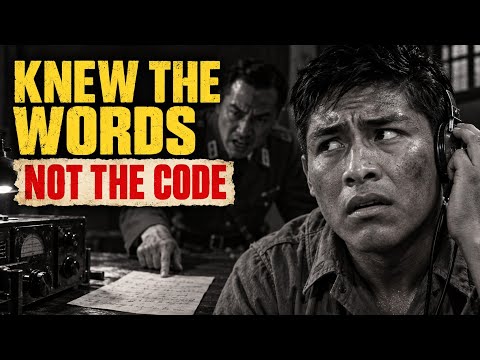
So they asked him. They asked with paper and fists, and once with a courtyard full of snow, and he gave them what he had, which was the truth. The problem was that the truth was the one thing the Marine code had been designed to make irrelevant.
This is the story of what Sergeant Joe Kieyoomia actually heard when Japan forced him to face that code. Why a man who could understand every syllable came away with nothing. And how a language his own government once tried to erase from Navajo children ended up locked against him too.
Stay with us to the end, because the last people to keep that secret from him were not the Japanese.
To understand what he heard, start with what he knew. Navajo is a language that resists borrowing. Its words depend on things an English speaker barely notices. Whether a vowel is long or short, whether the voice rises or falls, whether it comes through the nose or stops in the throat—change the tone and you change the word. A single Navajo verb can carry the meaning of a whole English sentence.
In 1942, there were only about 50,000 Navajo people. Most had never learned to read or write their own language. By one American estimate, no more than thirty outsiders could understand it. None of those outsiders were Japanese.
And for decades before the war, the United States had been working to shrink the number of speakers from the other end. Navajo children were sent to government and missionary boarding schools, where their language was treated as a habit to be beaten out of them. Chester Nez, who would become one of the Marines who built the code, had his English name forced on him at school and was punished for speaking Navajo. At the boarding school at Fort Defiance, a child caught using it might have his mouth washed out with soap. Hold on to that detail. In a few years, the same government would come to the reservation looking for young men who had kept the language anyway. And it would build one of the most successful wartime codes in history out of the very words it had tried to erase.
Joe Lewis Kieyoomia was born in November 1919. The written record says almost nothing about the boy. It shows him as a young man in uniform, serving in a New Mexico National Guard regiment that was about to be sent further than most of its soldiers had ever imagined.
The 200th Coast Artillery was an anti-aircraft regiment, and it was about as New Mexico as a unit could be. Its men came from towns and farms and villages and reservations across the state. Many of them spoke Spanish, which one of its old soldiers later wrote was part of why the Army sent them to the Philippines. In its ranks were men from Pueblo tribes and men from Navajo. By one Marine Corps count, there were only about twenty Navajos serving with the Army in the islands when the war began.
In September 1941, the regiment reached the shores of Luzon and set up its guns around Fort Stotsenburg and Clark Field, about seventy-five miles north of Manila. Roughly 1,800 New Mexicans made that voyage, including the men who split off in December to form a sister regiment, the 515th.
On December 8, just hours after Pearl Harbor and on the other side of the date line, Japanese bombers arrived over Clark Field and caught most of the Far East Air Force on the ground. The New Mexico soldiers worked their guns through that raid and the weeks that followed, then fell back with the rest of the army onto the Bataan Peninsula, where they were supposed to hold out until help came across the Pacific.
It never came. Rations were cut in half, then in half again. Cavalry horses were slaughtered and eaten. Malaria and dysentery spread through the ranks faster than the enemy did.
On April 9, 1942, the commander on Bataan surrendered, and roughly 75,000 American and Filipino troops became prisoners in a single day. What followed has a name almost everyone knows. The prisoners were marched north in columns, often on foot, for more than sixty miles in the heat of the Philippine dry season. A group of about a hundred men might take five days to cover that distance. There was little food and less water. Men who stepped out of line to drink from a ditch beside the road, or who fell and could not get up, were shot or bayoneted where they lay. Thousands of Filipino soldiers died on that road, along with hundreds of Americans.
Joe Kieyoomia survived it. For most of the march, the road ended at Camp O’Donnell, a former Philippine Army training ground, and the dying there was worse than on the road. About 1,500 Americans and many thousands of Filipinos died inside its walls within a few months.
Kieyoomia’s own account does not name the camp he was held in, but it describes the nature of those camps. He remembered meals of rice crawling with weevils. He remembered something harder to bear. Guards ordering prisoners, who were too weak to resist, to dig their own graves and then shooting them. A week after that, he said, they told him he would be next.
A few days later, instead of a grave, they gave him a place on a ship bound for Japan. He never said which ship or when it sailed, and I found no record to fill that gap. But the ships themselves are well documented. Largely because so many men died in them. The prisoners called them hell ships. They were ordinary Japanese cargo vessels that packed men into holds in heat and darkness. One bucket as a latrine, and never enough water. By one careful count, about 126,000 Allied prisoners were carried on 134 of these ships over more than 150 voyages.
They did not believe him. Half a century later, he tried to explain why. As far as he could tell, his captors believed Americans came in two kinds: white and black, and any man who was neither must be something they already knew about. “I guess they didn’t know anything about Indians,” he said. So they beat him for months, trying to force him to admit he was one of them.
The irony ran deeper than his guards could have known. In those same years, the United States was holding about 120,000 Japanese Americans behind wire for roughly the same reason the guards at Nagasaki were punishing Kieyoomia. A face and a name that seemed to announce which side they belonged to.
In the spring of 1943, the government turned an old boarding school on Navajo land at Leupp, Arizona, into a special prison for Japanese American men it labeled troublemakers. A Navajo boy named Joe Morris had attended school in those same buildings until they closed. He grew up to become one of the code talkers. And in the Pacific, Navajo Marines carrying the code sometimes met the same mistake from their own side. American soldiers who encountered a dark-haired man speaking a language they did not know sometimes thought they had caught a Japanese infiltrator. Some code talkers were detained and questioned by their fellow Americans, and a few came close to being shot.
So on both sides of the ocean, in the same years, men looked at a Navajo face and saw Japan. Think about what Kieyoomia was really being beaten for during those months. Not for a secret, not yet. He was being beaten for insisting on his identity, for repeating the name of his people over and over to men who had already decided what the answer should be. He never once gave them a different answer.
Eventually his captors accepted what he had been telling them all along. He said that was when things got worse. The moment they believed he was Navajo, he stopped being a traitor in their eyes and became something far more useful.
To see why, go back to early 1942, when he was still on Bataan, and to a man in Los Angeles reading a newspaper. Philip Johnston was the son of a missionary who had grown up on the Navajo reservation, where he learned the language as a boy. He had served in World War I. In early 1942, he read a story about the Army’s experiment with Native American signalmen in Louisiana maneuvers and pitched an idea to the Navy. Give the Marines Navajo radios and let them speak their mother tongue.
He brought four Navajo men to Camp Elliott, outside San Diego, to show officers what he meant. Messages went in English, traveled in Navajo, and came out English again, almost word for word. Within about a week, the commanding general asked for 200 Navajo recruits. The first 29 arrived at the Marine training center in San Diego in the first week of May. By then, Joe Kieyoomia had been a prisoner for nearly a month.
Through the summer of 1942, while he fought to stay alive in captivity, those twenty-nine young men sat in a classroom at Camp Elliott and did something no Marines had ever tried. They took the language of sheep camps and winter stories, the language of their grandparents, and turned it into a weapon no one else knew how to use.
In October, Philip Johnston, a man in his fifties, joined the Marines as a first sergeant so he could train new batches. So for the rest of the war, there were two sergeants at the ends of this story. One was in California, teaching the code to young Navajo men. The other was a prisoner of Japan, and before the war ended, he was beaten for not knowing it.
The trick was that there were two locks, and the native speaker held a key to only one. The first lock was the language itself, which almost no one outside the reservation could understand. The second was a private vocabulary. The Marines did not simply speak Navajo over the radio. They took ordinary Navajo words and quietly gave them new meanings that existed only inside the program.
Airplanes became birds. A fighter was da-he-tih-hi, the hummingbird, small and fast. A dive bomber was gini, the chicken hawk, which drops on its prey from above. A bomber was jay-sho, the buzzard, and the bombs it dropped were eggs. Ships became sea creatures. A battleship was lo-tso, the whale. A destroyer was a shark. A submarine was besh-lo, the iron fish. A hand grenade was a potato. And a tank was a turtle. Slow, armored, carrying its shell wherever it went.
For anything not on the list, there was an alphabet. Each English letter got a Navajo word for something whose English name began with that letter. A was wol-la-chee, the ant. B was the bear. T was the cat. Later, so the most common letters would not repeat too often, twelve of them were given extra words, so A could also be an apple or an axe.
Now imagine a code talker in 1945 sending the name of a volcano on a small island. What goes out over the air is a string of Navajo words meaning sheep, yucca, rabbit, snow, bear, ant, cat, horse, itch. Take the first English letter and put it into the one thing Japanese intelligence possessed and no amount of listening could produce: a man who had spoken Navajo since before he could walk.
There are two accounts of how they used him, and they do not quite match. The first is his own, from a 1995 Associated Press interview. He said that one day two Japanese women came to see him. They had Navajo words written on paper, spelled out in English letters, and they wanted to know what each one meant. So he told them. He read out simple meanings—bird, turtle, water. He never said who the women were or where the words on their paper came from.
The second account is shorter. A Navy fact sheet on the code talkers mentions, without naming him, a Navajo soldier captured on Bataan who was forced to listen to code talker messages and understood nothing. The sheet does not say where those details came from. The two accounts may be two parts of the same ordeal. They may even be the same thing seen from opposite ends.
Think about what those pages would have looked like. Japanese is built from simple syllables, most ending in a vowel, and does not distinguish between L and R. Navajo is full of sounds that exist in neither Japanese nor English. An L pronounced with air rushing off the tongue, consonants cut hard in the throat, vowels whose meaning changes as they pass through the nose. On top of that, it distinguishes its words by high and low pitch. Simple English letters in the hands of someone who does not speak Navajo cannot capture any of that. If those pages began as a radio broadcast, what reached Kieyoomia had been flattened twice, once by a foreign ear and once by a foreign alphabet. That he could pick out anything at all tells us a great deal about how well he knew his own language.
It must also have been strange, after all that time among strangers, to find pieces of home in that room. And here is the hard part. He had already read them, and read them correctly. A turtle in the Marine code meant a tank. The birds in that vocabulary meant aircraft. Kieyoomia gave his interrogators the true meaning of every word he recognized, the meaning those words had carried in his family for generations, and that was precisely the layer the code talkers had designed to be worthless.
He was answering in Navajo. The messages were in Marine. He told them, honestly, that he had never heard of any code. He was an Army soldier, not a Marine. The Army had Native American signalmen in this war, and Comanche soldiers were carrying messages ashore in Normandy, but the Army never built anything like the Marines’ Navajo program. He had been captured before the first code talker ever put on a uniform. No one outside the program had been told, and he was as far from the program as a man could be.
Try it yourself. Someone hands you a scrap of paper with words in your mother tongue: iron fish, whale, eggs, potatoes. You know every one of them. You could draw them. Is it a fishing trip, a shopping list, a story for a child? Nothing in those words tells you that a submarine has been sighted near a battleship, or that someone up front needs bombs and grenades. The meaning is not in the words at all. It lies in an agreement between speaker and listener. And Joe Kieyoomia was never part of that agreement.
His captors had no reason to believe any of it. From where they stood, a man who had spoken the enemy’s secret language since birth was telling them he did not understand it, so they decided to force him to. One winter day, by his account, a guard took him out of his cell completely naked and stood him in a parade yard in snow about six inches deep. He was told he would stay there until he gave them the code. He remembered the temperature was 27 degrees, and he remembered the guard threatening to shoot him if he moved. He stood there for an hour. His account does not say which winter, or which yard.
When they finally let him back inside, he could not walk. His feet had frozen to the ground. The guard pushed him, and the skin of his soles tore away and stayed stuck to the frozen yard. After that, he said, “the beatings happened almost every day.” For a while he lost the use of his right leg. At some point he tried to refuse food, and the guards beat him until he ate. Fifty years later, he told the reporter quietly that he had wanted to die, and that many times he felt he had come close.
It is worth pausing on how absurd this was, even from Japan’s point of view. They were holding something almost impossible to find outside the American Southwest, a man who carried the language in his bones. A patient analyst could have sat with him for months, built up the vocabulary word by word, then matched those words against intercepted messages and what the Marines actually did the next morning. Whether that would have worked is another matter; the Marines kept changing their code to stay ahead of exactly that kind of patience. Instead, by his account, they spent him trying to extract a confession that did not exist. Every blow was aimed at a secret he had never shared with anyone.
Whatever winter that was, he survived it, and the winters after. By the summer of 1945, he was in Nagasaki behind concrete walls. Nagasaki was not even the first choice on August 9. The B-29 Bockscar flew first to Kokura, found it hidden by cloud and smoke, and turned toward the secondary target. At 11:02, its bomb exploded over the Urakami Valley.
There were hundreds of Allied prisoners in Nagasaki that morning. Their nearest camp, beside the Mitsubishi foundry, was less than two kilometers from the point of detonation. The camp buildings collapsed, and eight prisoners are believed to have died there. Tens of thousands of the city’s people were killed that day or in the months that followed.
Nagasaki is a city of steep hills, and that morning the hills mattered. They channeled most of the destruction along the Urakami Valley and shielded parts of the old harbor district behind them. Survival depended on what stood between you and the flash. A hill, a wall, an earthen bank. Kieyoomia had concrete. He said it saved his life. The walls built to hold him were the same walls that stopped the blast from reaching him.
For three days afterward, by his account, no one came. The guards who had beaten him for so long simply left him in a city torn apart around him. Then a Japanese officer came to the cell and released him. Forty-three months had passed since Bataan.
He went home to the reservation in northwestern New Mexico. His leg, which had stopped working, recovered. The wounds on his soles healed. Of the roughly 1,800 New Mexicans who went to the Philippines with his regiment and its sister unit, 829 never came back. And a painful number of the survivors died within a year or two of returning. By one Army report, no state paid a heavier price for its size. Joe Kieyoomia was one of the survivors, and for a long time afterward he did not know why he had been tortured.
That is because the code talkers came home too, and they came home quietly. There were no parades. They took buses back to the reservation and picked up the lives they had left, having sworn not to reveal that they were the ones who had caused that trouble. It is hard to imagine a gentler description of the trouble than that.
So how much of all this was written down? Less than you might expect. The Army kept a punch card for every American prisoner it knew of. Name, serial number, rank, unit, the power holding him, and the camp he was reported to be in. A card like that has a space for the camp. It does not have a space for the parade yard. The Navy’s fact sheet remembered him in two sentences without naming him. The POW Medal, later added to his decorations, did not even exist until Congress created it in 1985, forty years after his release. And the Army personnel files from his era were kept in one building outside St. Louis, where a fire in July 1973 destroyed about four out of every five military records for soldiers discharged between 1912 and 1960. Families searching today often find the file gone and have to piece a man’s service together from whatever survived elsewhere.
Most of what we know about Joe Kieyoomia survives because a reporter came to his house in 1995 and he agreed to talk. The reporter found an old man with pale blue eyes behind thick glasses, sitting outside a remote home on the reservation. Kieyoomia brought out his twelve service medals. He had arranged them around a photograph of himself from his Army days. A handsome young soldier from before any of it happened. It was what his captors had demanded of him all those months. He said that even if he had known their code, the Japanese would never have gotten it from him.
He died on February 17, 1997, at the age of 77. He lived long enough to see a president declare August 14 National Navajo Code Talkers Day in 1982. But he did not live long enough for what came next. In July 2001, four of the five surviving members of the original 29 stood in the rotunda of the U.S. Capitol to receive the Congressional Gold Medal. The men who joined the program after them received silver medals. One of the four, John Brown Jr., spoke at length to the audience in Navajo and then drew laughter with a line in English. “Maybe Japan is listening.”
Japan had listened once. And the man it forced to listen in the hardest way was not in that room.
And so, in the end, this is what Joe Kieyoomia heard when Japan laid the Marine code in front of the only kind of man who could have broken it: he heard his homeland. He heard turtle and birds and water. Everything on those pages was nothing more than more of the same. Ant and bear and cat, sheep and rabbits and horses, simple words about sheep camps and winter stories. The very words teachers had once tried to scrub out of the mouths of Navajo children. Written down by young men of his own people. Not one of them meant a thing. The Marines had made a lock out of his language, and Japan brought the only key it could find. It fit every word. But it opened nothing.
So here is the question I keep returning to: if the key fit perfectly and still opened nothing, was the real lock the language itself—or the silence of the men who came home and never told him? What do you think Joe Kieyoomia deserved to hear, and from whom?
Report this article
Select a reason for reporting:






