Dr. Maya Freeman had seen thousands of photographs in her career as a cultural historian, but none had ever made her heart stop. The sepia-toned portrait from 1900 was unremarkable at first glance: a Black family of six, dressed in their Sunday best, posing with the stiff formality of early studio photography. But as Maya adjusted her magnifying lens under the bright examination light, her eyes fell on the youngest child—a little girl in a white dress with embroidered flowers. While everyone else held traditional poses, the girl’s left hand was pressed deliberately against her small chest, three fingers extended upward, the index and middle finger crossed tightly over the thumb.
It was too precise to be accidental. Too intentional for a child’s random fidgeting. Maya’s breath caught. She had spent years studying post-Reconstruction African-American communities, and she knew a coded gesture when she saw one. But what did it mean? And why would a four-year-old girl be making it in a formal family portrait?
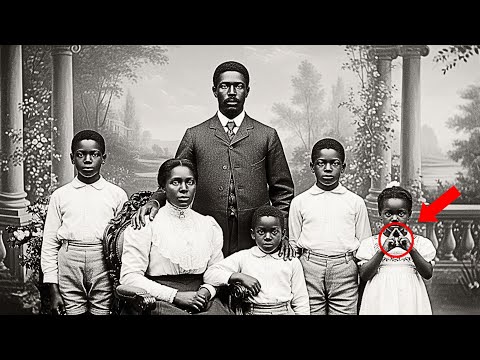
She photographed the detail with her high-resolution camera, zooming in on those tiny crossed fingers. The studio backdrop—a painted garden with artificial columns—suddenly felt less like decoration and more like a stage set concealing something deeper. What were they hiding? What did this family know that required speaking in codes, even in what should have been a documented public moment?
Maya checked the museum’s acquisition records. The photograph had been donated in 1987 from an estate in Chicago, part of a larger collection of early African-American portraiture. No names were recorded, no provenance beyond “Mississippi family, circa 1900.” Just six faces frozen in time—and one small hand making a signal that shouldn’t exist in 1900, thirty-five years after the Underground Railroad supposedly ceased operations.
She printed an enlargement and pinned it to her office corkboard. The investigation began now.
For five days, Maya barely slept. She surrounded herself with maps of Mississippi from 1900, census records, histories of Reconstruction and its violent collapse, scholarly texts on African-American survival strategies in the post-slavery South. The little girl’s hand gesture haunted her. Those three crossed fingers felt significant, deliberate—but nothing in her extensive knowledge base matched it.
She searched academic databases for documented hand signals and coded communication systems used by enslaved people and their descendants. She found references to quilt patterns allegedly used on the Underground Railroad, songs with double meanings, verbal codes—but no hand signals matching what she saw in the photograph.
On the sixth morning, Maya contacted Dr. Elliot Richardson, an elderly historian at Howard University who had spent forty-five years studying covert resistance networks among Black communities from slavery through Jim Crow. She emailed him high-resolution images of the child’s hand. His response arrived within two hours, marked urgent: “This changes everything I thought I knew. Call me immediately.”
Maya’s hands shook slightly as she dialed. Elliot’s voice trembled with barely contained excitement. “Where did you find this photograph?”
“Smithsonian Archives. Donated in 1987. No identification. Mississippi, 1900. Why? What am I looking at?”
Elliot paused, gathering his thoughts. “Maya, I need you to understand something. The Underground Railroad didn’t end in 1865. That’s the sanitized version we teach in schools. Slavery ended, the railroad shut down, everyone lived happily ever after. But the reality was far more complex—and far more dangerous.”
Maya grabbed her notebook, pen poised. “Explain.”
“After Reconstruction collapsed in 1877, the South became a killing ground for Black people. Lynchings, night riders, systematic economic exploitation, legal persecution under Jim Crow. Black families needed protection networks just as desperately as they had during slavery—maybe more so, because now they were supposedly free but had no federal protection. So the networks continued. They evolved.” Elliot corrected himself. “The original Underground Railroad conductors and station masters, those who survived, adapted their systems. They created new codes, new safe houses, new routes to help Black families escape racial violence, arrange safe passage to northern cities, warn each other about threats. These networks operated in absolute secrecy from roughly 1877 through the 1920s.”
Maya stared at the photograph pinned to her wall. “And the hand signal—that’s what shocks me.”
“I’ve read oral histories, studied coded letters, interviewed descendants of network families. I’ve heard rumors of hand signals for decades. Whispers, fragmented stories—but I’ve never seen photographic evidence.” His voice dropped. “What you’re looking at is called the ‘reload signal.’ It meant a family was connected, prepared, and ready to help or receive help. It was deliberately taught to children.”
“Why children?”
“Because children could move through communities without attracting suspicion. And if parents were killed or arrested, the children needed a way to identify safe families who would protect them.”
Maya felt chills run down her spine. She stared at the little girl in her white dress, holding a gesture that meant her parents had prepared her for their possible death.
The photograph was no longer just a family portrait. It was a survival code, waiting 124 years to be read.
Maya needed to find the photographer’s studio—the starting point of this family’s story. The photograph bore a faint stamp on the reverse side, partially degraded but still legible under magnification: Sterling & Sons Photography, Natchez, Miss.
She spent two days researching Natchez in 1900. The city sat on the Mississippi River, once a major hub of the cotton trade and slave auctions, now a Jim Crow stronghold where Black families navigated daily violence and oppression. Sterling & Sons operated from 1892 to 1911—one of the few photography studios in the South that served Black clientele.
Maya tracked down census records, city directories, newspaper archives. She found an obituary from 1928 for Marcus Sterling, the studio’s founder, describing him as “a respected colored businessman who served the community with dignity for thirty years.” The obituary mentioned his son, James Sterling, who continued operating a smaller portrait business in Chicago after leaving Mississippi in 1911.
Following the thread to Chicago, Maya discovered that James Sterling’s great-granddaughter, Vanessa Sterling Hughes, was a retired art teacher living on the city’s South Side. Maya sent a carefully worded email explaining her research, attaching a scan of the photograph’s backstamp. Vanessa responded within hours: “My great-grandfather rarely spoke about Mississippi, but he kept things. Come see me.”
Three days later, Maya sat in Vanessa’s living room surrounded by family photographs spanning five generations. Vanessa—a woman in her seventies with silver locks and warm eyes—brought out a wooden trunk that belonged to James Sterling.
“He carried this trunk from Mississippi to Chicago in 1911,” Vanessa explained. “Never let anyone look inside while he was alive. After he died, my grandmother inherited it, but didn’t know what to make of the contents. Now you’re the first historian to see this.”
Inside the trunk: hundreds of glass plate negatives, carefully wrapped and preserved. Portraits of Black families from Natchez between 1892 and 1911. And beneath the negatives, three leather-bound journals in James Sterling’s handwriting.
Vanessa opened the first journal. “My great-grandfather wrote everything down. Every family who came to the studio. Dates, names, sometimes notes about why they needed portraits made.”
Maya’s heart raced as Vanessa flipped through pages to September 1900. Her finger stopped at an entry dated September 14th: “Coleman family. Six portraits. Express order, three-day rush. Special arrangement.”
“Coleman,” Maya whispered. “What does ‘special arrangement’ mean?”
Vanessa looked at her with inherited knowledge in her eyes. “My great-grandfather’s studio wasn’t just a business. It was a safe place. A checkpoint. Families who needed help knew they could come to him.”
“Was he part of the network?”
“He never called it by name, not even in his journals. But yes. He documented people who were about to disappear by choice—to survive. This photograph you found—those people needed evidence they existed before they vanished into a new life somewhere safer.”
Maya stared at the journal entry. The Coleman family. Six people. One little girl making a signal that would outlive them all.
“Do you have the glass plate negative for this portrait?” Maya asked.
Vanessa smiled slightly. “I think I can find it.”
Vanessa lifted a smaller wooden box from the trunk and set it on the table between them, handling it with the reverence of someone touching a relic. Inside, wrapped in yellowed cloth, the glass plate negatives were stacked in careful chronological order. She moved through them methodically, reading dates penciled on the sleeves, until her fingers paused at September 1900.
“Here,” she said softly, holding the plate up to the window light. Maya saw the image in negative—dark figures against a pale background—but unmistakably the same family. The father’s protective stance. The mother’s formal posture. The three boys. And the little girl with her hand positioned in that deliberate gesture.
“Can we have this professionally scanned?” Maya asked. “The high resolution might reveal details the paper print doesn’t show.”
“I know someone at the Art Institute who specializes in historic photographic preservation,” Vanessa said. “Let me make a call.”
Two days later, Maya stood in a conservation lab at the Art Institute of Chicago as a specialist named Robert positioned the glass plate under a high-resolution scanner designed specifically for historic photographic materials. The resulting digital image was stunningly clear. Every texture of fabric, every strand of hair, every line in each subject’s face rendered in remarkable detail.
Robert zoomed in on the little girl’s hand. “That’s definitely intentional,” he confirmed. “See how her fingers are positioned with tension? She’s holding that gesture deliberately—probably for the entire exposure. That would have been difficult for a child this young.”
“Exposures in 1900 took several seconds of absolute stillness,” Maya said quietly. “She was trained.”
Robert pointed to another detail. “Look at the mother’s left hand resting in her lap. See this ring on her middle finger? It has an engraving.”
Maya leaned closer. The ring bore a tiny symbol—three interlocking circles forming a triangle. “What does that mean?” Vanessa asked from behind them.
“I don’t know yet,” Maya said, photographing the detail. “But it’s connected somehow.”
Back at Vanessa’s home, they examined James Sterling’s journals more carefully. Maya discovered that certain families had small symbols marked next to their names—stars, circles, triangles. The Coleman family entry bore three interlocking circles drawn in the margin.
“He was marking network families,” Maya realized. “Different symbols meant different things. Maybe levels of involvement, or types of assistance needed.”
Vanessa flipped through more pages. “Look at this. August 1900—one month before the Colemans. A Reverend Patterson visited. ‘Discussed arrangements for autumn departures. Twelve families confirmed.’”
“Twelve families preparing to leave Mississippi,” Maya said. “The Colemans were part of a larger exodus.”
“But why?” Vanessa asked.
Maya pulled out her laptop and began searching historical records. Within minutes, she found it—newspaper articles from the Natchez Democrat, August through October 1900. A wave of racial violence following a disputed land claim. Three Black landowners lynched. Churches burned. Families terrorized.
The September 14th portrait of the Coleman family was taken at the height of the violence. They were documenting themselves before they disappeared.
“This photograph was evidence of their existence,” Maya said. “Their dignity. Their family—preserved before they had to erase themselves to survive.”
Vanessa touched the journal gently. “And my great-grandfather helped them do it.”
Maya immersed herself in Natchez records from late 1900, piecing together a picture of systematic terror. The violence wasn’t random. It targeted Black families who had managed to acquire land, establish businesses, or gain any measure of economic independence in the thirty-five years since emancipation.
The Colemans, she learned from property records, owned forty acres of farmland outside Natchez, purchased in 1892. The father, Isaac Coleman, had been born enslaved in 1861, freed as an infant, and somehow managed to save enough money to buy land—an extraordinary achievement that made him a target.
She found Isaac’s name in an 1899 agricultural report as one of the few Black farmers successfully growing cotton and vegetables for market. Success that would have bred resentment among white landowners accustomed to Black subservience and economic dependence.
Then, in October 1900, a notice in the Natchez Democrat: “Coleman property, 40 acres, forfeited for unpaid taxes.” A legal theft disguised as bureaucracy.
But by then, the Colemans were gone.
Maya traced the family north through the 1910 census, finding Isaac and Esther Coleman in Detroit, their ages and children matching perfectly. “They made it,” she whispered. “They survived.” But the census taker had noted: family declined to provide prior address. They had buried Natchez deliberately.
She followed Ruth—the little girl in the white dress—through marriage records to Ruth Harris, Sunday school teacher at Detroit’s Second Baptist Church for forty years. When Maya called the church historian, he remembered her instantly. “Sister Ruth? Quiet woman. Very dignified. She died in 1987.”
Ruth’s daughter, Grace, wept when she saw the photograph. “That’s my mother. I’ve never seen a picture of her as a child.” Inside Ruth’s wooden box lay a hand-drawn escape map, a cotton handkerchief embroidered E.C., and the white dress itself—kept for ninety-one years.
In February 2025, the Charles H. Wright Museum opened Hidden Signals: Networks of Survival After Emancipation, the Coleman portrait at its center. Ruth’s three crossed fingers, enlarged and explained, were no longer a mystery—but a testament.
Maya returns to that photograph every morning. Isaac’s protective stance. Esther’s composed strength. And Ruth, small and bright, holding a secret that outlived everyone who knew its meaning.
What other silent codes are waiting in forgotten archives for someone to finally ask the right questions?
Report this article
Select a reason for reporting:






