On the 30th of September, 1941, the engines of Panzer Group 2 roared to life before dawn. It was two days ahead of schedule—Colonel General Guderian had begged for the early start—but the rest of Army Group Center would not begin until the 2nd of October. What was about to unfold was the largest offensive under a single commander of the entire Second World War: Operation Typhoon, Germany’s final lunge to take Moscow and end the war in the east before winter closed its iron fist.
But the soldiers climbing into those tanks were not the same men who had stormed across the Soviet border in June. They were exhausted, their vehicles worn to the breaking point, and the supply lines behind them already stretched to the snapping point. The question that haunted every commander from Field Marshal Bock down to the lowliest infantryman was simple: could an army on its last legs really reach the Soviet capital?
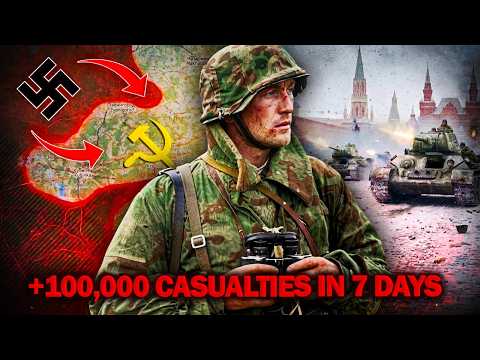
The answer, as history would show, lay buried in the mud of the Russian autumn. But in those first golden days of October, no one at headquarters wanted to ask it. Hitler himself declared in Berlin on the 3rd of October: “This adversary is already knocked down and will never rise again.” The propaganda machine had convinced the German people that victory was inevitable, and even the generals began to believe their own myth.
Yet the warning signs were there from the very first day. Fuel reserves were dangerously low. Some infantry divisions suffered catastrophic losses trying to dislodge entrenched Soviet positions. Panzer Group 3 reported mobility problems from the start. But in the euphoria of the initial advance—Guderian’s tanks had taken Orel 240 kilometers behind Soviet lines in just four days—no one paid attention.
What the German high command failed to grasp was that the Soviet Union was not France. Stalin had 99 new divisions moving toward the central front between October and December. The army that German intelligence had estimated at 200 divisions now numbered more than 360. When one Soviet army was destroyed, another appeared in its place. The Blitzkrieg that had crushed France in six weeks had found an adversary that could not be taken with a single thrust.
The mud came on the night of October 6th, when the first snow fell and then turned to rain. The Rasputitsa—the “period of the lawless roads”—turned the ground into a trap for any heavy vehicle. Guderian noted in his diary: “Vehicles could only advance at a snail’s pace and with a great wear on the engines.” A division that needed to advance 60 kilometers took 30 hours of continuous movement—and that was without counting breakdowns, attacks, or the simple fact that the fuel might not arrive at all.
And yet, the German command pressed on. The encirclements at Vyasma and Bryansk had netted nearly 674,000 Soviet prisoners—one of the greatest military successes in history. But it was not enough. The trapped Soviet armies fought with a ferocity that stunned the Germans, buying precious days for Zhukov to build the Mozhaisk defensive line. Zhukov himself would later write: “It was not in vain that the surrounded troops gave their lives and shed their blood.”
By mid-October, the advance had slowed to a crawl. The mud was not simply difficult; it was of a qualitatively different nature from anything the Germans had experienced in Europe. Even the tractors could barely move. A large proportion of the heavy artillery was soon stuck and never reached the front. General Blumentritt, Chief of Staff of the Fourth Army, admitted after the war: “The reality far exceeded our worst expectations.”
On the 19th of October, Guderian informed the army group that “at present large-scale operations are not possible.” Bock was still more than 100 kilometers from Moscow. The offensive that was supposed to end the war before winter had already run out of time.
The distance between the paper plan and the frozen reality was measured in more than kilometers. On the 22nd of October, Bock opened his diary with a single, lapidary sentence: “There is no significant advance anywhere.” The divisions that had begun Typhoon with hundreds of tanks now counted their operational vehicles in dozens, sometimes in single digits. A Panzer division with seven tanks was still listed as a Panzer division in the order of battle, a bureaucratic fiction that revealed how far headquarters had drifted from the front.
In the north, Reinhardt’s Panzer Group 3 had seized Kalinin, but the city became a trap. Koniev’s newly formed Kalinin Front counterattacked from every direction, and Krueger’s 1st Panzer Division, which had reached the city with 79 tanks on the 14th of October, had only 24 operational a week later. Eight more had been destroyed by their own crews to prevent capture after breaking down. Between the 13th and 20th of October, the division lost 765 men and 45 officers.
In the south, the 4th Panzer Division—spearhead of Guderian’s thrust toward Tula—had only 40 operational tanks from an original strength of more than 170. Its ammunition stocks were desperately low in every caliber. At the beginning of November, it had managed to repair exactly six tanks in three weeks. The arithmetic of attrition was merciless, and no amount of willpower could reverse it.
Then came the cold. The end of the mud was greeted with relief, but the frost brought its own catastrophes. Lubricants solidified at twenty degrees below zero. Tank brakes failed. Machine guns jammed. Aircraft engines refused to start. Field hospitals recorded thousands of frostbite cases, and the lack of winter clothing was total. A Soviet pamphlet dropped on the 30th of September had warned: “If you do not leave here voluntarily, you are lost. The harsh Russian winter is preparing.” It had turned out prophetic.
While German columns froze a hundred kilometers from the Kremlin, Moscow itself passed through its darkest hours. On the 15th of October, Stalin ordered the evacuation of the government to Kuibyshev. Ministries began to move. Foreign missions received orders to depart. On the 16th, the Moscow panic erupted—looting, riots, public insults against the regime. But Stalin did not go. When the Soviet dictator stayed in the Kremlin, the slogan “Stalin is with us” ceased to be propaganda and became a verifiable fact.
The city transformed into a fortress. Half a million Muscovites dug 80 kilometers of trenches and anti-tank ditches. Three hundred kilometers of barbed wire went up. Machine-gun nests appeared in attics, artillery positions at street junctions, metal hedgehogs on every avenue. The NKVD prepared the mining of hundreds of buildings, including the Bolshoi Theatre. If the Germans had reached Moscow in 1941, they would have found a desert.
Zhukov organized the defense with a combination of extreme toughness and operational talent. Commanders who yielded ground without authorization were shot; those who held under crushing pressure were promoted. He concentrated his scarce reserves at nodal points, massed artillery where the mud forced German tanks onto the roads, and preserved a counterattack capacity that Bock did not have. The logistical asymmetry was crushing: Zhukov fought a few kilometers from his depots and factories, while the Germans fought three hundred kilometers from theirs over roads that trucks crossed only when they could.
At the end of October, the Typhoon front had stopped de facto along its entire extension. There was no formal surrender of the offensive—only the tacit recognition that vehicles did not move and divisions did not advance. The officers called it a pause. In practice, the army had reached the limit of its capacity. And still the OKH planned the second phase, to begin on the 15th of November when the frozen ground would allow movement again.
Lieutenant Colonel Tresckow, first staff officer of Army Group Center, visited the OKW in October and delivered a verdict that was ignored. In his opinion, the troops were in worse condition than the Western German army in September of 1918, weeks before the armistice of the First World War. It was the moment, he argued, to end mobile operations and build winter positions. The OKH planned the second phase of Typhoon instead.
The second phase began on the 15th of November with the frozen ground. The hard surface allowed movement again, but temperatures of ten to twenty degrees below zero caused havoc among men without adequate clothing and vehicles without special lubricants for the cold. It was an exchange of one problem for another. The plan remained the same: Panzer Groups 3 and 4 would drive through the north toward the Moscow-Volga Canal, while Guderian’s Second Panzer Army pushed through the south toward Tula and beyond. The final objective was to surround Moscow in an enormous embrace, cut its communications, and force the city to surrender without the need for a direct assault.
On paper, the scheme was coherent. In practice, the divisions that had to execute it were in many cases weaker than they had been in October. The first phase had stopped. The frost had turned the roads into passable surfaces, but the same temperatures that facilitated movement destroyed the brakes, solidified the motor oils, and turned every repair into a survival exercise for mechanics working with numb fingers at twenty below zero.
Hoth’s Panzer Group 3 launched the renewed attack in the northern sector with Veiel’s 2nd Panzer Division and Scheller’s 11th Panzer Division as the spearhead. The 2nd Division, despite having rested relatively during the pause of late October, listed 149 operational tanks. Fehn’s 5th Panzer Division, which also participated in the sector, was in a similar state. The initial advance was faster than expected thanks to the frozen ground, and at the end of November the panzers of the 4th Panzer Group reached the outskirts of Krasnaya Polyana—barely 27 kilometers from the Kremlin.
Those were the closest kilometers to Moscow that the Germans would reach in the entire war. On clear days, soldiers with binoculars could distinguish the spires and domes of the highest buildings of the capital. Lieutenant Carl Ludwig von Brocke of the 62nd Infantry Division recalled after the war having seen through his binoculars the towers of the Kremlin. It was one of the few moments in which the initial euphoria of October seemed, for an instant, justified.
But it was an untenable position. The logistics of the second phase were, if anything, more fragile than those of October. Trains arrived with less regularity than before. Fuel was scarce. The artillery fired with extremely reduced rations to conserve ammunition. And Kershner’s XXXXI Army Corps, which should have joined the advance from Kalinin to seize the Moscow-Volga Canal in the north, did not arrive with enough force in time to do so.
In the north, Fink’s 7th Panzer Division and Krueger’s 1st Panzer Division managed to cross the Moscow-Volga Canal at Yakhroma on the 27th of November. It was the furthest point to the east that German troops would reach in the entire war. But the position was a bridgehead salient without support on the flanks, with the river at its back and Soviet forces in superior positions in three directions. The division crossed the bridge, established a small bridgehead on the east bank, and held it for forty-eight hours, but Soviet counterattacks and the absence of reinforcements made consolidation impossible. The panzers withdrew to the west side of the canal before the position was liquidated.
Guderian’s advance in the south was equally frustrating. Despite months of attempts, Tula never fell. The defenders—a mixture of regular NKVD soldiers and brigades of armed workers from the city’s own factories—resisted all assaults. Guderian tried to encircle the city, but he lacked enough infantry to seal a complete perimeter around an industrial city while at the same time advancing toward Moscow. In mid-November, the Second Panzer Army managed to cut the Tula-Moscow road south of the city, but could not advance further. Arnim’s 17th Panzer Division and Nehring’s 18th Panzer Division, which were to have continued north after taking Tula, were blocked before the suburbs.
In the central sector, Kluge’s Fourth Army held positions along the Moscow highway and resisted the continuous counterattacks of the Soviet 5th Army in the Mozhaisk sector. Each small German advance was answered with Soviet counterattacks that forced the attackers to retreat or spend precious ammunition and men to hold the gained ground. The equation did not add up. The German divisions attacked with less than half of their original strength, without reserves, with scarce supply—and were answered by Soviet units that kept arriving from the east.
At the beginning of December, the German command recognized that the second phase of Typhoon had also failed. The deepest advance had occurred in the northern sector, at about fifteen to twenty kilometers from the periphery of Moscow. From the most advanced suburbs, German soldiers could see the flash of the highest buildings of the Soviet capital with binoculars, but they could not enter.
On the 5th of December of 1941, Zhukov’s Western Front launched the great Soviet counteroffensive that would push Army Group Center hundreds of kilometers toward the west during the following months. At that moment, the German divisions before Moscow were so exhausted that the simple fact of maintaining their positions under the Soviet blow required superhuman efforts. For Army Group Center, the 5th of December was not the end of a defeat that had just occurred. It was the moment in which the defeat, which had been brewing for weeks, became finally impossible to deny.
The great gamble had failed. Operation Typhoon began with the German certainty of a decisive victory; it ended with the most powerful army in the world staring at Moscow from a distance it could not cross. The blitzkrieg that had crushed France in six weeks had found on the Russian plain an adversary that could not be taken with a single thrust.
Hundreds of thousands of casualties, tens of thousands of vehicles destroyed, four months of campaign without pause—all for a line on the map that never reached the Kremlin. On the 5th of December, Zhukov launched his counteroffensive, and Germany would never again be so close to Moscow.
The typhoon had passed without tearing the target out by the root. And in that failure lay already embryonic the final resolution of the conflict.
What if the German command had truly listened to its own logistical reports—could Moscow have fallen before the mud and snow?
Report this article
Select a reason for reporting:






