The engine died first. Not the enemy, not a burst of flak tearing through the fuselage—just silence, sudden and total, while Don McFersonson was still pulling his Hellcat out of a diving strafing run, low enough over a Japanese airfield that the treetops seemed close enough to touch. He had just watched his rockets tear a bomber apart on the ground below. It was his first combat mission. It was March 19, 1945, and for one long, breathless stretch of seconds, the young pilot from Nebraska was certain he was about to die before he ever fired another shot in anger.
He would live. And six weeks later, off the coast of Okinawa, he would face something far stranger than a dead engine. Not an enemy trying to survive the fight, but one trying to end it on purpose by flying straight into an American warship packed with sailors who had no idea what was coming. Some of those planes would be barely faster than a car on a highway. Some would be flown by boys not yet out of their teens. And on one morning in early May, Don McFersonson would find out just how hard it is to shoot down a man who has already decided he is not going home.
Don McFersonson grew up on a farm outside Adams, Nebraska, in the kind of flat, endless country where the sky was the biggest thing a boy ever saw. Long before he ever sat in a cockpit, he had spent his boyhood watching that sky change with the weather, learning the land by the smell of turned soil and the sound of wind moving through wheat. He had never flown a plane before the war came. Few young men from that stretch of prairie had.
Flight school was a different world entirely—a blur of classrooms, checklists, and instructors who expected a farm boy to master machines far more complicated than anything he had ever driven or repaired back home. He pushed through it anyway, one flight at a time, until the controls of a fighter plane began to feel less like a stranger’s tool and more like an extension of his own hands. By the time he turned 23, he was strapped into the cockpit of a Grumman F6F Hellcat, wearing the wings of the United States Navy, flying off the deck of the aircraft carrier USS Essex as a member of Fighter Squadron 83.
The Essex was a city unto itself—thousands of men living and working within a single steel hull—and McFersonson was now one small part of the air power that city carried into battle. He had traded the silence of the prairie for the constant din of a warship at sea: the grind of engines, the shouted orders on the flight deck, the smell of aviation fuel that never quite washed away.
The Pacific War he had joined was already deep into its most brutal chapter. Japan was losing, and everyone in the cockpit and on the bridge and in the White House knew it. But losing did not mean surrendering. It meant something else entirely—something the American pilots flying against the home islands in the spring of 1945 were only beginning to understand.
McFersonson’s first taste of that reality came on March 19, 1945, when Task Force 58 launched a series of raids against Japanese airfields on the island of Kyushu. It was his first combat mission. No amount of training fully prepares a young man for the moment he points the nose of his fighter at the ground and commits to a strafing run through enemy fire for the first time. McFersonson rolled his Hellcat into a dive, lined up a Japanese Betty bomber parked on the airfield below, and fired his rockets. The bomber burst into flame and smoke boiled up from the runway.
Then, pulling out of the dive at treetop height, his engine died.
There was no warning, no sputter building toward failure—just silence where the roar of the engine had been a heartbeat before. The cockpit that had been shaking with noise and vibration a moment earlier went suddenly, sickeningly quiet, and in that quiet, McFersonson could hear his own breathing and feel the sweat gathering under his flight helmet. For a pilot low over enemy territory, an engine failure at that altitude left almost no room for error and almost no time to think. The ground below was still enemy soil, still dotted with anti-aircraft positions that had been firing at him only seconds earlier, and a dead-stick landing here meant capture at best.
McFersonson fought the controls, working to keep the Hellcat’s nose up and its wings level, while the aircraft lost speed and altitude over hostile ground, trading precious feet of height for precious seconds of time, doing everything a young pilot’s instincts and training could offer against a machine that had simply stopped cooperating. Every second stretched longer than it should have.
Somehow—whether through skill or reflex or simple luck—the engine caught again before the Hellcat dropped into the trees, the roar returning as suddenly as it had vanished. He climbed away from the smoke rising off the ruined bomber and turned back toward the fleet, alive and newly aware of exactly how thin the margin for survival could be. He would fly dozens more missions in the weeks that followed, but he never fully forgot the sound of that silence. It would not be the last time he learned that lesson.
Three weeks later, on April 6, near a stretch of water called Kikaima, not far from Okinawa, McFersonson found himself in the air again—this time against a different kind of target. Japanese D3A dive bombers, the type Americans called Vals, were slower and more vulnerable than the fighters McFersonson had trained to face. But they were far from harmless, especially when masked in numbers against the fleet below. McFersonson closed on one, opened fire, and watched it fall from the sky, trailing smoke. Then he found a second and put that one down as well. Two kills in a single engagement.
It was the kind of afternoon that quietly built a combat record—one confirmed victory added to another, the sort of thing a pilot might not fully appreciate the significance of until much later, when someone added up the total and called him something he had never expected to be.
By the time these actions took place, the invasion of Okinawa was already underway, and it was proving to be the bloodiest campaign of the entire Pacific War. American Marines and soldiers were fighting yard by yard across a heavily fortified island, and the fighting on the ground was savage. Japanese troops had dug into caves, tunnel lines, and fortified positions that were nearly impossible to root out with infantry alone. That was where pilots like McFersonson came in.
The Hellcats of Task Force 58 and the pilots flying off carriers like the Essex were called on constantly to provide close air support, dropping bombs and firing rockets on Japanese positions that American ground troops could not otherwise reach without paying an enormous price in blood. McFersonson would later describe missions where he and his fellow pilots were given map coordinates showing Japanese soldiers surrounded and cornered by American troops—positions so tight that the only alternative to air support was sending men forward with flamethrowers at a cost few commanders wanted to accept. Instead, the Hellcats went in low, dropping ordnance close enough to friendly lines that there was no room at all for a mistake.
By his own account, some of those strikes landed within 50 yards of American troops—a margin that left no room for a shaking hand or a misjudged angle. It was, in his words, the toughest kind of flying he ever did, because the cost of an error was not an empty miss. It was hurting the very men the mission existed to protect.
The men on the ground rarely saw the faces of the pilots who saved them, and the pilots rarely saw the faces of the men they were protecting. But the connection between them was as real as anything in the war—a thin and invisible line running from the cockpit of a Hellcat down to a foxhole where exhausted Marines waited for the sound of engines overhead that meant help was coming instead of another Japanese counterattack.
Through the weeks that followed, the skies directly above Okinawa itself grew steadily quieter of enemy aircraft. Japanese air power on the island had been ground down, and pilots like McFersonson found themselves able to strike ground targets with less and less resistance overhead. It might have seemed briefly as though the worst of the danger in the air was behind them.
It was not. The threat had not disappeared. It had shifted out over the open water surrounding the island, where the American fleet sat exposed and waiting.
For months, American sailors and pilots alike had watched a new and terrible pattern emerge from Japan—one that defied everything the United States Navy had trained to expect from an enemy air force. Rather than trying to survive an engagement, rather than pressing an attack and then breaking away to fight another day, Japanese pilots had begun flying their aircraft directly into American ships on purpose, turning themselves and their planes into a single final weapon.
It was not a rare or isolated tactic anymore. It was becoming the plan. Every aircraft that could still take off from an airfield on the Japanese home islands was being pressed into service for the purpose—from frontline fighters flown by veteran pilots down to trainers and reconnaissance aircraft flown by boys barely out of flight school. Some as young as sixteen years old, sent up with wings, a full tank of fuel, and a single mission that offered no way home.
American sailors on picket duty had learned to scan the horizon and the sky with a kind of dread no amount of training could fully prepare them for. Because an enemy fighter attacking in the old way could be outmaneuvered, outgunned, or simply outlasted—while an enemy pilot who no longer cared whether he lived through the encounter changed the entire math of the fight.
It was a maniacal, all-out effort to break American sea power and cut off the men fighting on Okinawa from the ships that supplied and supported them. It was desperation given wings. And it was, as the sailors and pilots of the fleet were only beginning to fully grasp, the shape the rest of the war at sea was going to take—a struggle between men fighting to live and men who had already decided to die.
For pilots like McFersonson, trained to outfly and outfight an opponent who wanted to survive the encounter as badly as he did, this was a puzzle their training had never anticipated. There was no dogfighting instinct built for an enemy who considered the collision itself a victory.
Don McFersonson had already proven he could survive a dying engine and defeat a formation of enemy dive bombers. He had proven he could thread a bomb run within fifty yards of his own men without hesitation, and he had watched an island burn beneath him for weeks on end. He believed, as much as any twenty-three-year-old flying combat missions every day could believe anything for certain, that he had a working sense of what this war could throw at him.
Neither the dead engine, nor the dive bombers, nor anything he had seen over the churned and cratered ground of Okinawa had prepared him—or anyone else in Fighter Squadron 83—for what was coming on the morning of May 4, 1945.
The fourth of May began early and it began badly. Japan had committed itself to one of the largest coordinated suicide attacks of the entire Okinawa campaign—a mass strike later remembered by naval historians as one of the most punishing single days the United States Navy would endure in the whole war. Airfields across Kyushu emptied their aircraft into the sky in wave after wave, a mixture of frontline fighters and hastily converted trainers, all of it aimed at the fleet of ships supporting the invasion below.
Aboard the Essex, the morning had started the way most mornings did, with the ordinary rhythm of a carrier at war. Deck crews moved aircraft into position under the gray early light. Pilots gathered for briefings with cups of coffee going cold in their hands, and the ship’s radar operators watched their screens with the same practiced patience they brought to every watch. None of that ordinary rhythm would survive the next several hours.
Word began filtering up from radar and radio traffic that the raids building over Kyushu were larger than anything the fleet had faced in recent days. The tone in the ready rooms shifted from routine to something tighter and more urgent. Pilots pulled on their gear a little faster. Deck crews moved with a little more purpose. Everyone aboard understood, even before the first contact reports came in, that this was going to be a different kind of day.
Around the destroyers standing picket duty in the waters between Okinawa and the island of Kyushu, radar screens began lighting up before the sun had fully cleared the horizon. These picket ships carried a grim, unglamorous job. Stationed out ahead of the main fleet, they served as an early warning line, their radar sets scanning for incoming raids so the carriers and their more valuable cargo could prepare a defense. It also meant the picket destroyers were usually the first American ships an incoming kamikaze would find—and often the last thing many of them wanted to see.
Don McFersonson and his division, flying under the call sign Wander 5, were vectored out that morning to fly combat air patrol over one of these picket stations—orbiting above a pair of destroyers positioned to catch and report the incoming raids before they reached the main body of the fleet. It was routine duty, the kind of assignment that could pass in a long, uneventful stretch of empty sky and idle radio chatter. The sort of patrol where a pilot might spend two hours doing nothing more dramatic than watching the wake of the ships below trace long white lines across the blue water.
This particular morning would be nothing of the sort.
The flight out to the picket line took McFersonson and the rest of Wander 5 over open ocean, the destroyers below little more than gray slivers against the water until the formation descended to begin its patrol. From several thousand feet the sea around Okinawa looked deceptively calm. Sunlight scattered across the swells. The destroyers cut steady wakes as they held their assigned stations. It was the kind of view that made it easy, for a moment, to forget what waited on the other side of the horizon—back on the airfields of Kyushu, where engines were already turning over and pilots were climbing into cockpits with no intention of returning.
By the time Wander 5 arrived on station, the attack had already begun. The sky around the picket line was full of aircraft—and not the organized formations of enemy fighters McFersonson and his squadron mates had trained to expect. This was something closer to chaos. Planes of every type and vintage the Japanese could still put into the air: fast modern fighters mixed in with slow, aging reconnaissance float planes never designed for combat at all, every one of them diving and jinking toward the American ships below in a desperate attempt to close the distance and strike home.
The division split to cover the threat. One section, led by Lieutenant Saufley with McFersonson on his wing, was vectored north to intercept a single reported contact. The other section—Lieutenant Ward and his wingman, Ensign Truax—spotted a Japanese fighter identified as an Oscar diving hard toward the water, angling directly for one of the destroyers below.
The Oscar broke away from the American fighters and dove for the ship, and the destroyer’s own guns opened fire at the same moment Ward closed in from behind. For the sailors on that destroyer, the seconds that followed must have felt endless—tracers rising from their own guns while a Japanese fighter grew larger against the sky with every passing instant. No way to know, from the deck, whether the American pilot chasing it down would close the distance in time.
The Oscar caught fire and went into the water just short of the destroyer’s stern, close enough that sailors on deck could feel the heat of the blast and the spray of the impact across the water. The ship’s crew, watching from their own guns, radioed their thanks and credited the kill to the Hellcat pilot who had saved them in the last possible seconds. It was, for Fighter Squadron 83, only the first of many close calls that morning—and it made one thing brutally clear before the day had properly started. Without fighters like these standing between the fleet and the sky, many of these attackers were going to find their targets.
McFersonson did not have long to reflect on what he had just witnessed. Only minutes later, he and his section leader spotted a much larger formation below them—a group of aircraft flying low and slow over the water. And as they closed the distance, it became clear these were not conventional fighters at all. They were float planes, older reconnaissance types never intended for aerial combat, now loaded with explosives and flown by pilots with a single, irreversible purpose.
Under ordinary circumstances, an aircraft like this would have spent the war quietly circling a harbor or scouting ahead of a task force, its crew watching the water for submarines rather than hunting for a fight. Now, these same slow, ungainly machines were being flown straight at the heart of the American fleet, stripped of any purpose but one.
It would have been easy to assume these slower, weaker aircraft would be simple targets for a modern American fighter. That assumption, as pilots across the fleet were discovering that very morning, was dangerously wrong—and it was a lesson every pilot in Wander 5 would end up learning the hard way before the morning was finished.
The problem was speed—or rather, the enormous difference in it. A Hellcat closing on a target at full combat speed could not simply slow down and match pace with an aircraft barely faster than a car on an open road. Pilots who tried a standard high-speed firing pass found themselves overshooting their targets entirely, blowing past the float plane before they could line up a clean shot—forced to break off, circle back, and try again while precious seconds ticked away and the enemy aircraft crept closer to a ship.
It was a strange, almost bitter irony that the very weakness of these aircraft—aging designs never meant to fight—was what made them so difficult to kill in the brief window available before they reached a target. Worse, the float planes were flying so low over the water that a Hellcat pilot pulling out of an attacking dive risked clipping a wingtip on the ocean surface itself. There was no room below to dive through a shot the way pilots normally would against an aircraft flying at altitude. No cushion of empty air to absorb a misjudged angle or a moment of poor timing. Everything about the encounter had to happen close to the water, at low speed, with almost no margin for a mistake in either direction.
A pilot too aggressive would overshoot and lose the target. A pilot too cautious would watch it slip past toward a ship full of men who had no fighter of their own to call on. Somewhere between those two failures was the only path that worked, and finding it took nerve as much as skill.
McFersonson and his wingman that morning, a pilot named Carlos, spotted two of the float planes lining up an attack run on one of the destroyers below and rolled in to intercept. They came in fast, the way their training told them to, and immediately discovered the problem everyone else was fighting that morning. Neither pilot could slow down quickly enough to get a clean shot on the first float plane, and it slipped past them low over the water, forcing them to circle back for another attempt.
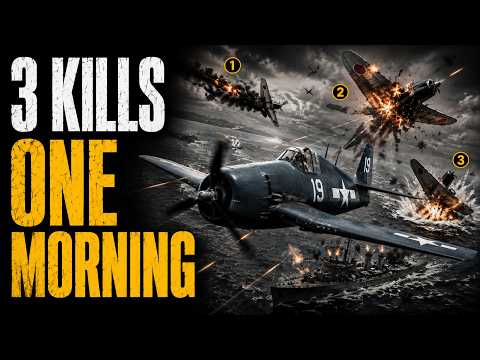
On the second aircraft, McFersonson managed to close the gap enough to fire and watch the float plane catch fire and go down before it could reach its target. It was his third confirmed kill of the war, though there was no time to think about numbers or records in the middle of a fight like this one.
Over the radio, the division leader gave a simple, urgent order. Split up. Get as many of these as you can.
There was no time left for coordinated attacks or careful formations. McFersonson understood immediately what the order meant for his own flying. He lowered his flaps, dropped his landing gear, and let his speed bleed away as much as he dared—trading the safety of a fast, maneuverable fighter for the ability to match pace with a slow, heavily loaded enemy aircraft, skimming just above the waves. It went against every instinct a fighter pilot carried, deliberately slowing down and lowering his gear in the middle of a combat engagement. But there was no other way to get a shot that would actually connect.
Not far from where McFersonson was fighting, one of the picket destroyers was living through the worst morning of its existence. The destroyer Luce, standing picket duty in these same waters, had already survived one kamikaze strike that morning when a suicide plane crashing nearby damaged her systems and knocked out electrical power to parts of the ship. Her crew had barely begun to assess the damage, working in the dark below decks to restore power and bring their guns back to life, when the sky delivered a second attacker before they had any real chance to recover.
A second kamikaze found her, slamming into her aft section while her crew fought to bring their guns back online. The impact tore into her engineering spaces, flooding compartments and jamming her rudder, leaving the ship unable to steer or fight back with anything close to her full strength. Within minutes, the destroyer was listing hard to starboard, water pouring into her hull faster than any damage control party could hope to contain. The order to abandon ship went out, and shortly afterward the Luce rolled and slipped beneath the surface of the water, carrying 126 of the 312 men aboard her down with her.
It happened only a short distance from where McFersonson and the rest of Wander 5 were fighting to keep more ships from suffering exactly the same fate—a stark and sobering reminder, playing out in real time just beyond the edge of their own fight, of precisely what was at stake every time one of these low, slow, heavily loaded aircraft slipped past the guns.
Word of a picket ship going down would not reach the pilots overhead in any clean or immediate way. There was no moment where someone radioed the details and McFersonson understood exactly what had happened a few miles off his wing. There was only the sense, shared by every pilot flying that morning, that time was the one thing none of them could afford to waste.
McFersonson had no way of knowing in the moment that a ship was going down nearby. He had only the fight directly in front of him—one float plane after another appearing out of the low haze over the water, each one demanding the same painstaking, nerve-wracking process of slowing down, lining up, and firing before it could reach a target of its own.
He spotted another group of enemy float planes ahead—six aircraft in a loose formation, all of them diving and turning erratically as their pilots tried to shake off the American fighters now converging on them from every direction. There was no possibility of an organized attack against a formation moving like that. It had become, in the truest sense, a chaotic dogfighting melee at wavetop height, with slow-moving suicide aircraft weaving in every direction and Hellcats diving and circling to find a clean angle on each one before it slipped away.
McFersonson picked out the nearest target and dove in, throttling back as much as he safely could. The Japanese pilot flying it was not going to make this easy. Even fully loaded with explosives, even flying an aircraft never designed for aerial combat, the pilot worked the controls—weaving left and right, trying everything he could to throw off McFersonson’s aim or force the American fighter to overshoot the way so many others had that morning.
There was something almost eerie about the sight—a slow, overloaded seaplane twisting and skidding through the air with a kind of desperate, improvised skill, its pilot fighting just as hard to complete his mission as McFersonson was fighting to stop him.
It did not work. McFersonson had learned his lesson from the first pass of the day, slowing his Hellcat down further than instinct wanted him to, closing the gap patiently instead of rushing the shot. When the float plane finally steadied for a fraction of a second, he opened fire. The rounds found their mark. The aircraft caught fire and dropped into the water in a plume of spray and smoke—McFersonson’s second kill of the day and his fourth of the war.
There was no time to savor it. One more float plane from the same group was still bearing down on the fleet, still flying steady and true toward an American destroyer that was rapidly running out of room to maneuver. Around McFersonson, the sky remained full of aircraft and gunfire—other Hellcats from Wander 5 diving and turning against their own targets, tracers crisscrossing low over the water in every direction. It was, in the truest sense, a swirling melee rather than a series of clean individual duels—the kind of fight where a pilot had to track his own target while staying aware of a dozen other threats moving through the same crowded stretch of sky.
McFersonson understood in an instant that this was the one that mattered most. The destroyer nearby was already opening fire, tracers arcing up from its deck toward the incoming aircraft. And if McFersonson could not bring this one down before it reached the ship, there might not be another chance. With the Luce already gone beneath the waves not far away, the cost of failure here was not an abstract number. It was hundreds of men standing at their guns on a ship that had no idea whether the fighter closing in from above would reach the target in time.
He pushed the throttle forward, accepting the risk of closing too fast in exchange for the speed he needed to catch the float plane before it reached the destroyer. There was no time left to lower his flaps and gear the way he had for the earlier kills. No time to slow to that careful, patient pace that had worked before. This shot would have to be taken fast, on the enemy’s terms rather than his own, with a closing speed that left almost no margin for a missed calculation.
He timed his approach against the enemy aircraft’s own movements, watching it weave and correct, adjusting his aim to lead the target rather than chase it. Below him, the destroyer’s guns kept firing, shells bursting in the air around the incoming plane—the ship’s own crew fighting for their lives in the last seconds before impact, every gunner on that deck aiming at the same target McFersonson was now diving toward from a completely different angle.
McFersonson closed the distance, brought his guns to bear, and fired.
His .50-caliber rounds tore into the float plane just short of the destroyer’s hull. The aircraft exploded on the surface of the water. Close enough that the destroyer’s crew must have felt the shock of it through the deck plates beneath their feet. Close enough that for one suspended moment, nobody on that ship could have said with certainty whether the explosion belonged to the enemy plane or to their own hull.
It was over as quickly as it had begun. McFersonson pulled his Hellcat up and away, banking low over the destroyer he had just protected—close enough to see men on deck, still crouched at their guns, still scanning the sky for the next threat. He did not know their names. He would not learn what that morning had truly meant to them for many years to come. But in that moment, climbing away from a ship that was still afloat because his rounds had found their target with only seconds to spare, he had done exactly what he had been sent up to do.
The rest of Wander 5 fought through the same chaos in the minutes that followed, each pilot adding kills of his own against the remaining float planes, until the last of the attackers in their sector had either been shot down or driven off. By the time McFersonson turned back toward the Essex, his fuel and ammunition running low after a morning that had asked more of him than almost any mission before it, Fighter Squadron 83 had accounted for a substantial share of the aircraft thrown against the picket line that day.
It had not been enough to save every ship. The Luce was gone, along with 126 of her crew, and other vessels nearby had taken damage from attackers that slipped through despite everything the Hellcats could do. But for the destroyers that Wander 5 had managed to shield in time, the difference between survival and disaster had come down to a handful of seconds, a handful of shots, and pilots willing to fly slower and closer than instinct told them was safe.
McFersonson brought his Hellcat down onto the deck of the Essex that afternoon with three confirmed kills added to his record for the day alone—five in total, counting the two Val dive bombers from weeks before. It was enough, though he did not know it yet in any formal sense, to make him an ace: one of a small number of pilots credited with five or more aerial victories in the war.
The deck crew who caught his Hellcat’s tail hook that afternoon had no way of knowing what the young pilot climbing out of the cockpit had just been through, and McFersonson himself had little energy left to explain it. His flight suit was soaked through with sweat, his hands still carried a faint tremor from hours of gripping the stick through violent low-altitude maneuvers, and his mind was still replaying the last seconds before that final shot found its mark.
As the deck crew guided his fighter to a stop and he climbed down from the cockpit, legs unsteady after hours of tension in the air, McFersonson was not thinking about numbers or titles. He was thinking about the ship he had circled low over on his way home, the men he had seen crouched at their guns, and the destroyer that had gone down not far away, with so many of her crew still aboard her when she slipped beneath the waves.
Other pilots from Wander 5 were landing behind him, each one carrying their own version of the same morning. And for a while, none of them said very much to each other at all. There would be time later for debriefings, for combat reports, for someone in the squadron office to add up the kills and make the numbers official. In that first hour back aboard the Essex, there was mostly just the quiet, bone-deep exhaustion of men who had spent the morning deciding, again and again in fractions of a second, who would live and who would not.
The days after the fourth of May folded back into the routine of the Okinawa campaign, though nothing about that routine ever felt entirely ordinary again. Fighter Squadron 83 kept flying, kept covering the picket line, kept answering calls for close air support over the island, where the ground fighting continued to grind forward yard by bloody yard. McFersonson flew mission after mission in the weeks that followed, but none of them carried quite the same weight as that single morning. Nothing else that spring would ask so much of him in such a short and unrelenting stretch of time.
By the time his combat tour ended, Don McFersonson had logged 79 days in combat and stood credited with five confirmed aerial victories—the two Val dive bombers from early April and the three float planes from the fourth of May. Five kills was the threshold that separated an ordinary fighter pilot’s record from something the Navy formally recognized as the mark of an ace, a distinction earned by only a small fraction of the men who ever strapped into a fighter cockpit during the war. McFersonson had not set out to chase that number. He had simply flown the missions in front of him, one after another, doing the job the Navy asked of him on whatever morning it happened to ask it. The title came afterward, almost as an afterthought, attached to a record built one dangerous encounter at a time.
He came home from the war, still a young man, not yet twenty-five, carrying a combat record that would follow him for the rest of his life without ever fully explaining itself to the people around him. Like so many veterans of his generation, McFersonson did not spend the post-war years dwelling publicly on what he had seen and done in the skies over the Pacific. He built a life. He returned eventually to the kind of quiet rural existence he had known before the Navy, settling in Nebraska, not far from the farm country where he had grown up, watching a sky that had once seemed like the biggest thing in the world.
The transition from carrier decks and burning aircraft to the slower rhythms of civilian life was one that thousands of young veterans faced in those years, each of them working out in their own way how to fold a war into the rest of a life that still had to be lived. For McFersonson, that meant a return to the land and the community that had raised him—a world measured in seasons and harvests rather than missions and kill counts. He rarely spoke in those early years about the specifics of what he had done over Okinawa. The men who had flown with him understood without needing to be told. Everyone else simply knew he had served in the same general way an entire generation of American men had served, without necessarily grasping the particular mornings that had shaped him most.
But one question from that morning off Okinawa stayed with him in a way that combat statistics never could. He had seen the destroyer he protected in those final seconds, seen the men crouched at their guns as he banked low over the ship on his way back to the Essex, and he had always wondered—in the quiet way a person wonders about something they will probably never learn—what had happened to those sailors. Whether the ship had made it through the rest of the war. Whether the men he had glimpsed for only a few seconds from the cockpit of a Hellcat had gone on to live full lives, or whether that morning had been merely one more brush with death among many still to come for them.
The answer arrived decades later, and in a way McFersonson could never have arranged for himself.
Sometime around the mid-1950s, roughly ten years after he left the service, a writer researching the war contacted him—one of several veterans he had helped over the years by answering questions and filling in details for a book project. McFersonson assumed, after their initial conversations, that his part in the writer’s work was finished. Then one day the phone rang again.
The writer told him he had located a man named Art Jones, a gunner who had served aboard one of the destroyers Wander 5 had defended that morning off Okinawa—and that Jones wanted very much to speak with him. McFersonson agreed without hesitation. He had spent years willing to talk with any veteran who wanted to talk with him, and this, he understood immediately, was no ordinary veteran.
When Art Jones called, he did not waste time on small talk. According to McFersonson’s own account of the conversation, Jones told him plainly that the pilots of Wander 5 had saved his ship and everyone still aboard her that day. The destroyer had already been hit once before McFersonson’s flight arrived, Jones explained—an earlier strike that had killed eight of the crew and left the ship damaged. A second hit, Jones told him, almost certainly would have sent her to the bottom, the same fate that had already claimed the Luce and her crew not far away that same morning.
Instead, the second attacker had gone down just off their deck, close enough that Jones and the rest of the gun crew had watched it happen from only yards away. Jones remarked more than once in that conversation on how brave it had seemed from the deck of the ship—watching a Hellcat pilot come down low and close in on a target while the destroyer’s own guns were still firing in the same direction, with no guarantee that stray rounds from either side would not find the wrong target. McFersonson, hearing this decades after the fact, could only think that the sailors on that ship had clearly been fine marksmen themselves, since none of Wander 5’s Hellcats had come home that day carrying holes from friendly fire. It was the kind of small, almost wry observation that only made sense to men who had lived through the same chaotic minutes from two entirely different vantage points—one from the cockpit and one from the deck—and had spent years afterward turning the memory over without ever quite being able to share it with anyone who truly understood.
Not long after that phone call, the destroyer’s crew held a reunion of their own, gathering the survivors of the ship for the first time in years to remember what they had lived through together. As part of that gathering, someone thought to send Don McFersonson a large photograph of the ship he had helped save. And on it, gathered around the image of the vessel, were 39 signatures—men who had been standing at their posts that morning in May, and who wanted the pilot who had circled low over their deck to know that they remembered him, too.
McFersonson kept that photograph for the rest of his life. He would say in later years that the moment he received it gave him a feeling he struggled to put into words—a quiet certainty that whatever else that war had cost him, he had been in the right place at the right time to spare a group of strangers from something far worse than what they had already endured.
Don McFersonson lived a long life after the war, long enough to become, in the eyes of historians and veterans organizations alike, something increasingly rare. As the years passed and the ranks of World War II veterans thinned, the small number of men formerly recognized as aces from that war thinned along with them—decade by decade, funeral by funeral—until the list of names that had once numbered in the hundreds shrank to a handful and then finally to just one. Don McFersonson held that distinction for the final stretch of his remarkable life: the last confirmed American fighter ace of the Second World War, still walking the earth, a direct and living link to a war that had otherwise passed entirely into history and memory.
In his later years, McFersonson became something of a quiet celebrity within the small circle of people who still cared deeply about that history—veterans groups, museum curators, historians chasing the last living voices who could describe what it had actually felt like to sit in the cockpit of a Hellcat over the Pacific. He gave interviews when asked, spoke plainly and without embellishment about what he remembered, and never seemed entirely comfortable with the idea that his survival into old age had made him, almost by default, a kind of living monument. He had simply outlived the others. That fact alone, more than anything he had done in the cockpit, was what people now wanted to ask him about.
On August 14, 2025, Don McFersonson died at his home in Adams, Nebraska, at the age of 103—in the same small farming community where his story had begun so many decades before, as a boy who had never flown a plane and could not have imagined the sky he would one day command. His funeral was held five days later, on the nineteenth of August, in the same town, among the same flat, endless country that had shaped him long before the Navy ever did. With his passing, America lost its last living link to that particular chapter of the war—the final ace of a conflict that had once asked ordinary young men to do extraordinary things, and had, in more cases than anyone liked to remember, never let them come home to tell about it.
Don McFersonson came home. He carried the memory of that morning off Okinawa for the rest of his 103 years. And in the end, it was not the kills or the title of ace that seemed to matter most to him, but the photograph with 39 signatures—proof that somewhere out on the water on the fourth of May, 1945, his split-second decisions had let dozens of strangers live to sign their names.
So here is the question worth sitting with: when the moment comes—the one you never trained for, the one where the margin is measured in seconds and the cost of hesitation is someone else’s life—would you have the nerve to slow down, fly closer, and take the shot?
Report this article
Select a reason for reporting:






