The morning of June 6, 1969, began with a single rocket. At 8:25 AM, a Viet Cong fighter knelt at a second-floor window of a schoolhouse in the village of Binh Ba, 4 kilometers north of the Australian base at Nui Dat. He aimed an RPG-2 at a Centurion tank rolling down Route 2. The rocket struck the turret — and bounced off. Inside the tank, the crew heard a hollow ring. The gunner, 20-year-old Mick Healey, traversed the main gun toward the school. Then he stopped. There were children in there yesterday.
That hesitation — a gunner’s memory of waving at kids in white shirts — would define the next six hours. The rocket gunner was reloading. Behind him, six more Viet Cong moved into firing positions. They had planned to ambush a truck convoy, not a 52-ton tank. Within minutes, Major Murray Blake radioed Lieutenant Colonel Colin Khan: enemy platoon inside a village of 1,000 civilians. Khan had two choices: call in artillery and air strikes, or send his men house to house. “Do not become the man who burned a village,” his predecessor had warned. Khan chose the harder path.
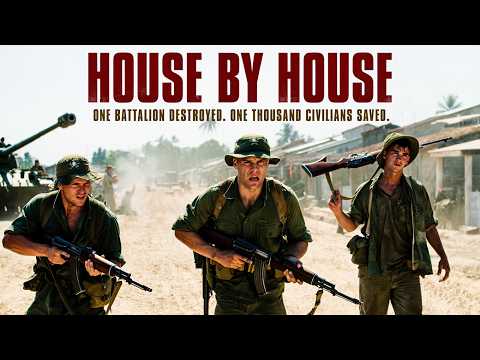
By 9:00 AM, Australian infantry were dismounting from APCs, moving toward the village edge. The Viet Cong watched in disbelief. They had been told Australians never fight in built-up areas. They were wrong. Corporal Jim Duffy’s section led the clearance. They entered the first house through a door already blown open by a tank round. Inside, a dead rifleman. A chicken walking along the back wall. Engineers placed a small charge against the interior wall — mouse holing, they called it. Blow a hole, clear the next room, repeat. The streets were killing grounds; the houses were the only way forward.
By noon, over 800 civilians had been evacuated to the pagoda. The village chief walked house to house with an interpreter, telling families to leave everything. Two men at the pagoda gate were searched and found carrying weapons. The fighting raged in the square. Tank gunner Healey fired 19 rounds. His ears rang with a high tone that would never leave him.
Then came the school. The largest building in the village, two stories, held an estimated 30 Viet Cong. And in its cellar: 140 kilos of explosives, dud howitzer rounds, two aerial bombs. A single tank round would level the village. Khan looked at Blake. “We have to take it room by room.” Blake nodded. “Who is the best you have got?” “Duffy.”
At 1:20 PM, Duffy stood before Khan, sweating, white-faced, four hours of house clearing behind him. He had killed at least four men at point-blank range. He had not eaten since dawn. Khan told him the school could not be shelled. A section would have to enter on foot. “Can you do it?” Duffy took a long time to answer. “Yes, sir.”
Duffy’s men approached through mouse holes, crossed the playground, and entered the back door. A body in the corridor. A classroom with small desks. On the blackboard: the date — June 5, 1969. Yesterday. The day before everything changed. They cleared the ground floor, then the stairs. A fighter stepped out, fired. Watson fell, hit in the chest. Pellerini killed the shooter. Duffy pushed on. Upstairs, a closed door. He kicked it open. Inside: three men. One was the rocket gunner from the morning, half-loaded RPG in hand. Duffy fired. Pellerini fired. The room went silent. On the wall, a school timetable in colored chalk: Monday, Tuesday, Wednesday.
By 2:15 PM, the school was clear. Seven Viet Cong had surrendered; five had not. Duffy walked out to the playground. He looked at the swing set. Then he radioed Blake: “School clear.” The engineers went into the cellar at 3:00 PM and found exactly what the chief had warned. They removed the explosives over four hours. The next morning, they detonated them in a controlled blast. The crater was still visible 27 years later.
By 4:00 PM, the village was quiet. The civilians emerged from the pagoda. The chief told Khan: “No civilian has been killed.” Khan asked him to repeat it. He did. 842 adults. 190 children. Every family accounted for. The chief said, “You did not bring them here. They came here. You came after them.” Khan did not reply. He walked back to his command post.
The final count: one Australian killed — Private Wayne Teeling, 19, from Maitland, six weeks in country. Ten wounded. Approximately 100 Viet Cong dead. The village of Binh Ba survived. The school was rebuilt. The children returned. But the boy from Maitland never came home. And the gunner who hesitated — who remembered the children in white shirts — would carry the ringing in his ears for the rest of his life.
This is the story of how a split-second decision and a gunner’s memory saved a village — and what it cost the men who fought there.
Thirty years later, Mick Healey stood at the edge of the same playground. The school had been rebuilt. The flag pole was new. A small girl in a white shirt and dark shorts was being pushed on a swing by her older sister. He watched for a long time and did not speak.
When he returned to Australia, he told his own daughter, then twelve, what he had seen. “I had been frightened the village would not exist anymore,” he said. “I was wrong to be frightened. The village was still there.”
In 2009, Australian and Vietnamese veterans met in the square for the fortieth anniversary. They shared a meal in the pagoda courtyard. A former D440 corporal, Tran Van Hue, said through an interpreter that he had spent forty years thinking about the day the tanks came. “We expected the artillery,” he said. “When it did not come, we knew what you were doing. You came into the houses on foot.”
Duffy, the carpenter from Jalong, said nothing for a long time. Then: “I am sorry about your brother.” The Vietnamese veteran replied, “I am sorry about the boy from Maitland.”
They sat together as the sun went down behind the rubber plantation. The lights came on in the houses. Children ran between the market stalls, chasing one another the way children had chased one another in that square on the morning of June 6, 1969, before the first rocket left the second-floor window of the school.
The histories record the order of battle, the rounds fired, the casualties on each side. They do not record the swing set, or the timetable in colored chalk, or the moment a lieutenant colonel and a major decided the howitzers would not fire. But that was the battle. That was Binh Ba.
So tell us — when the histories are written, should they remember the decisions that were never made?
Report this article
Select a reason for reporting:






