At exactly seven o’clock on a Friday morning, three companies of Australian soldiers stepped over the start line and walked upright toward a row of Japanese bunkers. Light tanks moved with them. Fourteen days earlier, on December 4, 1942, General Sir Thomas Blamey, commander of the Australian Army, had written to his prime minister about the Americans at Buna. They sat down and hardly made a step forward. Forty days after that walk, a Melbourne newspaper quoted the American general in charge of them: “I know of no better soldier than the Australians who fought under my command.”
How does a general go from that letter to that sentence? And was he right?
The story begins in Rockhampton, Queensland, on Sunday, November 29, 1942. Lieutenant General Robert Eichelberger, commander of the U.S. I Corps, was training the 41st American Division in jungle warfare on a quiet summer day when two messages arrived. The first said: prepare. The second, late that night, said: move out.
He landed at Seven Mile airfield outside Port Moresby late the next afternoon with his chief of staff, Brigadier General Clovis Byers, six staff officers, his aide, and nine soldiers. They were told to expect four or five days of briefings. They had barely reached their rooms when orders came to see General Douglas MacArthur.
MacArthur stood on the long veranda of Government House with air commander General George Kenney and chief of staff General Richard Sutherland. Sutherland had just returned from Dobodura. He sat at his desk, rigid, unsmiling. MacArthur did not sit. He paced. He said that American troops had thrown down their arms and fled from the enemy. He had never been so humiliated in his life. The division commander, Major General Edwin Harding, had failed, and Eichelberger was to take his place and his commanders’ places, or, MacArthur said sharply, “I’ll take charge of them myself, and you too.”
The official Army history records what he said next: “Go out there, Bob, and take Buna, or don’t come back alive.” He pointed at Byers. “And that goes for your chief of staff, Clovis.”
The next morning, MacArthur was relaxed and friendly over breakfast. He told Eichelberger: “Take care of yourself, because a dead general is no use.” “If Buna falls, it will mean the Distinguished Service Cross.”
Eichelberger landed at Dobodura airstrip at 10:52 a.m. on December 1. By 1:00 p.m., he was commanding all American soldiers at Buna. What did he find? The official Army history says: “The troops were suffering from severe malnutrition. Their average food since the fighting began had been about one-third of a C ration per day. Their shoes had shrunk in the rain, and they had to cut them open so the men could get their swollen feet into them.”
The visiting doctor, Major Roger Egeberg, told Eichelberger, within earshot of General Harding, that the men looked like Christ taken down from the cross. His intelligence officer, Colonel Gordon Rogers, toured the battlefield and took notes. Of two thousand men in the combat area, 150 were in the front line. “The rest,” he reported, “cannot even be considered reserves.”
Eichelberger would add years later that Rogers’s picture was not quite accurate. “Their weapons jammed because artillery oil arrived in containers too large to distribute. They had no tanks, no grenade launchers, no flamethrowers. Mortar and artillery fire and bombing seemed to have no effect on the Japanese bunkers. So the only way in was to crawl as far as possible under machine-gun fire and rush the firing slit with a grenade.” One man who was there said: “Far more failed than succeeded, but most of the time there was no other way.”
On December 2, Eichelberger climbed forward to see for himself. His aide, Captain Dan Edwards, crawled on his belly to the edge of Buna village and returned without a single shot being fired at him. That increased the general’s anger at the troops. At Colonel Mott’s command post, he exploded. He commented on the unwounded men in the aid station and the abandoned machine guns in the open. He said he was not sure the troops had fought at all. Mott remembers hearing him say: “You’ve been defeated.” Mott defended his men fiercely. When Mott finished speaking, Harding threw his cigar on the ground. That evening, Eichelberger took command of the division, replacing Harding, and Brigadier General Albert Waldron took command of the regiment.
Eichelberger would later tell the troops that he had not realized the size of the challenge they faced. The Australian commander-in-chief had already made up his mind. At Government House, about five days before Eichelberger arrived, Blamey told MacArthur that the Americans were not making the required fighting effort. General Kenney recorded it and saw it as a hard thing for MacArthur to accept. Harding’s notebook contains his own answer, given to Sutherland at lunch. He said: “The failure of the division to make any progress was not due to any lack of effort on our part.”
On December 4, Blamey put it in writing in a letter to his prime minister. He said the fighting had revealed the truth that American troops could not be classified as an offensive force. They were certainly no match for the Australian militia, and from the moment they met resistance, they stopped advancing and did not move an inch. Blamey reported MacArthur’s plan to relieve regimental commanders and five of six battalion commanders in the face of the enemy. Blamey told his prime minister of the Allied plan to sack their colonels in the middle of battle. Then he stated it plainly: “My faith in the militia is increasing, but my faith in the Americans has collapsed completely.”
Eichelberger took command of this army at 1:00 a.m. on December 1. Hungry, sick, poorly armed, and written off by the ally on the other side of the mountains. Within two weeks, he would agree to appoint an Australian brigadier over his battalions.
Buna is not a town. It stretches for a few miles along the coast, with a village, a mission station, a government center, two airstrips, and a coconut plantation. It is isolated by swamp. The Japanese turned it into a fortress. Their bunkers were built of coconut logs a foot thick and lay so close to the ground that 25-pounder shells were often ineffective. The bunkers were connected by trenches. They were covered so heavily with grass and branches that Eichelberger wrote they were almost invisible in daylight.
How many Japanese were there? The American troops were told to expect a few hundred sick and hungry men. An Army historian later estimated the garrison at about 2,200 soldiers when the first attacks began. Eichelberger, writing years later, remembered 3,000. By the end, 1,400 Japanese would be buried at Buna.
On December 5, he advanced himself. On the right, at Warren Front, five Australian Bren gun carriers led the attack. Half an hour after they started, all were out of action. On the left, at Urbana Front, Eichelberger walked through a company stuck in the grass under the roar of Japanese machine guns. He talked to the men as he walked: “Come on, you men.” And they did. He wore three stars on his collar in a place where regulations forbade officers to wear rank in the front line. He was glad of it. How else were these sick and dispirited soldiers to know their commander was with them?
General Waldron was shot in the shoulder that day. His aide, who had crawled to Buna village, was also wounded. The same day, an American platoon found a gap in the Japanese line. Sergeant Herman Bottcher of Company G, 126th Infantry, led his platoon across the sea to a narrow sand strip between Buna village and Buna mission. He had 18 men and one machine gun. His men dug in all night. He guessed the Japanese could not attack from both sides at once, and he was right. At dawn, the enemy attacked from the village, and the machine gun stopped them. Later, the enemy waded in from the mission through the shallows, and Bottcher, his hand on the hot gun, mowed them down. The bodies floated to the beach and… the tide went out for days. Photographs of the dead would give the place the name Worm Beach. Bottcher was born in Germany, left for America in the early thirties, and later went to Spain to fight Franco. On Eichelberger’s recommendation, he would be promoted to captain.
When Byers reached the sand strip and asked what the platoon needed, one soldier did a half-somersault to show that the swamp water had ruined his trousers. He said: “Trousers. My God, General, trousers!” These were the soldiers Blamey said had sat down and not made a step forward. His letter reveals half the truth.
Then came the food. The Americans were living on a third of a ration, and the man who set out to solve this problem was Colonel George De Graaf, Eichelberger’s supply officer. Eichelberger was careful to explain why. He says the fundamental fact was inadequate transport. But De Graaf’s account is documented. The Australians were, without question, responsible for supply, and De Graaf felt strongly that our troops were not receiving a fair distribution of available transport. De Graaf went to General Ennis Whitehead, commander of American air forces—a different Whitehead from the tank commander who came later—and asked him a direct question: if Owen Stanley aircraft surrounded his troops for three or four days, wouldn’t his troops starve? Whitehead placed every available American transport plane at his disposal, and within three days, the reserve at Dobodura reached 300,000 pounds. The Australians were furious with De Graaf, but the storm subsided. General Herring appointed De Graaf responsible for both Australian and American depots. And so, before mid-December, Australians and Americans were already clashing over transport, and not a single battalion of the Australian brigade on its way to Buna had arrived. Two weeks taught him this lesson well. His men would fight even if someone stopped them. Japanese bunkers would not surrender to rifles and grenades and the weight of a division without tanks. The one thing missing, armor, belonged to the army that had abandoned its men.
Buna village fell on December 14. The bunkers on the point, the plantation, and the strip beyond remained intact. Brigadier George Wootten was on Goodenough Island off the eastern tip of New Guinea when Blamey summoned him on December 8. Two days later, in Port Moresby, he received his orders. Take the 2/9 Battalion, a battalion of the 7th Brigade, and two companies of tanks, and head for Buna. Wootten asked for the 2/10 Battalion, one of his own, instead of the 7th Brigade battalion. Blamey agreed. The 18th Brigade was the 2/9, 2/10, and 2/12 Battalions. Eichelberger would describe them in his memoirs as sun-browned from the desert sun, men of the famous Tobruk Rats brotherhood. He added a warning: they were brave, experienced soldiers, but they were also strangers to jungle fighting.
Wootten flew to Popondetta on the 11th and met General Herring. Then he went to Dobodura, where he met Eichelberger. The next day, the 12th, a meeting was held. Wootten, Herring, Eichelberger, Byers, and Herring’s chief of staff, Brigadier Hopkins. What they decided was simple. Wootten would take command of Warren Force sector, including the American troops already there. Eichelberger recounts it in his memoirs. In combat terms, Brigadier George F. Wootten was to command Australian troops, and because he was senior to Colonel Martin, he proposed that he take command of the American right wing, which we called Warren Force. He proposed it. Twelve days earlier, MacArthur had ordered this man to take Buna or not come back alive, and on his second day, he had relieved the American division commander himself. The Australian commander-in-chief had written off the Americans in a private letter to his prime minister. And here he was offering American battalions to an Australian brigadier.
At 9:00 a.m. on December 17, Wootten took command. Colonel Clarence Martin, the American who had been controlling the sector, became in effect the commander of Wootten’s American troops. Under their command were Colonel McNab’s battalion of the 128th Regiment, Major Gordon Clarkson’s battalion of the same regiment—a young, handsome regular soldier who had formerly been on Eichelberger’s staff—and Major Beaver’s battalion of the 126th Regiment. The stated reason was rank: a brigadier is senior to a colonel. But for an army that had been fighting for a month, placing its battalions under foreign command meant admitting that the other army possessed what it needed to fight. Not every American officer was happy serving under Australian command. To the west, where the 126th Infantry had crossed the Girua River in November and come under Australian command by geography, Eichelberger notes that this geographical error caused great resentment among officers of the 32nd Division, and their attitude was understandable. The brigade he brought was weak. On December 16, the day before Wootten took command, the 2/9 Battalion consisted of 26 officers and 638 soldiers, 127 of them recent joiners. Nearly one in five was a new man.
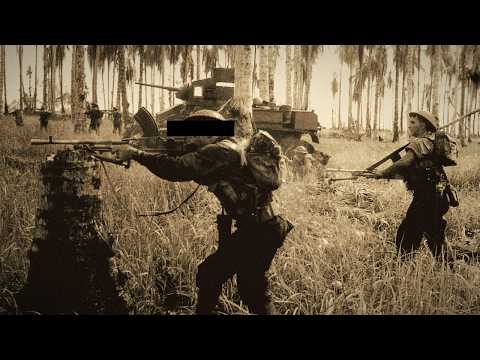
What Wootten brought with him was a machine. Seven light General Stuart tanks, each weighing 14 tons, with a 37mm gun and machine guns. They were brought by sea, secretly, from Port Moresby and Milne Bay, and landed at Hariko, a few miles from the battlefield, with very little equipment to do so. General Herring would describe the landing as an amazing feat. They were formed ad hoc into X Squadron under Captain Whitehead, a farmer from Orange in New South Wales, with their regimental commander, Lieutenant Colonel Hodgson, tall, thin, and aloof, at Wootten’s headquarters. Eichelberger says in his memoirs that the Australians called them Matildas. They were not. The official Australian historian has a better description. Dudley McCarthy writes that the Stuart tanks were like racehorses tied to heavy plows, fast and light, and in the country of Buna, nearly blind.
On the night of the 17th, Corporal Ivan Barnett crawled out of the American positions with Lieutenant McIntosh to find a Japanese position well fortified with trees. Barnett was 22 years old, a medical student from Bellevue Hill. McIntosh was a clerk from Townsville. They found it. The next morning, between 10:00 and 7:00, the guns opened. On Friday, December 18, the four guns of Captain Manning’s 2/1 Field Regiment opened between 10:00 and 7:00, searching for a log barricade that had long blocked the American advance. The aircraft that were supposed to cover the tanks’ approach the previous night did not arrive. The Australians began moving to their assembly positions at 5:30. Shortly after, Colonel McNab pulled his American soldiers back from the start line to make room. At exactly 7:00, the attackers crossed the barricade. Three companies of the 2/9 Battalion led by Lieutenant Colonel Cummings. Captain Griffin on the right heading for the point with three tanks led by Lieutenant McRae. Captain Taylor in the center with a platoon led by Lieutenant Curtis. Captain Barbour on the left flank without any tanks.
Dudley McCarthy, the official Australian historian, writes of that walk. For the watchers, it was an unforgettable picture as the three companies walked upright with apparent coolness straight toward a line of strong points that stretched like an invisible ribbon before them from the sea to the end of the strip. Eichelberger would write of it too. It was a magnificent, inspiring, and brave attack. And behind the tanks, the old Australian fighters, tall, mustached, upright with their blazing Tommy guns swinging before them. On the right, Lieutenant McIntosh’s platoon went in beside Corporal Bonnet’s tank. The log post they had crawled out to find the night before was their first objective. Tank explosions and McIntosh’s men finished the job with grenades. Corporal Thomas, a horse breaker from Townsville, received a grenade burst that nearly hit his face. As blood streamed from his face, he charged and killed two Japanese soldiers. He grabbed a Bren gun by its muzzle, pulled it through the slit, and killed its user with it. He stayed in action for two more days until ordered to withdraw.
The first Australians reached the point by 10:08. Barbour’s men, who had no tanks, walked into the part of the line that no one had breached. In less than 10 minutes, and advancing about 100 yards, the company lost 46 of its 87 men. Lieutenant De Fanti was killed with all his sergeants and section leaders but one. Captain Whitehead, commanding the squadron from inside his tank, spotted a sniper in the fronds. He ordered his gunner, Private Gordon Bray, a salesman from Balgownie, to bring down the tree. The second 37mm round cut through it as if it were paper. About an hour later, Whitehead responded to a call from Barbour and ordered a soldier to jump on his tank and fire a rifle through the vision slit from inches away. The bullet and steel splinter tore through Whitehead’s face and raised arm, costing him the sight of one eye. Two infantrymen guarding the tank killed the soldier. Lieutenant Colonel Hodgson, commander of the entire armored regiment, took command of the squadron. He looked out from the open turret to see what the future held. A burst of machine-gun fire raked his tank, and he fell back inside, severely wounded. It was not yet ten o’clock, and both senior tank officers were out of action.
Sergeant Jack Latimore’s tank overturned on a coconut log. The Japanese fired from beneath it to burn its crew. McRae radioed Corporal Barnett to go to their rescue, and Latimore was calling him too. Barnett had to reload his ammunition first, then went. He told his gunner. To ease the pain, they fired at point-blank range at the stuck tank, and the Japanese who had set the fires were driven off. Lieutenant Curtis’s tank got stuck on a log and burned. A second tank was lost later in the day to a magnetic mine. By one o’clock, Curtis, now in Sergeant Church’s tank, and two others reached Barbour. NCO Jesse moved between the tanks and fired very light shots at the Japanese positions to designate targets for the gunners. Around two o’clock, the desperate movement began and the Japanese collapsed. Eleven bunkers were cleared in half an hour. It was over by three. Between 80 and 90 Japanese lay dead around them. At least as many were trapped inside the smashed bunkers, and McCarthy recorded how they ended. The Americans, mopping up behind the Australians, blew any wretched survivors who remained inside.
Major Clarkson’s men also responded to Barbour’s call and crawled forward until they reached 30 or 40 yards behind the Australians, to help bring back the wounded. According to McCarthy’s estimates, casualties may have reached 11 officers and 160 soldiers, more than a third of the attacking force. Two tanks were destroyed. Eichelberger, who had not seen the Australian figures, estimated the casualties as higher. He says: “I never saw the official Australian figures, but I am sure the Australian battalion lost nearly half its fighting strength in killed and wounded. Nevertheless, the task was accomplished.” Neither figure is small, and the American general wrote that the task was accomplished by the equivalent of a battalion from another army. From 7:00 to 3:00, eight hours. The Japanese positions in the plantation that had long stalled the Americans on the coastal flank were overrun, and the point was in Australian hands. McCarthy gives the credit to the tanks. Despite their bravery, the infantry owed much to the tanks.
The next day, Eichelberger wrote: “The attack is moving toward the Buna mission.” He recorded the result. Now, the Allied forces on the right flank were finally on dry ground. No one at the cape thought the battle was over.
Private Jock Milne, of the 2/9 Intelligence Section, a fruit grower from Bowen in Queensland, born in Longside, Aberdeenshire, was shot by a sniper on December 20. He crawled but missed his platoon and found himself among the Japanese, who bayoneted him. As he lay dying, he wrote in a small notebook. McCarthy says the letters were formed irregularly by the pencil in his dying hand, making them look like the painful handwriting of a small child. On one page: “If I am dead when you find me, search the jungle around carefully for the wounded. Jack Allen is somewhere on my left.” On the opposite page: “Bombs are dropping around me, but I feel a bit happy about it.” Private Jack Allen, the man he was worried about, was found. He died of his wounds on the 29th.
On the 21st, the advance stopped again. And when the 21st came, it was clear the Americans had again failed to find any solution to their problems. The official Australian history did not soften it. Wootten ordered the two battalions of the 128th Regiment and the main part of the 2/10 Battalion to search Simemi Creek for a crossing. The solution came from an American. Major Gordon Clarkson suggested a bend in the creek northeast of the old lower strip. Lieutenant Colonel Dobbs of the 2/10 Battalion sent Captain Sanderson to search. At dawn on the 22nd, Dobbs came to see Sanderson, who was tired and had not come close to crossing. Sanderson said: “My platoon has patrolled all night, sir, and found nothing.” Dobbs was not convinced by this answer. You know what to do when your platoon commanders fail a task. Sanderson went himself, waded and swam the creek, and by late morning, Dobbs had established a bridgehead on the old strip. McCarthy was clear about the credit. Major Clarkson provided it.
At dawn on the 23rd, Captain Eward’s company of the 2/10 Battalion crossed the creek. McCarthy writes that the Japanese apparently considered the swamps and creek in their rear impassable. Positions that had defied the Americans for so long were abandoned with few casualties. American engineers under Second Lieutenant James Doughty, a brave and tireless young commander, began work on repairing the bridge for both infantry and tanks. An American idea, an Australian swim, an American bridge. If you want to keep the record of the men of Buna, Australian and American alike, subscribe and the next episode will come to your feed.
On Christmas Eve, Wootten sent four tanks up the old strip. Church on the right, then Latimore, Barnett, and McRae on the left. A Japanese anti-aircraft gun, waiting for them, engaged ground targets. McRae’s tank was hit first. He ordered the radio operator to warn the others: “Get out. The anti-aircraft gun is working.” But the radio failed. The driver said he couldn’t steer, and the tank fell into a hole. Barnett’s tank was hit. Corporal Jones was killed and Barnett’s arm was shattered. Latimore’s tank was hit. Private Forster was killed, Corporal Leggett was mortally wounded, and Latimore lost his leg. Church’s tank was hit. All four tanks, in MacArthur’s phrase, disappeared in this rapid and orderly destruction. The infantry was left bare.
That same morning, Captain Efler, who stood upright to face a sniper himself, was killed. Eichelberger woke on Christmas morning to heavy Japanese shelling. He wrote that his Christmas dinner was a cup of soup given to him by a kind doctor at a roadside hospital. On a trip to the front that day, he was accompanied by Merlin Spencer of the Associated Press, who could not, due to censorship, publish his name. Spencer wrote that the tall, gray-haired general commanding at Buna stopped constantly at stretchers to say: “Good morning, men. I just wish you were all home next Christmas.” His wife in North Carolina read his message at breakfast and wrote to Spencer that she knew her husband as the only general she knew who called soldiers “men.”
On that Christmas Day, the American advance did not go as expected. Urbana Force stuck in the kunai grass at the government gardens, and their commander lost contact with his forward units. One platoon of Company L, 127th Regiment, reached the sea, waited for reinforcements, got one officer and eight men, and withdrew. The next morning, he wrote to MacArthur: “I think the worst moments of my life happened yesterday.”
On the 26th, Private Hughes of the 2/10 Battalion, a laborer from Stonehouse Bay in South Australia, and an Aboriginal man, stood out even among his ferocious comrades, shooting and grenading defenders out of their trenches. That same day, Captain Mathers’s company captured an anti-aircraft gun on its concrete base and handed it to the Americans, which later annoyed Dobbs. Major Beaver, with one of Clarkson’s companies, captured the first of the two guns, silent and out of ammunition. Since the night of the 25th, a 25-pounder named Freddie One, under Sergeant Carson of the 2/5 Field Regiment, had been firing from an advanced position. On the 27th, its observer sat 70 feet up a banyan tree 1,300 yards forward. Major Trevethan, who was fighting from the gun positions at the end of the strip, later said of his shells: the drought had a visible effect on the top of the base. The Argus newspaper would report Eichelberger’s praise of Australian artillery accuracy.
At 2:00 a.m. on the 28th, Eichelberger listened from his tent to the reports. His soldiers, if the accounts were true, were suffering from battle shock and could not advance. Several of his senior officers were convinced the situation was hopeless. “I think I said, as I had said before: ‘Let’s not give in to our fears.'” “Nevertheless, I was very worried.” He asked himself a question. “Was Buna,” he asked himself, “an American military disaster?” At dawn, the front-line commanders on Urbana Front reported that the situation was not catastrophic but encouraging.
Meanwhile, Wootten was not satisfied with his American wing. On December 28, he told Colonel Martin that the Americans were leaving behind pockets of resistance, and that tactics of exploiting weaknesses did not mean leaving unknown strength centers behind. This was a complaint from an American officer in the midst of battle, and the commander of American forces replied: “For this sector.” That same day, Lieutenant Ruddell, an Australian soldier shot in the hip, insisted on staying with Matherson until his last wounded man reached an American medical station. That night, a Japanese patrol raided Clarkson’s company command post. McCarthy wrote: “The bodies of the dead and wounded, American and Australian, were scattered.” Ruddell was among the dead.
On December 29, the Australians misjudged, launching an attack at about 5:30 p.m. Major Tay’s tanks, just brought from Milne Bay, arrived hours late. When three finally appeared, the infantry rushed with them without the organized support they had been promised. The confused tanks aimed their guns at the soldiers in front. According to Captain Matherson’s account, Private Snowy Evans, a laborer from Adelaide, ran toward one tank and jumped on it as fire erupted around him, pounding on its armor to attract the crew’s attention. They seemed not to hear him. Of the 13 men who started with Sergeant Mitchell, only three remained. Captain Matherson’s company was reduced to about 22 of 46. McCarthy did not hesitate to criticize his own countrymen. The attack was a mistake in itself.
That morning, Wootten was impatiently criticizing Dobbs and the 2/10 Battalion. McCarthy wrote that Dobbs was sick, exhausted from stress, and grief-stricken over the loss of so many of his men. The citation did not mention it. Five days earlier, on Abau Front, the Americans suffered their losses. On Christmas Eve, Sergeant Elmer Burr of the 127th Battalion threw himself on a Japanese grenade to smother it with his body, saving his company commander at the cost of his life. Sergeant Kenneth Grahnat of the same regiment grenaded the defenders of the first position to death alone, then was wounded, moved on to the second position, destroyed his enemies, and fell dead from a shot by a nearby soldier.
On the night of the 28th, Lieutenant Colonel Arnold of the 2/12 Battalion landed at Oro Bay with 33 officers and 582 soldiers. Orders were issued on January 1 to attack the Giruwa point on a 400-yard front with six tanks under Captain May. At exactly 8:00 a.m. on New Year’s Day 1943, one man from each platoon carried a demolition charge of a kilogram of ammonal, a grenade, and an instantaneous fuse. Twelve medium machine guns fired at the treetops and drove out the snipers. On the right, Captain Kirk was killed and all his officers wounded, and messages could only be passed to and from his men by tank. On the left, Captain Murray and Lieutenant Logan were killed. Lieutenant Bowman led the dismounted transport drivers of the battalion, men who had driven trucks, in a series of fierce attacks. One position alone contained about 70 dead. The last position at Giruwa was reduced from 5 to 10 minutes on the morning of the 2nd. Two Japanese officers came out of a position on an island at the mouth of the Simemi River, and one saluted the sun. Arnold invited them to surrender and gave them until he counted to ten. At nine, the one who had saluted shouted: “and the Australians shot him!” The other was later found hanged.
Also on the 2nd, at 10:15 a.m., Captain William Dimes led his company of the 127th Battalion along the beach from the southeast through the coconut trees. He reached the tip of the land at 3:30 p.m. By 4:30, McCarthy wrote: “The government center is in American hands.” At the same hour, Eichelberger crossed the bridge from the island after Company G passed, and wrote in his diary that evening what he saw: “I saw American soldiers with their bellies out of the mud and their eyes in the sun.” He continued in the same diary: “That was one of the most magnificent sights I have ever seen in my life.” By evening, the American company trying to break through the front lines to join the Australians had succeeded, and the Buna operations were effectively over.
The cost. The official American history counts 620 killed, 2,065 wounded, and 132 missing at Buna, a total of 2,817 casualties. Of these, 1,954 were from the 32nd Division. The 18th Brigade lost 863 soldiers, including 267 killed. McCarthy gives a slightly different total, about 2,870 casualties, and the same number for the brigade, 863. McCarthy compares the brigade’s losses to its size. By his account, the brigade represented about a third of the American force for about a third of the time, and suffered 863 casualties. Compare that to 1,954 for the 32nd Division. A third of the men, a third of the time, and more than four Australian casualties for every 10 American. As for the Americans, of 10,825 soldiers of the 32nd Division in the combat area, 9,688 became casualties. 7,125 of them were wounded. The 126th Infantry entered with 131 officers and 3,040 soldiers. When it withdrew on January 22, only 32 officers and 579 soldiers remained. The Army historian writes that the regiment as an independent entity had ended. Both regiments were drained in Papua. And the general who commanded both on the front chose what to say about it.
At noon on January 3, Eichelberger told the American troops in the Buna area in a memo that they were now veterans. Later that day, the Australian commander-in-chief sent his personal message to Brigadier Wootten and the troops serving under him on Warren Front. These troops included American battalions. Blamey’s message said their operations were marked by the utmost precision in planning, constant firmness in control, and courage and determination in execution. General Herring, the Australian commander of all New Guinea forces, issued a special order to Australians and Americans alike. You have done a job that our country can be proud of. Herring added a warning: the battle of Buna is only a step on the road. He was right. Sanananda was next, and the 18th Brigade headed straight for it.
Merlin Spencer could not publish Eichelberger’s name at Christmas. There was a sergeant’s law. Eichelberger writes that censorship was very strict during the Papuan campaign. Australian and American forces were always allied forces. Divisions and their commanders, brigades and colonels were completely unknown. Yet, Eichelberger writes that on January 11, they heard on the radio from San Francisco an announcement that Brigadier Wootten would attack with his tanks the next day. That was exactly the plan. Wootten and the 18th Brigade attacking north from Soputa. The Japanese were ready. By noon, Wootten’s tanks were destroyed, and the 18th Brigade was repulsed. On the 13th, Eichelberger took official command of all Australian and American forces on the front. During those weeks, he asked Wootten to attack the leadership positions at Sanananda, where many attacks had been repulsed. Wootten was silent for a moment, then answered: “If you want me to attack, I will attack. I like the lucky man.”
Then the opportunity came. Eichelberger ordered intense patrolling, and the patrols found Japanese soldiers with full kit heading toward Cape Killerton. The evacuation of those fit to fight had begun. He ordered an attack with all available strength. The Australians attacked the enemy frontally, while the Americans infiltrated from the rear. By the morning of the 15th, the Japanese force at the top of the position had been eliminated. Wootten reached the sea, then turned south along the coast, and on the 18th joined the American 127th Infantry under Colonel Merle Howe. On the 22nd, all organized resistance in Papua ended. Exactly six months after the campaign began.
At Sanananda, the 18th Brigade lost a total of 426 men, including 155 killed. Adding the Buna casualties, the total losses for one brigade reached about 1,300. On January 24, Eichelberger and his officers flew to Port Moresby. He wrote that the gracious Ned Herring “received us with the utmost warmth.” A press conference was held with Australian journalists, and Eichelberger used it to praise the heroes of the Wirraway pilots, whose work he believed had not been fairly recognized. Then they took off back to Australia. On the plane, Eichelberger wrote a letter in pencil to his wife. “I have received many compliments from Australians and friends. But success in your eyes is a hundred times more important than the words of others.”
Two days later, on Tuesday, the Melbourne Argus correspondent, Mervyn Weston, sent an article dated somewhere in New Guinea. The paper published it on Wednesday, the 27th, on page two. Its main headline: “American General Praises Australians.” Its subheading: “Heroism at Buna.” Weston reported that Lieutenant General Robert Eichelberger, whom he identified as commander of American forces at Buna, described the Papuan campaign as a military nightmare. The general said the difficulties overcome by the men who besieged the Japanese beach strongholds were “indescribable in their intensity and violence.” Then came the statement: “I know of no better soldier than the Australians who fought under my command.” Immediately after, the Australian tank regiment, fighting its first battle, performed magnificently, and the support it received from Australian and American infantry and engineers was amazing. Our men have learned lessons that bode ill for the Japanese in the future. The Western report particularly praised the warm friendship and understanding cooperation the general received from MacArthur and Blamey. It also warmly praised Herring, Vasey, and Brigadier George Wootten. It said of them all: “They gave us their leadership, friendship, and cooperation in quantities we did not expect. The relationship and wonderful mutual understanding during this campaign was remarkable and amazing. It achieved something that would not have been achieved anywhere else in months of cooperation.” Blamey, by name. The man who wrote the letter of December 4. Weston adds that the general holds the deepest respect for the Australian artillerymen who showed superb skill in battle and were extremely accurate. The general also mentions the other half of the matter. Of course, we had to learn lessons. That was the first combat experience for the Americans. We had to overcome positions that could not be outflanked and could not be shelled. But we killed far more of them than they killed of us, and we taught them a lesson they will not forget.
The sentence in the headline comes within a statement that also says the Americans had to learn lessons. Was he right? This comes with five caveats. First, the sentence is the words of one general in one newspaper in wartime, addressed to Australian readers. The words quoted here are taken from a public version of that page. The original is on the Trove website. Second, it is a general. The Australians who fought under my command, not the 2/9 Battalion, nor the tank crews. Since January 13, Eichelberger had commanded all Australian and American forces on the front, including Sanananda. It is a tribute to a military campaign, not just a comment made on the afternoon of the fall of Buna. Third, it is not in his book. His book, Our Jungle Road to Tokyo, published in 1950, does not contain the sentence “I know of no better soldier.” What he wrote was “There is no better fighting partner than the man from Australia.” He also wrote that Allied operations are always difficult. There is jealousy, rivalry, and suspicion, and it is natural for commanders to prefer their own soldiers. Fourth, what was deliberately not mentioned in this text. Father Roy Wootten of the 2/12 Battalion, who should not be confused with the brigadier, stated in a 2003 oral history interview that Eichelberger described the 2/9 Battalion as the best troops in the world. He places the attack on Christmas Day, when it was actually December 18. No wartime source confirms this sentence. Engineer Bill Abbott also told the same archive in the same year that the Americans were not competent enough. He was a rear-area man, and adds that it was not their fault; they had not received the necessary training. Between them, the chaplain and the engineer, the Australians’ memory of the battle of Buna comes down to two sentences: our men were the best in the world, and their men were not competent enough. Fifth, the Australian side itself. According to McCarthy’s estimates, the three battalions of the 18th Brigade lost about 45% of their strength at Buna, and he does not claim that the blame falls entirely on the enemy. The attack of December 29, which according to Captain Matheson’s account drove his men away from the objective with artillery, was a mistake in itself. Wootten’s tank attack on January 12 also failed. McCarthy’s assessment of the American infantry in the government gardens at the end of December is much harsher than anything published in the Argus. He describes a confused collection of infantry companies floundering in the kunai grass, many of them very brave men who fought and died to achieve results thanks to their individual courage, which was supposed to be achieved through cohesion of purpose and effort, which was never there.
So who was right? Both. The Americans entered the bunkers with grenades and had only a third of their rations left. Bottcher held a beach with 18 men. The Australians provided their tanks, their guns, and a brigade of Tobruk veterans. And on December 29, they also made a mistake. Australian tanks opened the point, and American infantry cleared it. And from what that week showed, neither army succeeded alone. 1,954 Americans and 863 Australians are listed on the casualty list. On December 4, the Australian commander-in-chief struck the Americans from his records. And on December 12, eight days later, the American general who inherited them sat in a meeting and appointed an Australian brigadier over American battalions. According to his account, he proposed it. At 9:00 a.m. on December 17, the brigadier took them. Then came the point, the creek, four tanks on the old strip, and the Christmas that Eichelberger described as the worst moments of his life. On January 27, the Argus published what he had found. If we compare these dates, the sentence seems closer to a report than a compliment. Blamey was not inventing what he wrote on December 4. Eichelberger’s own intelligence officer reported 150 men in the front line out of 2,000, a picture Eichelberger later described as not entirely accurate. His personal diary is clearer. He writes, going to the front on December 2: “I found no front.” What changed was that the man who inherited that division took action on it, and then said what followed. Any Australian could have said the same thing about an American sergeant on a sand strip. Let us return to the plantation at seven o’clock on Friday morning. Three companies of the 2/9 Battalion crossed the start line and walked upright toward a row of bunkers. A clerk from Townsville and a medical student from Bellevue Hill had already crawled forward at night and found a closed machine-gun position. Light tanks, MacArthur’s horses, tied to heavy plows, advanced slowly. That same day, 30 or 40 yards behind the Australians on the left, American infantry would crawl forward to help bring the wounded back. The commander of American forces who helped plan that attack had soldiers Blamey had written off, and had been sent by MacArthur to clear their desks. Six days earlier, he had agreed to place his battalions under one of Blamey’s brigadiers. Eight hours later, the line was breached. Forty days later, a Melbourne newspaper published his judgment, and part of it was just six words: “I know of no better soldier.” He said it about men from another army.
If someone in your family served at Buna, or on the Kokoda Track, or in Vietnam, or with Sasa forces, in any unit, Australian or American, tell me about them. Names, units, and a letter home. The record is less detailed than it should be.
What do you think? Was Eichelberger right to praise the Australians so highly, or was Blamey’s earlier dismissal of the Americans justified? Share your thoughts in the comments below.
Report this article
Select a reason for reporting:






