June 1945. New York Harbor. A gray troopship groans past the Statue of Liberty, its decks packed with captured German soldiers. Among them, one 18-year-old girl presses both arms tight across her belly, hiding a secret that could get her killed—or so she was told.
Under her loose, stolen uniform, a life kicks against her ribs. In Germany, they warned her: “If the Americans find out, they will rip the baby from you. Better to die than fall into their hands.” Now, as the ship’s engines fall silent, she braces for chains and fists. But the first touch on her skin is from an American nurse in white—gentle hands on her swollen stomach. How did the monsters from the posters become the only people she could trust to save her child?
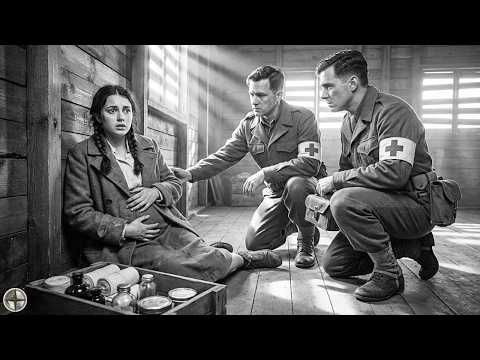
Anna Keller was 18, five months pregnant, and a prisoner of war. It was May 1945, and the world around her was collapsing. In a small town near the Rhine, houses were burned out, glass crunched under boots, and smoke hung low over broken streets. In the cellar of a half-ruined school, she wrapped a strip of cloth tight around her stomach, trying to hide the life inside her.
She had been a signals helper, sending messages for an army that no longer existed. Her officers had told the girls: “If the Americans take you, they will shame you. If they find a baby, they will tear it from you.” Anna believed them. She had seen the German papers, the photos of bombed cities blamed on Anglo-American murderers. In her mind, crossing into American control meant walking into the wolf’s mouth.
The Americans came at noon. Tanks clattered over the cobblestones, their engines deep and steady. White flags hung from windows. A loudspeaker ordered all soldiers to step into the street with their hands up. Anna climbed the steps with the other women, knees shaking, the cloth biting into her skin under her tunic.
Outside, the scene looked nothing like the terror she expected. Tired GIs in dusty uniforms pointed rifles, yes, but most looked more bored than cruel. One sergeant walked past the line of women, his eyes scanning faces, weapons, rank badges. When he reached Anna, his gaze rested for a second on the way she held her arms folded across her middle. Then he moved on without a word.
Within hours, Anna and hundreds of other prisoners were loaded into trucks. The wooden sides smelled of old hay and sweat. They drove past fields where farmers were already back at work, and past towns where white sheets still fluttered like ghosts. At a transit camp on the edge of the Ruhr, barbed wire glittered in the sun, and searchlights stood over long rows of tents. There were lines, roll calls, body searches that made Anna bite her lip and hold her breath. Somehow, the rough hands never noticed the slight bulge under her belt.
Rumors ran through the camp like electricity. “They are sending us to America.” “No, to work in French mines.” “No, to Siberia.” An older sergeant who had fought in Africa said quietly, “If you must go somewhere, pray it is America. I was their prisoner once. They feed you.” The men around him laughed bitterly. How could a country that rained fire on Hamburg and Dresden be generous to German soldiers?
To Anna, the idea sounded like a cruel joke. But the rumor was true. One morning, they marched them to a rail siding where American boxcars waited. The metal was cool under Anna’s fingers as she climbed in. The train rolled west for two days, past rivers, ruined bridges, and fields dotted with white crosses. At Le Havre, on the French coast, the smell of the sea hit her. Seagulls cried over long docks crammed with Liberty ships and gray transports. By war’s end, the United States would hold more than 370,000 German prisoners of war on its own soil. Anna was now one of them.
Her group was small, just under 2,000 men and a few dozen women auxiliaries, guided up a gangway onto a converted troopship. The metal steps rang under their boots. Inside, the air was thick with oil, soap, and old sweat. Triple bunks climbed the walls like ladders. Life at sea was a strange half-world. Days blurred. A bell marked mealtimes: white bread, watery stew, sometimes even coffee with sugar. It was more than Anna had eaten in months, yet every bite turned in her stomach.
The Atlantic swell lifted and dropped the ship, and the smell of diesel and cooking fat pressed into the steel air. At night, with the light bulbs humming overhead, she lay on her narrow bunk, one arm across her belly, willing it to stay flat. “Do not let them see you,” she wrote in a tiny notebook she kept hidden in her boot. “If they know, they will punish you, and the child will die, and it will be my fault for surviving.”
Her fiancé, a mechanic in a Panzer unit, had been reported missing near the Oder in February. In her mind, he was already dead. The baby he had left inside her was the last piece of him in the world. She would not let the enemy take that, too.
On the 12th day, the mood on deck changed. Men crowded the railings, pointing and shouting. Anna squeezed between shoulders until she could see it: a distant line of gray coast, then the sharp green shape of an island, and finally, a huge statue rising from the water, copper skin turned pale and strange. Behind it, towers and chimneys and a low cloud of city smoke. New York Harbor. It smelled of salt and coal smoke and something sweet she could not name.
They were sailing straight into the land she had been taught to fear. Yet as she watched the cranes move, the ferries dart, the windows flash in the sun, another thought crept in. Here, there were no bomb craters, no burned-out streets, no hungry children fighting over potato peels. The enemy country looked untouched, almost calm. For Anna, this was the sharpest paradox of all. She had left a thousand-year Reich that lay in ruins and entered the land of the victors as a captive, yet everything about this place suggested safety, order, and food. This was not propaganda’s hat; it was reality, and it did not fit any story she knew.
The ship’s siren blew long and low. Tugboats nosed them toward the pier. Guards shouted orders in English. Soon, there would be fences, barracks, and the feared medical check that might expose the life she hid under her uniform. What waited in that first examination room would challenge her terror more than the voyage ever had.
The ship’s engines fell quiet. Metal scraped as the gangway swung into place. Orders snapped across the deck in English. The prisoners were lined up and sent down the narrow stairs in single file. Anna kept one hand on the rail, the other tight across her middle. The steel steps were cold through the thin soles of her boots. Below, the smell changed from oil and sweat to tar, river water, and strong coffee drifting from somewhere on the pier.
On the dock, American soldiers waited with clipboards instead of clubs. Their uniforms were clean, their boots shined, rifles slung easy over their shoulders. One corporal walked along the line, counting under his breath. “Two thousand, give or take,” he muttered to the sergeant beside him. By that summer, ships were landing that many German prisoners in the United States every week. Anna did not know the number, but she could feel the scale of it. The line of gray uniforms seemed to go on forever.
She braced for blows, curses, spittle. None came. The sergeant at the head of the line pointed them toward a row of waiting trains, then went back to his notes. To him, this was a job, not a chance for revenge. The paradox hit her like cold water. She was a defeated enemy, yet no one even touched her.
The train rolled inland through the night. The wooden seat was hard under Anna’s legs. The car smelled of damp wool, coal smoke, and the sour tang of fear. Outside, she caught glimpses of wide rivers, then dark forests, then open land under a big sky. When dawn came, fields spread to the horizon, dotted with white farmhouses and red barns. “This was Iowa,” she heard someone say, a place she had never imagined, but would now remember all her life.
By afternoon, the train slowed beside a fenced compound on the edge of a small town. Guard towers stood at the corners, their windows glinting. Inside the wire, long barracks stretched in rows, but there was also a neat flagpole, a vegetable garden, even a baseball field marked out in chalk—prison and playground side by side. “Only the winning team has bats,” a guard joked to another, and a few of the German men smiled in spite of themselves.
At the camp gate, a painted sign read, “Prisoner of War Camp, US Army, capacity 10,000.” It was one of more than 500 such camps spread across America. Behind that simple number stood strict rules. Under the Geneva Convention, the United States had to give prisoners the same medical care and rations as its own troops. On paper at least, Anna had rights she had never enjoyed in Hitler’s Germany.
Processing began in a long wooden building that smelled of disinfectant and damp wood. The prisoners were split by sex. The few dozen women were led to a side wing away from the men. A female officer in khaki, her hair pinned tight under a cap, checked a list. “You go to medical,” she said slowly in German, pointing down a hallway. Her accent was clumsy but kind.
Anna’s legs felt heavy. Medical meant undressing. Undressing meant her secret would be seen. Inside the exam area, white curtains hung from metal rails forming small cubicles. The buzz of electric lights filled the air. A nurse waited behind one curtain, dressed in white with a blue cape folded over a chair. Her name tag read M. Lewis, R.N. She looked about fifty, with tired eyes and a firm mouth.
When Anna stepped inside, the nurse gave a small nod, then pointed gently to the hooks on the wall. “Clothes,” she said. “Bitte.” The German word sounded careful on her tongue. Anna’s fingers shook as she unbuttoned her tunic. Underneath, the rough cloth strip around her belly was clearly visible, wrapped too tight. Nurse Lewis’s eyes went to it at once.
For a heartbeat, Anna thought she saw anger. Instead, the older woman’s face softened. She stepped forward and with careful hands touched the edge of the binding. She did not call the guards. She did not shout. She reached back and pulled the curtain fully closed, the metal rings scraping softly on the rail. Then she called out a name.
Another nurse appeared, younger, with red hair tucked under her cap. Behind her came a woman in civilian dress with a small badge marked “Interpreter.” “My name is Elsa Bauer,” the interpreter said in clear German. “I was born in Chicago. My parents came from Bremen. I am here to help you talk to them.” She nodded toward the nurses. “They want to know how far along you are.”
Anna stared. “Five months,” she whispered, “maybe a little more.” Nurse Lewis held up five fingers, then rested her palm flat against Anna’s belly, very gently. Through Elsa, she spoke in short, careful phrases. “You are not in danger because of this. The baby is not a crime. American rules say we must care for you. We will do that. I promise.”
Anna’s throat closed. The first hands to touch her bare skin since her fiancé’s embrace were not brutal, but gentle. In that bright, strange room under the American flag, the old stories from German radio cracked like thin ice. This was not propaganda. It was reality, and it did not match anything she had been told.
Later in her diary, Anna would write: “The enemy nurse held my hands like my own mother. She spoke words I would not have believed a week ago—that my child had a right to live, even in the country that bombed our cities.”
The exam continued. Blood pressure, pulse, a cold stethoscope pressing lightly to her side, quiet nods. A note in a chart that marked her in neat English script as pregnant, special diet. When she was allowed to dress again, Nurse Lewis handed her a folded blanket. “For you,” Elsa translated, “and later for the baby.”
Outside, the evening air was cool and smelled of cut grass and cooking from the camp kitchen. Barbed wire still shone under the sunset. Guards still paced the fences. But now, as Anna walked toward the women’s barracks, the life inside her felt a little less threatened. She still did not trust this place. She still feared what the coming months might bring. Yet a promise had been given, and that promise would shape every day that followed.
The months passed. Anna worked in the library, ate eggs and white bread, and grew rounder while Germany starved. Then, one night in autumn, the pains came. Nurse Lewis and Joan stayed until dawn, and Frieda Joan was born under the stars and stripes, her first cry sharp as a trumpet.
Repatriation came in 1946. Anna carried her daughter home to a broken country, where her father took the baby with rough, cold hands and whispered, “She has his eyes.”
Frieda grew up hearing of an Iowa camp where enemies kept her alive. She became a nurse herself, saying, “If American nurses could care for my mother, I can care for anyone.”
Anna wrote in her old age: “We entered that camp as enemies of America. We left it as students of its mercy.”
America’s greatest weapon was never its tanks—it was choosing to treat even its enemies as human. What would you have done in that nurse’s place?
Report this article
Select a reason for reporting:






