The smell hit you before anything else. Wet ash, broken concrete, and something darker underneath that nobody wanted to name. Cologne, May 1945. The war was over, but the city was a graveyard of rubble, its famous cathedral standing like a lone sentinel over 90% destruction. In this landscape of survival, German women—housewives, nurses, teachers—scavenged for food and hope. They had been taught a story: a rigid racial hierarchy with white Europeans at the top. It was fact, as solid as gravity. And Australia, with its White Australia policy, was a distant white outpost, a testament to their worldview. But that story was about to crack.
Walking through the gates of Cologne were soldiers in pressed Allied uniforms, speaking English with broad Australian accents. But their faces were not white. They were of Chinese, Japanese, and Pacific Islander heritage—men from Darwin, Cairns, and Thursday Island. They were Australian, undeniably, but their existence defied every category the Nazi textbooks had carved. And they were here, in the ruins of the regime that had built an entire state around racial purity, handing out information about food collection points with Queensland accents.
“The German women stopped speaking entirely. They looked at the uniforms. They looked at the faces. They looked at each other. And something cracked open inside their understanding of the world.”
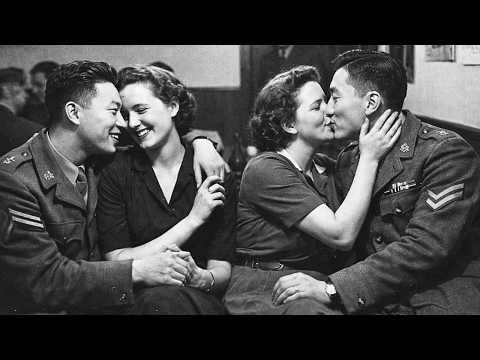
This encounter was no accident. It was the collision of two histories: one of a nation that had spent 12 years indoctrinating its people with a racial hierarchy, and another of a country that had quietly, reluctantly, allowed men of Asian and Pacific Islander descent to serve, despite its own racist laws. These men—between 3,000 and 4,000—had enlisted, fought, and survived, even as their own government questioned their loyalty and paid them less than their white counterparts.
Now, in the summer of 1945, their presence in Germany did what bombs and re-education programs could not: it made ordinary German women doubt everything they had been taught. Not through force, but through the simple, devastating fact of a human being standing in front of them who refused to be what they had been told he was.
To understand this moment, you must understand the men who wore those uniforms. They came from families that had been in Australia for generations—since the gold rushes of the 1850s. They spoke English as their first language, played cricket, and considered themselves Australian. Yet the law saw them as outsiders. The Immigration Restriction Act of 1901, designed to keep Australia white, still governed their lives. They couldn’t vote, needed permission to travel, and were often treated as a complication to be managed.
When war came to the Pacific, desperation forced a change. Recruiting officers, facing quotas, began accepting these men—not out of principle, but out of need. The Torres Strait Light Infantry Battalion, composed almost entirely of Indigenous and Pacific Islander men, defended Australia’s northern approaches while earning a third of white soldiers’ pay. One sergeant, Zaccharias Passi, protested the disparity in a letter that was filed and ignored. Yet they served anyway, because their homes were in the path of the Japanese advance.
By 1945, as Allied forces occupied Germany, these men found themselves in a country that had been taught to see them as inferior. The encounters that followed were documented by military historians and surveyors, who noted a “peculiar destabilization of prior assumptions.” German women, initially shocked, began to seek these soldiers out, finding them patient and helpful. The effect was profound: personal contact was undermining a decade of indoctrination in ways no pamphlet could.
“These people had been shown that everything they were taught was wrong. Not by argument, not by force, but simply by the fact of another human being standing in front of them.”
But while Germany began to confront its racial ideology, Australia did not. The men who had helped crack open a defeated regime returned home to a country that still had its own version of that ideology written into law. They received no parades, no official acknowledgment. The White Australia policy remained until the 1970s. Aboriginal Australians were not counted in the census until 1967. The story of their service was buried in archives, inconvenient for a nation that preferred a simple, white wartime narrative.
Yet the ripples of that summer in Cologne would quietly spread. The women who had their worldview shattered went home and raised children with new questions. Germany’s post-war reckoning, imperfect as it was, began. And the men from Cairns and Thursday Island, who had stood in the rubble and helped a German woman find her way, had made the world, in that moment, very slightly more true.
But the story did not end with the parades and the silence. It continued in the small, unrecorded spaces where history usually hides—in kitchens and pubs and pension offices, in the slow grind of bureaucracy and the quieter work of memory. Gordon Young, back in Darwin, did what most returned soldiers did. He found work. He raised a family. He stood in queues at the same government offices that had once required him to seek permission to travel within his own country. The medals sat in a drawer, and the drawer was not opened often.
In Thursday Island, the veterans of the Torres Strait Light Infantry returned to a community that knew their worth even when the paperwork did not. They had defended the narrow waters of their home, and their families had watched them do it. The pay gap was a wound that would not close for half a century, but the respect inside the community never wavered. They had said yes when their country had not yet decided whether to ask.
What changed, slowly, was not the law but the record. In the decades after the war, historians began to pull at the threads. Military archivists opened boxes that had gathered dust since 1945. Letters like Passi’s surfaced, carefully typed and formally worded, asking for nothing more than what any soldier deserved. Researchers interviewed the men who had served in signals companies and pioneer battalions, and the interviews revealed something the official histories had missed: these men had not seen themselves as trailblazers. They had seen themselves as Australians doing a job.
The recognition, when it came, was late and partial. In the 1980s and 1990s, as Australia began to reckon more honestly with its wartime past, the service of Indigenous and non-European soldiers started to appear in commemorations. The Torres Strait Light Infantry Battalion received formal acknowledgment of its role in defending the north. The pay disparity was eventually acknowledged as an injustice, though the compensation came decades after most of the men had died. History had finally caught up with what the soldiers had known all along: that they had been there, and that their being there mattered.
In Germany, the reckoning took a different shape. The women who had stood at those food collection points in 1945 carried their experience into a new society that was being rebuilt on anti-discrimination principles. Their children grew up in a country that taught the Holocaust as a central fact of national history, a country that built memorials and opened archives and made remembrance a civic duty. The encounter in Cologne was one small stone in that foundation, but it was a real one. The destabilization of assumptions that the Allied surveyors had noted in 1945 had become, over decades, a national commitment to never letting those assumptions harden again.
The men themselves, for the most part, did not live to see the full measure of what their presence had done. They had not set out to change minds. They had set out to serve, to survive, and to come home. But the world they returned to was not the same world they had left, even if their own countries were slow to admit it. In the rubble of Cologne, the simple fact of a human being standing in front of another human being had done something that no policy could undo.
And that fact—quiet, stubborn, undeniable—remained. It remained in the memories of the German women who had stopped speaking and then, slowly, begun to ask questions. It remained in the archives that would eventually be opened. It remained in the families who passed down the stories of men who had worn the uniform of a country that had not fully claimed them. The questions those men raised in 1945 are still being asked today, in different forms and different places, wherever a nation tries to tell a simple story about who belongs and who does not.
Somewhere in the rubble of Cologne, in the summer after the war ended, a man from Cairns or Darwin or Thursday Island stood in his pressed uniform and helped a German woman find her way. He did not know that he was making an argument. He was simply doing his job. But the argument was made anyway, and it rippled outward, quietly and persistently, into a future he would never fully see.
That future arrived unevenly. In Australia, the silence around these men lasted longer than the men themselves. Gordon Young died in 1988, three years before the Torres Strait Light Infantry Battalion was formally honored, and four decades before the pay gap was officially called what it was: theft. He never heard a prime minister say his name. He never saw a stamp or a plaque or a school lesson that mentioned the summer of 1945. But his grandchildren knew. Families remember what archives forget.
In Germany, the memory took root differently. A woman who had once stopped speaking at a food collection point grew old in a country that made remembrance a duty. She told her daughter about the soldier with the Queensland accent who had helped her find bread for her children. The daughter told a historian. The historian wrote it down. Small moments accumulate, and some of them outlast the empires that tried to erase them.
What remains, then, is not a monument but a pattern—one that repeats wherever a person stands before another person and the old story fails. The Nazis built a state on the idea that race determined everything. It took twelve years to build and a single conversation to crack. That is the fragility of every ideology that tries to explain away the human being in front of you.
Zaccharias Passi asked for equal pay in 1943 and was ignored. He kept serving anyway. That decision—to defend a country that had not yet decided whether to claim him—is the quiet heart of this story. It is not a story about gratitude. It is a story about presence. The men from Cairns and Darwin and Thursday Island were there, in the rubble, in uniform, and their being there made the world slightly more true.
So the question is not whether history remembers them. The question is whether we will. When a nation tells a simple story about who belongs, who gets to stand in the uniform, who gets to be counted—whose face do we picture? And what happens when the face in the uniform doesn’t match the story we were taught?
Report this article
Select a reason for reporting:






