In the autumn of 1966, General William Westmoreland did something his staff would later call completely out of character. He bypassed three layers of his own command and picked up a secure phone to call the Australian task force headquarters directly. He had a mission—one that American units, with all their firepower and technology, could not accomplish without triggering contact and compromising the objective. He needed it done quietly. He needed it done by men whose methods he did not fully understand, but whose results he could no longer explain away. He needed Australians.
That phone call was never documented in American after-action reports. The operation remained classified for decades. But the pattern it represented—the quiet, unofficial trust that senior American commanders placed in Australian SAS capabilities—is one of the most consequential and least examined stories of the Vietnam War. Because what those generals were doing was not simply requesting Allied assistance. They were admitting that the most powerful military force in human history could not do what five Australians with small packs and no radio could do in the dark.
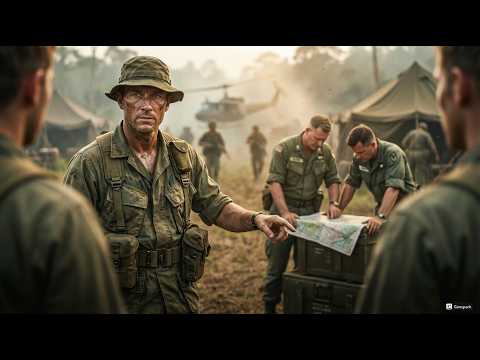
To understand why the hardest missions went to the Australians, you have to understand what made a mission hard in Vietnam. Hard did not mean dangerous in the conventional sense. Hard meant missions where detection before execution meant total failure. Where the noise signature of a conventional American patrol—the helicopter insertion audible for miles, the radio checks every thirty minutes—would alert the target before the mission reached its objective. Hard meant extended undetected presence in enemy-controlled territory for days, sometimes weeks. Hard meant intelligence gathering that required a patience and silence the American training system had not produced and could not quickly replicate.
The Australian Special Air Service Regiment had spent years closing that gap in Malaya and Borneo before they ever set foot in Vietnam. They did not prepare for the jungle. They prepared to become part of it. The distinction was not metaphorical. It was the operational difference between a force that understood its environment as terrain to be crossed and a force that understood its environment as a system to be inhabited.
General Creighton Abrams, who replaced Westmoreland in 1968, developed a working relationship with Australian SAS capabilities that went deeper than the back-channel requests of the Westmoreland era. Abrams had watched the operational statistics coming out of Phuoc Tuy Province with the specific attention of a man who understood what statistics meant when they defied the models everything else was producing. The kill ratios were the most visible anomaly: 1:10 for American Army units in the same theater, 1:500 for Australian SAS patrols. Pentagon analysts had initially flagged these numbers as reporting errors. Abrams knew they were not.
In his private communications, declassified decades after the war, Abrams described Australian SAS capabilities in language that never appeared in any public briefing. He called them the only force in theater that truly understood the environment they were operating in. He called their methods irreplaceable for the specific category of mission that required undetected extended presence. And he called the American failure to learn from them earlier one of the most expensive institutional mistakes of the entire war. Abrams said these things privately. He never said them publicly. The institution he commanded could not absorb the admission that a small Allied contingent had spent the entire war doing something his own forces could not replicate.
The specific missions quietly directed to Australian SAS through informal channels fall into categories the official histories only partially document. The most consequential was long-range intelligence gathering against high-value command targets. The Viet Cong and North Vietnamese Army operated from base areas and underground complexes that American aerial surveillance, photo interpretation, and electronic intelligence had consistently failed to locate. The failure was not technological. It was environmental. The triple-canopy jungle defeated aerial observation with a completeness no photographic technology of the era could overcome.
The intelligence gap that resulted was not a gap technology could close. It was a gap that could only be closed by human beings on the ground, undetected, watching and waiting with a patience and silence that extended days beyond what any American unit could sustain. The Australians could close that gap. The phone calls from American command to Nui Dat were, at their operational core, requests to close it.
One of the most extensively documented examples of this pattern involves the location and destruction of a Viet Cong battalion command element northwest of the district town of Xuyen Moc in early 1968. American intelligence had attempted to locate this element for weeks. Aerial surveillance had been flown repeatedly over the suspected area. Ground sensors had been implanted along every viable approach route. The official assessment, produced after an extensive and expensive effort, listed the area as cleared of significant enemy presence.
An SASR patrol was tasked with a reconnaissance mission in the same area. The patrol included a tracker whose capabilities had been developed through the integration of Aboriginal tracking knowledge the SASR had been incorporating into its doctrine since the Malayan Emergency. Within forty-eight hours of insertion, the tracker had identified signs of heavy recent human passage that American technology had produced no indication of. Not a visible trail—the Viet Cong were too skilled for anything photographic intelligence could detect—but signs a trained tracker could read with precision. Vegetation moved and replaced incorrectly. Bark disturbed at human hand height in darkness. Compression patterns in leaf litter consistent with laden human foot traffic rather than animal passage.
The patrol followed what the tracker called an invisible highway for three days, moving at a pace that barely qualified as movement by any conventional military standard. On the fourth day, they located a sophisticated underground complex housing an estimated two hundred enemy fighters, completely invisible from the air, exactly where American intelligence had said nothing significant existed. The coordinates were passed to American headquarters. B-52 bombers reduced the complex to overlapping craters. Secondary explosions from ammunition and fuel storage continued for six hours. The American intelligence community documented the strike as a success without publicly accounting for the fact that their own weeks of intensive technological effort had failed to find what an Australian five-man patrol with a tracker had found in four days.
Colonel Francis Kelly, who commanded the 5th Special Forces Group in Vietnam and was one of the American officers most directly engaged in the joint operational arrangements between American and Australian forces, documented his assessment of this pattern in a series of reports that circulated through special operations channels in 1968 and 1969. Kelly was not a man given to institutional modesty. His professional reputation rested on the capabilities of American special forces, and he had spent years building those capabilities with genuine commitment. But Kelly’s operational honesty was stronger than his institutional loyalty, and his reports said plainly what the back-channel phone calls had been implying for two years.
There are specific mission categories, Kelly wrote, where SASR capabilities represent the only reliable option available to the command. American units, including special forces, cannot consistently achieve the level of undetected extended presence that these missions require. We can approximate the doctrine. We cannot replicate the consistency.
Kelly went on to recommend the establishment of a formal joint operational framework that would integrate Australian and American special operations capabilities, matching mission requirements to the force best equipped to meet them rather than defaulting to American units regardless of mission suitability. The recommendation was received, reviewed, and filed in the bureaucratic location where inconvenient truths went to avoid disturbing institutional assumptions. But the informal practice it recommended continued regardless of whether the formal framework was established.
General Julian Ewell, whose name is more commonly associated with Operation Speedy Express and its devastating civilian toll, was simultaneously one of the American commanders who most clearly understood what the Australian methods represented and most deliberately used Australian intelligence products to direct American firepower. Ewell was not a man who lacked operational intelligence. He understood precisely what his body count metrics were producing and precisely what they were not producing. And in the gap between what his public operational philosophy required him to claim and what his private operational behavior revealed, the Australian intelligence contribution was indispensable.
Ewell’s 9th Infantry Division operated in the Mekong Delta, adjacent to the Australian area of operations in Phuoc Tuy. The intelligence flows between Australian reconnaissance operations and American strike assets were by 1968 and 1969 so thoroughly established as informal operational practice that American planning cells had effectively integrated Australian intelligence products into their targeting cycle without any formal doctrinal framework requiring them to do so. The Australian SAS found the targets. American firepower destroyed them. The arrangement suited both commands. The Australians maintained their operational independence and doctrinal integrity. The Americans obtained intelligence they could not generate themselves and applied it through the overwhelming firepower their doctrine required. The arrangement was never publicly acknowledged by either command.
David Hackworth’s experience with this arrangement was more direct and more personal than that of any other American officer who documented it. His Hardcore Battalion operated in the same environment as the Australian task force, and his practice of sending junior officers to train at Nui Dat had given him relationships with Australian commanders that went deeper than the formal liaison arrangements between the two forces. Hackworth understood from direct observation—not from reports filtered through command channels—precisely what the Australian methods produced and precisely why American methods consistently fell short.
Watching an Australian SAS patrol prepare for an operation, he wrote, was like watching a different species of soldier get ready to do something that had no equivalent in the American tactical vocabulary. Hackworth sent his officers to learn that second understanding because he had watched the first understanding cost American lives that proper preparation would have saved.
The psychological dimension created a second category of hard missions quietly directed to Australian assets. The Viet Cong designation of Australian operators as Ma Rung—the jungle ghosts—was not mere propaganda. It was an operational assessment with concrete behavioral consequences that American intelligence officers tracked with genuine attention. Experienced fighters who faced American forces with confidence refused assignments to sectors where Australian presence was confirmed or even suspected. Supply lines were rerouted at significant logistical cost. Local infrastructure began collapsing in Australian sectors—not because it was being directly targeted, but because the fear of Australian presence made routine activity impossible to conduct with the confidence functioning required.
American commanders understood this psychological effect was a strategic asset of the first order. They also understood it could not be produced by American methods, because the fear that produced it was specifically a fear of the unknown—and American methods were never unknown. The helicopters announced their presence from miles away. The artillery announced its presence the moment it fired. The Australians announced nothing. They were simply there or not there. And no one on the enemy’s side could ever determine which with sufficient confidence to act normally. That uncertainty was a weapon American firepower, for all its devastating material effect, could not replicate.
Major General Tim Vincent, who commanded the Australian task force from 1968 to 1969, described the dynamics with the precision of a man who had understood exactly what was happening at the time and had spent years deciding how much to put on the record. The Americans came to us with missions they could not officially assign to us, Vincent said, because assigning them officially would have required acknowledging why they were giving them to us rather than to their own people. So they came informally and we understood the arrangement. We took the missions because the missions needed to be done and we could do them. Whether the Americans ever formally acknowledged why those missions came to us was their problem, not ours.
The back channel was not a conspiracy. It was an institutional accommodation between operational truth and institutional narrative, conducted by professionals who understood the difference and needed both to function simultaneously. The missions got done. The Australians got tasking that utilized their capabilities appropriately. The Americans got results they could not generate themselves. And the official record remained consistent with the public narrative that American forces were meeting every operational requirement.
Hackworth tried to say this publicly in 1971 and paid for it with his career and his country. The generals who had been making the calls for years watched his television appearance and understood exactly why he was saying what he was saying and exactly why saying it publicly cost what it cost. They had the back channels because the public channels could not carry the truth. Hackworth had the courage to put the truth on the public channel, which meant he lost the back channel and everything connected to it. He bought a ticket to Australia instead and spent ten years among the soldiers whose worth he had been the only person in his position willing to openly declare.
The generals stayed. The back channel stayed open. The hardest missions kept going to Nui Dat, and the jungle ghosts kept answering the phone and going out into the dark and coming back with what the missions required, leaving no evidence of their passage except the results. That was always enough—for the generals who called and for the Australians who answered.
What does it say about an institution when its most senior leaders must work in shadows to access the excellence its own doctrine cannot produce—and have you ever served under a system where the official story and the operational truth lived in separate rooms?
Report this article
Select a reason for reporting:






