At 6 a.m. on a Wednesday in February 2015, a crew at the Museum of Science and Industry in Chicago began lowering a German dive bomber from the ceiling. Even without its engine—removed years earlier and displayed elsewhere—the aircraft weighed over 6,000 pounds. Five hours of careful work for a single plane. When its wheels finally touched the floor, you could see what the museum had spent nearly 70 years protecting: the original paint from the Libyan desert, bullet holes and shrapnel scars from 1941, never patched. “It is essentially in the condition it was found,” the specialist who managed the lift said. Then a team circled it with a 3D scanner, measuring every panel and curve. Because by now, this aircraft was no longer just an exhibit—it had become a reference.
It is one of only two. The other stands on the floor of the Royal Air Force Museum in north London. Neither has flown since the war. Germany built nearly 6,000 Ju 87s, and some estimates say more. They were over Poland on the first morning of World War II and still flying in its final weeks. Today, if you want to stand beside a complete original, you have exactly two choices on the entire planet—and both are indoors forever.
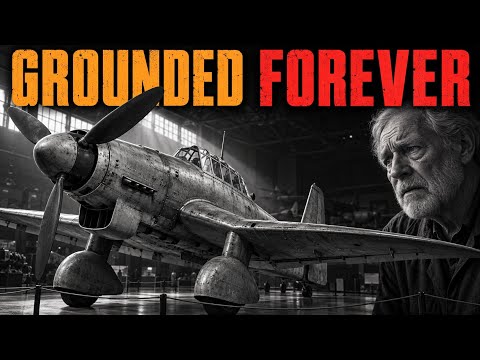
That leaves three questions. What happened to the other six thousand? How did these two survive, out of all of them? And why, when people now spend years and fortunes to return a Stuka to the sky, will the first two real ones never be allowed to join them? Along the way, there is a film crew that got one running and then walked away, a missing data plate, and two men on a frozen lake in 1944 whose final decision still shapes the future of the next Stuka.
It starts with what the aircraft was built to do. Because the thing that made the Stuka famous is the same thing that made almost no one want to keep one. Fifteen days before the war began, on August 15, 1939, the Luftwaffe staged a demonstration for senior commanders at the Neuhammer training ground in Silesia. A group of Stukas was supposed to dive through a cloud layer, drop practice bombs, and pull up beneath it. The crews believed the cloud base was high enough. It wasn’t. Below, ground fog had formed. The planes came out of the white and there was no room left to recover. Thirteen aircraft hit the ground almost together. Twenty-six men died in front of the officers who had come to be impressed.
If you want to compress the Stuka into a single image, that is it. The entire machine was designed for one maneuver, and that maneuver did not forgive error. When things went right, the scene looked like this: the pilot crossed above the target at about 4,500 meters, sighted it through a window in the cockpit floor, and pulled a lever. Dive brakes extended under the wings. He slowed, closed the radiator flaps, and rolled the aircraft until its nose pointed at the earth. It was never a gentle slope. Eric Brown, the British pilot who tested more aircraft types than anyone in history, said the Stuka was the only dive bomber he flew that truly went straight down.
The brakes held a constant speed of 500 to 600 km/h, giving the pilot long, stable seconds to fix his eyes on the target and correct his path during the fall. A contact altimeter watched the height. At the release point—usually no lower than 450 meters—a warning light came on. The pilot pressed a button on the control stick. A steel fork under the fuselage pushed the bomb down and forward to clear the propeller. The bomb fell, and the aircraft began to pull itself out of the dive. It endured up to 6 Gs. In Junkers’ own tests, that was the load at which half of all pilots began to lose their vision. If it continued, some blacked out entirely.
So the recovery was automatic. Small red tabs popped up from the top of each wing to show the system had activated. If the pilot was partially unconscious, the aircraft leveled itself without him. Then there was the sound. On the front of each landing gear leg sat a small propeller about 70 cm across, spinning a siren in the airstream as speed increased. Its official name was Lärmgerät—noise device. Pilots could estimate their speed from its rising tone, but its real job was spreading terror, and it cost the aircraft 20 to 25 km/h in speed. Later in the war, many units removed it, and some crews fitted sirens to the bomb fins instead, so the scream came from the thing falling on you rather than the thing that dropped it.
Put it all together and you get an aircraft with fixed landing gear, a single machine gun to protect its tail, modest speed, and an attack method that required pointing itself at the ground and climbing back on a path any observer could predict. Against an enemy with no air force, it was the most accurate aircraft in the world. Against an enemy with fighters, it was a target. The next twelve months would prove both things true.
At about 4:40 a.m. on September 1, 1939, Stukas of I./Sturzkampfgeschwader 76, led by Walter Sigel, arrived over a small market town called Wieluń, roughly 20 km inside Poland. There were no anti-aircraft guns. Most of the town was still asleep. One of the first buildings hit was the All Saints Hospital. Thirty-two people died inside it, patients and staff alike. Wave after wave followed through the morning, and in the end most of the town center was destroyed. No one agrees on the death toll that day—estimates run from about 130 to over 1,200. No film footage of it exists.
What kind of aircraft was it, then? German records admit to losing six Stukas over Sedan that day. By the time France surrendered, a third of the Stuka force had been destroyed or damaged, most of it by ground fire. The Luftwaffe was winning so fast that no one noticed. Then the Stukas were sent across the English Channel.
Over the convoys, they were devastating at first. On July 4, 1940, Stukas sank the anti-aircraft ship HMS Foyle Bank in Portland harbor, killing 176 of her crew. One of her gunners, Jack Mantle, kept firing at the attacking aircraft despite a mortal wound and was awarded the Victoria Cross posthumously. In August, the targets moved inland toward airfields and radar stations, and Fighter Command came out to meet them.
At midday on Sunday, August 18, 109 Stukas crossed the Channel, split into four groups at the coast, and headed for the airfields at Thorney Island, Ford, Gosport, and the radar station at Poling. Their fighter escort was spread so thin across so many targets that it could not cover any of them properly. Hurricanes and Spitfires found the Stukas at the worst possible moment—low, slow, coming out of their dives, lined up behind one another on the same path. That was the tax of the design. A dive bomber lives its most dangerous seconds immediately after the attack, when it has spent its height for accuracy and must climb again. The automatic pull-out made those seconds more predictable. One Stuka commander, Helmut Mahlke, later said his unit disconnected the system because it told the defenders exactly how and at what height each aircraft would level off. Over southern England, a fighter pilot did not need to chase a Stuka. He only had to wait where it would arrive.
At the Royal Navy airfield at Ford, 28 people were killed on the ground. In the air, 16 or 17 Stukas were lost that evening, depending on which statistic you trust, and others limped home damaged. Over six weeks of operations over Britain, 59 Stukas were destroyed and 33 more damaged—more than a fifth of the entire Stuka force in the ten days between August 8 and 18 alone. After that day, the Stukas were pulled from the battle over England. The Luftwaffe could not afford another August like it.
So the Stukas went where enemy fighters were rarer. To the Balkans, the Mediterranean, North Africa, and Russia. And in the desert begins the story of the first of our two survivors. Its factory number was 5954. It was an R-2, a long-range Stuka fitted with extra fuel tanks under the wings to reach ships far out at sea. This aircraft was tropicalized and carried the markings A5 + HL, of Sturzkampfgeschwader 1. In November 1941, the British Eighth Army began its winter offensive in Libya to break the siege of Tobruk. Somewhere in that fighting, aircraft 5954 made a forced landing. It is no longer certain exactly what brought it down—air combat or damage on the ground. What is certain is that the crew left it where it stopped, and British troops found it abandoned in the sand.
By then, the desert was full of wrecked aircraft. Most were stripped for parts, burned, or simply left. But this one was preserved, and the reason had nothing to do with engineering. The British Information Services, whose job was to keep Britain’s war before the eyes of the American public, organized a traveling exhibition of captured German equipment and toured it across the United States. A battle-damaged Stuka was the perfect centerpiece. Americans had heard that siren in newsreels. Now they could walk around the machine that made it and see the holes for themselves.
When the tour ended, the aircraft needed a home. In 1946, it was donated to the Museum of Science and Industry in Chicago. It has been there ever since, with one telling interruption. In the 1970s, it was damaged while being lowered from the ceiling for cleaning and spent several years with the Experimental Aircraft Association in Wisconsin for repair before returning home. That is the kind of thing this is. Even lowering it to dust it off can hurt it.
Notice how it survived. No one saved aircraft 5954 because they believed it was important to history. It survived because it was captured early. According to Luftwaffe statistics, its pilot flew more than 2,500 combat missions and destroyed over 500 tanks. These are claims, and historians treat them with caution. What is not in dispute is what happened afterward. He spent the rest of his life an unrepentant Nazi, helped fugitives of the regime in South America, and never renounced the cause he flew for. This deserves to be said plainly, because the Stuka in London carries the mounting points for his idea.
That aircraft began life around 1943 or 1944 as a D-5 ground-attack variant, later rebuilt as a G-2 with underwing cannon mounts. Its factory number was probably 2883; after rebuilding, 494083. No one knows who flew it, or where, or what it did. Even the code RI + JK has never been tied to any unit.
By then the Stuka’s day as a frontline aircraft was over. Fw 190s took the ground-attack role, and Ju 87 production ended in 1944. The survivors went to night operations, flame dampers fitted, sent across the lines in darkness. In March 1945 some were thrown against the Ludendorff Bridge at Remagen to stop the Americans who had just crossed the Rhine. It didn’t work. By then nothing was working.
Two months later the war in Europe ended, and thousands of German aircraft sat on airfields waiting to learn what the victors would do. For almost all of them, the answer was the scrapyard. In summer 1945 the Allies wanted jets, rocket fighters, radar night fighters—anything showing aviation’s next direction. The Stuka was the opposite of what they were looking for.
But someone in London’s Air Ministry set aside twelve German types for a museum that did not yet exist. At Eggebek, British troops found the G-2 marked RI + JK. It became one of the twelve. On September 4, 1945, it left by road. By January 1946 it was in a packing depot in Wales, beginning a second journey far longer than its first.
Around 1947 it moved to RAF Stanmore Park, where a small group of pilots tended the stored engines and airframes like guards of a museum with no visitors. In 1949 one of them noticed the Stuka still carried its original data plate. As far as anyone knows, that was the last time it was seen.
In September 1954 it was rolled out for a Battle of Britain display at RAF Andover. There is a quiet irony in that. This was an anti-tank Stuka built years after the battle, never near it. But it was the RAF’s only Stuka. So for one day it stood in for every one that fell over Sussex and Hampshire. Then it went back into storage.
In August 1960 it was sent to St Athan in South Wales, the first historic aircraft to go there. It never flew and was barely touched—which is exactly why it was intact in 1967 when the film industry came looking. The film was Battle of Britain, and its makers wanted real aircraft wherever they could find them.
By March 1967 it was at RAF Henlow, painted in 1940 markings, fitted with dummy wooden dive brakes, sirens on the legs, and a fiberglass bomb underneath. The Ministry of Defence gave permission to try making it airworthy. The engine was the easy part. After more than twenty years of silence, the Jumo started without much complaint. For a short while there was a Stuka with a running engine in England again.
Then the engineers opened the airframe. What they found was not a disaster but a bill. A unique German aircraft with no manufacturer, no spares, no support, where every structural part had to be inspected, proven, or replaced. The verdict was that the cost would be prohibitive. That Stuka would not fly.
So the production team built their own. Three Percival Proctors were rebuilt to pass as Stukas—people called them Proctukas. In the end, even those weren’t the ones diving on screen. The Stukas in the final film, released in 1969, are miniatures. And here is the detail that makes it almost perfect: those models were built to look like late-war Stukas, to match the aircraft at Henlow if it ever flew. The Stukas in one of the most famous war films are copies of a real aircraft that stayed on the ground.
The inspection settled one thing. It confirmed the identity as 494083 in the factory records. That mattered because the data plate recorded in 1949 was no longer there to prove it. Where it went, no one seems to know.
It would not be the only part lost. In 1945, taking a piece of a German aircraft home was a ritual among Allied soldiers. Data plates, instrument dials, a scrap of camouflage, a control stick grip—into bags and trunks, and many crossed the Atlantic to end up in American attics and basements. In boxes beside other things the man brought back from the war. A few photographs, a shoulder patch, a letter, a medal the family can’t quite place.
If your family owns one of those boxes, the man it belonged to may have been your grandfather, and he may have left a paper trail far longer than you imagine. Find Your Grandfather’s War is the guide I wrote to trace it—how to rebuild an American military history that someone may have decided wasn’t worth keeping.
Which brings us to the real question. Why are they still locked indoors? Why has no one put them back in the sky? Part of the answer lies in what the engineers found in 1967, plus another sixty years. These airframes are made of wartime German alloys and rivets that have aged in ways no one can fully see without taking them apart. To make either flyable, you would have to strip it, replace every structural part that can’t be proven sound, and rebuild it. By the time you finished, much of what flew would no longer be the aircraft that left Eggebek or the Libyan sand. You would have spent a fortune turning an original into a copy.
In Chicago’s case it is worse, because the damage is the value. Those holes were made in 1941. To fly it, you would have to patch every one, and the thing that makes it priceless would be gone.
The second part is what these two have become. Anyone rebuilding a Stuka today faces the same problem. The factories are gone, the drawings incomplete, the wreckage they work from twisted and burned and corroded. The only complete, undistorted Stukas left are the ones in museums. When Chicago’s came down in 2015, a team scanned it in 3D. Measurements like that are treasure to anyone building from wreckage. An original that stays on the ground can help build any number of flying aircraft. An original that crashes can help no one.
The third part is simple arithmetic. If a rebuilt Stuka is lost, that is terrible. If one of these two is lost, half of what remains disappears in a single afternoon. So the museums keep them, and they are right to. But that does not mean the Stuka will never fly again. It means the next one to fly is being assembled from aircraft that spent decades under snow and Arctic water.
On the far northern front, around Murmansk, Stukas attacked the railways and ports that carried Allied supplies to the Soviet Union. Many came down in marshes, snow, and frozen lakes so remote that no one returned for them, and the cold preserved them. The Deutsches Technikmuseum in Berlin holds one, factory number 5856, shot down while attacking the Murmansk railway in July 1942. Its crew walked back to their lines. The museum displays it wrecked and unrestored, exactly as it came out of the ground.
That supports the idea of leaving some wreckage alone—just like the Stuka that lay at the bottom for 77 years. Today it belongs to the American Heritage Museum in Stow, Massachusetts, and is being rebuilt to fly again. The team had to make their own rivets, because wartime German rivets differ from American ones in metal, size, and even head angle. The bomb is still part of the project. By the team’s estimate, the explosion destroyed the mechanism behind the pilot’s seat that links the flaps to the ailerons, and it is being rebuilt from surviving patterns and old data, some of it using 3D metal printing. Earlier this year, the museum’s founder said the wings might be complete by the end of 2026.
Think about that for a moment. Two men in 1944 destroyed their own aircraft so no one could fly it again. Eighty years later, people on two continents are repairing the damage they did, rivet by rivet, so someone can.
So here is the full answer. About 6,000 Stukas were built. Most were destroyed in the war, and almost all the rest were scrapped in 1945 by people who saw no value in keeping an aircraft that had lost the air war over England. Two survived by accident. One because it was already a war trophy across the Atlantic, the other because someone in the Air Ministry chose it as one of twelve to preserve. They are locked in museums now, not because no one cares, but because everyone does. They are the last two originals, the standard against which every restoration is measured, the only Stukas still as they were when the guns stopped.
The aircraft that fly in the years ahead will be original in their own way, each carrying the identity of a real Stuka that fell in the war. But much of what holds them together will be made in this century. The two in Chicago and London will not go anywhere. One hangs nose-down near the ceiling in a dive it will never finish. The other stands on the floor in London with its cannon mounts still empty.
So I will put the question to you. If the decision were yours, would you allow one of the two originals to fly again, knowing what it would take and what its loss would mean? Or should the sky belong to the rebuilt ones alone? Tell me in the comments—I will be waiting to read them.
Report this article
Select a reason for reporting:






