World War II gave cinema some of its greatest stories of courage and sacrifice. But not every trip back to that battlefield turned out heroic. Some films stumbled so badly they managed to anger veterans, mislead audiences, and even embarrass their own directors. So, what happens when Hollywood takes one of history’s most important chapters and fumbles it beyond belief? Get ready because a few of these disasters will leave your jaw hanging.
Take Pearl Harbor (2001). With a budget north of $140 million and a cast led by Ben Affleck, Josh Hartnett, and Kate Beckinsale, it should have been an epic. Instead, audiences were handed a glossy soap opera masquerading as history. The infamous love triangle consumed most of the film, pushing the actual attack into the background where it felt like an afterthought. Veterans who lived through the era were publicly outraged, calling the film insulting, hollow, and dishonest. Historians pointed out dozens of inaccuracies, from the way aircraft were depicted to romantic conflicts that never existed. The result was a script that trivialized one of the darkest days in US history.
Michael Bay can stage explosions better than most directors, but he proved that spectacle can’t save bad writing. Pearl Harbor made money at the box office largely thanks to heavy marketing, but its reputation quickly collapsed. Even today, it’s regularly cited as a warning of what happens when Hollywood sacrifices substance for spectacle. Some World War II movies make audiences cry out of respect for the lives lost. This one made people groan out of frustration.
Yes, even Steven Spielberg can miss the mark. And 1941 (1979) is living proof. Coming off the back-to-back triumphs of Jaws and Close Encounters of the Third Kind, Spielberg was at the height of his powers when he decided to tackle World War II, but with comedy. On paper, it sounded like a hit: Los Angeles descending into chaos after Pearl Harbor, a dream cast including John Belushi, Dan Aykroyd, and Ned Beatty, and the biggest budget comedy Hollywood had ever attempted.
Instead of sharp satire, audiences got a bloated, noisy spectacle that mistook chaos for humor. The film cost nearly $35 million, a staggering sum for the late ’70s. But the money went into elaborate set pieces that rarely landed laughs. Exploding houses, runaway tanks, fighter planes buzzing Hollywood Boulevard. It looked wild, but it had no wit or rhythm. Spielberg himself later admitted the reaction was devastating, saying it felt like critics treated him as if he had committed a war crime. That’s how badly 1941 went over.
The backlash wasn’t just from audiences and reviewers. John Wayne, Hollywood’s most patriotic leading man, refused to appear after reading the script, calling it the most anti-American thing he had ever seen. When Wayne sounds the alarm, you know you’ve hit the wrong chord. Yes, 1941 managed to make some money, but compared to Spielberg’s previous blockbusters, it was a disappointment that tarnished his otherwise golden run. Decades later, it remains the perfect cautionary tale of what happens when a director at the top of his game takes a swing at comedy and strikes out. 1941 is still remembered not for laughs, but for being one of Spielberg’s rare and spectacular misfires.
The story of the Tuskegee Airmen, the first black fighter pilots in American history, deserved a powerful, layered film. With George Lucas producing, Red Tails (2012) was supposed to finally give them the cinematic spotlight they had long been denied. Instead, what audiences got was a hollow, overslick action movie that valued flashy dogfights over substance and squandered one of the most inspiring stories of World War II.
Critics quickly pointed out that the script never dug into the full weight of racism the airmen faced both at home and in the military. Instead of a nuanced exploration of systemic prejudice, the film offered a handful of generic speeches and cardboard characters ripped straight from a video game cutscene. The dialogue was clunky, the stakes were non-existent, and the pilots felt less like real men and more like archetypes from an action toy line. Even the dogfight sequences, hyped as the film’s saving grace, felt overpolished and sterile. The digital effects looked slick, but they lacked the grit and tension that makes aerial combat gripping. Worse, the film blurred fact and fiction so heavily that many viewers walked away with a distorted version of history, believing its invented storylines were true.
Historians and veterans alike expressed disappointment at how much was fabricated. With only around 40% on Rotten Tomatoes, the reception was lukewarm at best. What should have been a defining tribute to trailblazers who broke barriers and proved doubters wrong instead reduced them to clichés. Red Tails had the budget, the cast, and the subject matter to soar. But it barely got off the runway. For a generation who might only know the Tuskegee Airmen through movies, that’s the real tragedy.
A film about the Navajo code talkers whose unbreakable language played a vital role in Allied victories should have been groundbreaking. Directed by John Woo and starring Nicolas Cage, Windtalkers (2002) had the ingredients for success. But instead of spotlighting the Navajo heroes, Hollywood chose to center the story on Cage’s marine character, turning it into just another generic action flick. The movie reduces the Navajo soldiers to side characters in their own story, while Cage takes up most of the screen time with slow-motion shootouts and heavy-handed drama.
Critics and Native American groups immediately called out the film for sidelining the real heroes. To make matters worse, the studio invented an entirely false subplot where Marines are ordered to kill code talkers if capture seems likely—a scenario historians confirm never existed. John Woo himself admitted he wanted to focus on trauma and brotherhood, but studio executives demanded more action. The result was a film that satisfied no one. Historians called it inaccurate. Veterans dismissed it as Hollywood fantasy, and audiences found it underwhelming. Despite a budget of over $100 million, it failed to recover its costs at the box office. Windtalkers should have been an inspiring story of Native American resilience and intelligence. Instead, it became a textbook example of how Hollywood can mishandle history when it puts explosions before truth.
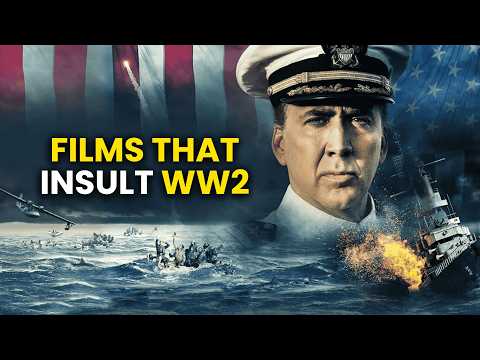
The sinking of the USS Indianapolis is one of the most harrowing true stories of World War II. After delivering components of the atomic bomb, the ship was torpedoed, leaving hundreds of sailors stranded in shark-infested waters for days. It’s a tale of survival, horror, and sacrifice. But the film adaptation starring Nicolas Cage turned it into something unintentionally laughable. Instead of capturing the desperation of those men, the movie served up CGI sharks that looked straight out of a low-budget video game. Dialogue was stiff, the acting wooden, and the pacing uneven. At times, the film veered into soap opera territory, complete with unnecessary romantic subplots that drag the focus away from the true ordeal.
Critics shredded it, giving it a dismal 18% on Rotten Tomatoes. With a $40 million budget, it only pulled in a couple million at the box office—a staggering failure by any standard. Survivors and families of the Indianapolis were especially disappointed, feeling the film didn’t honor the men who lived through that nightmare. The real story deserved a treatment with gravity and respect. What it got instead was a film that looked more like a parody. USS Indianapolis: Men of Courage will be remembered not for honoring history, but for botching one of its most powerful stories.
You’d think a film about one of the most pivotal battles of World War II would be bulletproof. Instead, Battle of the Bulge (1965) is remembered as one of the most inaccurate war movies ever made. Released with a star-studded cast including Henry Fonda, Robert Shaw, and Telly Savalas, it promised to deliver an epic recreation of the desperate winter clash. What audiences got instead was a geography-defying mess.
The real Battle of the Bulge was fought in snow-covered forests, but the film was shot in sunny Spain, where not a snowflake could be found. The result looked more like a desert skirmish than the brutal winter struggle soldiers endured. The German tanks weren’t authentic either—they used modern vehicles dressed up to look the part, which fooled nobody. Even veterans who had fought in the Ardennes blasted the film for misrepresenting their sacrifice.
The script simplified the complex battle into cartoonish good-versus-evil storytelling. Historians have since called it one of the most misleading portrayals of World War II ever put on screen. Despite its sweeping camera shots and big budget, it failed to resonate with audiences who expected realism and got Hollywood spectacle instead. Battle of the Bulge may have tried to be grand, but it ended up feeling like a theme park ride pretending to be history.
Imagine handing Bruce Willis and Adrien Brody a World War II epic with a $65 million budget only for the final product to look like a bargain bin reject. That’s Air Strike (2018), a disaster set during the Japanese bombing of a Chinese city in 1943. On paper, it had the makings of an international hit. With Willis cast as an American pilot training Chinese recruits and Brody in a supporting role, the film should have carried weight. Instead, it earned the rare humiliation of scoring 0% on Rotten Tomatoes.
The problems hit from every angle. The CGI looked like it belonged in an early 2000s video game, not a serious war drama. Planes moved like plastic toys. Explosions had no impact. And the whole thing felt cartoonish. The dubbing was so clumsy that it distracted from even the simplest conversations. Worst of all, Bruce Willis seemed barely awake, trudging through the role as though he was counting down the minutes until payday. Brody fared no better, disappearing into a confused script that never gave his character a purpose.
Behind the camera, the project was plagued with endless re-edits, re-shoots, and production scandals that left the final cut looking patched together. By the time it stumbled into release, critics shredded it, audiences ignored it, and theaters yanked it almost immediately. Online, it became a running joke with people comparing it to cheap mobile games that offered more realism and heart than this $65 million misfire. Air Strike set out to honor a painful chapter of history. Instead, it became infamous for wasting its budget, wasting its cast, and delivering a film so hollow that it was almost unwatchable.
Some war movies try too hard to mix dark comedy with violence, and The Misfit Brigade (1987) might be the most awkward example of them all. Based on Sven Hassel’s novel about a German penal unit on the Eastern Front, it had the chance to be a gritty exploration of desperation and moral compromise. Instead, the film veers wildly between brutal battle scenes and corny slapstick, leaving viewers unsure whether to cringe, laugh, or just switch it off.
The setup had potential: convicted German soldiers, essentially expendable, thrown into a dangerous mission. That premise could have delivered tension and moral ambiguity. But instead of weight and drama, the movie leans into absurdity. Audiences are treated to soldiers rescuing kittens from bombed-out buildings, tossing out sitcom-style one-liners, and stumbling through scenes that feel like rejected skits. What was meant to be dark humor ends up stripping the story of any power, reducing it to a parody of itself.
The production choices only made things worse. Authentic German tanks and equipment were nowhere to be seen. Instead, cheap Yugoslav substitutes stood in, making the film look like a discount reenactment at best. Even with actors like David Carradine and Oliver Reed in the cast, the performances were wasted on a script that never found its footing. Critics were merciless, calling it juvenile, pointless, and downright embarrassing. Historians dismissed it for trivializing the war, and fans of the novel were left baffled at how such a promising concept had been reduced to clumsy farce.
The Misfit Brigade isn’t just a bad World War II movie. It’s living proof that not every story belongs on the screen. Some novels should stay on the page, especially if the adaptation strips them of all credibility.
With a cast including Michael Douglas, Melanie Griffith, and Liam Neeson, Shining Through (1992) should have been a tense spy thriller. Instead, it became so laughably bad it actually won the Razzie for Worst Picture. Griffith plays a secretary turned spy who infiltrates Nazi Germany, but viewers are treated to absurd scenes like her baking pies for a Nazi officer while supposedly stealing secrets. What could have been a gripping wartime thriller became a cinematic punchline, remembered more for its Razzie win than anything else.
On paper, Escape to Athena (1979) looked like a winning formula: Roger Moore, Telly Savalas, David Niven, and Elliott Gould, all set against Nazi-occupied Greece. What audiences got was a bizarre mashup of tones that made no sense—part war film, part heist, part slapstick comedy. Then, out of nowhere, a disco dance sequence drops in, completely shattering any atmosphere of wartime realism. Critics called it disrespectful, with some saying it felt like the cast was simply on vacation in Greece while cameras rolled.
The Battle of Stalingrad is one of the most brutal clashes of World War II. Enemy at the Gates (2001) set out to tell that story through a sniper duel, but instead stuffed in a love triangle between Jude Law and Rachel Weisz. For a movie that wanted to honor Soviet endurance, it ended up as little more than a glossy distraction that trivialized the true scale of Stalingrad’s nightmare.
When a war movie gets condemned by actual world leaders, you know something’s wrong. U-571 (2000) tells the story of American sailors capturing a German U-boat and stealing an Enigma machine. The problem? That never happened. In reality, it was the British who achieved this feat months earlier. British Prime Minister Tony Blair openly criticized the movie, calling it disrespectful to those who had risked and lost their lives. Veterans groups blasted the film for stealing credit from the Royal Navy.
Quentin Tarantino is known for rewriting history with blood, flair, and dark humor. Inglourious Basterds (2009) took that approach to the extreme. While some hailed it as a masterpiece, many veterans and historians saw it as deeply disrespectful—a movie where the war is essentially won by a squad of rogue soldiers assassinating Hitler in a theater. The infamous Jew Hunter, played by Christoph Waltz, drew both praise and condemnation. Some European historians criticized the film for confusing younger audiences who might walk away thinking parts of it were real.
Spike Lee set out to tell a forgotten story of black soldiers in World War II with Miracle at St. Anna (2008). What followed was a muddled, overstuffed movie that left historians furious. Lee’s script introduced a fictional betrayal subplot that shifted blame onto Italian partisans, enraging survivors who pointed out the massacre was a documented war crime with no such betrayal involved. Italian media slammed the movie as an insult to history, and Lee refused to apologize, doubling down on his version of events. At the box office, it bombed.
And there you have it—fifteen World War II movies that tripped over their own ambition and landed in cinematic infamy. Some rewrote history, some drowned in melodrama, and a few were just plain embarrassing. But now it’s your turn: which of these misfires do you think deserves the top spot—and did we miss one that belongs on this list?
Report this article
Select a reason for reporting:






