The dogs picked up the scent in eleven minutes. They worked it hard for two hours, and then brought the American tracking team back through the bamboo to the exact gravel spot in the stream where they had started. The trainer checked his compass twice before he believed it. Major Hartley, the staff officer at the 2nd Field Force in Vietnam responsible for employing combat tracking teams in the operational area called Columbus, wrote in the margin of the first log sheet that the animal had been overworked in the heat. It was the only explanation available to him that morning. But it was also wrong.
Hartley faced the problem in late January 1968, in the weeks that turned every assumption of the staff in the Bien Hoa sector upside down. He was in his mid-forties, sweating across his forehead above a pale hairline, with short grey-blond hair, reading glasses pushed up, and a dark map case strap cutting diagonally across his chest with sweat. At the morning mission briefing inside the operations tent, he made his position clear. Reconnaissance tasks in Columbus were being assigned to allied patrols that were reporting late, few, and unverifiable. He wanted a demonstration of control. He wanted to send tracking teams against a friendly patrol whose drop-off point was pre-designated to prove how long a small unit could last in land where the enemy also hunted. He chose the Australian landing operation as proof of his idea. “Bring the dogs,” he said, and that phrase entered the staff minutes in those three words.
What was at stake was not pride. It was control of reconnaissance tasks in the entire operational area for the remainder of Operation Coburg. If the dogs could reach the Australians within a day, long-range patrols would be downgraded to a screening tool, and the ground would be monitored by aerial and field survey instead. The Australians were already on that ground. Four men from one squadron, from the Special Air Service Regiment, attached to the 1st Australian Task Force, had entered the previous afternoon. Their mission was not to ambush nor to pursue. They were to hide in plain sight of a transport corridor running south out of abandoned rubber plantations on the Bien Hoa and Long Khanh border, and to count numbers of men, weights and shapes of loads, direction, and above all, timings. How many hours after dusk transport began and what that meant for the arrival of supplies at the entrances to Long Binh and Bien Hoa.
Brigadier Ron Hughes, commander of the 1st Australian Task Force, made clear through his operations staff that counting was the only reason men were on that border at all. Four riflemen contributed nothing to Operation Coburg. Four pairs of eyes watching a trail for a week provided the one thing no one else could: a schedule. The accounts of that mission are what make the next three days understandable. A patrol that is spotted stops counting. A patrol that is tracked stops counting. There are no partial results.
And on the second morning, the men at that stream were being followed by a dog team about 200 meters behind, working a fresh scent from a drop-off point handed to the hunters on a map. They had cut the tracking line without running and without firing a shot. How four men did that against trained handlers and trained animals is the heart of the story, and the answer is not fitness, nor the jungle. It was landed properly. A single Huey hovered low over old rubber trees in the last hour of light, landed in a clearing 300 meters from the stream, settled on its skids for a few seconds, and lifted off again. Two more false approaches were made toward clearings to the east, a standard Australian procedure at the time documented in detail by David Horner in the official history of the regiment. The four men were out and lying in the grass before the skids left the ground.
They did not move for 20 minutes. They lay with their faces turned sideways between the stems and listened to the noise of the aircraft fade into the stillness of midday. Then they listened to what the clearing sounded like without it. A thermal creak in a bamboo clump at the tree line, the return of insects, a single bird that stopped and then began to sing again. Then they moved, over hard laterite soil, orange and baked by the sun, sounding under boots like fired brick. Laterite takes a heel print like wax when wet, and leaves no trace at all when dry. The forward scout chose his path through the dry part amid red ant nests knee-high, and the patrol crossed to the stream line without leaving a usable trace. That was the way. It was how Australian patrols had stayed alive in that province for two years.
What the way could not account for was the communications network. Within an hour, the landing coordinates of that helicopter were passed from the allied liaison office to the tracking team stationed at Bien Hoa with the unit’s estimate. This was not a leak and not a mistake. It was standard procedure. Coordination of friendly landings existed precisely so that no one bombed their own forces, and Hartley, operating within that procedure, simply read the coordinates off the board and used them. The entry log the next morning, declassified with subsequent operations reports of the 2nd Field Force, documents the team’s movement to a start point chosen by the trainer, with a note that the trail was about 4 hours old.
The team that came for them was not amateur. The American combat tracking team at that period consisted of five men: a team leader, a visual tracker who studied signs, a cover man, a trainer, and the dog. The dog was usually a black Labrador trained to follow human scent carried in the air rather than ground disturbances. The trainers and visual trackers had been trained at the British Jungle Warfare School in Johor, Malaysia, and the standards there were not easy. The team operated according to written standing operating procedures, a specific search pattern when the trail was lost, specific rest periods for the animal, and specific criteria for declaring the mission over. Those procedures were why the teams were effective. They were also, as Hartley would have to admit after 6 weeks, the thing the Australians attacked.
The stream itself was shallow and tea-colored over gravel, ankle-deep in most places, bordered on both sides by brick-red mud banks. That kind of mud holds a print for days. The visual tracker found the first sign in the morning on the east bank below a fallen tree trunk whose bark the water had stripped to silver. A smooth-soled rubber boot print, slowly filling. He read it, and read it correctly according to his training. There was no chevron pattern. There was no stud. There was no bare toe shape, and no military tread of any nation. The print was flat, slightly worn at the outer edge, and the step up the bank was short. A local woodcutter, that is what he logged. Perhaps a man crossed at dawn to cut wood and went south.
The trainer disagreed because the dog did. The animal was pulling on the leash, and the direction it pulled matched the bank where the print was. For about 90 minutes the team stood in the heat and settled the argument. They directed the dog north, then south. They examined the bank for a second print and found an incomplete mark that proved nothing. The team leader walked 200 meters downstream and came back. A radio conversation with Bien Hoa was summarized in the log in one line, and the summary is an argument over whether the dog or the human had priority when their readings conflicted. 90 minutes is not a long time inside an operations tent. But on the ground, it is 2000 meters of cautious movement, and the patrol had covered it meter by meter.
Those boots were not military issue. They were Bata canvas shoes, flat-soled, bought for a few dollars from the Nui Dat canteen, and they preferred them to American jungle boots at that period for one reason only. They printed footprints like everyone’s footprints in the province. Every woodcutter, every rice farmer, every man moving at night with a sack of rice on a bicycle wore that kind of rubber, or went barefoot. A military boot print in that country was a signature. A smooth sole meant disappearing into the crowd. Chris Masters, who later wrote about the regiment’s long habit of buying its own equipment, recorded the same instinct in another generation and another war.
And the price came at the second crossing. The canvas shoe provided no ankle support, and the mud on the bank above the stream was wet and slipped underfoot like soap. The lead scout went down with his weight on his left ankle, and got up without making a sound because falling silently is the first thing that land taught. He stayed in place for a full minute, testing the joint with his weight. The joint held, while swelling already began to show inside the cloth. The patrol leader watched his ten steps and decided not to report it. That simple ankle sprain changed the calculations of everything that followed. The patrol could still move. But it could no longer move fast, and it could no longer rely on the only option every small team keeps, which is rapid withdrawal while accepting the noise of pursuit. From that moment, the four men were forced to win by silence and cunning against a team that had dogs, radios, and a helicopter on call.
And in the operations tent at Bien Hoa, Hartley had just been told that the tracking team had lost 90 minutes of a 4-hour-old trail standing at a stream arguing about a woodcutter. Hartley did not argue with the team leader’s log. He removed the variable that caused it. By mid-afternoon, he stopped treating the stream trail as evidence at all. The print was just a reading, and readings could be wrong. The landing coordinates were a fact, passed over the communications network, timed to the minute, and signed by both sides. He ordered the team flown from the stream, over the ground they had walked all morning, and dropped on the grass of that very clearing. In that one spot in southern Vietnam that he knew for certain four Australians had lain flat for twenty minutes, faces turned between the grass. The helicopter took 11 minutes to do what the team had failed to do in 6 hours. The dog came off the skid onto the flat grass, with the leash wrapped twice around the trainer’s fist, put his head down, and did not begin to search around. He simply headed hard southwest across the dry, leech-filled hills, dragging behind him a man who had to trot to keep the leash from snapping tight. The trail was no longer 4 hours old, it was less than two hours old.
The reports of the 2nd Field Force after operations, declassified with the Coburg files preserved at the Australian War Memorial and the US Army Center of Military History, recorded the decision in dry administrative language. The team was repositioned to the confirmed landing point, the trail was reacquired, and the pursuit resumed at speed. What the report did not record was that this was a deliberate departure from the written doctrine on which tracking teams were built. The procedure in Johor taught trackers to work from discovered signs forward, because a discovered sign is physical, while a map reference is just paper. Hartley reversed it. He put the rhythm of his movement before his own system, and over the next ninety minutes, it worked better than the system itself.
The four men heard the sound at about 600 meters. They were in an old rubber plantation by that time. Trees planted by the French, standing in perfectly straight rows with light shrub between them, and the ground covered in dry leaves. Rubber plantations carry sound the way a corridor does. The first time, the sound came as a single muffled, cut-off bark, the kind a trainer allows once and then corrects. The second time, perhaps 3 minutes later, it came from a direction a few degrees further north, which meant it was moving. And moving along the path they had taken.
The forward scout was kneeling on one knee with his left ankle badly swollen inside his canvas shoe, and he did not need anyone to tell him what that direction meant. No one in that patrol had expected a dog. Dogs had been worked against Australian patrols in that province before. The regiment’s post-operations reports for 1967 note enemy tracking teams with animals in the Long Khanh area. But a dog working a hot trail from their landing point on the second morning of the mission was a problem of known origin and no good answer. The hide was 240 meters ahead. They had chosen it the previous night from the opposite bank. A low bamboo cluster above a bend, overlooking a porter trail 40 meters away with a dead zone behind it. That was the entire point of the landing. Occupy the site before dusk, stay in it for six or seven nights, count the men and loads and bicycles, and the hour transport began and the hour it ended. Brigadier Ron Hughes had been perfectly clear through his staff that timings were the goal. Everything else was secondary.
The patrol leader did the calculations kneeling on one knee over fallen leaves, and the result was inevitable. The hide was a box with one door. Occupying it with a dog team two kilometers away working the trail would turn four observers into four men in a hole, found as fast as the animal chose. He signaled the scout forward, and turned the patrol west away from the trail line down toward the stream. The price of that decision was that night’s statistic. The porters moved after dark on a schedule the task force had never directly observed, and the patrol had just abandoned the site from which they would have watched them. The ground they had been sent to read would not be read by anyone that night. No sightings, no loads, no timings. Four men alive and moving, and the mission they came for postponed to a day they did not yet know.
Ian McNeill’s official encyclopedia of the Australian Army in Vietnam makes this point with unusual clarity for an official historian. The measure of a reconnaissance patrol is not what it survives, but what information it sends. They did not know it, but at about the same hour, the pursuit operation mounted to envelop them was quietly splitting in two. The second element was not a dog team. It was a visual section sweeping the eastern approaches with a survey platoon behind it. And it had run into the patrol’s outgoing track less than two kilometers north, where the spine of hard laterite soil met a cart track, and the crust crumbled into a strip of powdered orange dust. The hard laterite had preserved no trace of them. Twenty meters of fine, flour-like dust caught three partial marks. The visual tracker bent over them using a piece of bamboo as a pointer, the way he had been taught. He had a good eye. He found the third mark that the first two had hidden. He fixed the line of march and read the details that mattered to him. No tread, no stud, no protrusion, the outer edge worn, the step short, and the weight carried forward on the ball of the foot in the manner of men walking a trail they know. He logged a move of three persons wearing canvas or similar rubber boots heading west, most likely woodcutters or porters posing no immediate threat, while the sweep platoon behind him veered toward the village approaches to the east to chase a threat that seemed more important. Five dollars of canvas from the Nui Dat canteen had pulled a company-level sweep platoon away from the stream line and sent it two and a half kilometers in the wrong direction. The Australians never saw it and did not learn of it for weeks.
What that meant on the ground was that the ring closing on them would contain one animal pursuit element instead of two. And a four-man patrol can make trouble for a single tracker in a way it cannot for two converging lines. By dusk, Hartley had decided to make the one element equal four. He had been told the dog was holding the trail, not searching for it and not recovering it, but holding it. And that was the only sentence from the field that mattered to him that day. He began stripping tasks from others. He took an airborne relay radio from a mission supporting operations east, so the tracking team could talk to Bien Hoa continuously from inside the rubber plantation instead of intermittent periods. He pulled a second combat tracking team out of rest status and prepared it at a fire support base, to be ready for lift at first light. Then he drew the box. It was a simple administrative geometry problem, and it was correct. North lay the abandoned farm track, a raised strip of greyish-white dust running east-west, exposed along most of its length. East, the sweep platoon line and the village approaches. West, open ground sloping down to cultivated rice fields, where four men in daylight could be seen from 1000 meters. And south ran the stream, and the stream was where the dog was headed. Three sides were closed by men, or terrain, or visibility. The fourth side was an unknown watercourse three kilometers long, ankle-deep over gravel, bordered by mud banks that preserved any print a man left climbing them.
Hartley signed for the relay aircraft and the second team in one line of the log, and recorded the reason as a demonstration requirement. The irony of what he had built was not clear to him until another 6 weeks had passed. He had begun the week arguing that allied patrols were unverifiable and undisciplined, but he spent the last twelve hours canceling a written tracking procedure, diverting an aircraft, and standing down a rested unit, just to keep one animal on one trail. The Australians at that moment were doing nothing at all but staying still.
The last rest before full dark was 8 minutes in an area of ant nests, where the red hills rose knee-high and the soil smelled of hot iron. The signals man spent three minutes of that period handling his pouch. He had been carrying since Nui Dat a double-sealed plastic bag containing coarse CS crystals like wet sugar. The inner bag was knotted and the outer taped and flattened. The bag was at the bottom of the pouch under the radio batteries, a place unsuited to it now. He tore the tape with his teeth, took out the bag, and re-taped it under the top flap where it could be reached with one hand without untying anything. He did not mention the reason. Everyone in the patrol understood the geometry of tracking, and no one discussed it openly.
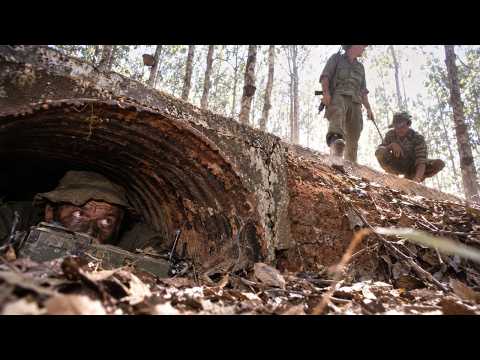
The scout spent the three minutes examining the route. He crawled to the edge of the farm track in the last light, and lay watching the track stretching ahead. Dust covered the track ankle-deep, greyish-white, untouched by anyone, a surface that recorded any crossing as clearly as a signature on paper. Nothing could cross it without leaving a mark. Forty meters west, where the track cut a shallow drain, the French had placed a culvert. A rusted iron pipe about 80 cm in diameter, half-blocked with dry leaves and dry to the touch. He recorded it in the patrol log with direction and distance, as the only place along that stretch where men could cross from one side to the other without leaving a trace in the dust. Then the dog barked again, closer, and the patrol went down into the water.
The water absorbed the sound of their movement. It covered the ankle over gravel, tea-colored in the last light, curling around the canvas of their desert boots, and the scout felt the swelling in his left ankle go numb and become useful for the first time in 6 hours. Gravel is the only stream bed that punishes carelessness. A man who puts his foot down flat rolls two stones against each other, and the click carries 200 meters in still air. They entered the water heel first and then toe, four men spaced 8 meters apart, and the patrol leader faced them downstream because that was the only direction that offered cover. The sound of the dog was audible now between the air currents. It came in bursts, footsteps on dry leaves, and the sound of a man moving fast without concern for who heard him, then 90 seconds of silence when the air moved the other way. The leader estimated the distance at 200 meters, and his estimate was very accurate. The record of that pursuit, preserved in the post-operations correspondence of the 2nd Field Force and matching the patrol’s interrogation report at the Australian War Memorial, indicates that the distance at the moment the Australians entered the water was about 180 meters.
The banks were the problem, and everyone at that stream knew it. Wet laterite mud holds a heel print like wax for days, and four men exiting the water at any point along that course would leave a chain of prints that a half-trained eye could read while walking. There was only one place along that stretch where a man could exit the water onto dry ground without touching the mud, and that was a fallen dipterocarp trunk 260 meters downstream, extending diagonally across the channel, its bark stripped to silver, its root mass protruding from the east bank like a torn fingernail. The patrol had identified this place during their entry. It was not a plan. It was the only door in the room.
What the water did not do was end the problem. And the patrol discovered that while still in the water. The trainer did not come across the stream. He executed the standard search. The procedure taught at the jungle warfare school in Johor, and transferred almost literally into the standing instructions for American tracking teams at that period. When a trail enters running water, the dog is taken to the point where the trail was lost, then walked along the near bank in stages, then the far bank in an expanding pattern; because human scent does not sink into a stream. It drifts off the surface, and is caught in the vegetation on the windward side, and collects wherever the air is still. The Labrador picked up the scent at about the fifth stage, 200 meters downstream of the entry point, working at a bend where the bank shrubs leaned over the water, and the air was still beneath them. He did not need the men. He needed the terrain of the valley. The scout heard the animal reacquire the trail and understood what it meant before the leader signaled him. They were walking in the water while a dog paralleled them on the bank, and the distance they had covered that morning with 90 minutes of effort had just been lost. The water had bought minutes. But it had not bought survival. And no amount of fitness was going to make four men—one with a swollen ankle inside his boot—outrun a trained animal moving freely on dry ground.
So the patrol leader stopped trying to beat the dog. The decision he made at that stream is the complete answer to the question the command tent at Bien Hoa had been asking for two days. The animal could not be fooled by distance, or by water, or by speed. But the man holding the leash could. The dog read the trail. The team leader read the signs, and under his written procedures, he had priority when they conflicted, a matter not yet settled, as the morning’s events on the gravel had proved. They made him something to read.
Twenty meters before the dipterocarp trunk, the second scout climbed the east bank deliberately. He climbed badly, which is harder to do on purpose than to do well. A partial slip with the ball of the foot, a handprint where he braced, and a bank grass stem broken at knee level and left hanging. He penetrated seven meters into the scrub on the east side, then turned and came back to the water through the same prints. In the broken grass, where a man kneeling on one knee could see it in less than a minute, he dropped a cigarette butt. Rice paper, flat and compressed, locally made, which he had been carrying in his pocket since Nui Dat for this purpose only. Then he waited for the others to return, and the four of them crossed the stream over the silver trunk toward the west, one after another, moving from the root base to the dry leaves and dry soil, leaving no trace behind them.
The team reached that bend 11 minutes later. The dog wanted to go toward the west air, while the team leader wanted the east bank. Because the east bank carried a print, a handprint, a broken stem, and a cigarette butt smoked during the day. He sent the cover man and the visual tracker to examine it. This is not a failure of training. This is training itself. Physical evidence, documented and photographable, always takes precedence over a passing reading in an institution that has to justify tracking operations in writing to offices that have never smelled the bottom of a stream. The two men spent 22 minutes and 200 meters on the east bank confirming that whoever had climbed up had come back down. Under the written procedures, the trainer had only one move left, and the Australians had been counting on it since the last halt in the ant nest scrub. When a tracking operation fails or is disrupted, the trainer returns the dog to the last point where the trail was confirmed and starts again. This is in the instructions. It was also in the Australian counter-tracking curriculum. Taught at the jungle training center at Canungra, and refined through the regiment’s contact with the Malayan Emergency generation. David Horner’s official history notes that Australian patrol leaders at that period were briefed on the methods of allied tracking teams in detail, because allied tracking teams were operating in the same area.
The last point of confirmed scent was the lost point at the bend. The patrol knew its location to within 10 meters because they had defined it. The signals man had done the job while passing. He cut the tape under his pouch flap with his thumbnail, took out the double-sealed bag with one hand, opened the inner knot, and walked back along their line of march for 15 meters, scattering coarse CS crystals into the fallen leaves and wet bank soil, and pressed them with the sole of his boot until they disappeared from sight. CS crystals do nothing inside a bag. When combined with warm, moist leaves, they sublimate slowly for hours, and emit at nose height, which is 18 inches, the exact height of a Labrador’s nose while working. The animal lunged for them at a run with its head down, and that was the end of the day. The dog leaped off the ground as if struck, recoiled into its trainer’s legs, and began rubbing its muzzle sideways in the gravel while wiping its face with its front paws. Its eyes closed from the tears. The trainer poured water on the dog’s face from his own canteen, and the water made it worse, which is what usually happens when water reacts with this compound. He wrapped the leash around his fist twice as he had since the moment they left the clearing, and the dog turned a full circle and sat down in the stream, refusing to put its nose on anything. The procedure that had made the team formidable had now closed the file on them. A dog showing signs of nasal contamination is withdrawn. The dog is not worked again that day. It is examined and the incident is logged. There was no room for initiative for a trained sergeant standing in a stream at dusk, and there was no room for his team leader either. The second tracking team Hartley had prepared at the fire support base was 6 hours from first light, and no helicopter in that sector was going to lift it into an unsecured area in the dark. Four men had stopped a trained pursuit team without escaping it and without firing a single shot, by putting half a kilogram of white powder in one place, and written instructions had forced their opponent to stop.
The price arrived within 4 minutes. CS does not stay where it is placed in a still stream without wind at dusk. It collects in the channel like cold air and moves with the current the way water moves, which was exactly the route the patrol intended to leave by. The leader had to take them the other way. Out of the water on the west side, against the wind, up over the mud and the slope. Away from the stream line entirely and into open farmland, where the rubber stood in perfectly straight rows with the shrub removed between them, making a man visible at 150 meters in daylight. The scout climbed that bank using his hands and his good knee and his eyes streaming tears. His ankle was no longer numb. The cold water was behind him now, and the radio signaller climbed behind him carrying the set and an empty plastic bag he could not throw away. They had beaten the dogs to the open ground. Behind them were 3 kilometers of stream cover, and ahead of them nothing but trees in rows.
Hartley read the trainer’s log in the operations tent that evening, having set his reading glasses aside for once, and did not accept the result. He wrote the word “irritant” twice. His assessment, recorded in the daily staff reports declassified with the Coburg files, was that the Australian element had used a riot control agent against a friendly trial series. And that this had degraded the capability of a trained animal for not less than 24 hours, and therefore the results of the trial could not be counted. They had broken the test conditions, he wrote, not the teams’ method, and he demanded a formal ruling from the 2nd Field Force on the point before the series continued. Then he addressed the second half of the problem, which was that he still had one trained element positioned forward at the fire support base, and that patrol which he now knew was standing in an open plantation. He communicated with the teams, and he had read the log twice, and somewhere between the two readings, he changed what he was going to send. A degraded animal is useless in open rubber, and the second combat tracking team positioned at the fire support base had a Labrador with it that would be of no value if the stream line still contained gas at first light. So Hartley trimmed the team. He kept the team leader and the visual tracker, left the trainer and the dog at the base, and attached to them three Kit Carson scouts from the division program. Former fighters who had defected under the Chieu Hoi program, and had spent years in that land before anyone thought to bring a Labrador to it. The lift arrived at first light at the same farm track, where the ground was hard and the dust recorded everything. It was a perfectly logical decision by every measure available in that tent. It was also the worst thing that could possibly have happened to four Australians standing among trees growing in rows.
The dog does not care what a man walks on. It follows what comes off him and hangs in the air behind him. And against that, the patrol had spent a day and a half fighting water, hard laterite, and finally a chemical. But the visual tracker cares about nothing but the ground. He reads the bent grass that has not yet straightened. The bruise on a leaf where a weight rested. The ant hill top that has been scraped. The way a tired man’s heel digs slightly deeper than his toe when he is carrying 25 kg and resting on one leg. The thin plantation soil that the CS gas had pushed them onto had no water, no bamboo choke, and almost no vegetation cover. It had flat, dry fallen leaves between the rows, and dry leaves are like paper. Terry Smith’s study of tracking in allied forces in Vietnam makes the difference in one line that the Australians would have endorsed without reservation. Dog teams find you where the air moves, and visual teams find you where you were careless.
The scout saw them at nine twenty-five, and he saw them because of the birds. He was lying in a shallow scrape at the base of a rubber tree with his left ankle propped above his body. The canvas of his boot had been cut open at the side with a knife two hours earlier to let the joint swell, and he was watching a flock of small ground birds scratching among the leaves four rows east. The birds rose suddenly without warning, and headed east. Nothing had made any sound. Something was close enough to frighten them, and it had not turned them toward the patrol, which meant it was walking parallel to them. He waited 11 minutes, and he got what he wanted. A man came through the fourth row in a crouch, moving in a way that cannot be taught to a man raised in that province. Three steps then a stop, head down, weight on the front foot, eyes on the ground instead of the horizon. Behind him at a good distance came a second man, then an American wearing a soft cap, no helmet, carrying a cut piece of bamboo. They were not following the patrol’s track. They were walking parallel to it about 150 meters away, sweeping the area inward as they advanced, which is what you do when you have lost a trail and know roughly which way it must have gone.
The patrol leader sent the report over the radio in the morning stream. In the flat, clipped phrasing Australian patrols had grown used to; because the transmit key was operated by hand, and every extra word meant another 15 seconds for a direction-finding set to catch their signal. Element paralleling the track, local trackers. Request extraction at current light.
That request reached Nui Dat, and there it went to Major Jim Hughes, the squadron commander, who had spent the previous six weeks arguing the opposite of what he was now forced to request. He forwarded it to higher command within one hour with his personal recommendation. The patrol had a man with an injured ankle, had been compromised since the second morning, was without cover, and was now being followed by trackers who did not need dogs. In any normal week, that recommendation would have been approved by a staff captain without waking the brigadier. But Brigadier Ron Hughes refused the request. The refusal looks cold on paper, but it was not. In the weeks following Tet, the 1st Australian Task Force had no direct observation of what moved at night toward the entrances to Bien Hoa and Long Binh. They had aerial photographs that showed the ground and not the people. They had sensor readings and field survey contacts that showed something was there. They had prisoner statements, but they were weeks old by the time they were translated. What they did not have, anywhere in their files, was a record of hours written by an Australian who had watched the start of transport operations and watched them stop. That was the only reason four men were on the border. McNeill’s official history records the pressures on task force intelligence at that period in terms that make the brigadier’s decision understandable. The formation was being asked to predict a second attack on inference alone. The signal that came back was short and curt. Mission unchanged. Extraction on completion.
And so the patrol stayed, and the first thing survival required was crossing the farm track without leaving a trace in it. They did it in the last twenty minutes of light, when the thermal currents had died and the dust had cooled enough to stop rising with every step. The scout took them to the culvert according to the coordinate he had recorded two nights earlier. A rusted iron pipe the French had placed under the raised track bed, 80 cm in diameter, half-blocked at the mouth with fallen leaves, and chalky dry mud that had not seen water in months. The crossing through it was not elegant. The signals man went first because the set had to be carried by hand and not dragged, so he entered on his elbows pushing the radio ahead of him, his face 11 cm from the rust. The pipe smelled of dry rot and iron and the sharp ammonia of something that had made its home there. A man cannot raise his head inside 80 cm. He cannot see what he is about to put his hand in, and there were enough snakes in that province for every man who went through that pipe to have kept the calculation to himself. The scout entered last, and his position was the worst. His ankle did not bend the way the pipe required, so he dragged his leg behind him and carried his weight on his forearms, and he had to shift the debris at the far mouth by hand and put it back behind him, handful by handful, until it looked as it had. Above them, across 4 meters of raised grey dust, there were no prints at all.
The sweep section reached that track at about ten the next morning and lost every thread it had. The line they had been sweeping inward clearly reached the southern edge of the track and stopped. Three Kit Carson scouts worked the dust in both directions for over a kilometer, and the American tracker worked with them, and the ground told them the truth, which was that nothing had crossed over it. The post-operations reports, declassified with the Coburg files and preserved at the Australian War Memorial alongside the patrol’s interrogation report, recorded the result in one sentence. Elements believed to have concealed south of the track. They turned south and began searching ground the Australians had already left.
Survival cost more than the crossing. The hide they established on the other side was 40 meters off a feeder trail amid ant nest scrub, and they stayed in it for two nights and two days without moving. Water ran out first. They had been landed with four bottles per man for a seven-night mission. The stream was now on the wrong side of a track they could not cross twice, so the leader ordered one bottle each for the duration. No cooking, which meant dry biscuits and canned cheese in the dark, with the can opened inside a shirt to muffle the sound. No smoking, which had already been a fact for days. Urine into a plastic bag, and the bag into the pouch. Cramps began in the signals man’s hands on the afternoon of the second day. His fingers stiffened at the second joint from dehydration, and from the pressure of the Morse key and his flat hand on hot soil. He opened his fist with his other hand between transmission periods. His sending speed dropped, and the base operator at Nui Dat noticed and said nothing over the radio.
On the second night, the trail delivered what they had come for, and it happened seven meters away. A group of porters came down the feeder trail at nine twenty-two, and the lead man stepped off the trail to urinate at the base of an ant heap. It was almost directly above the scout. The scout lay with his cheek against the red soil that smelled of hot iron, with ants walking on the back of his hand, and did not move his face. He could hear the man breathing, the fall of his sandal sole, and the shift of the rice sack on the carrying frame on his shoulder. It lasted about forty seconds. Then the man returned to the trail and the group moved south, while the patrol counted them as they passed. Twenty-six porters in two groups with bicycles loaded on both sides. The loads were rice, and what the patrol logged as ammunition packed in crates based on shape, and the way the porters moved under the weight. Transport began at nine and stopped before three. The trail headed southwest toward the entrances, not south toward the plantations, and it ran to a timetable. They sent the report at first light in a short message, which took 41 seconds on the key while the operator’s fingers were stiff around it, and Nui Dat acknowledged with four characters. Within a day, that map square became a target for aircraft, which meant four men, with one bottle of water each, were now lying inside a no-fire zone of their own making, on the wrong side of the track, and 4 kilometers from the only place they could possibly be extracted from.
The crater was the only solution, and every man in that hide knew what was wrong with it. Four kilometers to the northwest lay the clearing they had come in through, and between them stretched the farm track, the dust, and three Kit Carson scouts who had spent the morning walking in that dust with bamboo sticks. Crossing that track again was not a plan. It was an admission of defeat. On their side of the track, there was only one piece of ground open enough for a Huey to land, and it was a bomb crater in an old rubber plantation a kilometer and a half to the southeast. A sunken bowl of raw orange laterite soil, thirty meters across, left by a 500-pound bomb two seasons earlier, surrounded by bare trees leaning away from it like a torn collar. The crater was exposed from two sides. A low spur ran along its eastern side, covered in dense secondary scrub reaching sixty meters from the rim. And to the north, the ground rose gently through standing rubber trees, in straight lines toward the track. A man in either of those two places would see everything that happened in the bowl, and whoever sat on the spur the moment the aircraft arrived would have the patrol under his eyes, lit by the rotor wash. The lift took eleven minutes. That was not a guess. The operations staff at Nui Dat calculated it in two stages. Two RAAF 9 Squadron Iroquois flying from a holding pattern over secure ground, with a light fire support team, remaining over the crater while the first aircraft landed in a bowl with no safe overshoot, and trees leaning inward from every side. From the moment the patrol sent the distress call to the moment the second aircraft’s skids left the rubber, the ground beneath them had to be held for 11 minutes.
They moved at four in the morning, and their movement was labored. The scout’s left ankle inside a boot cut open two days earlier had taken on the color of mashed plum. He could put weight on it moving forward, but he could not twist it at all, which meant that when he met fallen rubber branches, he stopped, set his foot flat, and turned his whole body. The 1200 meters took them two hours and forty minutes. The signals man carried the radio and the scout’s pouch together, with cramped fingers, and the straps cut his shoulders through a shirt that had been soaked with stream water and dried with body sweat four times in three days. They reached the crater from the southwest at six twenty-five, and the patrol leader put two men on the rim, and took the scout and the signals man to a covering position on the protected side of the fallen tree collar. Then he did the only thing left, which was to wait and watch the spur for half an hour in broad daylight before calling the aircraft. Nothing moved there. The birds scratched the ground on the east side without taking off. At seven seven, the signals man sent the extraction group code, and Nui Dat acknowledged, and somewhere south, two aircraft lifted off the ground.
The scrub on the hill came alive at the fourth minute. It began with a single shot, dry and close, that struck the raw laterite soil at the rim two meters left of the leader, scattering gravel aside. Then more shots followed, random and high, six or seven rounds that cracked through the trees leaning above them. The scout flattened onto his stomach, pressed the plastic butt of his Armalite hard into his shoulder pocket, aimed at the base of the scrub line rather than into it, and fired low in bursts of two, parallel to the ground where any man lying down should be. Dirt and fallen leaves flew at the feet of the scrub. He emptied one magazine in about 15 seconds and changed it without lifting his cheek from the butt. The empty magazine fell inside his shirt because that was the habit, and habit does not stop for anything. The second man on the rim fired a burst from his belt-fed machine gun toward the same line. Whoever was up there had gone to ground, and that is the primary purpose. A group that is shooting is not a group maneuvering to turn a flank. The signals man had the smoke out before the leader asked for it. He threw two grenades, one from the rim and one before the east side, and the grenades burst with that muffled sound, and began pumping orange and then violet into still air that did not move it. With no wind, the smoke settled in the basin and rose in two huge columns, and the basin beneath them filled with a fog the color of pale sunlight. Someone on the hill fired into the smoke. The rounds did not come near anyone. The first Iroquois came in through that fog with its nose high, the crew chief hanging from the floor plate, and did not land. There was no flat ground in the basin for the skids, so it hovered with its tail low over the eastern rim, and the door gunners fired at the hill above the men below. The scout boarded third. He could not jump to the floor, so two hands reached from the cabin, grabbed him by his belt and collar and pulled him up the way a sack is pulled, and his swollen ankle struck the floor plate as he entered, and he made no sound despite it. The signals man boarded last with the radio still attached to him. They lifted off the ground 38 seconds after the first aircraft touched the fog, and the gunships worked the hill for 4 minutes afterward for a result no one in that patrol ever knew.
Six days on the ground. One set of timings. One man would spend eight weeks on light duties at Nui Dat. The patrol interrogation sheet was sent on the eleventh of February, and a copy reached the 2nd Field Force in Vietnam in the usual exchange of reports. Hartley read it with the tracking team’s log beside it on the same wooden table, and what the two documents did together, neither did alone. The log described six separate periods of contact with the trail over 3 days. A 90-minute halt at a stream over a footprint. A repositioning to a coordinate on the map. A reacquisition at a bend downstream. A wrong turn east for 22 minutes. A contaminated animal withdrawn from service. And a visual element that lost the trail at the edge of a dirt track and never recovered it. The interrogation sheet described the same three days from the inside, item by item, including the purchase price of the boots and the direction and dimensions of a drainage pipe. Then he did his calculations, and these numbers are in the post-operations reports at Coburg, declassified with the 2nd Field Force files and preserved in copies at the Australian War Memorial alongside the Australian patrol reports. Combat tracking teams were tasked with 31 follow-up operations in the Columbus area during the operation. 14 of them ended in contact, equipment recovery, or a confirmed site. A 45% find rate, which is in line with everything the teams had achieved since Johor, and it was not a bad number for that work. During the same weeks, the Australian squadron inserted 83 patrols into that ground and adjacent areas. Of those, 11 patrols were detected by any party, friendly or otherwise, before completing the mission. At 13%, none of them were located by a tracking team working a scent line. The teams were finding people. They were finding people who walked like everyone else in that province, in boots, in formation, on expected trails, and they found them at the rate the method predicted. The method was never tested against men who had read the method.
Hartley did not write an assessment of allied reconnaissance practices. He did not withdraw his request for a formal ruling on the use of riot control agent. And that request stayed in the file unanswered until the operation closed, and then it stayed in the file. What he did was open the tasking annex for combat tracking teams and delete the paragraph that gave dog handlers access to friendly insertion coordinates through the liaison office. From that date, teams had to be inserted at trail locations or reported contact sites, and nothing else. Coordination to avoid friendly fire and airstrikes continued through the communications network as it always had. But the dogs no longer did. He signed the change with one line in the margin of the annex, and that line did not refer to the Australians. It stated that prior knowledge of a friendly force’s start point had proven to obviate the need for tracking.
In March 1969, 13 months later, nine men from the US Army’s combat tracker detachment traveled from Saigon to Brisbane, then overland to the jungle training center at Canungra in Queensland. The program lasted 3 weeks. And for 11 days of it, the handlers and their animals were inserted into the field as a tracking team, and the men they were ordered to find were Australians.
The Australians, for their part, never wrote a doctrine about what happened at that stream. They did not need to. The lesson had already been paid for in a swollen ankle, a crumpled cigarette butt, and half a kilogram of white powder that cost five dollars from a canteen shelf.
What they taught at Canungra in those eleven days was simpler than any manual. A tracker is a man who trusts his eyes. Give him something to see, and he will stop trusting his nose. The Americans learned it the way the Australians had learned it: by walking into the trap and feeling it close.
Hartley kept the margin note in his files until he rotated home. He never wrote the assessment, and he never withdrew the complaint. But somewhere in the dry language of an annex, one paragraph vanished, and the dogs never again knew where the friendly patrols had landed.
Four men had proven that the most sophisticated pursuit system in the war could be stopped by a pair of cheap canvas shoes and a written procedure. The question that remains is not whether the method worked. It is whether any army ever truly learns the lesson its enemy teaches it.
What do you think — did Hartley’s quiet deletion of that paragraph count as a confession, or was it just the only honest thing left to do?
Report this article
Select a reason for reporting:






