They were the smiling faces of the Reich’s most brutal machinery—young women in crisp uniforms, some barely out of their teens, who wielded whips and pistols with chilling enthusiasm. When the Third Reich collapsed in a heap of rubble and shame, these women vanished into the chaos of post-war Europe, their crimes buried beneath the rubble of a defeated nation. But justice, it turned out, was as fragile as the peace that followed.
Of the roughly 3,500 women who served as SS guards in Nazi concentration camps, fewer than 100 ever faced trial. Only a handful were convicted. And for those who escaped the gallows, the post-war years offered something astonishing: a chance to start over, to change a name, to slip back into ordinary life as if the horrors of Ravensbrück, Auschwitz, and Bergen-Belsen had never happened.
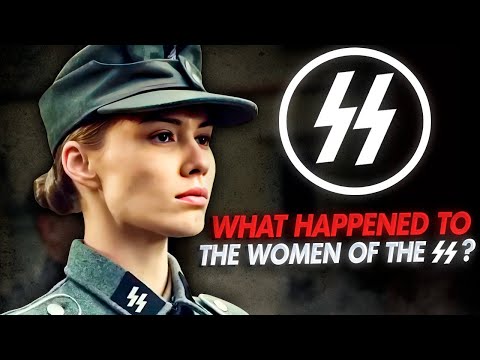
The story of what happened to these women is not one of justice. It is a story of silence, of bureaucratic indifference, and of a world too exhausted by war to hunt down every monster in a skirt. Some, like Irma Grese—the beautiful, sadistic “Angel of Auschwitz”—met the hangman. Others, like Hildegard Lächert, the “Bloodthirsty Tigress,” served a few years and then walked free, later recruited by Western intelligence agencies desperate for anyone who knew the Soviet bloc.
“She remained defiant to the end,” the British executioner Albert Pierrepoint recalled of Irma Grese, who at 22 went to the gallows with a smirk and a demand: “Schnell!”—hurry up. But most of her sisters-in-arms did not share her fate. They disappeared.
In the years that followed, these women were not hunted down like their male counterparts. They were not dragged before tribunals or forced to confront the shattered lives they had left behind. Instead, many simply went home. They married. They found jobs. They raised children. And they never spoke of the camps again.
Some, like Hertha Bothe—the “Sadist of Stutthof”—served just six years before being released as an act of British clemency. She changed her name, moved to a quiet town in northwestern Germany, and lived to be 79. When asked about her crimes in a rare interview, she offered a response that stunned the world: “Did I make a mistake? No. The mistake was the concentration camp, but I had to do it, otherwise they would have put me there.”
Others, like Ilse Koch—the “Witch of Buchenwald”—were pursued for years, their trials becoming media spectacles. Koch, accused of ordering prisoners killed for their tattooed skin, was sentenced to life imprisonment but later had her sentence reduced to four years by an American general. She was retried, convicted again, and finally took her own life in prison in 1967, unrepentant to the last.
But for every Koch or Grese, there were dozens of women whose names never made headlines. They slipped through the cracks of a shattered legal system, their crimes forgotten in the rush to rebuild Europe. Some were helped by the very prisoners they had once tormented—like Johanna Langefeld, the “Guardian Angel of Ravensbrück,” who was reportedly aided in her escape by former inmates who remembered her rare kindness.
The truth is more unsettling than any fiction: the women of the SS were not extraordinary monsters. They were ordinary women—nurses, factory workers, farmers’ daughters—who chose to participate in genocide. And when it was over, most of them chose to forget.
But the world has not forgotten them entirely. The image of the blonde, sadistic guard in polished boots has become a cultural archetype, a sexualized villain in films and comics. Yet behind the caricature lie real women, real victims, and a justice system that failed on an epic scale.
What happened to the SS women after the fall of the Third Reich? Some were hanged. Some were imprisoned. Most simply went home. And in the quiet anonymity of post-war Germany, they lived out their lives—unpunished, unrepentant, and largely unknown.
Yet the story does not end with those who escaped. In the decades that followed, a slow and painful reckoning began—not in the grand courtrooms of Nuremberg, but in small municipal halls and regional courthouses across West Germany. The 1960s and 1970s brought a new wave of investigations, driven not by the Allies but by German prosecutors confronting their own nation’s crimes.
The Frankfurt Auschwitz Trials, held between 1963 and 1965, put twenty-two former SS personnel in the dock. Among them were women whose names had long been forgotten. Their presence in the courtroom shocked a public that had grown comfortable with the narrative of male perpetrators and female bystanders.
“I was only following orders,” became the refrain—a defense that had worn thin by the time the verdicts were read. But the courts, bound by the legal standards of the time, often struggled to prove individual acts of cruelty beyond reasonable doubt. Many walked free.
One such case was that of Hermine Braunsteiner, a guard at Majdanek known as “the Stomping Mare” for her habit of kicking prisoners with steel-tipped boots. She had emigrated to the United States in 1959, married an American construction worker, and become a suburban housewife in Queens, New York. For years, she lived a quiet life—until a Nazi hunter named Simon Wiesenthal tracked her down.
In 1973, Braunsteiner became the first Nazi war criminal to be extradited from the United States. Her trial in Düsseldorf lasted six years, one of the longest in German legal history. She was convicted of murder and accessory to murder and sentenced to life imprisonment. Yet even then, she was released in 1996 on health grounds and died three years later, still claiming her innocence.
The case of Braunsteiner exposed a disturbing truth: many of these women had not merely vanished into anonymity—they had built new lives on the foundation of a lie. They had husbands, children, neighbors who knew nothing of their past. When the truth emerged, it shattered families and reopened wounds that had barely begun to heal.
But perhaps the most chilling legacy of the SS women is not their crimes, nor their escapes, but the way they were remembered. In the decades after the war, popular culture seized upon the image of the female guard—the SS-Aufseherin—and transformed her into something grotesque and titillating. Films like Ilsa, She Wolf of the SS turned the reality of genocide into exploitation cinema. The sexualized villain became a trope, a caricature that obscured the real women behind the uniforms.
Historians now argue that this fetishization served a darker purpose: it allowed society to distance itself from the crimes. If the female guards were monsters, they were aberrations—not products of a society that had nurtured them. If they were sexual deviants, their crimes could be dismissed as perversion rather than ideology.
But the truth, as always, is more complicated. The women of the SS were not born monsters. They were made—by poverty, by propaganda, by a regime that offered them power and purpose in exchange for their humanity. And when the war ended, they were not punished as monsters should be. They were allowed to become ordinary again.
The question that lingers, decades later, is not what happened to them. It is what their survival says about us—about the limits of justice, the fragility of memory, and the uncomfortable truth that history’s greatest horrors were committed not by demons, but by people who looked remarkably like ourselves.
That reckoning was never complete. Even as prosecutors in the 1970s and 1980s reopened files and tracked down aging women in quiet apartments, the legal machinery of the Federal Republic proved maddeningly slow. Witnesses had died. Memories had faded. And the courts demanded proof of specific acts—a single blow, a particular murder—rather than the broader architecture of complicity that had made the camps function.
For many of the SS women, this legal technicality became a shield. They could admit to having been there, to having worn the uniform, to having watched—and still walk free, because no one could prove they had personally killed anyone. The distinction between the woman who pulled the trigger and the woman who selected who would stand before it was one the courts struggled to bridge.
One of the last great attempts to bridge it came in the trial of Erna Wallisch, a guard at Majdanek and Auschwitz who had been nicknamed “the Beast of Majdanek” by prisoners. For decades she lived in Vienna under her married name, and when Austrian authorities finally began investigating her in the 1970s, the case dragged on for years. She died in 2008, at the age of 86, without ever standing trial. The file was closed. Justice, once again, had arrived too late.
Similar fates befell Luise Danz, a guard at Majdanek and Auschwitz who was convicted in 1947 and sentenced to life imprisonment—only to be released in 1956 under an amnesty. She was tried again in 1996 for the murder of a child, but the case was dismissed on grounds of insufficient evidence. She died in 2009, free.
What these cases reveal is a pattern that historians have only recently begun to confront: the post-war German justice system was not designed to prosecute the thousands of small cogs in the Nazi machine. It was designed for the architects—the Himmlers, the Eichmanns, the commandants. The guards, the secretaries, the cooks, the nurses—they were left to their silence.
And yet, the silence itself became a kind of confession. In the small towns of Bavaria and Lower Saxony, in the suburbs of Hamburg and Munich, there lived women who never spoke of the war. Their neighbors knew them as kindly grandmothers, as churchgoers, as volunteers at the local library. No one asked questions. No one wanted to.
“She was always so nice to me,” one neighbor of a former Aufseherin recalled decades later, when a journalist came knocking. “I couldn’t believe it when I heard.” The disbelief was genuine—and it was also a choice. To believe would have meant confronting the possibility that the woman next door, the woman who baked bread and tended her garden, had once stood in a smoky courtyard and pointed to the left, to the right, to the gas chamber.
The generation that had lived through the war was not eager to relitigate it. They had rebuilt their country on the rubble of the old one, and the rubble included the women who had served the Reich. To dig them up would have meant digging up too much else—the complicity of the Wehrmacht, the silence of the churches, the ordinary Germans who had looked away.
So the women faded. They grew old. They died. And with each death, another chapter of the story closed—not with a verdict, but with an obituary that mentioned nothing of the camps.
And yet, the reckoning left a strange residue. In the archives of Ludwigsburg, where German prosecutors centralized Nazi war crimes investigations, thousands of files gathered dust—names, dates, testimonies, all waiting for a trial that never came. Researchers who combed through them found something unexpected: letters from the women themselves, written in careful handwriting, protesting their innocence or pleading for understanding.
One former guard wrote that she had only been “a small wheel in a great machine.” Another insisted she had “never raised a hand against anyone.” The words echoed the defenses of a generation, a chorus of denial that outlasted the defendants themselves.
Historians now speak of a “second silence”—the decades in which these women lived openly, their pasts known to authorities but hidden from neighbors, from children, from the world. It was a silence built not on ignorance but on convenience, on a society that preferred not to ask.
When the last of them died—quietly, in nursing homes and small apartments—there were no headlines. No final verdicts. Only the slow closing of a file that should never have been left open.
But the story of the SS women is not only about them. It is about what we choose to remember, and what we choose to forget. And it leaves us with a question that refuses to fade: if ordinary women could commit such horrors and then vanish into ordinary lives, what does that say about the ordinary world we inhabit today?
What do you think—should the women who served the Reich have been hunted down more aggressively, or was the post-war silence an inevitable product of a broken world? Share your thoughts below.
Report this article
Select a reason for reporting:






