In the last week of May 1944, a staff officer at Imperial Japanese Navy headquarters in Tokyo stood before a wall chart, grease pencil in hand, and froze. Seven marks stretched across the Pacific—a scouting line of submarines meant to be the eyes of the fleet. Five of them had gone silent. No distress signals, no final transmissions. Just silence, one after another, with clockwork regularity. Tokyo assumed it was a massive hunter-killer group: a carrier, a dozen destroyers, aircraft overhead. Nothing smaller made sense. They were wrong.
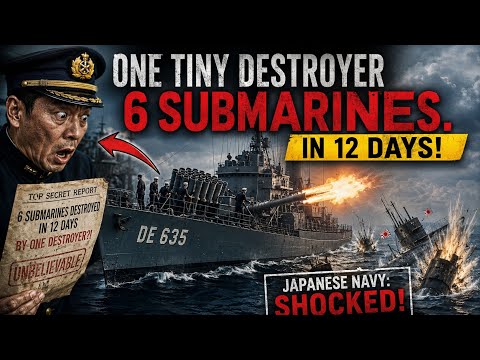
It was one ship. A 306-foot destroyer escort, built cheap and fast, crewed by young men who had never seen combat. She had no armor, three small guns, and a top speed slower than most ships she protected. Her name was USS England, and she was about to carve a record that has stood for over 80 years.
But before the sonar contacts and the hedgehog patterns, there was a 21-year-old kid in a sinking battleship at Pearl Harbor. His name was John Charles England. On December 7, 1941, he went back into the capsizing USS Oklahoma again and again, pulling men from flooding compartments. He didn’t come back from his last trip. He was 20 years old. Two years later, his mother swung a bottle of champagne against the bow of a new destroyer escort. The ship carried her son’s name.
Every man who walked up that gangway knew exactly who the ship was named for and how he died. They were sailing a memorial into the same ocean, with the same enemy.
By 1943, the U.S. Navy had a submarine problem money couldn’t solve. Depth charges—the standard weapon—were a prayer. Sonar had a blind cone directly beneath the ship, and submarines knew exactly when to turn and change depth. Across the war, depth charge attacks ran at roughly one kill for every 60 attempts. But crews loved them because they felt like something: the ship shook, columns of water climbed into the sky. Hedgehog, a British invention, was different. It fired 24 contact-fused projectiles ahead of the ship, and if they missed, there was no explosion—no turbulence, no lost sonar contact. It was a monster on paper. In practice, the fleet hated it. Silence after an attack was unnerving. Captains quietly went back to depth charges.
Lieutenant Commander Walter Pendleton didn’t care what the men believed in. He cared what the numbers said. A depth charge is a prayer, a Hedgehog is an equation, and he would rather solve an equation. He drilled his crew relentlessly, teaching them to fire at where a submarine would be, not where it was. By May 1944, England had done nothing—months of convoy work, not one shot fired. Then code breakers handed them a gift.
On May 13, 1944, FRUPAC decoded a message from Japanese submarine I-16, heading to Bougainville with rice for starving troops. Three destroyer escorts—George, Raby, and England—stood out of Purvis Bay. On the morning of May 19, England’s sonar got a solid return. I-16 went deep and started turning. Pendleton fired his first Hedgehog attack. Miss. The second scored a single hit—a wound, not a death. The third and fourth missed. Four attacks, nothing. The Japanese skipper had every reason to think he’d survive.
At 14:33, England fired for the fifth time. Four detonations, then a fifth and sixth. Then the ocean itself detonated. I-16 came apart. The blast knocked men off their feet. Oil and debris rose for 20 minutes. 107 men went down. Five attacks, one kill—20%. Pendleton’s arithmetic had paid out. It was a warm-up.
FRUPAC was already decoding something else. The Japanese Sixth Fleet had deployed a scouting line designated NA—seven submarines strung across the sea lanes north of the Admiralty Islands. RO-104, RO-105, RO-106, RO-108, RO-109, RO-112, RO-116. Their orders were not to attack. They were to watch and report. Admiral Toyoda needed to know where the next American blow would fall, and he had a fleet he could commit exactly once.
Haynes got the intercept at Tulagi on the 20th and did the math. Three destroyer escorts, seven submarines, thousands of square miles of ocean. On paper, a losing proposition. But he had just watched England kill a maneuvering fleet boat in under an hour with a weapon most of the Navy had written off. The hunter-killer group turned northeast toward the line.
They had one enormous advantage that had nothing to do with technology. Submarines have to breathe. A diesel-electric boat underwater runs on batteries, and batteries die. Every submarine on that line had to surface at night to recharge—not because the skipper was careless, but because physics gave him no choice. And an American destroyer escort carried surface search radar that could pick a conning tower out of the dark at 15,000 yards.
That is the shape of every one of the next five engagements. Radar finds a surfaced boat in the dark. The boat crash dives. Sonar picks her up going down. And then it is a mathematics problem with 56 lives on the answer sheet.
At 0350 on the 22nd of May, George’s radar got a return at roughly 15,000 yards. RO-106 was on the surface with her diesels running. Her lookout saw nothing—a radar contact does not glow. She got under in about 90 seconds, which is genuinely good work, and George threw a Hedgehog pattern at 0415. Miss. England picked her up on sonar at 0425, running deep, turning hard.
The skipper was doing everything the manual told him to do, and the manual was written for depth charges. Turn inside the pattern, change depth constantly, wait for the explosions, because the explosions are your cover. The explosions never came. England’s first attack missed—RO-106 swung roughly 30 degrees during the nine seconds the projectiles were falling. Pendleton’s people logged it and used it. At 0501, the second attack. Three detonations, right on top of each other. Then the big one. The pressure wave rolled out and shook England’s hull. When the sun came up, there was an oil slick half a mile across. 56 men. Kill number two, 72 hours after the first.
The escorts reformed and kept moving northeast. At around 0600 on the 23rd, Raby’s radar found the next one at 22,000 yards. She dove before anyone could close. What happened over the following two and a half hours is the part people usually skip and shouldn’t.
Raby attacked first, missed, attacked again, missed. Four Hedgehog attacks starting at 0617, every one into empty water. George took over, missed at 0717, missed again at 0730, missed at 0750, missed at 0810. Eight attacks, nearly 200 projectiles. Nothing. George and Raby were not bad ships. They were doing precisely what they had been trained to do against a skipper in RO-104 who was frankly excellent. Every time projectiles hit the water above him, he turned. And every time he turned, he broke the solution.
This is what the war looked like for almost everybody. This is the one kill in 60. Two ships spent two and a half hours executing textbook attacks on a real submarine and got nothing at all for it. If that had been the end of it, nobody would ever have made a video about any of this.
Hamilton Haines was watching from George. By 0820, he had a decision to make that no divisional commander enjoys making, because it involves telling two of your own captains over a radio circuit they can both hear that they’ve had their chance. England had been sitting off to the side for two and a half hours, watching, listening, her plot running the whole time. Pendleton’s team had tracked RO-104 through eight failed attacks by other people. They had every single one of those turns on paper.
Haynes keyed the circuit and said the thing that ended up in the histories. “Go ahead, England.” Four words. Everyone on that circuit understood exactly what it meant.
England came in. Her first attack missed. RO-104 turned again, same as she had nine times now. The second attack, at 0834, put ten detonations in the water—some accounts say twelve—so fast that men aboard heard them as a single tearing roar. Then the sonar operators heard the sound nobody ever described well afterward, because there isn’t a good word for it. Breaking up noise. Metal failing under pressure. Bulkheads collapsing one after another as a hull that is no longer whole gets driven deeper by the water pouring into it. It goes on for a while. It is not quick.
Three minutes later, a major underwater explosion as RO-104’s batteries let go. Oil and debris reached the surface at 10:45. Kill number three. Three submarines in five days, and the number of Japanese sailors dead had passed 220. Two ships had put eight attacks into that submarine and failed. England needed two.
At that point, people in the division started asking the obvious question, which was what exactly England was doing that the others weren’t. The answer was not a secret weapon—all three had the same weapon. It was that Pendleton’s plotting team never stopped solving. Most treated an attack as an event: set up, fire, evaluate, reset. England treated it as a continuous process where the solution was alive at every second and the miss data from the last attack was already feeding the next one. She wasn’t guessing better. She had stopped guessing.
At 0120 on the 24th, George’s radar found RO-116 on the surface at 15,000 yards. She dove at 0130, and England had sonar contact at 0150. This skipper tried something clever: he stayed shallow, around 150 feet, betting the Americans would set up for a deep target and their pattern would sink right past him. It was a good bet. It was also the last mistake he ever made. England’s fathometer team called the shallow depth immediately, and the solution changed to match.
First attack, 0214. Three detonations, possibly five. No enormous blast—just the small ugly reality of what a Hedgehog projectile does: punch a three-inch hole through a pressure hull at 700 feet per second. At 150 feet, seawater comes through a three-inch hole under enough pressure to cut a man in half. More holes meant more water, more weight, deeper. There is no bottom to that spiral. Oil appeared after sunrise. Kill number four. Six days.
The action reports landed on Admiral Ernest J. King’s desk in Washington. King read that one destroyer escort had killed four submarines in six days with a weapon his own captains were avoiding, and sent a signal that outlived almost everything else he ever wrote: “There’ll always be an England in the United States Navy.” Coming from King, that was an eruption of emotion. The phrase was through the Pacific Fleet within hours.
But fame mid-operation is a complication, and Halsey drew the conclusion senior officers usually draw about a valuable asset: protect it. The recommendation came down to pull England off submarine hunting and put her on carrier screening. Haynes argued it out and won a compromise. Three boats were still unaccounted for on the NA line, and the intelligence advantage would not last. One more patrol.
At 23:03 on the 26th, Raby got a radar contact. RO-108 dove. England was on her with sonar inside a couple of minutes. Raby went in first and missed. Haynes didn’t wait this time. “Go ahead, England.” At 23:23, England fired once. Four hits, possibly six, all at once. RO-108 did not flood and settle the way RO-116 had. She came apart. Multiple simultaneous ruptures at depth means the sea does not enter—it arrives. One attack, one kill, 24 projectiles. Kill number five in eight days.
Now go back to Tokyo, to that officer with the grease pencil. Five boats gone off the same line. No survivors, no wreckage, no radio traffic. Toyota’s staff could not even establish what weapon was doing it. If it had been depth charges, somebody would have gotten off a contact report first, because a depth charge attack announces itself for hours. Instead, the boats were simply going silent, and the interval between disappearances was almost exactly 24 hours.
The orders that went out to the survivors tell you everything about how badly they were guessing. Stay below 400 feet. Do not surface to charge unless there is no alternative. On first sign of detection, stop everything and run silent. No radical maneuvering, because maneuvering makes noise. Every one of those instructions was reasonable. Several of them were exactly wrong. They were written by men trying to reconstruct a murder weapon from bodies that never came back up.
Meanwhile, the hunters had a problem of their own, and it was arithmetic again. England carried a finite number of Hedgehog projectiles, and she had been firing them 24 at a time for eight days. She was running down toward the bottom of her magazine. There were only so many attacks left in the ship.
On the 30th of May, radar found RO-105. And RO-105 was different, because RO-105 had a squadron commander aboard and a captain who had clearly been thinking hard about what was killing his friends. He went deep, then stopped everything: no propellers, no pumps, no ventilation. Nothing for sonar to grab except the faint return off a motionless steel hull sitting in the dark, which on a 1944 sonar stack is almost indistinguishable from a thermal layer. England held a weak intermittent contact at around 2,000 yards. Pendleton could have fired into it. He didn’t. He waited. Four hours. Two ships full of exhausted men holding formation over a target that might not have been there, while the ammunition count stayed where it was.
The waiting worked, because RO-105 had batteries, and batteries do not care how clever her captain was. Sometime after 0230 on the 31st, the contact firmed up. She was moving. She had to be. What followed was the hardest fight of the twelve days, and England was not the only ship in it. Over that night and morning, the group threw attack after attack at RO-105, and she slipped every one. She surfaced briefly, several miles from where anyone expected her, stole 90 seconds of diesel time, and crash dived again. Then she ran deep and fast, and the mathematics turned against the hunters. At 400 feet, a Hedgehog pattern takes something like 17 seconds to reach the target. A submarine making six knots covers about 170 feet in 17 seconds. Get the lead wrong by two seconds, and every projectile falls harmlessly astern.
Pendleton’s first two attacks that morning missed. So did everyone else’s. This skipper was varying his speed deliberately: six knots, then four, then six again, poisoning the solution. But nobody is random. Human beings under pressure fall into rhythm without knowing they’re doing it, and around 0447, England’s plotting team saw it. RO-105 was turning roughly every four minutes. Thirty degrees to port, hold. Thirty degrees to starboard, hold. He thought he was being unpredictable. He was being a metronome.
Pendleton stopped firing at the submarine and started firing at the pattern. The next attack breached her. Four detonations, maybe five. Not a kill. RO-105 kept moving, hurt, flooding, and her captain went for an emergency blow, trying to get his men to the surface. England’s following attack, just after 0700 that morning, hit with eight. The emergency blow stopped. Nobody reached the surface. Oil and debris came up into the daylight, and the NA line was finished as a functioning formation.
Six submarines, twelve days, roughly 335 men, and a Japanese admiral in Tokyo who had just lost his eyes at the exact moment he needed them most. Two boats from that scouting line survived, RO-109 and RO-112. They had abandoned their stations and run, which was the only correct answer to a problem nobody in Tokyo had solved.
The record itself is worth sitting with, because the ratios are absurd. Across the war, depth charge attacks killed a submarine somewhere around once in every 60 tries. Hedgehog across the Atlantic did far better, in the region of one kill for every five or six attacks, and that made it the most effective anti-submarine weapon of the entire war. England killed six boats in roughly 15 attacks. Nobody in either ocean touched that before or after.
The Navy noticed, which is the part that actually mattered. England’s action reports were copied and circulated. Her tracking procedures, her loading drills, her firing solutions, her lead calculations turned into fleet standard, and Hedgehog stopped being the ugly thing on the forecastle that captains quietly ignored. She got a presidential unit citation. Pendleton got the Navy Cross. The citation talks about tactical skill and heroism, which is true and also completely misses it. What he actually did was trust arithmetic in a profession that ran on instinct.
And then, essentially nothing. England went back to escort work. Convoys, carrier screens, patrols. She hunted for another year and never found another submarine. She never fired Hedgehog at an enemy again. The greatest submarine killer in the history of naval warfare spent the rest of her war doing the same dull job she had been doing before, which is a very honest description of how the Navy actually works.
On the 9th of May, 1945, she was on picket station north of Kerama Retto off Okinawa when three Japanese aircraft came in on her. Her gunners set the first one on fire. It kept coming anyway and hit her on the starboard side just below the bridge, and the bomb went off a fraction of a second later straight into the nerve center of the ship. 37 of her men were killed or went missing. 25 more were wounded. Combat air patrol shot down the other two while England’s surviving crew fought fires for hours to keep her afloat, and she made Kerama Retto under tow. 37 dead—almost exactly the number of a submarine crew’s worth of Japanese sailors she had killed at a stroke, delivered back to her by one young man in an airplane who had been told to aim for the bridge.
She got temporary repairs at Leyte and limped home to Philadelphia in July. The war ended a month later. The Navy looked at the cost of putting her right against the value of a two-year-old destroyer escort in a fleet that suddenly had far too many of them, and made the decision anyone could have predicted. She was decommissioned in October 1945 and sold for scrap in November 1946. Cut up at three years old. The ship that sank six submarines in twelve days went out of the world as razor blades and tin cans.
King’s promise did get kept for a while. In December 1963, on the anniversary of Pearl Harbor, the Navy commissioned a guided missile ship named England, hull number DLG-22, later CG-22. She served for 31 years, longer than the original lasted by a factor of ten, and John England’s name went to sea again on the bow of something modern. She was decommissioned in January 1994. There has not been a USS England since.
That’s the part I keep turning over. There’ll always be an England in the United States Navy. It’s been more than 30 years. The name of a 20-year-old ensign who went back down into a capsizing battleship at Pearl Harbor to pull his shipmates out, and of the ship that carried it to a record nobody has ever equaled, is currently not on any hull anywhere.
The men are what survive. A crew of kids in their late teens and early twenties, most of whom had never been to sea before 1943, on an unglamorous little ship the Navy considered expendable, who trained until the arithmetic was automatic and then did something in twelve days that 80 years of naval history has not been able to repeat.
Somebody has to say these names out loud, or they go quiet the same way those submarines did.
So here’s my question for you: if a single unremarkable ship and a crew of kids could change the mathematics of an entire ocean in twelve days, what is the quiet, unglamorous work that you or someone you love is doing right now—the kind that never makes the good photographs—that might matter more than anyone realizes? Tell me in the comments. I read them.
Report this article
Select a reason for reporting:






