By the end of 1943, the German Army had lost over two million soldiers, and the defeats on the Eastern Front and in Italy made it clear that victory was impossible. Yet the most savage battles were still to come. Between June and August 1944, after the fall of France and the collapse of the Eastern Front, the Wehrmacht suffered another million casualties. The quality of these new soldiers could no longer match those of the early campaigns—and the worst was yet to come.
By late 1944, Germany had sent practically all its men to the battlefield, but the need for new soldiers to defend the homeland was greater than ever. How could they find hundreds of thousands of new troops to contain the final Allied offensives? The answer would lie in a desperate mobilization that would push the last reserves of German manpower into the fire.
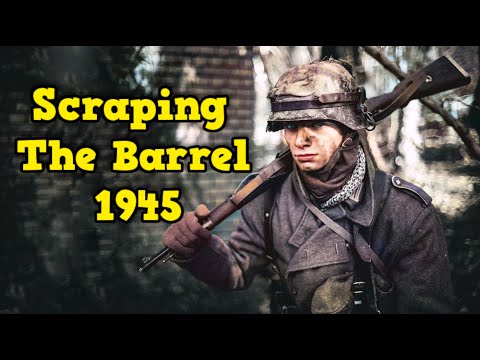
It began with Hitler’s decree on July 18, 1944, ordering preparations to defend the original borders of the Third Reich. Two days later, after the assassination attempt, Himmler convinced Hitler that what they needed were new divisions to instill a fresh fighting spirit. These would be the so-called Volksgrenadier divisions—a name chosen to evoke nationalist pride and the elite grenadiers of the 19th century. The propaganda value was immense, but the reality was far grimmer.
To create up to 49 new divisions, Himmler first merged battered infantry divisions that needed rebuilding, giving the illusion of new units. But the real challenge was finding soldiers. Military police raided factories and farms, rounding up any civilian doing non-essential work. Hospitals were forced to discharge patients early, sending wounded men back to the front. Even Luftwaffe and Kriegsmarine ground staff—nearly two million men—were transferred to infantry divisions.
Finally, they turned to ethnic Germans from Category 3 of the Volksliste—people of supposed German descent who often no longer spoke German. These men from Poland, Ukraine, Romania, Yugoslavia, and Czechoslovakia were now deemed fit for combat. Many did not even speak German. With these measures, 49 divisions were formed, totaling almost half a million combatants.
But morale was low. The mix of young soldiers—some as young as 16—veterans, wounded men, and foreigners created little cohesion. Training, normally 12 weeks, was cut to six or less. Most units were sent to the front unprepared. On December 1, 1944, Field Marshal von Rundstedt wrote that the training state of the new Volksgrenadier divisions was poor, but the critical situation at the front demanded their immediate commitment.
Thus, the Germans continued to resist on their borders in late 1944 and early 1945, launching their last desperate offensives. The story of these final soldiers is one of sacrifice, desperation, and the bitter end of a shattered army.
The men who filled the ranks of the Volksgrenadier divisions came from every corner of a collapsing empire. A teenage boy from the Hitler Youth stood shoulder to shoulder with a forty-year-old veteran who had lost an eye at Stalingrad, a wounded sailor still bandaged from a British bomb, and a Polish farmer who understood only half of the commands shouted at him. They were given a rifle, a handful of panzerfausts, and told to hold the line.
Their officers, many of them hastily promoted from the ranks, had never commanded a battalion in their lives. Some had not even completed their own training before being handed a map and a compass. The blind were leading the exhausted.
When these divisions first met the Allies—whether in the snows of the Ardennes or along the muddy banks of the Rhine—the results were predictable. Whole companies dissolved under artillery fire before they had fired a shot. Others fought with a ferocity born of sheer desperation, holding villages for days at a cost that would have shattered a veteran unit.
Yet the true tragedy lay in what these men were asked to believe. Propaganda films showed them as the reincarnation of Frederick the Great’s grenadiers, marching to save the Fatherland. The reality was a rabble of boys and cripples, armed with whatever the factories could still produce, thrown into a war their leaders knew was lost.
By early 1945, the Volksgrenadier divisions had been bled white on both fronts. Of the nearly half a million men who had been scraped together in the autumn of 1944, few remained. Those who survived were absorbed into the regular army, their special name forgotten, their sacrifice remembered only by the families who received the telegrams.
And still the orders came. Still the trains rolled east and west, carrying more boys, more wounded, more foreigners in German uniforms. The machinery of the Third Reich would not stop until it had ground itself to dust.
What had begun as a propaganda masterstroke—a name to inspire the people—had become a grim epitaph for a generation. Himmler’s Volksgrenadiers were not the saviors of Germany; they were its last, most bitter sacrifice.
The first major test of these divisions came in the Ardennes, where Hitler gambled his last reserves on a winter offensive that he believed could split the Allied armies. Volksgrenadiers, many still teenagers or men in their fifties, were sent forward through frozen forests and muddy tracks. They had been promised air support and fuel, but the skies belonged to the Allies and the fuel never came.
In the opening days, some units achieved complete surprise. American troops, caught off guard, fell back in disarray. But the Volksgrenadiers lacked the mobility and training to exploit their gains. When they encountered a determined defense, they either melted away or threw themselves into futile frontal assaults.
One officer later recalled watching a company of young soldiers advance across an open field, their white winter camouflage blending with the snow. Within minutes, machine-gun fire had cut them down, and the field was dotted with bodies that looked like discarded rags. The survivors, if any, were too few to hold the ground they had won.
The same story repeated on the Eastern Front. Soviet offensives in January 1945 smashed through the Volksgrenadier lines with overwhelming force. Divisions that had been cobbled together from Luftwaffe clerks and wounded veterans were simply annihilated. Some fought to the last man; others broke and fled, only to be rounded up by military police and shot for cowardice.
By March, the Volksgrenadier divisions existed mostly on paper. The men who had survived were a hardened, bitter remnant—no longer the hopeful recruits of the autumn, but hollow-eyed veterans who knew the war was lost. They continued to fight not for victory, but because there was nothing else left to do.
Yet even in their destruction, they bought time. Every day they held a bridge or a crossroads delayed the Allied advance and allowed other German units to escape to the east. Their sacrifice was not in vain for the men they saved, but it was a sacrifice made in the service of a doomed regime.
As the Reich collapsed around them, the Volksgrenadiers became a symbol of the war’s final madness—a name that had once promised glory now whispered with shame and sorrow.
By April 1945, the Volksgrenadier divisions had ceased to exist as organized formations. What remained of them was scattered across a shrinking front, fighting not for a Führer or a Fatherland, but for the simple instinct to survive another hour. Boys who had once marched proudly to the sound of drums now crawled through rubble, clutching rifles they barely knew how to fire.
In the ruins of Berlin, the last remnants of these units were thrown into the cauldron of street fighting. Teenagers from the Hitler Youth, some no older than fourteen, manned barricades alongside exhausted veterans who had seen three years of slaughter. They were given panzerfausts and told to destroy Soviet tanks—many died before they could fire a single shot.
The end, when it came, was not a battle but a silence. On May 8, 1945, the German High Command surrendered unconditionally. The Volksgrenadiers who had survived—fewer than one in five—laid down their weapons and began the long walk into captivity or the longer walk home through a country that no longer existed.
Their name, invented by Himmler to inspire a nation, became a footnote in the histories of the Second World War. They were neither elite troops nor the saviors of Germany; they were the last, desperate levy of a regime that had already destroyed itself. The boys who had worn that uniform would grow old carrying the memory of a war they never had a chance to win.
And so the story of the Volksgrenadiers ends—not with glory, but with the quiet tragedy of a generation sacrificed for a lost cause. What lessons can we draw from their fate, and how do we honor the memory of those who were forced to fight for a regime they did not choose?
Report this article
Select a reason for reporting:






