Imagine a general who led hundreds of thousands of men to victory, executed one of the most flawless amphibious invasions in history, and reached the Rhine before anyone else—yet his name is barely a whisper in the annals of World War II. While Eisenhower, Bradley, and Patton became legends, Jacob L. Devers was systematically erased from the narrative. This is not an accident of history. It is a deliberate act of institutional betrayal, orchestrated by the very men he served alongside.
In the fall of 1944, Devers’ Sixth Army Group was racing toward the German border, having advanced over 400 miles in less than 30 days. They were poised to strike at the heart of the Third Reich. But instead of glory, Devers was about to be stopped—not by the German military, but by the fragile egos of his own superiors. “They simply could not allow an outsider to cross the Rhine first,” and so they issued an order that defied all military logic: halt the advance.
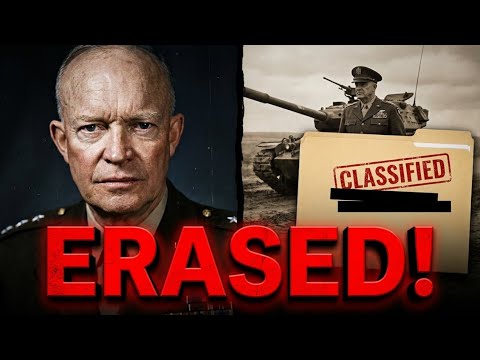
The man behind this order was Dwight D. Eisenhower, the Supreme Allied Commander, who, along with Omar Bradley, had built a carefully curated narrative of the war. They were the golden children of General George C. Marshall, a tight-knit fraternity of cautious, politically astute officers. Devers, a brilliant artilleryman and protégé of an earlier chief of staff, was never part of their club. He was relentlessly positive, fiercely independent, and—most threatening of all—arguably a better combat commander than the men chosen to outrank him.
Devers had proven his brilliance in Operation Dragoon, the invasion of Southern France. While Bradley’s forces were bogged down in the north, Devers’ armies swept up the Rhone Valley with lightning speed, dismantling the German 19th Army and capturing tens of thousands of prisoners. His success was undeniable—and it made Bradley look slow. Bradley, harboring a deep professional jealousy, began to view Devers as a rival. Eisenhower, ever protective of his inner circle, saw Devers as a complication.
The tension reached a boiling point as the Allies approached the Rhine. Devers was perfectly positioned to cross the river and potentially end the war before winter. But Eisenhower and Bradley looked at the same maps and made a cold, political calculation. They could not let an outsider steal the ultimate glory. So they used logistics as a weapon. SHAEF ordered a drastic reduction of gasoline and ammunition to the Sixth Army Group and explicitly forbade Devers from crossing the Rhine. He was ordered to halt his victorious army and wait.
When the orders arrived, Devers’ subordinates were furious. General Alexander Patch could see the Germans scrambling in chaos across the river. General Jean de Lattre de Tassigny, commanding the French First Army, was vibrating with rage. For the French, this was a matter of national honor—they were on the verge of liberating their own country. De Lattre argued passionately that they should defy the order, cross the river, and force Eisenhower to accept the victory after the fact. But Devers was a disciplined soldier. He knew the consequences of insubordination. With a heavy heart, he obeyed.
The psychological toll on the men was devastating. They had fought their way off the beaches, marched up the Rhone, and dismantled every German force in their path. Now they sat in their stationary tanks and watched as the Germans, given a reprieve, began to fortify the Colmar Pocket—a massive, entrenched defensive fortress that would cost thousands of Allied lives in the brutal winter months to come. Every casualty in that frozen hell was a direct result of the political decision to halt Devers.
In the north, Montgomery’s Operation Market Garden failed spectacularly, and Bradley’s forces became bogged down in the Hurtgen Forest. The rapid end to the war that Eisenhower had gambled on evaporated. By the time Devers was finally ordered to eliminate the Colmar Pocket, it was the dead of winter. American and French soldiers assaulted heavily fortified positions through waist-deep snow and blinding blizzards. Frostbite and trench foot caused almost as many casualties as German machine guns. It was a needless slaughter, born of ego and jealousy.
Devers eventually crushed the pocket and led his army group across the Rhine, deep into Germany, accepting the surrender of German Army Group G in May 1945. By any objective measure, he was one of the most successful combat commanders of the war. But the damage to his legacy had already been done.
After the war, Eisenhower and Bradley took control of the Pentagon and the narrative. In their best-selling memoirs, they marginalized Devers’ achievements, dismissed Operation Dragoon as a sideshow, and blamed the Colmar Pocket on weather and terrain. The official histories, written under their influence, codified the myth. Devers was retired and offered only a bureaucratic dead-end command. He refused to write a tell-all memoir or engage in public mudslinging, believing his record would speak for itself. He was wrong.
Jacob Devers died in 1979, unknown to the general public. His story is not just about a forgotten general—it is a stark revelation about the true nature of institutional power. History is not a pure meritocracy; it is written by those who control the narrative. And the men who controlled the narrative had already decided that Devers didn’t exist.
But the erasure was never quite complete. In the decades after his death, a quiet counter-narrative began to surface, carried not by historians or filmmakers, but by the aging veterans of the Sixth Army Group. They held reunions in small towns across the American South and Midwest, where men who had once crewed tanks through the Rhone Valley would raise a glass to the general who never got his due. “He was the best we had,” one veteran told a local newspaper in 1985, “and nobody outside this room knows his name.”
These were not men given to exaggeration. They had watched their commander do something rare in the annals of military history: he had won without drama, without self-promotion, without the theatrical flair that made Patton a household name. Devers had simply outmaneuvered the German army and then, when ordered to stop, had swallowed his pride and obeyed. That obedience, ironically, was the very quality that condemned him to obscurity.
The archives, however, tell a different story than the memoirs. In the years following the war, military historians who bothered to dig into the primary documents began to notice the gap between the popular narrative and the operational record. Devers’ Sixth Army Group had advanced faster, with fewer casualties, and against stiffer resistance than Bradley’s forces in the north. The supply records showed that Devers had been starved of fuel not because of a genuine shortage, but because SHAEF had prioritized Montgomery’s failed airborne gamble and Bradley’s grinding attrition.
One such historian, a young professor named David Colley, spent years poring over the forgotten files of the Sixth Army Group. What he found shocked him. The orders halting Devers at the Rhine were not vague suggestions or logistical necessities—they were explicit, repeated, and increasingly desperate directives from Eisenhower’s headquarters. “The pattern was unmistakable,” Colley later wrote. “Devers was being held back, and the only explanation that fit the evidence was political.”
Colley’s research eventually became a book, but it was published by a small academic press and received little attention. The established histories, after all, had been written by men who had served under Eisenhower and Bradley, and they had no interest in revising the story that had made their own careers. The myth had calcified into fact.
Yet the myth had a cost that went beyond one man’s reputation. The American military had spent decades studying the wrong lessons from the European campaign. Officers were taught to admire Bradley’s cautious, methodical approach and to distrust the kind of aggressive, independent maneuvering that Devers had perfected. The army had institutionalized the very qualities that had held it back in 1944.
In the 1990s, a retired lieutenant general named William Odom, a former head of Army Intelligence, stumbled across Devers’ file while researching a different project. He was stunned by what he read. Here was a commander who had done everything right—and had been punished for it. Odom began to speak about Devers at military conferences, and slowly, tentatively, the conversation began to shift.
But shifting a conversation is not the same as changing a culture. The men who controlled the narrative were long dead, but their successors had inherited the same instincts. They defended the old story because it was the story that had elevated their mentors and, by extension, themselves. To admit that Devers had been wronged was to admit that the heroes of the war had been small men.
The veterans of the Sixth Army Group continued to dwindle. By the early 2000s, only a handful remained, and their reunions grew quiet and small. At one of the last gatherings, a frail veteran in a wheelchair was asked why he still came. He looked at the young interviewer with clear eyes and said, “Because somebody has to remember that we won too.”
It was a simple statement, but it carried the weight of a half-century of silence. The men who had served under Devers had never needed medals or monuments to know what they had accomplished. They had driven the Germans out of France, crossed the Rhine, and accepted the surrender of an entire enemy army group. They had done it with less fuel, less ammunition, and less recognition than any other American force in Europe.
And their commander, the man who had made it all possible, had asked for nothing in return except the chance to serve. When that chance was denied, he had not complained. He had simply gone home.
But history, unlike an army, does not obey orders. It has a way of leaking through the cracks of even the most carefully constructed narrative. The question was no longer whether Jacob Devers had been erased. The question was whether anyone would care enough to put him back.
In 2013, a small group of active-duty officers at Fort Leavenworth began a staff ride through Alsace, retracing the Sixth Army Group’s advance. They stood at the edge of the Rhine where Devers had been ordered to halt, and one major asked aloud, “How many lives would have been saved if we’d crossed here in September?” The silence that followed was answer enough.
That same year, the Army’s official history office quietly published a revised monograph acknowledging that the Colmar Pocket had been “exacerbated by the decision to halt the Sixth Army Group.” It was a single sentence buried on page 412—but it was the first crack in the official wall of silence.
Veterans’ families began donating their fathers’ letters and journals to the National Archives. In them, Devers appears not as a footnote but as a relentless, caring commander who toured the front in a tiny observation plane and refused to send men into battle without adequate supplies. “He never asked us to do anything he wouldn’t do himself,” one sergeant wrote in 1945.
The myth, once calcified, was now being chipped away—not by Hollywood, but by archivists and grandchildren and the slow, stubborn work of truth. Jacob Devers may never get his blockbuster film. But the record is finally being corrected, one document at a time.
And that raises a question we all must answer: How many other quiet heroes are still waiting in the shadows, erased not by enemies but by the politics of memory?
Report this article
Select a reason for reporting:






