Dr. Rebecca Torres had seen thousands of old photographs in her 15 years as a digital genealogist, but something about this one made her pause. It was a Tuesday afternoon in February 2024, and she was working from her small office in Boston, Massachusetts, scanning through a collection of images submitted by the Hendricks family. The photograph, dated 1898, showed a family gathered on the porch of a grand Victorian house. At first glance, it was unremarkable—a typical late 19th-century portrait. But as Rebecca zoomed in on the baby held by the mother, a chill ran down her spine.
The baby’s face was blurred, as if it had been deliberately smudged. Rebecca had seen damage from age, but this was different. The blur was too precise, too unnatural. She quickly checked the other faces—they were sharp and clear. Why would someone obscure only the baby? Her mind raced with possibilities: a mistake during development, a deliberate act to hide something? She adjusted the contrast, hoping to reveal more, but the blur remained stubbornly opaque.
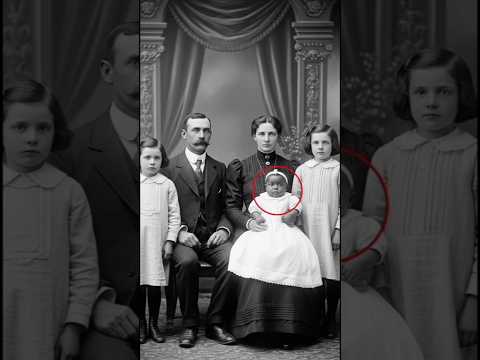
Rebecca leaned back in her chair, the hum of her computer the only sound in the quiet office. She had encountered anomalies before, but this felt personal. The Hendricks family had submitted the photo as part of a genealogical research request, hoping to trace their lineage. “This doesn’t make sense,” she muttered, reaching for her notebook. She jotted down the details: the baby’s position, the blur’s shape, the date. Then she noticed something else—a faint inscription on the back of the photo, barely legible: “Our dearest Emma, 1898.” But the family tree provided by the Hendricks listed no Emma in that generation.
Determined to uncover the truth, Rebecca decided to dig deeper. She spent the next hour cross-referencing the photograph with other records from the Hendricks family. Nothing matched. The baby’s clothing, the setting, even the family’s expressions seemed off. It was as if the photograph belonged to a different family entirely. Her curiosity turned to unease. Could this be a forgery? Or something more sinister?
As the sun dipped below the Boston skyline, Rebecca made a decision. She would contact the Hendricks family directly. But before she could pick up the phone, her email pinged. A new message from an unknown sender, subject line: “Stop looking into the photograph.” Her heart skipped a beat. How did anyone know she was investigating? She glanced at the photo again, the blurred baby face now seeming to stare back at her. The mystery was deepening, and Rebecca realized she was no longer just researching a family tree—she was unraveling a secret that someone wanted to keep buried.
She didn’t reply to the email. Instead, she saved it to a separate encrypted folder and printed a hard copy, a habit she’d developed years ago when a client’s account was mysteriously wiped. The sender’s address was a string of random characters—no name, no signature, no traceable domain. “Amateur,” she whispered, though her hands weren’t quite steady. Whoever sent it had made a mistake: they’d shown their hand too early.
Rebecca pulled the original high-resolution scan back onto her screen and began isolating sections of the image, layer by layer. The porch, the family, the house—everything checked out against the period. But when she examined the baby’s blanket, something caught her eye. A faint pattern was woven into the fabric, one she hadn’t noticed before. She magnified it until the pixels blurred into abstraction.
It wasn’t a floral design or a standard weave. It was a monogram—two letters intertwined: E.H. Emma Hendricks. But the family tree had no Emma, and the initials didn’t match any known member of that generation. Rebecca cross-checked the family’s submitted documents again, this time reading every marginal note and faded pencil mark.
That was when she found it. A single line in a handwritten ledger, scanned and uploaded almost as an afterthought: “Infant daughter, stillborn, 1898. Name not recorded.” Her breath caught. A stillborn child in 1898 would explain the absence from the family tree—but not the photograph. Why would a family pose with a baby who had never lived? And why blur her face?
Rebecca thought of the Victorian tradition of post-mortem photography, where families memorialized the dead in staged portraits. But the baby in this image was held upright, alert, unmistakably alive. Unless the photograph had been altered—not to hide a death, but to hide a life. Someone had erased Emma from the record twice: once from the family tree, and once from the image itself.
Her phone buzzed. A text from her colleague Marcus, who ran the digitization lab downstairs. “Someone came by asking about you. Wouldn’t leave a name. Said he was a ‘friend of the family.'” Rebecca stared at the message, then at the blurred face on her screen. The office felt suddenly smaller, the shadows in the corners deeper.
She typed back quickly: “Did he say which family?” The three dots appeared, vanished, appeared again. Then: “Hendricks. He said his name was William. William Hendricks.” But Rebecca had reviewed the family’s correspondence for weeks. There was no William in any of the records—and no one had mentioned him.
She stared at Marcus’s message until the letters swam. A man claiming to be a Hendricks, asking about her, while an anonymous email warned her to stop. Two threads pulling in opposite directions—or perhaps the same thread, frayed at both ends. She typed back: “What did he look like? Age, build, anything.”
The reply took longer than she liked. “Forties. Tall. Gray coat. Said he’d come back tomorrow.” Rebecca glanced at her office door, then at the window overlooking the darkening street. She’d worked late many nights, but tonight the building felt different. Quieter in a way that wasn’t peaceful.
She made a decision. If William Hendricks was coming back, she would be ready—but on her terms. She pulled up the original submission file and scrolled to the cover letter the family had sent. It was signed by a woman named Patricia Hendricks, a great-granddaughter of the family in the photograph. Rebecca had exchanged three emails with her, all cordial, all businesslike. No mention of a William.
She opened a new message and typed carefully: “Mrs. Hendricks, I’ve encountered an anomaly in the 1898 photograph and would like to clarify a few details. Also—do you have a relative named William? He may have visited my office.” She read it twice, then sent it before she could second-guess herself.
While she waited, she returned to the monogram. E.H. Emma Hendricks. The stillborn infant in the ledger. But the baby in the photograph was alive—she was certain of it now. The posture, the tiny clenched fist, the way the mother’s hands supported her. No Victorian photographer could have staged that lifelessness into such warmth.
Rebecca pulled up a database of Boston-area photographers active in 1898. If she could identify the studio, she might find the original glass plate negatives—or at least a record of the sitting. The photograph’s border had a faint embossed stamp, nearly worn away. She enhanced it pixel by pixel until letters emerged: “HALLOWELL & SONS, FINE PORTRAITURE, BOSTON.”
Her fingers flew across the keyboard. Hallowell & Sons had operated on Tremont Street from 1885 to 1911. Most of their records were lost in a fire in 1923—but a partial ledger survived in the city archives. Rebecca requested the digitized files, her pulse quickening. If the sitting was recorded, she might find the name of the child, the date, even the family’s instructions.
Her email pinged. Patricia Hendricks had replied within minutes—unusually fast for a woman who typically took days. “I don’t know anyone named William. And I’d appreciate it if you didn’t discuss our family with strangers. Please call me.” The number she included was different from the one on file.
Rebecca stared at the message. Patricia’s tone had shifted—from warm to wary, almost frightened. And the new phone number felt like a test, or a trap. She picked up her desk phone, then set it down again. Not yet. First, she needed to know what Hallowell & Sons had recorded.
She pulled on her coat and headed for the door, the printed photograph tucked into her bag. As she stepped into the hallway, the lights in the corridor flickered once, twice, then steadied. At the far end, near the stairwell, a tall figure in a gray coat stood watching her.
Rebecca didn’t run. Fifteen years of chasing ghosts through archives had taught her that panic was a luxury she couldn’t afford. Instead, she walked toward the figure, her heels clicking a steady rhythm on the linoleum. “You must be William,” she said, her voice echoing in the empty corridor.
The man stepped into the light. Forties, tall, gray coat—Marcus had been right. But his face was not hostile. It was tired, hollowed out by something that looked like grief. “You found Emma,” he said. It wasn’t a question.
“I found a name in a ledger and a blur on a photograph,” Rebecca replied. “I found a family that erased a child twice. What I haven’t found is the truth.”
William reached into his coat and withdrew a small velvet box. “Then let me give you the last piece.” Inside lay a locket, tarnished with age, and a photograph—the same porch, the same family, but this time the baby’s face was sharp and clear. A tiny girl with dark eyes and a stubborn chin. Emma.
“She didn’t die in 1898,” William said quietly. “She was hidden. Given to a distant cousin and raised under another name. The family was ashamed—she was born before the wedding, and the Hendricks name couldn’t bear the scandal. So they staged a death, blurred her face in the only portrait, and buried the truth in a ledger.”
Rebecca stared at the locket. “And you? Who are you to Emma?”
William’s eyes glistened. “Her great-grandson. Patricia is my sister. She wanted to keep the secret. I wanted to set Emma free.” He paused. “The email—that was her. She was desperate to stop you before the family’s reputation crumbled again.”
Rebecca looked down at the blurred photograph in her bag, then at the sharp, defiant face in the locket. Our dearest Emma, 1898. Not a memorial. A plea. A child who had lived, loved, and been erased by shame.
She looked up at William. “What do you want me to do?”
“Tell her story,” he said. “All of it. The blur, the lie, the life she deserved.”
Rebecca nodded slowly, the weight of the locket settling into her palm like a promise. She would write the truth—not to shame the living, but to honor the forgotten. And somewhere, in the quiet of the archives, a baby’s blurred face would finally come into focus.
But as she turned to leave, William’s voice stopped her. “There’s one more thing. The locket—it was inside a box that arrived at my door yesterday. No return address. Just a note: ‘For the one who remembers.’” He met her eyes. “Someone else knows, Dr. Torres. Someone who’s been waiting a very long time.”
Rebecca felt the chill return, sharper than before. The secret wasn’t just buried—it was guarded. And now she was holding the key.
What would you do if the truth you uncovered had been waiting a century for someone brave enough to tell it?
Report this article
Select a reason for reporting:






