In the winter of 1952, a 71-year-old man fed cattle on a remote property outside Richmond, Queensland. His movements hinted at old injuries—a slight favoring of the left side, a careful economy in the shoulders—but nothing that would make a passing motorist slow down. He was just a man with dogs, a wife, and a quiet life. Yet this man, Harry Murray, was once the most highly decorated infantry soldier in the entire British Empire.
His property, Glenlion Station, was 74,000 acres of grazing country in northwestern Queensland—a long way from anywhere. That distance was not accidental. It had been chosen for what it offered: good feed, reliable bores, decent wool prices. But also, one suspects, for what it did not offer: telegrams, reporters, and the lingering gaze of a nation. The men who had commanded him in France were dead. The men who had served under him were scattered across the continent. And the official historian who had once written that he was the most distinguished fighting officer in the whole of the Australian Imperial Force was himself nearing retirement in Canberra, surrounded by diaries and notebooks that constituted perhaps the largest private archive of the First World War held by any individual in the English-speaking world.
Harry Murray did not read those volumes. He had a signed set. They sat on a shelf in the homestead, and by the accounts of those who visited him, he seldom opened them. His daughter would recall, years later, that her father preferred the cattle to the books and the bush to the cattle, and that when asked about the war, he tended to change the subject with the gentleness of a man who had never mastered the harsher methods of deflection. The war was something that had happened to other people.
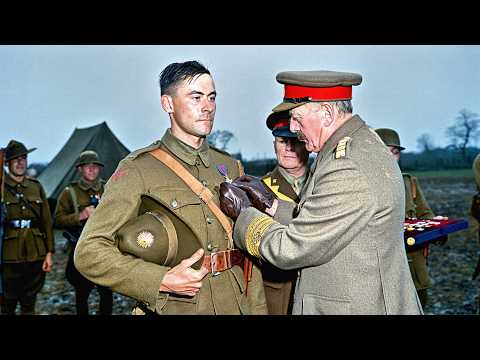
Charles Bean understood the problem before he understood the man. He had encountered Murray in the diaries—first as a name, then as an incident, then as a pattern. By the time he sat down to write the sections of the official history that would deal with Stormy Trench, he had already accumulated the kind of file on Murray that a biographer might have envied. There were battalion records, brigade dispatches, witness statements, private letters. There were photographs that showed a tall, solidly built man with dark hair and a composed expression, standing in doorways or leaning against carts, always slightly apart from the groups he was pictured with. There was a reticence in the archive that matched, one suspects, the reticence of its subject.
Bean had been at Gallipoli with Murray, though they had not met. He had been in the mud at Gueudecourt in the winter of 1916 and 17, and although he was not present at the night attack that earned the Victoria Cross, he had stood in those trenches not long before, had talked to the men who would soon follow Murray across the frozen snow, and had taken the kinds of notes that the official historian would later describe as the foundation of everything he wrote. His method was distinctive. He believed, against the preferences of the British historical establishment, that the war could only be understood from the bottom up, through the testimony of the men who had fought it. And he had cultivated over four years a network of informants from private to general who trusted him to tell the truth about what they had seen.
Murray was, in this sense, exactly the kind of witness Bean most valued: senior enough to understand the strategic context, junior enough to have been in the fighting, clear-headed in his recollections, and almost entirely uninterested in self-promotion. The problem was that Murray would not speak. There were letters between them, mostly brief and courteous, but whenever Bean pressed for the kind of detail he needed—the interior of a decision, the feel of a moment, the private reckoning that preceded a charge—Murray turned the question aside. He would praise Percy Black, his machine-gun partner from the Gallipoli days, the man he called the finest soldier he had ever known. He would praise the sergeants and the corporals and the privates. He would name them carefully and record what they had done. But the figure at the center of the story—the officer whose name appeared in the London Gazette on more occasions than any other infantryman in the Empire—was consistently displaced.
So that Bean found himself reading letters in which Murray described Stormy Trench as though he had merely happened to be in attendance. Bean’s method, when confronted with this kind of modesty, was to work around it. He gathered testimony from others—from the men who had followed Murray across the snow, from the bombers he had led, from the stretcher-bearers who had watched him carry the wounded—and he assembled from those accounts a composite portrait that Murray himself would not provide.
The portrait was, by the standards of the official history, extraordinarily detailed. Bean recorded not only what Murray did, but how he moved, where he placed himself in the line, what he said to the men when the German counterattacks came in, and the specific manner in which he rallied his company after they had been driven briefly back. The result was a passage in the third volume of the history that many readers have since described as the most vivid portrait of a combat officer in the entire 12-volume work—and that Murray himself, when it was published, declined to comment on in anything except the most glancing terms.
What Bean had discovered in working his way through the archive was not a hero in the conventional sense, but a man whose courage had been, as the 13th Battalion historian later put it, anything but reckless. Murray was not an Albert Jacka. He did not, by all accounts, lack fear. He was, on the contrary, a sensitive man—a man who wrote at one point that he was by nature nervy and highly strung, and whose courage consisted not in the absence of apprehension, but in the deliberate mastery of it.
He believed in discipline. He believed in training. He believed in reconnaissance—in the kind of patient, often solitary work of walking the ground before the attack, noting the folds and the dead spaces and the lines of enfilade, and returning to his men with a plan that reduced, insofar as any plan could, the margin of their dying. The 13th Battalion historian would later write that no officer in the brigade took more care to avoid losing men. The same writer would add that no officer took greater personal risks in the reconnaissance that made such care possible.
In the aggregate, these facts constituted the puzzle that Bean had set himself to resolve. How could a man be at once careful and reckless, quiet and ferocious, modest and ubiquitous on the battlefield? The answer, which Bean arrived at over a period of years, was that the apparent contradictions were not contradictions at all. Murray’s recklessness was always directed outward—at the enemy and at the terrain—and never inward at the men who followed him. His carefulness was always directed at the men. What looked like a single quality was in fact two, held in deliberate tension by a temperament that had been formed in the Tasmanian bush, refined in the West Australian gold fields, and tempered, finally, by the long apprenticeship of Gallipoli.
Bean wrote 412 words about Harry Murray that were not meant for public consumption. Notes in a private hand, passed over in the edit, returned to occasionally over the long decades in which he revised and re-revised his official history. They described the man feeding cattle on the property outside Richmond. They described the quiet economy of his movements. They described the man who walked the ground before the attack and returned with a plan, and who then walked the line during the attack and brought back as many of his men as could be brought back.
When archivists cataloged Bean’s papers, they found that the official historian—the man whose job had been to record everything—had concluded that some things were better left in the silence of the man who had earned them. Murray had earned his silence. Bean, in the end, had simply tried to honor it.
What the two of them had shared, across the distance of Canberra and Richmond and the years between the war and its long aftermath, was the understanding that the highest form of honor for a man who had done what Murray had done was the permission to feed his cattle in winter, with his wife driving the truck, and his dogs at his heel, and no further claim made upon him by the country that he had served.
So the question lingers, as it lingered in Bean’s margins: when a man gives everything and asks for nothing, is silence the truest monument we can offer—or the one we impose because we cannot bear the weight of his answer? What do you think?
Report this article
Select a reason for reporting:






