Dr. Sarah Mitchell had spent years unraveling the quiet lives of 19th-century women, but nothing prepared her for the chill that ran down her spine when she first saw the photograph. It was a simple portrait of two women, their faces serene, their posture stiff—typical of the era. Yet, something about the image gnawed at her, a whisper of a secret buried in the faded silver gelatin.
She had discovered the photo in a dusty box in the attic of a Victorian house in Philadelphia, a house slated for demolition. As a historian, Sarah was used to forgotten treasures, but this one felt different. The autumn light filtered through grimy windows, casting long shadows that seemed to reach for her as she carefully lifted the box.
“There’s something in her hand,” Sarah murmured, her breath fogging the glass as she peered closer. The woman on the left, identified only as “E.M.” on the back, held something small and dark. It was barely visible, but Sarah’s trained eye caught it—a tiny object clutched in her fingers.
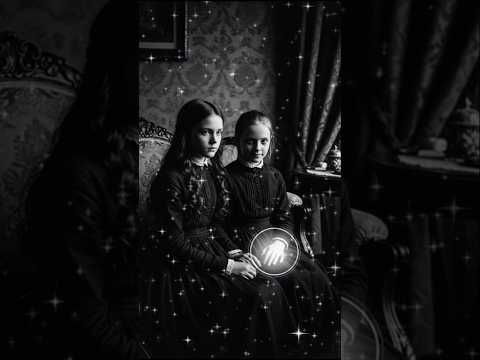
She adjusted her gloves and moved to the desk, where a magnifying glass and a digital scanner awaited. The house was silent except for the creak of old wood, but Sarah’s mind raced. Who were these women? Why did E.M. hold that object with such intensity, as if it were a lifeline?
She scanned the photo at high resolution and zoomed in on the hand. The object was cylindrical, perhaps a small vial or a rolled piece of paper. But it was the expression on E.M.’s face that haunted Sarah—a mix of fear and defiance, hidden behind a mask of composure.
“This isn’t just a portrait,” she whispered. “It’s a message.”
Sarah spent the next hours researching the house’s history. The Victorian had belonged to the Whitaker family, prominent in Philadelphia society, but their records were sparse. E.M. could be Elizabeth Whitaker, the eldest daughter, who vanished from public records after 1887. Rumors had circulated about a scandal, but nothing was proven.
As Sarah delved deeper, she uncovered a diary entry from a servant, mentioning “Miss Elizabeth’s secret burden” and a “small token she carried always.” The pieces began to align. The object in the photo was no ordinary item—it was a key, both literal and symbolic.
The light outside faded, and Sarah realized she had been holding her breath. She looked again at the photo, at the two women standing side by side, their hands clasped. The other woman, unidentified, seemed to be guarding Elizabeth, her gaze steady and protective.
“What were you hiding, Elizabeth?” Sarah asked aloud, her voice barely a whisper.
The answer, she knew, lay not in the photograph alone but in the house itself. The demolition was scheduled for next week. Sarah had seven days to uncover the truth before the past was erased forever.
She began with the floorboards. In houses of that era, secrets were rarely kept in safes—they were hidden beneath rugs, behind wainscoting, inside the hollow spaces that builders left for the dead to keep their silence. Sarah worked methodically, tapping each plank in the parlor where the portrait had likely been taken, listening for the hollow note that betrayed a hiding place.
By the third evening, her knees ached and her patience thinned. She had found nothing but mouse droppings and a tarnished thimble. It was then, as she sat back against the fireplace, that her eye caught the faint seam in the brickwork—a single brick that sat a fraction too proud of its neighbors.
“There you are,” she breathed, and reached for the chisel.
The brick gave way with a gritty sigh. Behind it lay a recess barely large enough for a child’s hand, and within it, wrapped in oilcloth turned brittle with age, a bundle of letters tied with faded blue ribbon. Sarah’s fingers trembled as she untied the knot.
The handwriting was elegant, hurried—the hand of a woman writing in secret. The first letter began without preamble: “If you are reading this, then I am gone, and the child is safe. Do not look for me. Look for the key.”
Sarah’s heart hammered. A child. Elizabeth Whitaker had not simply vanished—she had disappeared to protect someone. The letters, dated through the winter of 1886, were addressed to a woman named Margaret, the second figure in the photograph. Margaret, it seemed, was not a servant or a companion but Elizabeth’s dearest friend—and, the letters hinted, something more.
“They will call it madness, what we are,” Elizabeth had written. “But I would rather be mad with you than sane in their world.”
The scandal the rumors had whispered about was not a fallen woman’s shame. It was a love that the Whitaker family had gone to extraordinary lengths to bury. The child, Sarah gathered, had been born to a cousin and raised as an orphan—a fiction maintained by the small token Elizabeth carried always: a key to a lockbox that held the child’s true parentage.
Sarah set the letters down and stared at the portrait again. The two women, hands clasped, gazes fixed on the camera as though daring it to expose them. They had known the risk. They had posed anyway.
Outside, a car door slammed. Sarah flinched and looked at the clock—nearly nine. The neighborhood was quiet, but the sound had been close. She crossed to the window and peered through the dusty glass.
A black sedan idled at the curb, its engine running, its headlights dark. No one had gotten out. No one had gone in. It simply sat there, patient as a held breath, watching the house that was supposed to be empty.
Sarah stepped back from the window, her pulse quickening. She had been careful—parking her car around the corner, telling no one at the university where she was working. Yet the sedan’s presence felt deliberate, a warning pressed against the glass.
She returned to the letters and gathered them quickly, tucking them into her satchel. Whatever the key opened, it was no longer the only thing at stake. Someone else knew about the Whitaker house, and they had arrived at precisely the wrong moment.
“Think, Sarah,” she muttered. The key in the photograph—where would Elizabeth have hidden it? The letters spoke of a lockbox, but they never named its location. She flipped through the pages again, her eyes scanning for any mention of a place, a room, a piece of furniture.
Then she found it, buried in the postscript of the final letter: “The garden remembers what the house forgets.”
The garden. Sarah had barely glanced at the overgrown yard behind the house, assuming it was nothing but weeds and rubble. She grabbed her flashlight and slipped out the back door, the cold autumn air biting at her cheeks.
The garden was a tangle of dead vines and cracked flagstones, but beneath the neglect, a pattern emerged—a circle of stones half-swallowed by earth, centered on a sundial green with moss. Sarah knelt and brushed the debris away. The sundial’s base was loose.
She worked her fingers into the gap and lifted. Beneath it, packed in oilcloth identical to the letters’ wrapping, lay a small iron box. The key from the photograph would fit it—she was certain of that now.
But as she reached for the box, a voice cut through the darkness behind her.
“Dr. Mitchell. I was hoping we wouldn’t have to meet like this.”
Sarah spun around. A man stood at the edge of the garden, his silhouette sharp against the glow of the streetlamp. He held no weapon, but his stillness was somehow worse—the calm of someone who had been waiting a very long time.
“Who are you?” Sarah asked, her voice steadier than she felt.
“Someone who has spent thirty years looking for what you just found,” he said. “My grandmother was Margaret. The woman in the photograph.”
The world tilted. Sarah’s grip tightened on the iron box. “Margaret’s granddaughter?”
“She never spoke of Elizabeth until the end,” he said, stepping closer. “And when she did, she made me promise to find the truth before the house came down. I’ve been watching it for weeks.”
Sarah looked from the box in her hands to the man before her. The same blood ran through his veins as the woman who had guarded Elizabeth in that faded portrait. “Then you should know,” she said slowly, “that the truth isn’t just about a scandal. It’s about a child.”
The man’s expression flickered—surprise, then something softer. “A child,” he repeated, as though testing the word for the first time.
Sarah held out the box. “Shall we open it together?”
The man—Thomas, he introduced himself—knelt beside her, his hands trembling as Sarah fitted the small key into the lock. It turned with a whisper of rusted metal, and the lid lifted.
Inside lay a photograph of an infant, a lock of dark hair tied with thread, and a birth certificate bearing a name neither of them recognized: “Margaret Elizabeth Whitaker, born December 1886.” The child had been named for both women—a secret kept in plain sight.
Thomas exhaled slowly. “So the child was Elizabeth’s after all,” he said. “Not a cousin’s.”
Sarah shook her head. “It doesn’t matter whose blood it was. What matters is that they loved her enough to hide her.” She lifted the birth certificate to the light. “This is the proof. They erased themselves so she could live.”
Thomas was quiet for a long moment. Then he reached into his coat and produced a worn envelope. “My grandmother’s last letter,” he said. “I never understood it until now.”
He read aloud: “If you find the key, do not mourn us. We chose our silence. But tell the child—tell her we were not afraid.” His voice broke on the final word.
They sat together in the overgrown garden until the streetlamp flickered and died, the iron box between them like a small, heavy heart. Sarah thought of the portrait—two women, hands clasped, daring the world to look. They had not been erased. They had simply waited.
By morning, Sarah had called the historical society. The demolition was halted, the house granted a temporary reprieve. The letters and the box would go to the archive, catalogued not as scandal but as a love story—one that had survived a century of silence.
Thomas stood on the porch as she locked the front door for the last time. “What happens now?” he asked.
Sarah looked back at the house, its windows catching the pale autumn sun. “Now we tell the truth,” she said. “And we make sure no one forgets their names.”
But as she walked to her car, she couldn’t shake the feeling that somewhere, in another dusty attic or forgotten garden, another portrait was waiting—another secret holding its breath.
What would you do if you found a message meant only for you?
Report this article
Select a reason for reporting:






