In August 1944, above the fields east of Leipzig, the fastest fighter aircraft on Earth was falling from the sky. It had carried a human being faster than any human in history. It could climb to the bomber stream in roughly three minutes—a rate no Allied fighter could match. Two American P-51 Mustangs, propeller-driven and far slower, destroyed it. Their pilots didn’t need to win any race. All they needed was to wait.
There was a flaw buried inside that rocket fighter, placed there by its designers from the very first drawing. It wasn’t a technical defect—it was a choice. And by the time anyone could change it, time had run out for Germany. That aircraft was the Messerschmitt Me 163 Komet, and its story is usually told as a puzzle: how do you catch something that flies so much faster than you?
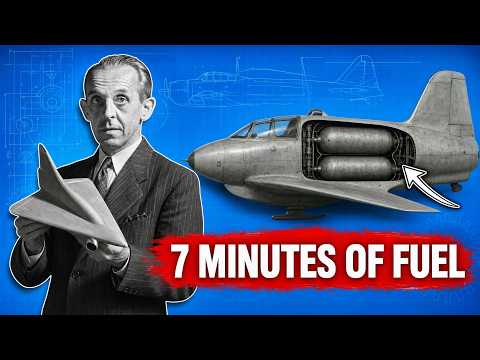
Hold that question in your mind. By the end, you’ll realize what the engineers truly failed to do—something far more unsettling than mere confusion. To understand why a Mustang could catch a rocket, we have to start with something that had no engine at all.
After World War I, the Treaty of Versailles forbade Germany from building military aircraft, but it said nothing about gliders, and nothing about rockets. So an entire generation of German aviation talent poured its focus into gliding, wind tunnels, and the art of staying aloft without power. One of these men was a designer obsessed with a single idea: a tailless aircraft.
Most planes carry a horizontal tail at the back to keep them stable. This man wanted to merge that stability into the wing itself—to make the entire aircraft more streamlined, lighter, and more efficient. His name was Alexander Lippisch, and from the 1920s onward, he built tailless glider after tailless glider. In 1928, he even let someone strap rockets to one of his designs, a small glider called the Ente—German for “Duck.” After a failed first attempt, a rocket fired and the pilot flew it nearly 1.5 kilometers. It was primitive. It was also a hint of where his thinking was going.
Because a completely different kind of engineer was working on the power source. Hellmuth Walter was a rocket expert who specialized in concentrated hydrogen peroxide—a chemical that releases enormous energy when it decomposes. Lippisch understood the shape. Walter understood the fire. Put them together and you get the philosophy behind everything that followed: an aircraft that was essentially a glider given a short, violent burst of power.
Keep that word in mind—glider. It is the hidden answer to this entire story. The man who proved what this philosophy could do was not a fighter pilot. Heini Dittmar came from the world of gliding too. He had built his own glider, trained at the German Institute for Glider Research, and became one of the best glider pilots in the country. In other words, he knew exactly how to fly a plane whose engine had run out of fuel.
By 1941, Lippisch’s rocket design existed as a research machine, the Me 163A. On October 2, 1941, Dittmar was towed into the sky in the fourth prototype. At altitude, he released, ignited the rocket, and the aircraft accelerated. His speed was recorded at 1,004.5 km/h—about 624 mph. No human had ever flown faster than 1,000 km/h, and at that moment, frontline fighters were roughly 400 km/h slower.
Here lies the crucial part of our story. At that speed, the air itself began to resist. The little aircraft lost stability and Dittmar lost control as it pitched into a steep dive. He shut down the engine. The plane glided down until it stabilized. Then he relit the rocket, burned off the remaining fuel, and landed safely.
Think about that sequence. The fastest flight in human history up to that moment ended exactly the way every flight of this aircraft would end: engine off, glide home. And no one outside the program was allowed to know. The record was kept secret. But a record is not a weapon.
And here the story stops being about gliders and starts being about pressure. Lippisch had not come from a big company. His team was transferred to Messerschmitt in Augsburg in January 1939, carrying a half-finished airframe with them. Messerschmitt provided the factory, the model number, and eventually the name. What it did not provide was harmony. The friction between Lippisch and Willy Messerschmitt was constant.
Meanwhile, the German Air Ministry had seen what the Me 163A could do and wanted more. They asked Lippisch to design an improved version using a more powerful Walter rocket engine. The research aircraft was to become a combat fighter. That sounds like an upgrade. In reality, it was a trap.
A research aircraft flies when the weather is good, takes off when everyone is ready, and lands in a long open field with no one chasing it. A fighter takes off when the enemy arrives and comes home through the same sky the enemy is still in. Every flaw you can tolerate in an experiment becomes a fatal vulnerability in war. And the man who had shaped the idea would not be there to see the aircraft fight. In 1943, Lippisch left Messerschmitt for Vienna. The Komet was going into battle without its creator.
So why did Germany want a rocket fighter at all? Because by 1944, Allied bombers were sweeping across Germany in massive formations, striking the one thing Germany could not live without: fuel. Synthetic fuel plants, like the sprawling Leuna works near Leipzig, turned coal into gasoline and oil to keep the war running.
An ordinary fighter took too long to reach bomber altitude. A rocket carried its own oxygen, so it didn’t choke on the thin air. The idea was simple and brutal: wait on the ground until the bombers approached, then shoot up through them vertically like a missile with a pilot inside.
The engine that made this possible was the Walter HWK 109-509, and the fuel it burned is the first place where the cost of the Komet’s greatest feature begins to show. It used two liquids. One was T-Stoff, hydrogen peroxide at about 80 percent concentration. The other was C-Stoff, a mixture of methanol, hydrazine hydrate, and water. When they met, they needed no spark. They reacted on contact. That gave the engine its enormous thrust very quickly—and it is also why ground crews treated them like live explosives.
T-Stoff containers were painted white. C-Stoff containers were painted yellow. Mixing them by mistake was not a mistake you could learn from. And T-Stoff had another bad habit. It could set fire to any organic material it touched—cloth, leather, skin.
And all that power did not last long. During development, fuel consumption turned out to be nearly double what had been calculated. In service, the Komet had roughly seven and a half minutes of powered flight. Compare that to the aircraft that would eventually hunt it. A Mustang with drop tanks could escort bombers deep into Germany and return to England. One fighter measured its fuel in hours, the other in minutes.
But running out of fuel only becomes deadly if you cannot get home safely afterward. And the Komet’s way of getting home was another sacrifice buried in its airframe. To save weight, the Komet had no conventional landing gear. It took off on a two-wheeled dolly that the pilot jettisoned immediately after liftoff. It landed on a skid that dropped out of its belly like a sled.
On paper, it looks elegant. Less weight means better performance. In reality, it meant the Komet had to land on its belly in one attempt with no engine to correct any error. And the program’s own pilots paid the price.
Hanna Reitsch, one of Germany’s most famous test pilots, flew a towed test flight in which the takeoff dolly failed to separate. The aircraft shook violently, and when she tried to land, the dolly hanging beneath it disturbed the airflow and made the controls ineffective. The Komet rolled sideways and stopped flying at about 100 feet. She survived the crash with serious injuries. She was not alone. Dittmar himself and his fellow test pilot Rudolf Opitz, another veteran glider pilot, were seriously injured in a hard landing as well. These were not beginners. They were among the most experienced people in the world at landing aircraft without engines.
Now you can see the nature of the problem. A normal fighter that misjudges its approach can push the throttle forward, climb away, and try again. The returning Komet had no fuel left. It had to land on that approach wherever it ended up, no matter what was behind it.
And there was something else that made landing dangerous. It is tied to the most famous horror story about this aircraft. If you have heard anything about the Komet, you have probably heard this one: its fuel was so corrosive that it dissolved its pilots.
It is easy to see why people believe it. T-Stoff really could ignite organic material. The tanks really were next to the pilot. Crashes really did end in fire and chemical exposure. And there is one specific case cited again and again. On December 30, 1943, at Bad Zwischenahn, the home of the Komet test unit, a Luftwaffe fighter pilot named Josef Pöhs took off in a Komet. When he jettisoned the dolly, it reportedly bounced off the ground, struck the aircraft, and damaged a fuel line. The engine stopped. Pöhs tried to return, but he clipped a radio mast with his wing, and the aircraft crashed.
The famous detail comes from Wolfgang Späte, the fighter pilot who commanded that test unit. In his postwar account, he repeats what the unit’s chief engineer told him: that despite Pöhs’s protective suit, his right arm was dissolved by T-Stoff. Now, notice the kind of evidence this is. It is a memoir written after the war, passing on what someone else told the author. More cautious accounts say Pöhs died from crash injuries alongside T-Stoff exposure. Some researchers say the aircraft exploded on impact and killed him. The grim account may contain some truth, but the internet legend of pilots regularly melting in their seats rests on a single relayed story.
Here is the better explanation, and it is actually more terrifying. The danger was not only the chemical. It was the timing. Any fuel left in the tanks on landing turned a violent touchdown into a possible explosion. The safest way home was with empty tanks—which meant coming home as a pure glider, with no options at all. Every minute of Komet flight made the next minute worse, and the pilots had not even reached the enemy yet.
And when they did reach the enemy, they discovered that the speed the aircraft was built for made it hard to hit anything. The production Komet carried two 30 mm cannons. A single good hit could cripple a bomber, but those cannons were unreliable and demanded expert aiming. And the Komet closed on its target so fast that the pilot had roughly three seconds to fire before he flashed past. Three seconds. Then the bomber was behind you, and you were burning fuel you could not replace.
Pilots tried shutting down the engine and gliding through the formation to slow the pace of combat, then relighting the rocket to climb for another pass. That created a trap of its own. Späte described relighting his engine to catch a target, but the acceleration was so violent that he hit compressibility—the same invisible wall of air that had seized Dittmar’s aircraft in 1941. He had to break off his attack. The Komet was so fast that it could not safely use its full speed. Its power was capped by a ceiling of its own making.
And there was another limit, perhaps the most important of all. It was not about speed. It was about distance. With seven and a half minutes of power, the Komet’s combat radius was only about 40 kilometers—roughly 25 miles. It could not be sent to where the bombers went. It had to be stationed right next to the target it protected.
So the Luftwaffe placed it exactly there. The unit that flew the Komet in combat, Jagdgeschwader 400, was based at Brandis, east of Leipzig, near the Leuna plants. Another group would later protect the fuel plant at Pölitz. And these were not ordinary airfields. They needed special fuel trucks, trained chemical crews, and fuel supplies most bases could not handle.
Now let us review everything we have learned. The fastest fighter in the world has seven and a half minutes of power. It must land without power. It cannot make a second sortie. It must land on a skid, ideally with empty tanks. And it can only return to one known airfield. But the Komet was not only fast—it was predictable.
But first, Germany had to actually build these things, and the factory turned out to be a battlefield of its own.
The first trainers were built by Wolf Hirth, a glider company in Göttingen. Ten were completed engineless and towed aloft with ballast instead of fuel. Again—the Komet was fundamentally a glider. The combat version was harder. An order for 70 aircraft went to Messerschmitt’s Obertraubling plant near Regensburg, a site tied to the Flossenbürg concentration camp and forced labor. But that plant was needed for Bf 109s.
So in late 1943, Komet production shifted to Klemm, a maker of light sports planes, through subcontractors. Here the precision of a rocket fighter met a bitter reality. Klemm had little experience with metal aircraft. Subcontractors were not used to fine tolerances. Komet airframes from Klemm were noticeably worse than Messerschmitt’s. Wings suffered from poor glue, and in at least one airframe, investigators later found sabotage by French forced laborers. Eventually production moved again, to Junkers.
And even when airframes left the factories, they had nowhere to go. In January 1944, many sat completed and waiting. There were no engines to put in them. Walter rocket engine production lagged far behind. Imagine the scene: rows of finished rocket fighters standing silent, waiting for a beating heart. By summer, enough engines and pilots were available. The Komet was finally going to war.
On July 28, 1944, B-17s were flying over the Merseburg area near Leuna when crews saw something entirely new: a thin trail climbing almost vertically, at fantastic speed. The escorting Mustangs belonged to the 359th Fighter Group under Colonel Avelin Tacon Jr. His pilots were astonished, but they acted correctly. They placed their Mustangs between the strange new aircraft and the bombers. The Germans fired a burst at the Mustangs and dived away. Nothing decisive happened, but Allied pilots, used to being the hunters over Germany until that moment, suddenly began to wonder if that was still true.
Around the same time, a P-38 pilot of the 479th Fighter Group, Arthur Jeffrey, attacked a Komet pursuing a damaged B-17. He saw direct hits. The Komet flipped and plunged into the clouds. Jeffrey became famous as the man with the first rocket-fighter kill. There is only one problem. No surviving German records indicate a Komet loss that day. History gave him the prize. The paperwork cannot confirm the wreck.
The first confirmed clash came on August 16, 1944. Three Komet pilots—Leutnant Hartmut Ryll, Herbert Straznicky, and Siegfried Schubert—attacked B-17s near Brandis. Each claimed a bomber. Ryll badly damaged one from the 305th Bomb Group. It struggled all the way back to England, but the kill was credited to him. Then the 359th’s Mustangs arrived. Major John Murphy chased one Komet. He wrote in his report that the enemy cockpit seemed to dissolve entirely. As the aircraft fell in a spiraling path, Murphy turned inside its arc and kept firing. He claimed that Komet, then helped Lieutenant Cyril Jones Jr. shoot down another. Ryll’s aircraft exploded over Bad Lausick. He was killed.
On the first day the Komet seriously fought American bombers, it lost a pilot to American Mustangs. And here the question in the title becomes real. The Mustang could not match the Komet in a climb. It could not catch the Komet under power. So how did it keep finding them in a position to shoot them down?
The answer was not a secret weapon. It was a clock. Allied pilots quickly noticed how short the Komet’s powered flight was. They did not need to understand the chemistry. They only needed to see the pattern. The Komet would streak through the formation, make its attacks, and then, after a few minutes, it was no longer a rocket. It became a small tailless glider, descending without power, heading for its base. And the base was always the same place.
So the solution was patience. Don’t chase the rocket. Let it burn out. Then wait for the glider. The Mustang had something the Komet never had: time in the air. It could loiter over the area with plenty of altitude and fuel, while the Komet had to land whether it wanted to or not. Once the fuel was gone, the Komet was vulnerable to any escort fighter that found it.
Think of what faced the Komet pilot at that point. No engine, no ability to climb, a single airfield he must reach, one landing approach to follow, a belly slide that could break his spine if he misjudged it, and possibly leftover fuel that could explode on impact—and above him somewhere, perhaps a Mustang pilot with nothing to do but wait for him to slow down.
Brandis itself became a target. American pilots quickly identified it as the Komet base, and strafing attacks disrupted operations. A Komet that had just landed lay on its skids in the open, unable to move, waiting to be towed. The fighter circling over that field did not need rocket speed. It only needed the right moment.
And sometimes, the Komet did not need an enemy at all. Siegfried Schubert, one of the pilots from that August mission who later became the unit’s most successful Komet pilot with three bombers destroyed, was killed during takeoff from Brandis. His engine failed halfway down the runway. He veered onto the grass to avoid the aircraft behind him. One wing touched the ground. The Komet flipped and exploded.
The unit fought on. On September 11, seven Komets attacked an American formation and claimed three B-17s. But by September 24, JG 400 had eleven Komets ready for service with no capable pilots to fly them.
And now the big question. With all that speed, what did the Komet actually achieve? Nearly 364 to 370 airframes were built. A completely new rocket engine, a dedicated chemical supply chain, specialized ground crews, a dedicated fighter wing. And the result? Nine confirmed victories. Komet pilots claimed more—up to about 16—but only nine can be confirmed from Allied records. By contrast, one widely quoted statistic suggests JG 400’s losses were 14 Komets from all causes, especially crashes and accidents. Other statistics vary, but they agree on the uncomfortable truth. Between six and nine were shot down in combat, most by Mustangs, one by a B-17 tail gunner. The unit lost far more in takeoffs, landings, fires, and explosions than it ever lost to the enemy.
At this point, it is tempting to say the Mustang defeated the Komet. In the air, the Mustang did most of the damage, but that is not the whole story. Because the thing that kept the Komet on the ground most of the time was not an American fighter. It was the very problem the aircraft was designed to solve: fuel. By the end of 1944, 91 Komets had been delivered to JG 400, but fuel shortages kept most of them grounded. The grand plan to build rocket-fighter bases across Germany to protect Berlin, the Ruhr, and the coast would never materialize. Germany’s fuel supply was collapsing under the very bombing the Komet was supposed to stop.
And the Americans found the simplest answer of all: to avoid rocket fighters, they only had to avoid Brandis. A fighter limited to a 40 km radius cannot defend anything outside that circle. Route the bombers around it, and the fastest aircraft in the world never appears at all.
In the end, the Komet’s mission shrank to chasing lone reconnaissance aircraft. And even then, it showed flashes of what it could do. It was one of the few German aircraft that could catch the Royal Air Force’s Mosquito in level flight. In April 1945, a Komet fitted with upward-firing launch tubes, triggered by a photocell as it passed beneath a bomber, shot down a British four-engine aircraft. Sources differ on whether it was a Lancaster or a Halifax. That was the only time the system was used in combat. Weeks later, it was all over. JG 400 was disbanded, and many of its pilots were sent to fly the Me 262 jet instead.
So what happened to the proposed solution? Because there was one. The Komet needed more fuel and real landing gear. Work continued on improved versions at Messerschmitt and then Junkers. The design that became the Me 263 received a larger airframe for more fuel and new retractable landing gear. In other words, it addressed exactly the two weaknesses the Mustangs had learned to exploit. The Me 263 made its first unpowered flight in February 1945. It no longer mattered. There was no time left to build it, and soon there was no Germany left to build it for.
And what about the people? Wolfgang Späte, the decorated pilot who commanded the Komet units, survived the war. He was one of the few pilots to fly both a rocket fighter and a jet fighter in combat. Heini Dittmar, the glider pilot who carried the first human past 1,000 km/h, returned to designing light aircraft. In 1960, he was killed during a test flight of one of his own designs. Alexander Lippisch, the man who wanted to remove the tail, went to the United States after the war under Operation Paperclip. His ideas about delta and tailless wings continued to advance through the jet age long after the rocket fighter that made them famous had vanished.
And that brings us back to that August afternoon east of Leipzig. How could two slower propeller fighters catch the fastest aircraft on Earth? You will hear the story told as if the German engineers were baffled. But look at what we have seen. Dittmar’s record flight ended in a gliding landing. The test pilots were physically injured by skid landings. The fuel ran out in minutes and could not be trusted on landing. A single airfield tied every Komet to one known location. The people who built this aircraft understood its weaknesses as well as anyone. They designed the Me 263 specifically to fix them.
So the honest version of the title is harsher than the myth. The engineers could explain it perfectly well. What they could not do was escape reality. The weakness was not hidden inside the Komet. The Komet was the weakness. Lippisch’s idea from the beginning was a glider with a burst of fire. The fire made it the fastest fighter of the war, but it had to come home as a glider. And the Mustang did not win by being faster. It won by being able to wait longer. One aircraft was designed for seven and a half minutes of brilliance. The other was designed to last after those minutes were gone.
So here is the question that remains: if you were the pilot of that Komet, knowing the fuel would run out, the airfield was fixed, and the Mustangs were waiting—would you still climb into the cockpit? Tell us in the comments below.
Report this article
Select a reason for reporting:






