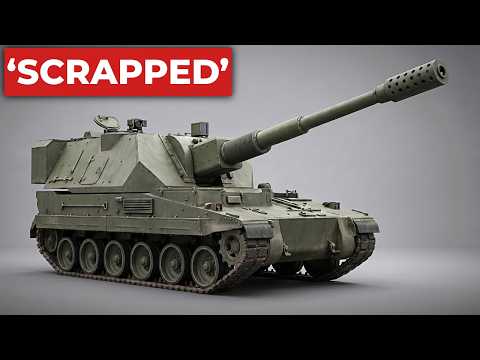
January 2025. A tree line between Zaporizhzhia and Pokrovsk. A Ukrainian battery commander with the call sign Azure stands beside a 45-ton British howitzer that his own army had quietly retired. A journalist asks him to compare it to Soviet weapons. Azure doesn’t reach for a spec sheet. He says one sentence that will travel further than any official press release ever did.
“It’s like comparing a Zhiguli to a Mercedes E-Class. The difference is not just noticeable, it is colossal in every category, in every criterion.”
The weapon he was talking about was 30 years old. It fired a barrel three calibers shorter than the modern NATO standard. By any specification table, it should have been obsolete. And yet, by November 2025, the British Ministry of Defense confirmed something extraordinary: every single AS90 in the British inventory—99 vehicles in total—had been transferred to Ukraine. The British Army no longer operates this howitzer in any form. The entire fleet now serves on the Eastern Front against Russia.
This is the story of how a dated British self-propelled gun became one of the most quietly devastating Western artillery systems on the Ukrainian battlefield, and why the Ukrainians who crew it refused to give it up.
The problem began in 1985. The British Army needed to replace its aging Abbot self-propelled gun and the American M109 it had supplemented it with. The trinational SP70 project—a joint British, German, and Italian howitzer program—was collapsing under cost overruns and political deadlock. Vickers Shipbuilding and Engineering Limited, based in Barrow-in-Furness, made a private gamble. They would build their own 155-mm self-propelled howitzer on their own money, betting that SP70 would die.
It died. In 1989, Vickers won the British Army’s Abbot replacement competition against three rivals, including the American M109 Paladin. The contract was for 179 vehicles at 300 million pounds. They called it the artillery system for the 1990s: AS90. Deliveries ran from 1992 to 1995.
Now the technical reality. The AS90 weighs 45 tons combat loaded. It is powered by a Cummins VTA 903 diesel producing 660 horsepower, pushing it to 55 km/h on road with a 370 km operational range. It crews five: commander, driver, gunner, and two loaders. Armor is 17 mm of welded steel—proof against small arms and shell splinters but nothing heavier. The main gun is a 155 mm L31 ordnance, 39 calibers long. Elevation runs from -5° to +70°. Traverse is a full 360°. Ammunition stowage is 48 projectiles with 31 in a turret bustle magazine and 17 in the hull, plus 33 charges. Maximum range with the standard L15 high explosive shell is 24.7 km; with base bleed extended range projectiles that climbs to roughly 30 km.
But the number that matters most on the modern battlefield is not range. It is rate of fire. According to British Army specifications, the AS90 can deliver three rounds in under 10 seconds in burst mode. Six rounds per minute for three minutes at intense rate. Two rounds per minute sustained for an hour. In trials, two AS90s firing in concert have placed 261 kg of high explosive on a single target in less than 10 seconds.
A 2008 to 2009 capability enhancement program added BAE Systems LINAPS laser inertial pointing system, GPS, automatic fuse setting, and barrel bend measurement. The vehicle can come into action, fire 18 rounds, and displace position in under 5 minutes. In 2007, it was certified to fire the Raytheon M982 Excalibur GPS guided round following trials at Yuma Proving Ground.
There were supposed to be more. Much more. In 1993, Britain approved an upgrade called Braveheart: a 52-caliber barrel, 96 conversions contracted to BAE Systems in 2002. Promised range was 30 km unassisted, 40 km with extended range ammunition. The program died when the South African BI modular propellant charge failed both insensitive munitions and intensive fire requirements. That cancellation locked the British Army into the L39 barrel. It meant the AS90 would forever fire roughly the same distance as Russia’s 1989-vintage 2S19 Msta-S, and fall 15 km short of modern L52 systems like the German PzH 2000, the French Caesar, the Polish Krab, and Ukraine’s own Bohdana.
By the 2020s, the British Army was actively retiring the AS90. The fleet had eroded from 179 to 134 by 2008, to roughly 89 by April 2016. Range was the killer. NATO peers had moved on. The final British live fire took place at Exercise Winter Camp in Estonia in May 2024, conducted by 127 Battery at Tapa.
The first transfer was announced by Prime Minister Rishi Sunak on January 14, 2023: 30 AS90s pledged alongside 14 Challenger 2 tanks. The first tranche delivered in 2023 totaled 32 vehicles—20 battle-ready and 12 stripped for spare parts. A second tranche followed in April 2024. A third batch of roughly 16 came in July to September 2024 under the new Labour government, with Defence Secretary John Healey confirming on September 30, 2024, that 10 had arrived with six more imminent.
Then came the disclosure. A November 2025 UK Ministry of Defense Freedom of Information release, reported by Janes, confirmed that the Ministry had donated to Ukraine all 99 AS90s declared in its 2021 United Nations Register of Conventional Arms Return. Every operable hull. Every cannibalization donor. The entire declared fleet.
Ukrainian crews trained at the Royal School of Artillery at Larkhill on Salisbury Plain in a compressed three-week conversion course delivered primarily by 19 Regiment Royal Artillery. According to The Defence Post, Lieutenant Colonel Ed Butterill, Chief Instructor at the Royal School of Artillery, said of his Ukrainian students that they had soaked up everything taught them and within a couple of weeks they would be firing the AS90 in anger. He was right.
First combat use was documented on June 15, 2023, with footage circulated on the Ukrainian General Staff linked Telegram channel Operativniy ZSU. Ukrainian operators across open-source reporting include the Third Assault Brigade, the 49th Artillery Brigade Mstislav the Brave out of Chernihiv, the 58th Motorized Brigade, the 116th Mechanized Brigade firing on Kupiansk, the 117th Heavy Mechanized Brigade, and the 151st Mechanized Brigade. Operations have been documented across the Zaporizhzhia, Kupiansk, Pokrovsk, and Kursk axes.
A Forbes relayed account picked up via Polish tech outlet WP Tech describes one AS90 crew surviving at least six consecutive Russian strikes: artillery, FPV drones, more artillery, and a Lancet loitering munition. The vehicle was severely damaged. It did not burn. It did not cook off. The crew walked away.
That survival story matters more than any brochure figure. In a war where Russian artillery doctrine still leans on massed barrages and where a single Lancet can turn a concealed howitzer into a burning wreck, the AS90’s ability to take a beating and keep its crew alive became its own kind of capability. Ukrainian crews learned to trust the steel around them.
Now the comparison Azure was making. The Russian D-30, a 122 mm towed howitzer designed in 1963, has a maximum range of 15.4 km. The 2S3 Akatsiya, a 152 mm self-propelled gun from 1971, manages 17.4 km. The 2S19 Msta-S, the Russian front-line equivalent fielded in 1989, matches the AS90 at 24.7 km—but relies heavily on optical sighting with manual ballistic computation. PG-1M panoramic. OP-4M telescope. A gunner with a slide rule.
The AS90 integrates ring laser gyro inertial navigation, automatic gun laying, and digital fire control. It feeds directly into Ukraine’s homegrown Kropyva fire direction software, which assigns the nearest available gun to a target with live atmospheric ballistics. Russian crews still mostly compute manually.
Royal United Services Institute analyst Sam Cranny-Evans noted in a 2023 assessment that Russia has tried to compensate via UAV-cued reconnaissance fire and Krasnopol laser-guided rounds, but forward observation remains weak, and Krasnopol is degraded by cloud cover and electronic warfare.
Colonel Serhii Musiienko, deputy commander of rocket forces and artillery of the Ukrainian Armed Forces, told RBC Ukraine in late 2024 that across the M777, M109, PzH 2000, AS90, Krab, and Archer, Western guns provide an advantage in both accuracy and range—provided crews are equipped with the proper amount and appropriate range of ammunition. He cited Soviet ammunition’s calculated dispersion of 20 to 25 meters against tighter Western precision figures.
The 117th Brigade itself, in a public early 2025 statement via Militarni, declared the AS90 capable of inflicting devastating and crushing blows on the enemy with sniper accuracy.
The verdict, then—the honest verdict, because British engineering excellence does not require lying about it. The AS90 did not win in Ukraine on raw range. Its 24.7 km reach is identical to the baseline Msta-S and shorter than the long-barreled 2S5 Giacint-S. Where it wins is in the system around the gun. Burst rate of three rounds in 10 seconds, faster than any Russian system fielded in volume. Digital fire control plugged into Kropyva. A fully enclosed, climate-controlled NBC turret—while the 2S5 exposes its crew during firing in a way that has proven catastrophic against drone-saturated battlefields. NATO ammunition compatibility, including Excalibur. And crews trained at Larkhill in shoot-and-scoot doctrine, treating survivability as a daily discipline rather than an afterthought.
According to Oryx’s open-source intelligence tracking, by August 2025 Russia had lost roughly 246 Msta-S, 54 modernized Msta-SM2, 132 Akatsiya, and 76 D-30 howitzers visually confirmed across the Ukrainian battlefield. Ukrainian AS90 losses sit at approximately 19 vehicles visually confirmed—13 destroyed and six damaged—out of the roughly 68 transferred by mid-2025. Crews specifically cite Lancet loitering munitions as the dominant threat and consistently emplace the howitzers in revetted or concealed positions.
A British howitzer that was being quietly retired for being too short-ranged, too tracked, too dated, has now outlasted its own army’s frontline service by going to the front.
Britain is replacing it not with another tracked howitzer, but with the KNDS RCH 155—an unmanned automated turret on a Boxer 8×8 chassis. The UK announced its selection on April 23, 2024. On December 28, 2025, the UK and Germany signed a 52 million pound joint early capability demonstrator contract for three prototypes under the Trinity House agreement. The lesson Britain has written into its next artillery program comes directly from Ukrainian battlefields: mobility, automation, networked fires, range.
Return to that tree line. Azure stands beside a 45-ton British howitzer designed when the Cold War was still the relevant war. He has a tablet running Kropyva. He has three weeks of Salisbury Plain training in his crew’s muscle memory. He has Excalibur-certified ammunition and a fire control computer that talks to drones overhead. And he has, sitting in his memory, a Russian battery somewhere over the horizon still using optics his grandfather would recognize.
Azure lowers the tablet and gestures toward the gun behind him. “The Zhiguli gets you there,” he says. “The Mercedes gets you there, and you survive the trip.” His crew laughs. They have heard the line before, and they still like it.
By the time the last AS90 crossed the Polish border, there were no more left in Britain. Not a single hull in reserve. The entire fleet had traded a quiet retirement for the loudest war in Europe.
Somewhere in Barrow-in-Furness, the men who gambled on the AS90 in 1989 never imagined this ending. They built it to hold a line in Germany that never came. Instead, it held a line in Donbas that did.
“They said it was too old,” Azure says, tapping the hull. “It wasn’t too old. It was too honest. It did exactly what it was built to do.”
The Mercedes comparison will outlive the war. But the gun itself already has a better epitaph: it was retired by the army that built it, and it is still fighting for the army that needed it.
What does it say about a weapon when its own country gives up on it, and another country refuses to?
Report this article
Select a reason for reporting:






