April 7th, 1945. Low over the East China Sea, Commander Edmund Conrad circles the largest warship ever built and begins calling his squadrons in one by one. Below him, 72,000 tons of Japanese steel, the battleship Yamato. Nine guns that could throw a shell the weight of a car more than 20 miles. What Conrad’s torpedo planes are about to do will roll this monster completely onto her side before the afternoon is over.
For 80 years, the story has been that they were ordered to do it. Ordered to drive every torpedo into one side of her and capsize her. But was that true? And what would the Yamato’s own crew do in her final minutes to try to keep her from going over?
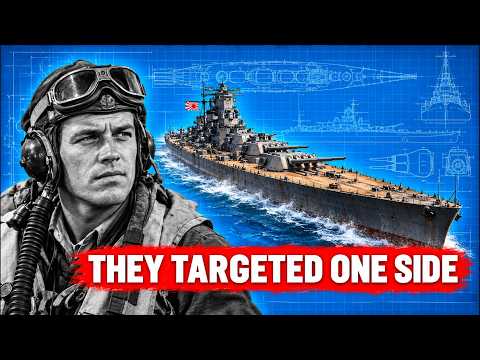
To understand why one side would matter, you have to understand what the Yamato was. She was the heaviest, most heavily armored warship ever to put to sea. Built in secret at the Kure Naval Arsenal, launched in August 1940, commissioned on the 16th of December 1941, nine days after Pearl Harbor. Her main belt was over 16 inches of steel. The faces of her gun turrets carried more than two feet of armor plate, thicker than the entire hull of most ships that ever sailed. And the guns themselves had no equal. Nine 18.1-inch rifles, 46 centimeters across the bore. Each turret as heavy as a destroyer. The Japanese labeled them 40-centimeter guns to hide the truth. Each one could fire a shell weighing over 3,000 pounds, as much as a small car, out past the horizon at a target the crew could not even see. On paper, nothing afloat could stand against her.
The problem was that by 1945, she had almost nothing left to stand against. She had been hit before. On Christmas Day 1943, off the atoll of Truk, the American submarine Skate put a single torpedo into her starboard side near the number three turret. She took on roughly 3,000 tons of water, corrected herself, and steamed on. The wound barely slowed her. It only deepened the legend: the ship that could not be killed.
Then came her sister. October 24th, 1944, the Sibuyan Sea in the Philippines. The battleship Musashi, same class, same guns, same armor, ran into the full weight of American carrier aviation. Wave after wave of Helldivers and Avengers. The bombs cracked her deck. The torpedoes opened her hull on both sides, port and starboard, almost evenly. And here is the thing that mattered. Because the damage was balanced, her crew could fight it. They flooded compartment against compartment to hold her upright. They kept her afloat for hours. It took something close to 19 torpedoes and 17 bombs by the highest American count to finally put the Musashi under.
American analysts studied that battle hard, and they drew a conclusion that would echo six months later. That if the hits had been concentrated instead of spread evenly across both sides, far fewer of them would have been needed. So the Americans had seen, up close, that a Yamato-class ship could be killed from the air. They also knew it was going to cost them, unless they were smarter about where the torpedoes went.
By the spring of 1945, the Japanese high command had run out of good options, and nearly out of bad ones. American troops had landed on Okinawa on the 1st of April. The home islands were next. And so the Navy reached for the Yamato one last time. The plan was called Operation Ten-Go, Heaven Number One. The Yamato, one light cruiser, and eight destroyers would steam south, alone, with almost no air cover, straight into the heart of the American fleet. Their orders were to fight through to Okinawa, run the Yamato aground in the shallows off the invasion beaches, and use her as an unsinkable fortress of 18-inch guns until she was destroyed.
It was a death sentence, and everyone involved knew it. Vice Admiral Seiichi Ito, who led the Second Fleet, objected outright. The captains, called together on the 5th of April, came close to open revolt. Captain Tameichi Hara, who would take the light cruiser Yahagi on that voyage, later described the mission in a single, bitter image. Sending the Yamato out, he said, was like throwing an egg against a rock. They went anyway. Told that the emperor himself expected the navy to act, the officers relented. Before sailing, they put the youngest men ashore. Dozens of naval cadets, the sick, a few of the older sailors. Men who were ordered to live. The rest sailed to die.
Now, why one side? Why does it matter which side the torpedoes hit? The answer is the key to the entire battle, and it lives in a dull-sounding piece of engineering called counter-flooding. A battleship floats because her weight is balanced. Put a torpedo into her port side, and the sea pours into that side. She leans. She lists to port. Left uncorrected, enough holes on one side will simply tip her over. So the damage control crews fight back with water of their own. They deliberately flood empty compartments on the opposite side, the high, dry, starboard side, to balance the weight and pull her back upright. They shift fuel across. They trade damage for level trim.
But there is a trap inside that logic. You only have so many empty compartments to flood, and every ton of water you let in to correct the list pushes the whole ship lower into the sea. You are buying balance by spending buoyancy. Do it too many times, and the ship rides level right up until the moment she rides level and then slides straight under. Hold those two facts together. A battleship can survive a great deal of damage, but only if that damage is balanced enough to fight. And her ability to correct a list runs out. That is the hinge of the whole story.
Spread your torpedoes across both sides, the way they had against the Musashi, and you let her crew play the balancing game for hours. Drive them into one side, the same side, over and over, and the counter-flooding has to run only one direction until there is nothing left to flood and nothing left to spend. So keep that one question with you as the planes come down out of the clouds. Were these men told to hammer one side of her, or did something else decide it for them? Hold on to it, because the answer is not where you think it is.
The men came from Task Force 58, the fast carriers of the United States Pacific Fleet under Vice Admiral Marc Mitscher, his flag flying in the carrier Bunker Hill. Hundreds of aircraft across a dozen flight decks. Hellcats and Corsairs to sweep the sky and strafe the gun crews. Helldiver dive bombers carrying 1,000-pound armor-piercing bombs. And the ship killers, the Avengers, the fat, tough torpedo bombers, each one slung with a single Mark 13 torpedo.
The Mark 13 had been a bad joke earlier in the war. Dropped too fast or too high, it would porpoise, run deep, or break apart on impact. By 1945, it had been fixed. A wooden drag ring on the nose to cushion the water entry, a plywood shroud on the tail to steady it. Now a pilot could release it at 800 feet and 300 knots and trust it to run true, carrying 600 pounds of Torpex into a hull at over 30 knots.
The Yamato left the Inland Sea on the afternoon of the 6th of April in failing light. She did not get far unseen. Within hours, the American submarine Threadfin spotted the formation and flashed a contact report in the clear. Plain language, deliberately, so the whole ocean would hear it. A second submarine, Hackleback, shadowed her through the night, reporting again and again. The Japanese radio operators heard the transmissions. They knew they were being watched. There was nothing they could do about it.
At dawn on the 7th, American float planes found them. Two lumbering PBM Mariner flying boats took station at the edge of the Yamato’s anti-aircraft range and simply sat there circling for five hours, feeding her position back to the carriers. The Yamato’s own radar had already caught the carrier strikes forming up. Her gunners could do nothing but wait.
A little after half past twelve, as the American formations wheeled into range, her forward turrets opened fire. Not at ships, but at aircraft. The 18-inch guns threw up special anti-aircraft rounds, the Type 3 beehive shells. Each one bursting into a shotgun pattern of burning fragments meant to shred a formation in the sky. The American pilots flew straight through the bursts. They barely noticed.
The first real blow fell at around 12:37. The strike coordinator overhead, Commander Edmund Conrad of Air Group 17 off the carrier Hornet, took control of the attack after the senior coordinator had to turn back. He circled low inside the storm of anti-aircraft fire and started feeding the squadrons in by radio, one group at a time. Dive bombers first to smash the top side and kill the gunners. Then the torpedo planes, low on the water, where it counted.
One of his pilots, Ensign Harry Jones of Torpedo Squadron 17, looked down at the thing he was about to attack and could only compare it to a skyscraper. The Yamato, he said, looked like the Empire State Building plowing through the water.
At around 12:40, 2,000-pound bombs from the Helldivers struck aft. One wrecked a secondary gun director and lit a fire that the crew would never fully put out. A fire that would smolder and spread for the next 90 minutes deep in the ship, moving toward places no one wanted it to go.
Then the Avengers came in low. Five of them off the Hornet bored in from the port side while Corsairs raked the deck with rockets and gunfire to keep the gunners’ heads down. At around 12:45, the first torpedo struck home forward on the port side. The Yamato shuddered and took on water. She listed. Her crew went to work flooding to starboard and clawed the list back down toward level. The counter-flooding was working, for now.
The screen died first. The light cruiser Yahagi, Captain Hara’s ship, took a torpedo clean in the engine room and went dead in the water almost at once. A stationary target. Finished off over the next hour by bomb after bomb and torpedo after torpedo. Hara would survive, blown into the sea when she finally rolled. The destroyer Hamakaze was hit and broken in two, her bow and stern lifting as she folded. The destroyer Asashimo, which had already fallen behind with engine trouble, was swarmed and sunk with every man aboard, more than 300 of them, gone before the main attack on the Yamato had even peaked.
Now watch the pattern that gives this story its title. Wave after wave of Avengers lined up and attacked, and the torpedoes kept going into the same side. An Essex Corsair put a 1,000-pound bomb into the port bow. Torpedo Squadron 84 off the Bunker Hill had been briefed with unusual clarity. Attack the battleship and nothing else unless they had to. They came in from multiple angles at once, crisscrossing over the target, and still more fish went into her. And still almost all of them went into the port side. One side. Exactly the way the legend says.
But hold the obvious conclusion a little longer, because whether anyone actually ordered that is the question we promised to answer. Then came Task Force 58.4. Between roughly half past one and a quarter to two, the carriers Intrepid, Yorktown, and Langley threw their aircraft into her. Twenty Avengers attacked from the port side and three torpedoes struck home almost together. All port. The list jumped past seven degrees and kept climbing.
And now the Yamato’s officers reached the end of the arithmetic. The starboard compartments meant for counter-flooding were already full. There was only one thing left to flood: the starboard engine rooms, with hundreds of men still at their stations inside. They flooded them anyway. The sea and scalding steam came in together. Ensign Mitsuru Yoshida later wrote: what was done in those engine rooms was not bravery. It was suicide born of desperation.
It bought almost nothing. The last attack came from Torpedo Squadron Nine, led by Lieutenant Thomas Stetson, who reset his fish to run deep and made the one deliberate choice of the day: he went for the starboard side, the high side, to finish what the other flank had started. At 23 minutes past two, the Yamato capsized and her magazines detonated. Of 3,332 men aboard, 3,055 died.
So was there an order? No directive has ever been found. The one pilot who consciously chose a side chose the opposite one. The concentration came from the shape of the battle itself, not a diagram. She lies in the East China Sea still, a war grave, and has not moved since.
Knowing all this, do you think the legend of the order deserves to survive, or should the truth of those final two hours finally replace it?
Report this article
Select a reason for reporting:






