Warrant Officer Jack Tredrea checked the cyanide capsule in his breast pocket one more time. The American bomber hummed around him, a metal cocoon hurtling through the dark toward occupied Borneo. It was March 1945. Four minutes to the drop. He was a 20-year-old medic from New South Wales who couldn’t speak a word of the language spoken on the ground below. The eight men on this aircraft were the entire Allied presence in the interior of the island. If the Japanese took him, the capsule was preferable to what came next.
Below them lay the third-largest island on Earth, a place of mountains and jungle so thick a man could walk into it and simply stop existing. The Japanese had held it since 1941, and tens of thousands of their soldiers were waiting. The Allied invasion fleet was still three months away. These eight men were not. They had 21 rifles, one shotgun, and 1,500 rounds of ammunition between them. No backup. No way out if it went wrong.
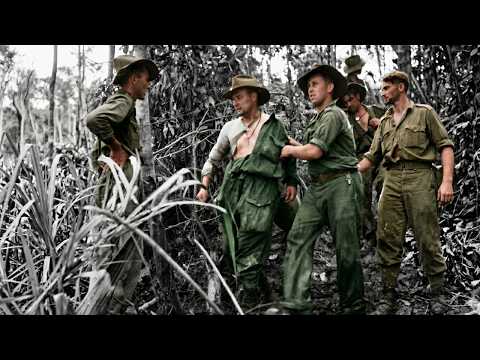
The question Tredrea couldn’t answer yet was the only one that mattered: Would the people waiting in that jungle let them live long enough to start a war?
More Australians fought in Borneo in 1945 than landed at Gallipoli—75,000 of them. That number has sat quietly at the back of Australian history for 80 years, and most Australians have no idea it exists. The biggest amphibious operation this country ever ran, and almost nobody knows it happened because the people who ran it did everything they could to make sure nobody would.
But this story doesn’t start with 75,000 men. It starts with eight.
The unit that sent them had no fixed name. It was called the Inter-Allied Services Department, then Special Operations Australia, then the Services Reconnaissance Department. Each name was a deliberate cover, a door that led to a different empty room. When the war ended, whoever kept records made sure those records did not survive. The files were gone before anyone could ask questions.
For 30 years after the war, the men who ran these operations carried a legal order in their heads: they were not allowed to talk about what they had done. Not to journalists, not to historians, not to their wives, not to their children. They came home and sat at tables and answered questions about the war the same way every time. “I cannot say.” Not because they had nothing to say, but because someone had told them not to say it.
So they carried it alone—in houses in Newcastle, in the Hunter Valley, along the coast of New South Wales—for three decades while the people who loved them had no idea who they were actually living with.
They were called Z Special Unit. And what eight of them did in the interior of Borneo before the invasion fleet arrived is one of the most extraordinary things Australian soldiers have ever done.
They raised an army—not a patrol, not a small network, an army—from inside a country most of them had never seen, with weapons that would embarrass a rural rifle club, working alongside people who had never spoken to a white man before. One of the eight, a nursing orderly from the Hunter Valley named Fred Sanderson, started with those 21 rifles and built a fighting force of 500 men inside months. Another party operating separately later put a number on what they had done: 265 Japanese soldiers killed by one team alone at a conservative count.
None of that has happened yet. Right now, the Pacific war is turning, but it is not over. Japan has taken losses on island after island. It is not surrendering. Its soldiers have orders to hold every piece of ground until there is no ground left to hold. Borneo is one more piece. The oil is there. The position matters. And the Japanese 37th Army knows the Australians are coming and has had three years to get ready for them.
Right now, there is only a Liberator somewhere over the South China Sea and eight men preparing to jump into the dark. One of them is Warrant Officer Jack Tredrea. He is the team medic. He is 20 years old. His kit has bandages and morphine, everything a medic carries. He also has a cyanide capsule in his breast pocket. They all do.
The capsule is not a last resort. It is the planned answer to a specific situation. The Japanese have already captured other Z Special operatives on other operations. What happened to those men is not a rumor. It is known. The capsule means Tredrea never has to find out what it feels like to be in that room.
He stands at the door of the aircraft. The cold comes in hard and smells like nothing. Below him, there is only black. Somewhere in that black are the people who will decide in the next few minutes whether to feed him and help him start a war or hand him to the men who are hunting for exactly this kind of thing.
He is 20 years old. He is a medic from New South Wales. And the question he cannot answer yet is the only one that matters: Whether the people waiting down in that jungle are going to let him live long enough to find out what he came here to do.
Melbourne, 1942. A room full of men who have run out of good news. Some of them are British officers who got out of Singapore before it fell. They watched a city of nearly a million people handed over to the Japanese because the guns were pointing the wrong way and nobody had thought hard enough about what an army coming through the jungle would look like. They are not the same men they were before that.
They know things now they did not know before. One of those things is that the Japanese are very good at using covered country and that the Allies are not. Another is that the entire northern stretch of Australia’s near region is now occupied. Borneo, Malaya, the Dutch East Indies, Timor—islands full of oil and ports and airfields. All of it behind Japanese lines.
The Australian officers in that room have a simpler problem. They need information. Where are the Japanese? How many? What are they building? What are they planning? And whether the people living under the occupation might help if someone could get in to ask them.
What comes out of that room has no fixed name. It will be called the Inter-Allied Services Department, then Special Operations Australia, then the Services Reconnaissance Department. Each name is a deliberate cover. Each name is designed so that anyone who hears it learns nothing useful. Small teams of men going in by parachute or submarine into occupied territory to gather intelligence and build resistance from the inside. The British had done it in Europe. Now, someone was going to do it in the Pacific, in jungle that made European forests look like a public park.
Nobody in that room uses the phrase Z Special Unit as anything but an administrative label on a piece of paper. That name will mean something different after the war. Right now, it is just a way to move men and stores through the army system without anyone asking the wrong question.
To run an operation in Borneo, they need someone who actually knows Borneo—not the coast, the interior, the high plateaus where the Dayak people live, where the rivers begin, where the country is so thick that a Japanese patrol cannot push through it without being heard a hundred meters away. There is exactly one Allied officer alive who has been there. His name is Tom Harrisson.
Harrisson is British Army. He is also a man who had spent years studying birds and people in remote country, written about both, and caused problems for anyone who tried to manage him. That last quality is relevant here. In 1932, he led an Oxford expedition to Sarawak and spent months living with the Kelabit people in the highlands—not visiting, not passing through, actually living with them. He studied their customs, learned what they ate and how they moved, what mattered to them, what frightened them. He came back and wrote about them. Then the war started. He went into uniform like everyone else, and he was somewhere in the army system when the SRD planners were looking for someone who could land in the Kelabit Highlands and not be dead inside a week. There was only one name.
In 1944, Harrisson sits in a planning room with a map of Sarawak spread in front of him. The map has gaps. Large parts of the interior drawn from approximation because nobody who made it had actually been there. Harrisson knows where those gaps are wrong. He marks the high plateau at Bario where the Kelabit people keep their longhouses, where the ground is firm enough to take a drop and the altitude keeps it cool enough to work in. He marks the rivers running down from the plateau and connecting it to the lower country. He marks the paths the Japanese use.
The senior officer across the table asks him what he thinks the Dayak people will do if a team drops in. Harrisson thinks for a moment. Then he writes one word in the margin of his notes.
Wait.
One word in a margin. That is the entire strategic assessment of one of the most unusual military operations Australia has ever run. He does not mean wait as in do nothing. He means the Kelabit people have been watching the Japanese for three years and deciding. They are waiting for something that looks like it might actually change things. He is betting eight men’s lives on the idea that dropping from the sky at night might be enough to tip that decision.
A thousand kilometers away in the Hunter Valley of New South Wales, a nursing orderly from Charlestown had just been asked if he wanted to volunteer for something the army described only as special training. His name is Fred Sanderson. He is 25 years old, has already served at Tobruk, and knows better than most what happens when a plan goes wrong in a hurry. He volunteers without being told where he is going. He finds out at Fraser Island off the Queensland coast. The training involves explosives, radio signals, and how to move through thick country without making a sound. It becomes clear to him and to everyone around him that whatever comes next is not going to be like anything they have done before.
Z Special operatives would keep a covert presence in Borneo from this point forward through 1944 and into 1945, until the Japanese finally signed the surrender papers. In total, across nearly 18 months of continuous operations, this island that most Australians had never heard of became the place where Australia ran its most ambitious secret war.
Nobody told Sanderson that yet. Nobody told him about the Kelabit Highlands or the rivers or the Japanese garrison three hours march from where he was going to land. Nobody told him about the 21 rifles and the 1,500 rounds that would be the entire fighting capacity of the army he was about to build. He found that out later.
The stores came down scattered. Some landed in trees. Some landed in water. The weapons and ammunition and radio equipment that were supposed to hit a specific clearing on the plateau at Bario came down where they came down. In the dark, eight men who had just jumped from a bomber at several thousand feet were now moving through unfamiliar country trying to find the things they needed to survive. The air smelled of wet earth and something rotting deep under the canopy. Every footstep was louder than it should have been.
The first hours in occupied Borneo were not a military operation. They were a search party. By morning, they had most of what they needed. The radios worked. The rifles were accounted for. The men were alive and undetected. They had done the hard part. Except the hard part had not started yet.
The Kelabit people knew something had come down from the sky in the night. In a place as remote and quiet as the Bario Plateau, eight men landing with guns and equipment were not something that went unnoticed. By the time Major Tom Harrisson and his team had gathered themselves and their gear, there were people watching from the edge of the tree line. Silent, still, not coming forward.
This was the problem nobody in Melbourne had been able to fully solve. The Kelabit people had no reason to trust white men. The British had been their colonial administrators before the Japanese arrived, and the British had left when the Japanese came. Just left. The Japanese had then spent three years proving themselves to be something considerably worse. And now, into that history, eight Australians had dropped from the sky with guns.
The question every person at that tree line was asking was reasonable. Why should this time be any different?
Harrisson understood that. He had lived with these people. He knew the worst thing he could do right now was act like a soldier who had arrived to give orders. So, he put his weapons down. He sat. When the first Kelabit men came close enough to speak to, he greeted them the way he had learned 13 years ago. There was local rice beer called borak, and there were hours of careful, slow conversation—Harrisson working through partial Malay, the Kelabit people extending patience to a white man who at least tried to get the words right.
The negotiations went through the night and into the next day and the day after that. What shifted things was not something any planner could have arranged. The Dayak people across the interior of Borneo had been watching the Japanese for three years. Up close, the cruelty was not abstract to them. It was specific, remembered, and personal. When word started moving through the Highlands that white soldiers had arrived who asked rather than took, who sat in longhouses, who ate what was put in front of them, and tried to learn the names of children, something changed. The response began to shift.
Harrisson later said something about the Kelabit and Murut warriors that has stayed in the record ever since. He said they never had to be taught how to move or kill. What he meant was that these were people who had lived in this country their whole lives. They knew every path and every river crossing and every piece of ground that would slow a man down when he was carrying a rifle. They knew how to be completely silent in terrain that would betray a European soldier with every step. They did not need training. They needed weapons and someone to point them at the right target.
Sergeant Fred Sanderson got that job in the weeks after the drop. He moved south from Bario into Iban territory with the unit’s rifles and a mandate to build a fighting force. 21 rifles, 1,500 rounds, no shared language. He worked through interpreters and through the expanding network of contacts Harrisson’s team had built, and he sat in longhouse after longhouse making the same offer. Join this and we take the fight to the Japanese together.
Within months, Sanderson had 500 Iban men ready to fight.
Stop and think about what that actually means. A nursing orderly from Charlestown in the middle of occupied Borneo with a small pile of rifles and no common language. 500 men.
On paper, none of this was happening. The organization that sent these men had no single official name. The files tracking their movements were already being marked for destruction. They were operating under a unit that was officially never meant to exist. Not in any public record, not in any acknowledgement, not in anything a family could point to and say, “This is what he did. This is where he went.”
They worked in the gap between what the army acknowledged and what it actually did, and that gap was not an accident. The people who built the organization had built that gap on purpose.
The supply line keeping all of this alive was the RAAF’s 200 Flight. Pilots who flew weapons and food and medicine into unmapped mountains in all weather by dropping them from altitude onto highland clearings. 30 of those pilots were killed in crashes before the operation ended. Thirty. The men on the ground heard the aircraft coming and hoped the stores landed where they could reach them, and they kept moving.
There was a cyanide capsule in every man’s kit. Warrant Officer Tredrea kept his in his breast pocket. It was not spoken about. It was simply there, the way a tourniquet was there—the answer to a situation nobody wanted to arrive at.
And there was something else nobody spoke about. Captain William Sochon was 300 kilometers away on the Rejang River with his own small team and his own Dayak fighters. His scouts came back. Japanese patrol on the track ahead. His fighters were in position. Sochon had perhaps 60 seconds.
That was the reality of Operation Semut that no briefing could capture. It was three and four separate stories running at once across hundreds of kilometers of occupied country, with no way of knowing whether the men you had trained beside at Fraser Island were alive or dead.
The order came on the 1st of August, 1945. Two words with the weight of everything behind them: close the door. The Semut parties and their Dayak fighters were to take every river crossing, every mountain pass, every inland track. The guerrilla forces that had spent months learning these routes were now to use that knowledge to seal them.
The ambushes began. The Dayak warriors who had spent three years watching Japanese soldiers move through their country put months of preparation into the ground at once. Harrisson had said they never had to be taught how to move or kill. In August 1945, every ambush that Japanese soldiers walked into and did not walk out of was the full meaning of that statement.
Captain Sochon’s Semut 3 party had by this point been behind Japanese lines for six months. In his own words, at a conservative estimate, his party had killed 265 Japanese soldiers. The full record of what all four Semut parties did across that island was never written down. The files were already being prepared for destruction.
The signal came through the radio on the 15th of August, 1945. The Japanese emperor had spoken. The war was over. Cease aggressive action immediately. Major Tom Harrisson read it. Then he stepped outside and looked at the interior around him. It looked exactly the same as the day before.
The problem was that most Japanese soldiers in the interior had not received it—or had received it and found reasons to ignore it. The 37th Army had spent years training to hold and fight. Stopping because someone signed a document somewhere was not something that translated easily into the behavior of men who were cut off, hungry, frightened, and still armed.
So they kept moving. They came through villages in the night and took food. They burned what they could not carry. The Semut operatives stood in those same villages with weapons they were no longer allowed to use and they watched it happen. They had promised the Dayak communities that had fed them and sheltered them that those communities would be protected. That promise had no expiry date.
The Dayak people had not been given the ceasefire order. They had made an agreement with the men from the sky, and the agreement said nothing about a date on which it expired.
Harrisson stayed. While other operatives began the process of returning to Australia, he stayed in the Sapong area and did what the official channels were too slow and too distant to do. He found the isolated Japanese commanders still in the field. He tracked them through the same country he had moved through for months and sat across from men who had been the enemy and talked until they agreed it was over. He kept doing this through September and into October.
The formal ceremony happened without him. On the 10th of September, 1945, on the island of Labuan, Lieutenant General Baba Masao stood before Allied commanders and formally surrendered the Japanese 37th Army. Signatures, witnesses, the documented conclusion of a campaign. The men who had made the invasion possible were not at that ceremony. They were still in the interior finishing a war that the ceremony had not actually finished.
The last surrender in the Semut operational area was recorded on the 29th of October, 1945—seven months after Bario, four months after the fleet arrived.
The farewells were not ceremonies. The Dayak chiefs who had given everything received medals. Tama Weng Ajing, the Kenyah chief who had staked his community’s future on a promise given in a longhouse, received an MBE. The medals were real. The recognition was genuine. Then the aircraft came and the white soldiers left and the highlands went quiet in a way they had not been quiet since March.
Sanderson came home to New South Wales. No parade, no public acknowledgement. A family that had spent months not knowing where he was now asked to accept that he was back and that the details were not something that could be talked about. His wife knew he had served. She did not know about the 500 Iban men or the Distinguished Conduct Medal or the months in occupied country. He was not allowed to tell her.
Every Z Special operative got the same instruction on discharge. The operations were classified. The organization had no public existence. The files were gone. What remained was only the men themselves, carrying the operational record inside them, now being asked to lock that record away for as long as the government required.
Sanderson moved to Maitland. He and his wife opened a restaurant, then a petrol station. He went to church. He raised his children. He did not tell them what he had done in Borneo or who he had become there or what it had cost to carry all of that back to a quiet town on the New South Wales coast and pretend it had not happened.
Across Australia, in houses and farms and suburbs, the men of Z Special Unit came home and became invisible in the same way they had been trained to become invisible—quietly, completely, without leaving a trace.
Here is a number that most Australians do not know. 60,000 Australians landed at Gallipoli. 14,000 served at Tobruk. 75,000 fought in Borneo in 1945, and most Australians have never heard that campaign’s name. That is not a gap in the history books. That is a deliberate erasure built by the same people who destroyed the files, and it kept going long after the war ended—in classrooms and textbooks that simply pointed somewhere else.
The Semut and Agas operations were not a footnote to the Borneo campaign. They were the architecture that made it possible. For months before the first boot hit the beach, radio signals had been coming in from highland clearings—intel that no aircraft could gather, because aircraft saw shapes and rooftops and the vague suggestion of movement, while the men on the ground saw faces and heard conversations and counted soldiers walking past in the rain.
Over 100 Allied personnel were inserted into Sarawak alone. Most of them were Australian. Between them and the Dayak fighters they had recruited and trained, Semut controlled guerrilla forces exceeding 1,000 men by the middle of 1945. When the offensive order came in August, those 1,000 men held every path needed. The 37th Army’s entire inland withdrawal strategy depended on a retreat that never happened, because every time a column moved inland, it found the interior was already occupied by people who had been waiting for exactly that moment.
Operation Agas, the parallel operation running in North Borneo, killed fewer than 100—but the intelligence it produced shaped the timing and tactics of the North Borneo landings in ways that do not show up in any casualty figure. The total Japanese cost across all Semut and Agas operations was never fully recorded because the records were destroyed. What was recorded is the outcome. The 9th Division secured North Borneo. Major combat ended largely by July 1945. The door was closed.
The Allied cost is also on record, though it appears nowhere most Australians will ever see. 30 aircrew from RAAF 200 Flight killed in crashes supplying these operations. More than 80 Z Special operatives killed across all Pacific operations. 112 men died in service with the Services Reconnaissance Department in Borneo. That is more than fill a standard company. Most of them forgotten. Every single one of them sworn to keep quiet about the fact that they had served at all.
There is one more thing about what these operations were actually for. Operation Semut had two objectives. The first was the one the operatives knew: gather intelligence, build guerrilla forces, support the 9th Division’s landings. That objective was achieved completely. The second was British in origin and was never shared with the Australians. Because the British controlled the Special Operations organization, a political aim sat alongside the military one. Restore British credibility in Sarawak. Prepare for the return of British colonial rule. Make sure that when the war ended, Britain was back in charge of a country it had failed to protect when it mattered.
The men who jumped from the Liberator at Bario did not know about that second objective. They were there to fight and to keep a promise to the people who helped them fight. That they were also, without being told, being used to restore a colonial system to a country that had not asked for it back—that is part of the full weight of what those men carried home. Not guilt. Something harder than guilt. The knowledge that the thing you fought for, honestly, was also being used for something you were never asked to agree to. That knowledge went into the drawer with the rest of it. And for 30 years it stayed there.
Tom Harrisson did not come home. When the war ended and the other operatives flew back to Australia and the files were destroyed and the long quiet began, Harrisson went the other way. He became curator of the Sarawak Museum in Kuching and held that position for nearly two decades. In a cave in Sarawak’s interior, not far from the highland country he had operated in during Semut, he found evidence of human habitation stretching back 40,000 years. The man who raised a guerrilla army in the Kelabit Highlands spent the next two decades excavating what was buried beneath them. He died in 1976. He was 63 years old.
Fred Sanderson ran the petrol station and said nothing for the years the restriction required. Then kept saying nothing for the years after that, because silence had become the habit and habits do not stop just because the reason for them is gone. In 1965, Harrisson called him. The Indonesian-Malaysian confrontation was hot in Borneo, a proxy conflict running through the same interior and the same border country Sanderson had operated in 20 years earlier. The British needed people who knew the terrain, knew the communities, and could be trusted to do quiet work. Sanderson was in his mid-50s. He had a family and a business and a life in New South Wales. He got on a plane and flew back to the country he had spent 20 years not being allowed to name. He did what was asked. He came home. He did not discuss that either. He died in Newcastle in 1997, aged 87.
Warrant Officer Jack Tredrea was 94 years old when an SBS camera crew found him in 2014. He was the last known surviving member of the original eight who jumped at Bario on the night of the 25th of March, 1945. He sat in front of the camera and talked about the cyanide capsule and the sounds of the highlands at night, about what it felt like to be 20 years old standing at the door of a bomber over occupied territory with nothing below you but darkness. He talked about coming home and saying nothing. And what that silence had cost the people around him who deserved to know who they were actually living with. He was not angry. He was a Z man. They were not built for anger about what they had been asked to do. They had agreed to all of it, every part, including the silence.
Barney Shinkle, the radio operator from Operation Agas 4, put it plainly in an interview later in his life. He had sworn when he got out that he would forget all of it—where they went and what they did and all the rest. “It was a secret mission. I couldn’t tell anyone, not even my family. They just blocked it off altogether.”
And then there is what Christine Helliwell found when she spent 20 years sitting with elderly Dayak people in Sarawak and asking them what they remembered about 1945. They did not talk about tactics. They did not talk about casualty counts or guerrilla methods. They talked about the men who had sat in their longhouses and eaten their food and tried to say the names of their children correctly. They talked about the morning the white soldiers left. They remembered every face. They had been remembering every face for 70 years. Nobody had told them to forget.
The silence did not end with a government announcement. There was no moment when someone in Canberra stood up and said the classification had run its course. No press release confirming that what they had done in Borneo was real and documented and worth knowing. It ended the way it had always been sustained—quietly, slowly, through the work of people who believed the story was worth finding.
Helliwell was an anthropologist from New Zealand who spent 20 years living with and studying Dayak communities in Sarawak. She was not looking for a war story. She was looking at the culture and the long history of the communities she had come to know well, but the war kept coming up. The elderly people she sat with in longhouses along the Baram and Rejang rivers kept mentioning the white soldiers. The ones who had come in 1945, who had sat and eaten and asked the names of the children. She started pulling on that thread. She interviewed the surviving Semut operatives. She read through thousands of military documents—the ones that had not been destroyed—held in the Australian War Memorial and the Imperial War Museum and in private collections that veterans had kept in boxes under their beds for 40 years. She interviewed more than 100 Dayak people. It took her almost four years to write what she found. When it came out in 2021, it won the Les Carlyon Literary Prize. It won the Prime Minister’s Literary Award for Australian History. It was shortlisted for awards in three separate categories in two countries. A book about a secret Australian military operation in the jungles of wartime Borneo became one of the most recognized works of Australian history published in years—because the story was always there. It just needed someone willing to sit with it long enough to write it down.
Three years before the book, in 2018, the Australian War Memorial launched an exhibition called A Matter of Trust: Dayaks and Z Special Unit Operatives in Borneo 1945. The memorial published more than 10,000 documents from the Harrisson Collection online—decoded signals, patrol reports, maps drawn in the field by men who had been told their work would never be acknowledged. For the first time, families of the men who served could read in their fathers’ own handwriting what had happened in Borneo in 1945. Some of those families had been waiting 70 years for exactly that.
Every year on the 25th of March, in the highland community of Bario in Sarawak, the Kelabit people hold a ceremony. They mark the night the eight men came down from the sky. They have been doing this since 1945. They did not stop when the Australians went home. They did not stop during the decades when the Australians were legally barred from speaking about what had happened. They kept the date and kept the memory and passed it to their children the way you pass something that belongs to you—carefully, and without letting go. In 2025, for the 80th anniversary, the Rurum Kelabit Association planned a full reenactment of the parachute drop. The community that was never told to forget has been remembering for eight decades without prompting, without ceremony, without anyone having to ask.
Here is the answer to the question this story planted at the start. How do eight men with 21 rifles and no shared language win a war in occupied country and then come home and say nothing for 30 years? These men were loyal not to an organization that had already destroyed its own files, but to the word they had given. They agreed to the secrecy as the condition of the operation, and they kept it after the operation ended because they were the kind of men who did not renegotiate the terms after the fact. What it cost them was the one thing soldiers who do hard things in the dark most need: to be known. To have the people they loved understand who they had been, what they had done, and why it had mattered.
In 2016, the Australian War Memorial held a ceremony to honor the men of Z Special Unit. Warrant Officer Jack Tredrea attended. He had been 20 years old at Bario. He had carried a cyanide capsule and a medical kit into occupied territory and come home and kept his word for three decades. He stood in front of the memorial in Canberra and received in public, in daylight, with witnesses, something that had not been offered to these men when it would have changed the shape of their lives. He did not make a speech about what it meant. He was a Z man. They did not do that. He stood there in daylight, in front of witnesses, in a country that had taken 70 years to learn his name. And for the first time since Borneo, what he had done was no longer a secret.
So the question now is not whether these men deserve to be remembered—the Kelabit have answered that every March for 80 years. The question is whether the rest of us will finally listen. What other stories of quiet courage are still waiting in the dark, and who will be the one to finally turn on the light?
Report this article
Select a reason for reporting:






