What if the official story of the Iraq War is a lie? Thirty hours before the first American bombs fell, before the world even knew the war had begun, a handful of Australian operators slipped into the deadliest desert on Earth. No armor. No backup. No rescue. They were fighting a war so classified that even top allied commanders didn’t know they existed.
Their mission? Prevent a global catastrophe. One wrong move in the dark, and World War III was guaranteed.
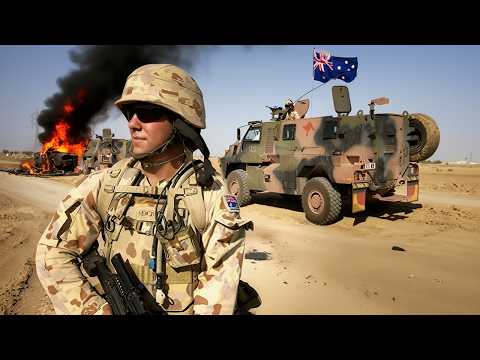
The date was March 18, 2003. While Washington polished its podiums and embedded journalists waited for the fireworks, Task Force 64—a tiny phantom unit of the Australian SASR—was already tearing through Western Iraq’s Anbar province. This was a territory the size of California, Nevada, and Arizona combined. Flat, featureless, and utterly hostile. Scorching by day, freezing by night. No cover. No place to hide.
And they were completely alone.
A stunned US Army liaison officer, attached to the Australian command, later called it the most disorienting experience of his career. He had been raised on the Powell doctrine: overwhelming force, massive armored divisions, endless supply chains. Instead, he watched a few rugged men in unarmored vehicles disappear into 300,000 square kilometers of enemy territory.
Their orders were not to observe. Not to patrol. But to control that entire expanse with nothing but their vehicles, their weapons, and their tactical brilliance.
The American officer couldn’t comprehend it. How could a force so small dominate a space so vast? Yet the Australians didn’t wait for permission. They bypassed the red tape and slipped through the shadows like ghosts.
Their vehicles were stripped of armor, trading protection for speed and firepower. Heavy machine guns mounted on exposed roll cages. Javelin anti-tank missiles bolted to open frames—a decision that would make any conventional general scream in panic. But these operators knew exactly what they were doing.
And the most shocking secret? No supply chain. No fuel convoys. No emergency resupply. They drove into the void with only the fuel in their tanks and the ammunition strapped to their vehicles. They were completely self-contained, laughing in the face of military doctrine.
Why would anyone risk such a reckless mission? Because the world was on the brink of an apocalyptic nightmare. The real threat wasn’t Saddam’s Republican Guard. It was the mobile Scud missile launchers hidden in the western desert—launchers that could strike Israel with chemical or biological warheads. One launch would trigger a regional war, shatter the coalition, and drag the globe into chaos.
Task Force 64 was ordered to hunt them down and erase the threat before the first missile flew. They were the only force fast enough, independent enough, and crazy enough to try.
And what they discovered buried beneath the desert sand would leave the Pentagon speechless.
The hunt began the moment their tires bit into the sand. The Australians moved only at night, engines muffled, headlights dead, navigating by stars and thermal optics. By day they vanished into dry riverbeds, waiting out the killing heat beneath camouflage nets while the desert baked around them.
Every shadow on the horizon demanded a decision. Every dust plume had to be identified. Every anomaly on the thermal screen could be a Scud launcher—or a trap.
And the pressure never let up. A single missed target meant a missile raining down on Tel Aviv. A single wrong turn meant a global war.
The American liaison officer watched it all with mounting disbelief. He kept waiting for the supply convoys, the reaction forces, the safety net he had been taught to trust his entire career. None ever came.
These men had severed every tie to safety and simply refused to fail.
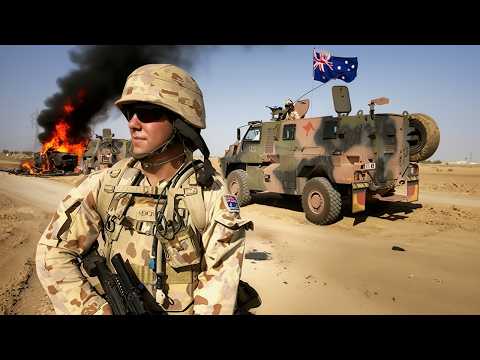
Then came the first contact. An Iraqi motorized column, confident and aggressive, expecting to swarm vulnerable light vehicles at close range. Instead, the lead elements vanished in fire before the defenders even knew they were under attack.
Javelin missiles streaked from the empty horizon and turned armored trucks into burning wreckage. The enemy commanders scrambled for answers that never came. They were fighting a phantom force that struck from nowhere and disappeared before the dust settled.
Within forty-eight hours, the entire western defense architecture began to collapse. Iraqi units that should have dominated the open desert found themselves paralyzed—outpaced, outthought, and outfought by a handful of men in unarmored rovers.
The vast emptiness that was supposed to protect them had become their cage.
But the Australians weren’t finished. Their real prize sat deep in Anbar: Al Asad airbase, the largest military airfield in the country. Long runways. Hardened shelters. Fuel depots built to sustain a relentless air campaign.
Conventional planners had assumed it would take weeks to reach, and by then the defenders would have burned everything of value. They were wrong.
The phantom patrols converged on the base from multiple directions at terrifying speed. The garrison had hours—not days—to react. There was no time to destroy the runways, no time to incinerate the classified files, no time to do anything but surrender the ground.
When the Australians swept through the perimeter, they found something no one had expected. Across the sprawling base, in deep sand revetments and under layers of camouflage netting, sat more than fifty combat aircraft—buried alive to hide them from coalition eyes.
But the aircraft were nothing compared to what waited in the bunkers.
The ammunition stockpiles at Al Asad contained nearly eight million kilograms of explosives. Enough to level entire cities. Enough to arm an insurgency for a decade.
And a tiny force moving faster than any conventional army had ever dreamed had just secured it all.
Had those stockpiles been looted and dispersed into the chaos that followed, the insurgency would have been born with an arsenal beyond imagination. Instead, Task Force 64 had erased the nightmare before the world even knew it existed.
When the classified reports finally reached the desks of American generals, they read them in stunned silence. The bedrock belief that power scales with size had been shattered by a force small enough to fit in a school gymnasium.
But the story was far from over. Because what the Australians found next—hidden in the deepest bunkers beneath Al Asad—was something no one had been briefed on. Something that would force the highest levels of command to ask a terrifying question.
What else had been buried out here that no one was supposed to find?
The answer came in the form of a sealed subterranean vault, tucked beneath the main operations building and guarded by blast doors that took the operators nearly an hour to breach. Inside, the air was cold and stale, untouched by the desert heat above. What they found wasn’t weapons. It wasn’t documents. It was a room full of filing cabinets—thousands of them—each one crammed with intelligence files that had absolutely nothing to do with Iraq’s own military.
They were running the logistics for someone else.
The files told a story the coalition had never anticipated. Detailed manifests, shipping records, and encrypted communications traced a shadow network stretching far beyond Iraq’s borders—a supply chain that funneled money, materials, and expertise into a web of regional proxies. And at the center of it all sat a name that made the Australian commander’s blood run cold.
He didn’t radio it in. Not yet. Because the name belonged to someone the coalition had been actively negotiating with.
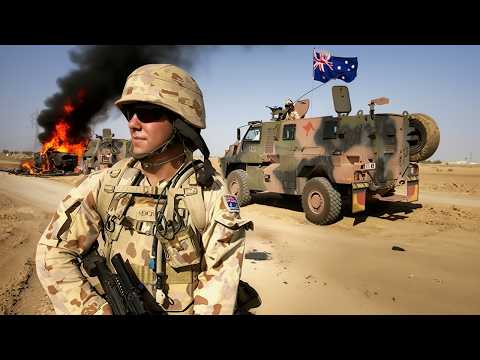
The liaison officer wanted to call it up the chain immediately. The Australians refused. They had seen what happened to intelligence that traveled too fast through too many hands—it got sanitized, buried, or worse, leaked. So they did what they always did. They kept it quiet and kept moving.
But the discovery changed the shape of the mission. The Scud hunt was no longer just about protecting Israel. It was about protecting the truth itself.
They pushed deeper into the desert, hunting the last remaining launchers with a new urgency. Every hour of daylight they spent hidden in the wadis felt like a lifetime. Every night run was a gamble against the clock.
And then, on the third night, the thermal screens lit up. Three heat signatures, moving fast along a dried riverbed. The profile matched exactly what the intelligence analysts had described. Mobile launchers. Fully fueled. Ready to fire.
The Australians didn’t hesitate. Two vehicles broke left, two broke right, cutting off the escape route before the enemy even knew they were surrounded. The Javelins came off the mounts and locked on. The launchers never had a chance to set up.
The first missile struck the lead vehicle before its crew could even open the launch hatch.
The second and third went up seconds later, their warheads cooking off in a chain of fire that lit the desert for miles. When the smoke cleared, there was nothing left but twisted metal and the smell of burning fuel.
The threat was gone. The nightmare was over.
But as the operators swept the wreckage, they found something that made the entire mission feel suddenly, terrifyingly incomplete. A fourth launcher had been there. The tracks in the sand were fresh—hours old, maybe less. It had slipped away while they were engaging the others.
And its tracks pointed east. Toward the border. Toward Israel.
The commander stared at the trail for a long moment, then keyed his radio for the first time in days. The message was short, clipped, and utterly calm.
“One runner. Heading east. We’re going after it.”
The American liaison officer, listening from the command vehicle, felt his stomach drop. They were hundreds of kilometers from any support, low on fuel, and chasing a target that could launch at any moment. By every rule he had ever learned, this was suicide.
But these men didn’t follow rules. They made them up as they went.
The chase lasted through the night, the Australians pushing their vehicles to the edge of mechanical failure. Sand clogged the filters, the engines screamed, and still they drove—guided only by the faint heat trail of the fleeing launcher.
Dawn broke with the target in sight: a single vehicle, half-buried in a shallow wadi, its crew frantically working to set up the launch rail. They had minutes, maybe less.
Two Javelins fired simultaneously. The launcher exploded before the missile could ever leave the rail.
The desert fell silent. The operator lowered his binoculars and let out a breath he hadn’t realized he’d been holding. “Target destroyed,” he radioed. “No launch. No war.”
They turned back toward Al Asad, engines coughing, fuel gauges buried in the red. Nobody spoke. There was nothing left to say.
Back at the base, the American officer met them at the gate. He had been waiting for hours, expecting the worst. When the battered rovers rolled in, he just shook his head and said, “I don’t know how you did it. But I’m glad you did.”
The Australians didn’t answer. They just climbed out, checked their weapons, and started preparing for the next mission.
Weeks later, the official history of the Iraq War would be written without them. No medals. No headlines. Just a footnote buried in classified archives.
But the world never knew how close it came. And the men who saved it never told a soul.
So here’s the question: if the greatest heroes of modern warfare are the ones we never hear about—how many other silent missions are still hidden in the shadows?
Report this article
Select a reason for reporting:






