In the summer of 1971, as the F-15 Eagle was still months away from its first flight, McDonnell Douglas quietly pitched a radical idea to the U.S. Navy: a carrier-capable version of the Air Force’s new air-superiority fighter. The proposal, designated F-15N, promised to bring the Eagle’s raw speed and advanced avionics to the flight deck—if it could survive the brutal demands of carrier operations.
The Navy was skeptical. It already had the F-14 Tomcat, a purpose-built fleet defender with the powerful AWG-9 radar and the long-range AIM-54 Phoenix missile. The F-15N, by contrast, would lack the Phoenix and its radar, the APG-63, was less powerful. Yet McDonnell Douglas believed the Eagle’s lighter weight, superior engines, and simpler maintenance could make it a compelling alternative. “We can offer a fighter that is faster, more agile, and cheaper to operate,” the company argued, hoping to exploit any gap in the Navy’s plans.
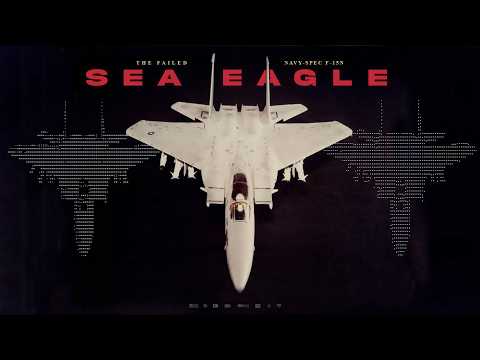
The initial concept was modest: add a tailhook, strengthen the landing gear, and fold the wings. The weight penalty was estimated at less than 2,000 pounds—a figure that seemed almost too good to be true. But as the Navy’s own studies would later reveal, integrating the Phoenix missile and its supporting systems would balloon the weight by 10,000 pounds, erasing the Eagle’s advantage. “The F-15N was a paper airplane,” one Navy official later remarked. “On paper, it could do anything. On a carrier, it would have been a nightmare.”
Still, the idea refused to die. In 1973, as the F-15 began to prove its mettle in flight tests, the Senate Armed Services Committee took notice. Senator Thomas Eagleton, a Missouri Democrat and Navy veteran, suggested a fly-off between the F-15N and the F-14. “Let the best plane win,” he urged. But the fly-off never happened. The Navy’s interest waned, and the F-15N faded into obscurity.
Why did the Navy ultimately reject the Sea Eagle? The answer lies in the unforgiving math of carrier aviation. The F-15’s landing speed and approach angle were already marginal; adding the weight of carrier gear and Phoenix missiles pushed it beyond acceptable limits. “You can’t cheat physics,” a Grumman engineer noted. “The Tomcat was designed for the sea from the start. The Eagle was a land bird.”
Yet the story of the F-15N is more than a footnote. It reveals the fierce interservice rivalry and technological gambles of the 1970s—and the enduring appeal of a fighter that could do it all. As one McDonnell Douglas executive put it, “We almost turned the Eagle into a sea eagle. Almost.”
But the Navy’s rejection was not the end of the road. The lessons learned from the F-15N would echo in later programs, including the F/A-18 Hornet, which would eventually become the Navy’s workhorse. And the Eagle itself would go on to dominate the skies for decades, albeit from land bases. Still, the question lingers: what if the F-15N had been given a chance? Would it have changed the course of naval aviation? The answer, like the Sea Eagle itself, remains tantalizingly out of reach.
To understand why the Navy’s skepticism hardened into outright rejection, one must look beyond the headline numbers and into the unforgiving environment of the carrier deck. The F-15’s legendary thrust-to-weight ratio, so decisive in air-to-air combat, became a liability during approach. Its relatively high wing loading meant higher landing speeds—a dangerous proposition on a pitching deck at night.
McDonnell Douglas’s revised Model 199-A-11 attempted to address this with full-span leading-edge flaps and blown trailing-edge surfaces, but these added complexity and weight. “Every pound you add to fix a carrier problem creates two more pounds of problems,” a Navy test pilot observed. “The Eagle was already at the edge of the envelope.”
Then came the Phoenix problem. The AWG-9 radar and AIM-54 missile were not merely bolt-on systems; they demanded liquid cooling, dedicated power, and a massive nose radome. The Navy’s own Carrier Fighter Study Group 3 found that a Phoenix-capable Eagle would weigh 10,000 pounds more than the F-15A—and its approach angle would exceed 12 degrees, making carrier landings perilously steep.
McDonnell Douglas countered with the F-15NPHX, mating a modified APG-64 radar to the Phoenix. The company promised six missiles and a software-defined back end. But the Navy had heard enough. “You can put a tuxedo on a farm boy,” one admiral reportedly said, “but he still won’t fit in the ballroom.”
What the Navy did not say publicly was that the F-15N threatened the F-14 program at its most vulnerable moment. Grumman was struggling with the Tomcat’s TF30 engines, and any suggestion that a cheaper, simpler alternative existed could have doomed the fleet defender in Congress. “It was a political non-starter,” a Senate staffer later admitted. “The Navy needed the Tomcat to work, and the Eagle was a distraction.”
By 1974, the F-15N was dead. McDonnell Douglas quietly shelved the design studies, and the Navy turned its attention to fixing the F-14 and, eventually, to the VFAX program that would become the F/A-18. Yet the Sea Eagle’s ghost lingered in the corridors of Naval Air Systems Command—a reminder of what might have been.
Decades later, when the Navy faced a fighter gap in the 1990s, some analysts dusted off the F-15N concept. Could a navalized Eagle, now with mature digital avionics and more powerful engines, fill the breach? The answer was the same: the physics had not changed. “The Tomcat was a sea bird,” a retired admiral said. “The Eagle was a land bird. You can teach a land bird to swim, but it will never be a sea bird.”
And yet, the F-15N’s story is not merely one of failure. It forced the Navy to confront the limits of its own requirements and to recognize that no single platform could do everything. That lesson would shape the F/A-18’s design, which traded raw performance for carrier suitability and multirole flexibility. In a strange way, the Sea Eagle’s sacrifice paved the way for the Hornet’s triumph.
The F-15N was not the only navalized Eagle concept to surface. In the mid-1970s, as the Navy grappled with the rising costs of the F-14, McDonnell Douglas proposed a stripped-down version called the F-15N Sea Eagle—a simpler, cheaper fleet defender that would forgo the Phoenix missile entirely. “We can give you eighty percent of the Tomcat’s capability at sixty percent of the cost,” the company claimed. But the Navy, still burned by the earlier F-15N debacle, was in no mood for half-measures.
The Sea Eagle’s proponents argued that the F-15’s superior acceleration and climb rate could compensate for the lack of Phoenix. In a world where Soviet bombers were increasingly armed with long-range anti-ship missiles, however, the Navy wanted reach—and the Phoenix provided it. “Without the Phoenix, you’re just another fighter,” a Navy captain said. “The Tomcat is a fleet defender. The Eagle would be a fleet liability.”
Still, the concept refused to die entirely. In 1978, as the F/A-18 Hornet program ramped up, some analysts suggested that a navalized F-15 could serve as a complementary interceptor, filling gaps in the carrier air wing. But the Navy’s budget was already stretched thin, and the Hornet promised lower operating costs. “We had to choose between the good and the good enough,” a Pentagon official later reflected. “The Hornet was good enough.”
What ultimately sealed the F-15N’s fate was not just physics or politics, but the changing nature of naval warfare. The Soviet threat that had driven the F-14’s design—massed bomber raids with long-range missiles—was evolving. By the 1980s, the Navy faced a more diverse set of threats, from anti-ship missiles to land-attack missions. The F/A-18, with its multirole flexibility, was better suited to this new world than a specialized interceptor like the F-15N.
Yet the Eagle’s shadow lingered. When the Navy sought a replacement for the aging A-6 Intruder in the 1990s, some voices called for a navalized F-15E Strike Eagle. The proposal, dubbed “Sea Strike Eagle,” would have brought the Eagle’s heavy payload and advanced sensors to the carrier deck. But the Navy, committed to the F/A-18E/F Super Hornet, rejected the idea. “We’ve been down this road before,” an admiral said. “The answer hasn’t changed.”
In the end, the F-15N remains a fascinating what-if—a testament to the ingenuity of McDonnell Douglas and the stubbornness of naval aviation. The company never stopped believing that the Eagle could be tamed for the sea. “Give us a carrier and a decade,” one engineer mused, “and we’ll give you a Sea Eagle that flies circles around the Tomcat.” But the Navy never gave them that chance.
And perhaps that was for the best. The F-15N’s failure was not a failure of engineering, but a failure of fit. The Navy did not need a faster fighter; it needed a longer arm. The Phoenix missile, for all its bulk and complexity, was the weapon that defined the fleet defender, and the Eagle could never carry it without becoming something it was not.
“The Tomcat was built around the missile,” a Grumman historian later explained. “The Eagle was built around the dogfight. You can’t swap their souls.”
Still, the Sea Eagle’s ghost whispers to us across the decades. Imagine a carrier deck in 1980, crowded not with Tomcats but with sleek, single-seat F-15Ns—lighter, faster, cheaper, and unburdened by the Phoenix’s weight. Would they have guarded the fleet as well? Or would the Navy have discovered, too late, that reach matters more than speed?
The answer died with the proposal. But the question—like the Sea Eagle itself—refuses to fade. What if the Navy had said yes? Would the skies over the fleet have looked different? Or would the Eagle, like so many land birds, have drowned in the sea?
We may never know. But the story of the F-15N reminds us that in aviation, as in war, the winner is not always the best machine—it is the machine that fits the mission. The Eagle was a masterpiece of air superiority. The Tomcat was a masterpiece of fleet defense. And the Navy, wisely or not, chose the bird that could swim.
So here is the question for you, reader: if you were the admiral in 1973, would you have bet on the Sea Eagle—or would you have kept your Tomcats? Let us know in the comments below.
Report this article
Select a reason for reporting:






