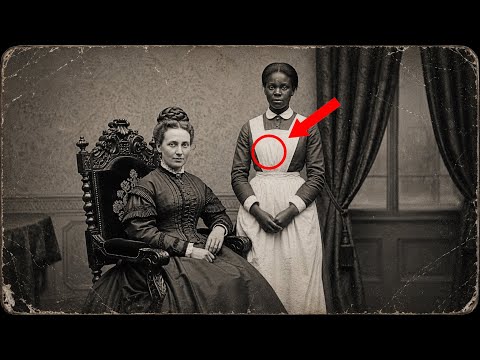
The afternoon sun slanted through the tall windows of the Virginia Historical Textile Archive, casting long shadows across Dr. Naomi Carter’s workstation. It was a Tuesday in October 2024, and she was halfway through digitizing a collection of 19th-century clothing and photographs from a Richmond estate. Most items were predictable—elaborate ball gowns, men’s formalwear, children’s christening outfits. But Naomi, a textile historian with twenty years of experience, treated each piece with quiet reverence.
She reached for the next item in the archival box: a large photograph in a gilded frame, its glass surprisingly intact. The image showed two women in a photographer’s studio. A white woman, perhaps in her early forties, sat regally in an ornate velvet chair, wearing an expensive silk gown with elaborate pleating and lace trim. Her dark hair was swept up in the fashion of the late 1870s, and her expression was composed, almost stern. Standing slightly behind and to her right was a young Black woman, maybe twenty years old, dressed in a simple but well-made servant’s uniform—a dark dress with a white apron and collar.
Naomi turned the photograph over. On the back, in faded ink: “Mrs. Elizabeth Hartwell and Household Servant, Richmond, Virginia, April 1878.”
She set the frame carefully on her workstation and studied the image more closely. The composition was typical for the era—wealthy families often included domestic servants in formal portraits as a display of status. What was less typical was the quality of the photograph itself. The clarity was exceptional, the lighting perfectly balanced, suggesting a skilled and expensive photographer. But something about the image nagged at her.
Naomi reached for her high-resolution digital camera and began photographing the portrait in sections, capturing every detail for closer analysis. When she transferred the images and zoomed in on her monitor, her breath caught.
The servant’s uniform, which had appeared simply white in the original viewing, was actually covered in intricate embroidery. The collar and apron weren’t plain cotton—they were decorated with elaborate needlework in white thread on white fabric. Nearly invisible to the casual observer, but unmistakably present under magnification.
Naomi leaned closer to the screen, her pulse quickening. The embroidery wasn’t merely decorative. The patterns were too precise, too geometric, too deliberately arranged. Along the collar’s edge ran a series of small symbols—stars, diamonds, crosses, and circles—each carefully stitched in a specific sequence. The apron featured similar patterns with additional elements that looked almost like simplified maps: lines intersecting at angles, small X marks at specific points, and what appeared to be directional indicators.
She’d seen coded needlework before. During the Civil War, some women had embroidered military intelligence into quilts and handkerchiefs. But this photograph was from 1878—thirteen years after the war’s end. Why would someone encode information into a servant’s uniform, and why document it so carefully in an expensive photograph?
Naomi spent the next three days consumed by the photograph. She created detailed sketches of each visible symbol, measured angles, counted stitches, and documented every pattern. She cross-referenced the image with databases of Victorian embroidery, military codes, and period symbolism. Nothing matched. The patterns were unique—or at least unknown to modern scholarship.
On Thursday morning, she decided to consult Dr. Marcus Webb, a colleague who specialized in African-American history and coded communication during the slavery and Reconstruction eras. She found him in his cluttered office on the museum’s third floor, surrounded by stacks of books and archival boxes.
“Marcus, I need you to look at something,” she said, placing her laptop on his desk and opening the high-resolution scan. “Tell me what you see.”
He leaned forward, studying the image carefully. His expression shifted from casual interest to intense focus. After a long moment, he sat back in his chair, removing his glasses. “Where did you find this?”
“In the estate collection. It came with other items. Nothing particularly remarkable. But look at the embroidery on the servant’s uniform. Every pattern is deliberate, Marcus. This is coded.”
Marcus stood and moved closer to the screen, zooming in on the collar, then the apron. His jaw tightened. “Naomi, I’ve seen references to something like this before. Not exactly this, but similar. There were stories—oral histories passed down in some African-American families—about domestic workers who used needlework to encode information. Ways to communicate without words, to identify safe houses, to warn of danger. Most historians dismissed them as folklore because there was never any physical evidence.”
Naomi’s heart raced. “But this is evidence.”
“This might be evidence,” Marcus corrected carefully. “We need to be certain before we make any claims. But if this is what I think it is, you found something that could change how we understand post-war resistance networks.”
He pulled a book from his shelf—a collection of oral histories from formerly enslaved people compiled in the 1930s. One passage, highlighted in yellow, described special sewing used by domestic workers to carry messages between households. “The descriptions are vague,” Marcus said. “But they mention white thread on white fabric. Patterns that looked decorative but held meaning. Look at the servant’s collar in your photo. Those symbols aren’t random decoration.”
Naomi looked again at the careful arrangement of stars, crosses, diamonds, and circles. Her skin prickled with excitement. “We need to find out who these women were.”
Marcus nodded slowly, still studying the image. “And we need to understand what message they were preserving. Because if someone went to this much trouble to document coded needlework in a professional photograph, it wasn’t just about pretty embroidery. They were creating a permanent record of something important.”
The back of the photograph’s mounting board provided their first real lead. In faded pencil, someone had written: “Mrs. Elizabeth Hartwell and household servant, Richmond, Virginia, April 1878.” No first name for the servant, no street address—but it was enough to begin their search.
Naomi and Marcus spent the following week immersed in Richmond’s historical records. They started with Elizabeth Hartwell, since they at least had her name. Richmond’s Historical Society had extensive records from the post–Civil War period, and Naomi found her quickly in census data and property records.
Elizabeth Hartwell had been born Elizabeth Morrison in 1836 to a prominent Richmond merchant family. She married Charles Hartwell, a successful textile importer, in 1856. The couple had two daughters, both of whom died in a diphtheria outbreak in 1869. Charles himself had died in 1875, leaving Elizabeth a childless widow at thirty-nine.
On the surface, it was a tragic but unremarkable story for the time. But as Naomi dug deeper, she found peculiarities. Elizabeth’s household expenses, recorded in ledgers held by the Historical Society, showed unusual patterns. Large sums were spent on household supplies and charitable contributions with remarkable frequency—amounts that seemed excessive even for a wealthy widow maintaining a social position.
More intriguingly, Elizabeth’s name appeared in connection with several progressive causes. She had donated to schools for Black children, supported a women’s literacy program, and was listed as a patron of the First African Baptist Church—unusual for a white woman of her social standing in 1870s Richmond.
Marcus, meanwhile, was trying to identify the servant in the photograph. Without a name, the task was significantly harder. He started by examining Elizabeth Hartwell’s household records, looking for any Black women employed between 1876 and 1880.
He found several names, but one appeared with unusual frequency in the expense ledgers: a woman listed simply as Clara. Unlike other servants who appeared for a few months or a year before their names disappeared from the records, Clara’s name appeared consistently from 1876 through 1882. She was paid more than typical domestic servants—not dramatically more, but noticeably more. And there were occasional additional payments noted as travel expenses and special services.
“A long-term, well-paid servant who traveled,” Marcus said, reviewing his notes with Naomi. “That suggests Elizabeth trusted her implicitly. In the context of the photograph, it suggests something more—a partnership.”
They found Clara’s name in one more place: the membership rolls of the First African Baptist Church. Listed in 1877 was Clara Washington, domestic servant, residing at the Hartwell residence.
“Clara Washington,” Naomi said softly, looking again at the young woman’s face in the photograph. “Now we have a name.”
With both names, they could search more effectively. Marcus contacted descendants of families who had attended First African Baptist Church in the 1870s. One woman, Mrs. Eleanor Patterson, responded immediately.
“I know that name,” she wrote. “Clara Washington. My great-great-grandmother mentioned her in family stories. She called her the seamstress who sewed freedom.”
Mrs. Patterson invited them to her home in Richmond’s Church Hill neighborhood. She was ninety-two years old, sharp-minded, and keeper of her family’s history. Her small house was filled with photographs, documents, and carefully preserved artifacts spanning generations. She served them sweet tea and settled into her favorite chair surrounded by the history of her family.
“My great-great-grandmother, Viola, was born in 1870,” Eleanor began. “She was too young to remember the Civil War, but she remembered the hard years that followed. She told stories about women in the community who did dangerous work—to help people escape violence, find safer places to live, or reunite with family members who had been separated during slavery.”
“Did she mention Clara Washington specifically?” Marcus asked gently.
“She did. She said Clara worked for a white woman who was good people. That was how she phrased it. Viola said Clara could put messages in needlework that only certain people could read. She said Clara traveled all over Virginia and into North Carolina, supposedly as a lady’s companion, but really she was carrying information and coordinating safe houses.”
Eleanor stood slowly and retrieved a small wooden box from a cabinet. Inside was a handkerchief, yellowed with age but still intact. “Viola kept this. She said Clara had given it to her mother during a difficult time. Look at the corners.”
Naomi examined the handkerchief carefully. In each corner, embroidered in white thread, were small symbols: a star, a cross, a diamond, and a circle. The same symbols that appeared on Clara’s collar in the photograph.
“This is extraordinary,” Naomi breathed. “This is physical evidence of the coding system. We can study the stitching techniques, compare the patterns, potentially decode the messages.”
“There’s more,” Eleanor said. She pulled out a small leather journal, its pages brittle with age. “This belonged to Viola’s mother, Sarah. She wasn’t fully literate—many entries are just drawings and simple words—but she kept records. Look at the entries from 1878.”
Marcus carefully turned the pages. In April 1878—the same month the photograph had been taken—there was a series of entries showing small sketched symbols, some matching those on the handkerchief and in the photograph. Beside the symbols were brief notes: “Mrs. H house safe. Clara says road clear north. Meeting at church tomorrow.”
“This is a log,” Marcus said, his voice filled with awe. “Sarah was documenting messages she received through Clara’s needlework. She was part of the network.”
Eleanor nodded. “Viola said her mother helped at least a dozen families escape violence in the late 1870s and early 1880s. She said they used the seamstresses’ language to coordinate everything, and nobody outside the community ever understood what they were doing.”
Naomi looked at the photograph on her tablet, seeing it now with complete clarity. Clara Washington wasn’t just wearing a uniform—she was wearing a communication device, all hidden in plain sight as ordinary servants’ clothing. And Elizabeth Hartwell had helped her create it, fund it, and document it for posterity.
Naomi and Marcus assembled a small team of experts to decode the embroidery on Clara’s uniform. Dr. Helen Chu, a textile expert, confirmed the whitework was a deliberate hiding technique. Cryptographer David Armstrong identified 37 unique symbols—a substitution cipher combined with positional encoding. “A star on the collar means something different than a star on the apron,” he explained.
When Marcus overlaid known safe-house locations onto Clara’s apron pattern, the correlation was unmistakable. “There are at least twenty different sites on this piece of embroidery,” Naomi said. “Clara was walking around with a comprehensive map of the entire Richmond network.”
Descendant Joyce Bennett later shared Clara’s teaching manual, which documented the entire philosophy of “freedom’s art.” In February 2025, the team held a press conference in Elizabeth’s former home, now a community center. Joyce held up her own needlework. “Clara wanted us to know we were never helpless,” she said. “We were always fighting, always finding ways to protect each other.”
The thread continued, unbroken—from past to present to future. But how many other ordinary photographs are sitting in archives right now, waiting for someone to look closely enough?
Report this article
Select a reason for reporting:






