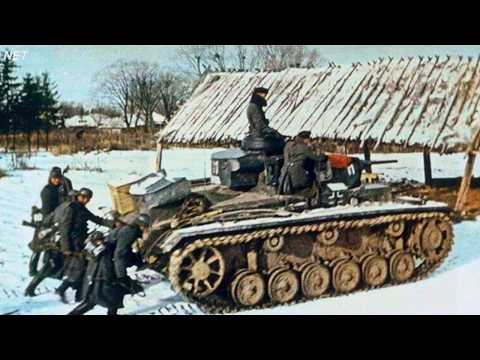
The silence before dawn on September 30, 1941, was shattered by the roar of engines. German panzers, gleaming in the early light, surged forward along the Smolensk highway. Their objective: Moscow. Their expectation: victory within weeks. But they were about to collide with a resistance that would rewrite the rules of war.
This is the story of Operation Typhoon—the final, desperate gamble to crush the Soviet capital and end the war in the East. It is a tale of unimaginable scale, of 1.8 million men hurling themselves against a city that refused to fall.
For the German high command, the plan seemed flawless. Three massive panzer groups would slice through Soviet defenses, encircle the capital from north and south, and strangle it into submission. The numbers were staggering: 14,000 guns, 1,320 aircraft, and nearly 2,000 tanks. Against them stood 1.25 million Red Army soldiers, outnumbered and outgunned, but not outmatched in spirit.
“The enemy’s resistance near Smolensk had been underestimated,” a German commander later admitted. Those words would haunt the Wehrmacht as the autumn rains turned roads into rivers of mud, and the first frosts hardened the ground—but also the resolve of Moscow’s defenders.
The Soviet leadership, caught off guard by the sheer scale of the offensive, scrambled to respond. General Zhukov, summoned from the besieged city of Leningrad, arrived to find the Western Front in chaos. “The defensive line had virtually disappeared,” he recalled. “All roads to Moscow were essentially open.”
But Moscow was not defenseless. In a race against time, Zhukov ordered the construction of three lines of fortifications, using anti-tank ditches, mines, and every available tank—even obsolete models dug into the ground as fixed gun emplacements. The Mozhaisk Line, just 120 kilometers from the city, became the last barrier.
Here, on the same fields where Napoleon’s Grande Armée had met its doom in 1812, history prepared to repeat itself. Siberian divisions, fresh from the Far East, arrived to reinforce the line. Among them was the 32nd Rifle Division, which clashed with the elite SS Das Reich Division in a brutal struggle for the Borodino heights.
“The regiments measured their strength against the Siberians,” wrote SS General Paul Hausser. “They fought steadfastly and never panicked. They did not give up a single inch of ground without a savage fight.”
The fighting was ferocious. German tanks, attempting to flank Soviet positions, were met by devastating fire from 85mm anti-aircraft guns, repositioned from Moscow’s air defense to the front lines. “The last battles for the Russian positions were the most violent of the entire campaign,” a German corps report noted.
But the Germans pressed on. By mid-November, with the ground frozen hard, they resumed their assault. Panzer groups advanced through Volokolamsk and Klin, threatening to outflank the Soviet defenders. On November 24, they captured Klin and Solnechnogorsk, just 50 kilometers from Moscow.
The situation grew more desperate by the hour. General Rokossovsky’s 16th Army, defending the Istra line, faced imminent encirclement. A withdrawal order came from the General Staff, but Marshal Zhukov, commanding the Western Front, countermanded it immediately. “Hold your positions at any cost,” he ordered. The dispute was settled not by headquarters, but by the Germans, who seized Klin and Solnechnogorsk on November 24, forcing Rokossovsky’s men to abandon the reservoir line anyway.
This was a tactical triumph for the Wehrmacht. The capture of Solnechnogorsk opened a northern corridor for panzer and infantry divisions. To strike directly at Moscow, they pushed forward through the frozen suburbs, the spires of the Kremlin now visible through binoculars.
On November 30, motorcycle troops from an engineer battalion reached Khimki—just eight kilometers from the city limits. To the north, Reinhardt’s 3rd Panzer Group seized the Moscow-Volga Canal, and elements of its right flank captured Krasnaya Polyana, a mere 30 kilometers from the city center. “We could see Moscow through our binoculars,” one German officer wrote. “It was so close we could almost touch it.”
But the offensive had reached its breaking point. In the south, Guderian’s forces bypassed Tula and took Venev, advancing to the outskirts of Kashira. There, they stopped. The ground offensive had exhausted itself. The German divisions were spent—their tanks frozen, their infantry exhausted, their supply lines stretched to the breaking point.
Now the stage was set for a counterstroke. Fresh Soviet reserve armies began deploying to the front lines. The Red Army had been preparing its own surprise.
Local counterattacks began as early as November 27 near Kashira, and on November 29 north of Moscow, striking the German southern and northern groupings respectively. These were probing blows, testing the enemy’s strength. Then, on December 5, three Soviet fronts launched a massive, coordinated counteroffensive.
The timing was perfect. The German troops, unprepared for winter warfare, were caught in temperatures that plunged to minus forty degrees. Their weapons froze, their vehicles seized up, and their soldiers—still wearing summer uniforms in many cases—suffered frostbite and hypothermia. “The days of waiting are over,” the order had read just weeks before. Now, those days were replaced by a nightmare of retreat.
The Red Army drove the Wehrmacht back 100 to 350 kilometers from the Soviet capital. Three days after the counteroffensive began, Hitler signed Directive No. 39, ordering the entire Eastern Front to transition to defensive operations. For the first time since the war began, the German army was on the back foot.
General Günther Blumentritt, chief of staff of the German 4th Army, later acknowledged the truth that many in the high command refused to see. “This was the turning point in our Eastern campaign,” he confessed. “Our hopes of knocking Russia out of the war in 1941 collapsed at the last moment.”
What Blumentritt omitted was perhaps more telling. At Moscow, the Wehrmacht had encountered something entirely new: Soviet tactical innovation. The Red Army had not only mastered defensive operations—it had learned to strike precisely at unprepared enemy positions, using mobile gun tactics and anti-tank ambushes that baffled German commanders.
In the snows outside Moscow, the myth of German invincibility died. And the road to Berlin, though long and bloody, had finally come into view.
The counteroffensive did not end with the pushback from Moscow’s gates. As December unfolded, the Red Army pressed its advantage along the entire front, and the German retreat became a desperate, freezing ordeal. Whole divisions that had marched toward the Kremlin in autumn now staggered westward through blizzards, abandoning tanks, artillery, and wounded men in the snow.
“The Russians are not human beings,” a shaken German infantryman wrote home. “They come out of the snow like ghosts, and they do not stop.” The phrase would echo through the ranks of a Wehrmacht that had never expected to fight a winter war.
Yet the Soviet triumph was not merely a matter of weather or numbers. It was the product of something the German high command had fatally underestimated: the Red Army’s capacity to learn. The men who had been encircled at Vyazma and Bryansk in October were not the same men who counterattacked in December.
Colonel Katukov, whose armored brigade had bloodied Guderian’s spearhead at Mtsensk, now commanded a tank corps that spearheaded the southern counterstroke. His tactics—ambush, mobility, and the ruthless exploitation of German overextension—had been studied, refined, and distributed across the front.
At the same time, the newly formed Kalinin Front under General Konev pressed relentlessly against the German 9th Army. Konev’s night operations, with their fake radio traffic and simulated attack preparations, had pinned down German reserves at a critical moment. Now those same tricks were turned toward the offensive, keeping the enemy off balance as Soviet ski troops bypassed strongpoints and struck supply columns deep in the rear.
But the Germans did not collapse entirely. Hitler, enraged by the retreat, issued his infamous “stand fast” order, forbidding any withdrawal without his personal approval. Units that obeyed were often encircled and destroyed; units that disobeyed survived, but their commanders faced courts-martial. The result was a patchwork defense—some sectors holding stubbornly, others dissolving into chaos.
By mid-December, the front had stabilized in places, but the damage to German confidence was irreparable. Army Group Center’s war diary recorded a grim litany of losses: thousands of vehicles abandoned, entire regiments reduced to a few hundred men, and temperatures that made every movement a struggle for survival.
In Moscow, the mood was transformed. The city that had prepared for street fighting now celebrated a victory that few had dared to imagine. Stalin, who had remained in the capital when others fled, ordered the liberation of Kalinin and the push toward Rzhev. The Red Army was not merely surviving—it was advancing.
Yet the winter offensive also revealed the limits of Soviet power. Supply lines stretched thin, and the newly raised divisions were often poorly trained. Attempts to encircle and destroy Army Group Center outright failed, and the Germans, despite their losses, managed to hold a ragged line that would become the front for the next year.
Still, the strategic picture had changed forever. The Blitzkrieg that had conquered Europe in weeks had been stopped by a nation that refused to break. “We had no idea that the Russians had such reserves,” a captured German officer confessed during interrogation. “We were told the war was almost over.”
Those words, repeated in a thousand variations across the frozen front, marked the true end of the myth of invincibility. The road to Berlin would be long—four more years of bloodshed, of Stalingrad and Kursk, of suffering on a scale the world had never seen. But the first step on that road had been taken in the snows outside Moscow.
The victory at Moscow did not end the war, but it changed its soul. The Red Army had learned that the German war machine could be stopped, and more importantly, that it could be made to bleed. From the frozen suburbs of Khimki to the historical fields of Borodino, the Wehrmacht had met a force that refused to yield.
In the months that followed, the lessons of December would echo across the Eastern Front. The mobile ambushes of Katukov, the night deceptions of Konev, and the stubborn defense of Zhukov became the blueprint for survival—and for counterattack. Soviet commanders who had once been caught flat-footed now read German intentions with growing precision.
The German high command, meanwhile, faced a new reality. The blitzkrieg was dead. The war in the East would no longer be a matter of weeks or months, but of years. And in the snows of Moscow, the first crack had appeared in the armor of invincibility.
For the soldiers who fought there, the memories would never fade. The frozen fields, the burning tanks, the desperate charges—all of it etched into the collective memory of a nation that had stared into the abyss and refused to blink. “Moscow was not just a city,” Zhukov later wrote. “It was the heart of Russia. And we had saved it.”
Yet the cost was staggering. Millions of men had been killed, wounded, or captured. Cities lay in ruins, and the land was scarred by war. The victory at Moscow was a triumph of will, but it was also a warning of the horrors yet to come.
The road to Berlin would pass through Stalingrad and Kursk, through rivers of blood and mountains of rubble. But the first step had been taken. The myth of the invincible Wehrmacht had been broken, and the Red Army had proven that it could do more than defend—it could attack, and it could win.
What do you think—was Moscow the true turning point of World War II, or merely the first of many bloody battles to come? Share your thoughts in the comments below.
Report this article
Select a reason for reporting:






