The morning of October 25, 1854, dawned clear over the Crimean Peninsula. In the valley below, 666 cavalrymen of the British Light Brigade sat mounted, their sabers sheathed, their horses restless. They had no idea that within hours, a catastrophic miscommunication would send them charging straight into the mouths of Russian cannons—a doomed assault that would echo through history as the Charge of the Light Brigade.
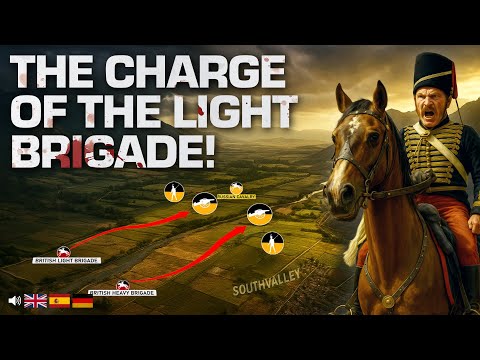
Bugles blared. The order was given. “The brigade will advance,” shouted Lord Cardigan, and the horsemen surged forward into the Valley of Death.
But how did it come to this? Eight months earlier, Britain had issued an ultimatum to Tsar Nicholas I, whose troops had crossed the Danube into Turkey. When the Tsar ignored it, London declared war. The Crimean War had begun.
By September 1854, a combined Allied army of 64,000 men had landed on the Crimean Peninsula, aiming to seize Sevastopol and destroy the Russian Black Sea Fleet. Among them was the Light Brigade—five cavalry regiments of working-class lads in their mid-twenties, led by wealthy officers who had purchased their commissions.
At the head of this brigade were two men who despised each other: Major General James Brudenell, 7th Earl of Cardigan, and Lieutenant General George Bingham, 3rd Earl of Lucan. Brothers-in-law, their mutual hatred was so deep that the Duke of Wellington, attempting to mediate, gave up, declaring that his victory at Waterloo was easier than any reconciliation between these feuding earls.
Their animosity would have deadly consequences. From their arrival in the east, Lord Raglan, the British commander, micromanaged both Lucan and Cardigan, holding them back at critical moments. The cavalry got lost, were laughed at by their own infantry, and earned the nickname “the Look-Ons” for their inactivity.
Now, on October 25, the Russian army under Prince Menshikov had advanced to threaten the Allied supply port of Balaclava. The Russians stormed the Causeway Heights, forcing Turkish defenders from their redoubts. The situation was critical.
Sir Colin Campbell’s 93rd Highlanders made a legendary stand—the “Thin Red Line”—repulsing a Russian cavalry charge. Then, the Heavy Brigade under General Scarlett charged uphill into a mass of Russian horsemen three times their number and miraculously drove them back.
All the while, just 500 yards away, the Light Brigade watched. Captain Morris of the 17th Lancers rode to Cardigan and asked, “My lord, are we not going to charge the flying enemy?” Cardigan replied, “No, we have orders to remain here.” That inactivity allowed the Russian cavalry to reform at the far end of the North Valley, behind eight guns, with more guns and infantry on the heights to either side.
By 10:30 a.m., Lord Raglan was impatient. He saw movement at a redoubt and believed the Russians were dragging away captured guns. He dictated a fateful order: “Lord Raglan wishes the cavalry to advance rapidly to the front, follow the enemy, and try to prevent the enemy carrying away the guns.”
Captain Nolan, one of the army’s most accomplished riders, was sent to deliver the message. When he reached Lucan, the exchange was infamous. Lucan, unable to see any guns from his position, questioned the order: “Attack, sir. Attack what? What guns, sir?” With visible contempt, Nolan replied, “There, my lord, there is your enemy. There are your guns.” He seemed to point straight down the North Valley—not at the Causeway Heights.
Lucan assumed Nolan meant the guns at the far end of the valley. He ordered Cardigan to attack. When Cardigan pointed out the peril of batteries to front and flank, Lucan replied, “I cannot help that. It is Lord Raglan’s positive order that the Light Brigade is to attack the enemy.”
And so, at 11:11 a.m., the Light Brigade moved forward. “Draw swords,” Cardigan ordered. Over 500 sabers flashed in the sun. Then: “The brigade will advance.”
At regulation pace, knee to knee, they would take about seven minutes to close with the enemy a mile and a quarter away. But the Russian guns on the Fedioukine Heights thundered out. Captain Nolan, riding across the face of the advance, was struck by shrapnel and killed instantly—the first to fall.
As the brigade pushed on at the trot, cannon fire increased from right to left. Private Albert Mitchell described the advance: “Oaths might be heard between the reports of the guns and the bursting shells as the men crowded and jostled each other to close up.” Shells burst in the ranks, bringing down three or four men and horses at a time.
The Light Brigade continued ever forward, deeper into the North Valley. Under fire from both sides, their ranks endured shot and shell. Officers saw troopers lose limbs to round shot; men were splattered by the gore of their friends. Behind them, Lord Lucan and the Heavy Brigade started forward in support, but Lucan soon had a change of heart. “They’ve sacrificed the Light Brigade,” he remarked. “They shall not have the Heavy if I can help it.” He turned the Heavies back.
Ahead, the situation grew desperate as Russian marksmen opened fire from both flanks. When the first line was 250 yards from the guns, Cardigan ordered the gallop. Spurs were pressed home, and the survivors surged toward the guns. At 100 yards, the Russian gunners loaded with canister—hundreds of lead balls in a deadly spray. Each discharge left heaps of broken horses and men.
Seconds later, Cardigan called for the charge. Lances and sabers were brought down. Lieutenant Gordon of the 17th Lancers recalled: “We, like bulldogs who had been tied up all day, were too glad to be let loose, and off we went at a thundering gallop.”
The first line charged into a thick bank of smoke. Within seconds, survivors were slashing down at Russian gunners, thrusting lance points through torsos, wreaking a mad vengeance. Of the first line—the 17th Lancers and 13th Light Dragoons—less than half reached the guns. Most joined the melee at the gun line; others continued through 80 yards of smoke to encounter a large mass of waiting Russian cavalry.
Lord Cardigan, seeing the overwhelming mass, seems to have wheeled about and beat a swift solo retreat back across the valley. Command fell to Lieutenant Colonel Mayow, who rallied 27 men and gallantly charged a far greater group of opponents, scattering them 500 yards back to the Chernaya River. Captain Morris of the 17th Lancers led 20 men against a complete regiment of Russian Hussars, who also fled—but once they realized how few men Morris had, they encircled the Lancers and cut them down.
The 11th Hussars thundered through the smoke and found their route blocked by the same Russian Hussars. Colonel Douglas led the 80 survivors straight at them, sending them fleeing back over the Chernaya River. The second line—the 4th Light Dragoons and 8th Hussars—now joined the fray. The 4th fared better, with one captain unhorsing up to six Cossacks. It was in this desperate fighting that several men selflessly went to the aid of wounded comrades, earning the newly created Victoria Cross.
Despite shock successes, the tide turned. Isolated and too few to hold the position, the remnants of the Light Brigade turned for home, running the gauntlet once more. But the Russians had pushed Uhlan Lancers round to cut off the retreat. A Russian officer, Lieutenant Kazukov, described what happened next: “There was only one way out of the valley for the English. They had no choice but to surrender. We watched for them to lay down their sabers and lances, but that’s not what happened. The English chose to do what we had not considered because no one imagined it possible. They chose to charge our cavalry once again, this time heading back along the same ground.”
Small, tired, bloodied groups of the Light Brigade literally fought their way to safety through Russian cavalry and the unrelenting guns on both flanks. By midday, those who could had returned to the far end of the North Valley to the cheers of their comrades. But the toll was enormous: of the 666 men who began the advance, 271 became casualties, with 110 killed or dying of wounds. Their mounts fared no better—332 fell during the charge, and 43 more were later shot for wounds.
The Light Brigade was effectively broken. After reading William Russell’s account in The Times just 20 days later, Alfred Lord Tennyson put pen to paper with his poem, “The Charge of the Light Brigade.” Its final words sum up the courage and tragedy: “Cannon to the right of them, cannon to the left of them, cannon behind them, volleyed and thundered… Honor the charge they made. Honor the Light Brigade, noble six hundred.”
Powerful and poignant though Tennyson’s words are, perhaps a more accurate observation came from French General Pierre Bosquet as he watched from the Sapoun Heights: “Magnificent, but it isn’t war, it’s madness.”
But the story of the Light Brigade was far from over. The survivors would face the brutal Russian winter, and the charge itself would become a legend—a symbol of courage, sacrifice, and the tragic cost of blundering orders.
In the weeks that followed, the survivors of the Light Brigade huddled in freezing encampments as winter descended on the Crimea. Disease and starvation claimed more lives than Russian sabers ever had. By the time spring arrived, the brigade that had charged into legend existed in name only.
Lord Cardigan, who had retreated alone from the guns, returned to England aboard his private yacht before the campaign even ended. He was greeted as a hero, feted at banquets, and never faced a court-martial. Lord Lucan, blamed by many for the disaster, spent years defending his conduct in a bitter public feud with Raglan, who died of dysentery before the war ended.
The blunder that sent 666 men into the jaws of death was never fully resolved. Was it Nolan’s ambiguous gesture? Raglan’s vague order? Lucan’s stubborn refusal to question it? History would argue for generations, but the men who rode that day cared little for such debates.
What endured was not the failure of command but the astonishing courage of the ordinary soldier. Farm laborers and grooms, they had obeyed without hesitation, charging guns on three sides because orders were orders and honor demanded nothing less.
Today, the Valley of Death is a quiet vineyard. Visitors walk among the vines where 110 men fell, and the wind still whispers through the grass. Tennyson’s words remain carved in memory—a warning and a tribute to the noble six hundred.
What do you think history should remember most about the Charge of the Light Brigade—the blunder or the bravery?
Report this article
Select a reason for reporting:






