October 1945. The Atlantic Ocean was a black, freezing void. Twenty-two-year-old Greta Weber sank beneath the waves, her lungs burning, her heavy uniform dragging her down. “I can’t breathe,” she screamed before the water swallowed her again. She was a German prisoner of war, an enemy. The Americans on the ship above could have watched her drown. She had been told they were savages. But then something impossible happened.
A soldier jumped in after her. Not to finish her—to save her. An American risked his own life in the freezing water to rescue a Nazi prisoner. And that was just the beginning. What happened next on American soil would shatter everything she thought she knew about enemies, about her country, and about the war itself.
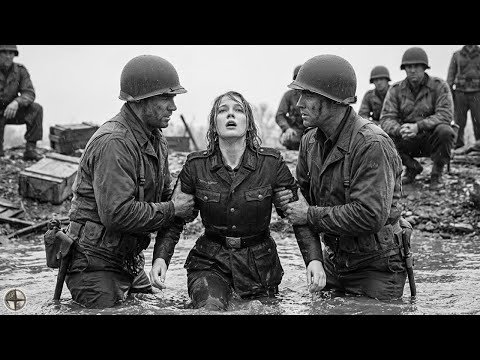
Below deck, in a cargo hold turned floating prison, 200 German women waited in fear. They were not soldiers who had fired guns, but radio operators, clerks, and secretaries—the invisible workers who had kept the war running from behind desks. Greta sat on a metal bunk, her blonde hair pulled back tight, her eyes older than her years. For three years, she had served as a radio operator for the Luftwaffe, believing in her country with all her heart. Now that country lay in ruins, and she was crossing an ocean to face judgment from strangers.
The hold smelled of vomit, sweat, and fear. “What do you think they will do to us?” asked Hannah, a young woman from Hamburg, her knees pulled to her chest. Greta did not answer right away. They had all heard the stories. Nazi propaganda had painted Americans as brutal savages. But so far, nothing matched the warnings. The American guards brought bread and thin soup. They counted heads and left. Their faces showed neither kindness nor hatred—just the blank look of men doing a job.
On the fifth day, nausea drove Greta to the deck. The wind hit her face like a slap, but it was clean and fresh. She gripped the cold metal railing and stared at the endless ocean. For a moment, she forgot she was a prisoner. Then the wave came. A rogue swell tilted the ship sharply. Her feet slipped on the wet metal. She grabbed for the rail, but her fingers caught only air. Time slowed as she fell, the dark water rushing up to meet her.
The cold hit like a physical blow. The Atlantic in October averages 45 degrees—cold enough to kill in fifteen minutes. Her uniform dragged her down like an anchor. She kicked and thrashed, her head breaking the surface. “Help!” she screamed, but the wind swallowed her voice. The ship was already moving past her, its massive hull sliding away. She went under again, her wool skirt tangling around her legs. I can’t breathe. The words came out as a sob. Water filled her mouth. Her arms grew weak. She could see the ship’s stern getting smaller. They are not stopping, she thought. Why would they? I am just a prisoner, just another enemy. Then came the whistle—sharp and piercing. The ship’s engines changed sound. They were stopping for her.
A life preserver splashed ten feet away, but her arms would not obey. She went under again, deeper this time. The water was quieter below the surface, peaceful almost. It would be easy to let go. But something grabbed her jacket and yanked her upward. She broke the surface, retching and coughing. Arms wrapped around her from behind, holding her head above water. A voice spoke close to her ear—English words she did not understand, but the tone was calm, steady, almost gentle. An American soldier had jumped into the freezing Atlantic to save her.
He was risking death to keep her alive. Later, survivors of cold-water immersion would report that rescuers often had only minutes before their own muscles failed. This man knew the danger. He jumped anyway. “Got her!” he shouted to the ship above. Ropes fell. Other soldiers climbed down. Hands lifted Greta from the water. They hauled her onto the deck, wrapped her in a blanket, and carried her to the medical bay. Through it all, one thought repeated in her frozen mind: They saved me. The enemy jumped into freezing water and saved me.
Nothing made sense anymore, but everything was about to change even more. They carried Greta to the medical bay instead of returning her to the cargo hold. The room was small but clean. They laid her on a cot and removed her wet clothes with professional care, covering her with warm, dry blankets. Someone pressed a metal cup of hot tea into her shaking hands. The liquid was sweet and scalding. It was the most wonderful thing she had ever tasted. The medic stayed with her all night, checking her breathing, monitoring her temperature. He smiled at her—not with mockery, but with genuine concern.
Six days later, the ship reached New York Harbor. The women were brought on deck to see the approach. The skyline rose before them, untouched by bombs, shining in the morning sun. Buildings taller than anything they had ever imagined stretched toward the clouds. The Statue of Liberty passed on their right, green and massive, holding her torch high. This was not a defeated nation. This was something else entirely. Buses took them to trains. Trains took them south. Two days of travel through a country that seemed impossibly rich. The roads were smooth and paved. Houses stood whole and neat with green lawns and cars in driveways. Children played in yards. Everything was so normal, so untouched by war. Greta thought of her hometown in Bavaria—the rubble, the ruins, the hollow-eyed survivors picking through debris. The contrast made her stomach hurt.
Camp Livingston in Louisiana was their final destination. It looked like a small city. Rows of wooden barracks stretched into the distance. Guard towers stood at the corners, but they seemed almost decorative. The processing was efficient. Then came the showers—clean and private, with hot water that actually ran hot. They were given soap that smelled like flowers and towels that were soft and fresh. After showers came clean clothes, simple gray dresses that fit reasonably well. Greta touched the fabric in disbelief. These were not rags. These were decent clothes.
The final shock came at dinner. They were led to a mess hall, a long wooden building with rows of tables and benches. The smell hit them first—bread baking, meat cooking, coffee brewing. Real food smells, not the thin soup and sawdust bread they had known for years. Greta watched in disbelief as her tray was loaded. Mashed potatoes, white and buttery. Green beans, actually green. Slices of real meat, thick and covered with gravy. A soft, warm roll, a cup of milk, a piece of pie. According to camp records, German prisoners at American facilities received approximately 3,300 calories per day—the same ration as American soldiers. In Germany, at that same time, civilians survived on less than 1,000 calories daily.
Greta carried her tray to a table and sat down. Around her, other women were equally stunned. Some began eating immediately, tears running down their faces. Others hesitated, suspicion fighting with hunger. Hannah sat across from Greta, her eyes wide. “Is this real?” the girl whispered. Greta picked up her fork and took a bite of potato. It was hot, creamy, perfectly salted. She closed her eyes as tears leaked from the corners. “It’s real,” she said quietly. “God help us. It’s real.”
That first meal was eaten in near silence. Only the sounds of chewing and occasional sobs broke the quiet. Guards walked slowly up and down the aisles, watching but not threatening. One paused near Greta’s table and spoke to a translator. “He says to take your time,” the translator reported. “There is plenty more if you want seconds.” Seconds? The word seemed absurd. In Germany, there were no seconds. There was barely firsts.
Days became weeks. The routine of camp life settled into place with surprising ease. Wake at six, wash in clean facilities, eat breakfast—eggs, bread, real coffee. Then came work assignments: kitchen duty, laundry, grounds maintenance, work in nearby fields. The hours were long but not brutal, and they were paid for their labor in camp money that could be spent at the canteen. The canteen sold chocolate bars, cigarettes, soap, pencils, writing paper—even lipstick and rouge. The prices were low. Greta bought a Hershey’s chocolate bar wrapped in brown paper. She held it in her hands for a long time before unwrapping it. The sweetness exploded on her tongue, almost painful in its intensity. But even as she savored each bite, something dark was growing inside her chest: guilt, heavy and cold. What right did she have to chocolate when children in Germany were starving? This question was about to become much harder to ignore, because letters from home were coming—and they would carry words that turned every meal into torture.
The letters arrived in December, just before Christmas. Greta received three from her mother, written over three months. Each page grew more desperate. “We eat potato peels boiled in water when we are lucky,” her mother wrote. “Most days we are not lucky.” The final letter was barely legible: “We are dying here slowly. I dream of food every night. Please come home if you can.” Greta sat frozen, the paper crumpled in her grip. Around her, other women wept over their own letters. The barracks filled with the sound of grief.
That night, Greta could not eat. She stared at her tray—pot roast, mashed potatoes, bread with butter, a piece of cake—and her stomach twisted. How could she eat this when her mother was starving? Hannah found her later in the dark barracks. “I hate them,” Greta whispered. “I hate the Americans for being so rich, for feeding us better than our own country ever did. I hate them for making me see them as human.” Hannah asked gently, “Or do you hate that they have shown you the truth?” Greta closed her eyes. “Maybe both.”
The guilt spread through the camp like a disease. Some women stopped eating; others ate compulsively. Most simply carried the impossible burden of being well-fed prisoners while their homelands died. The Americans seemed unaware. Guards continued with professional detachment—some friendly, some quiet. One afternoon, an older sergeant offered Greta a cigarette. They stood in silence, watching clouds. “You okay?” he asked. “Letters from home?” She nodded. “I’m sorry,” he said simply. “War is hell for everybody. But it’s over now. Things will get better.” His kindness made it worse. She wanted to hate him, but he was just a tired man offering comfort.
In February 1946, the Americans gathered all prisoners in the mess hall. A film projector sat ready. “What you are about to see is difficult, but it is necessary,” the camp commander said. “It is the truth.” The lights went out. The film showed the liberation of concentration camps—Belsen, Dachau, Buchenwald. Bodies stacked like firewood. Mass graves. Survivors who looked more dead than alive. Mountains of shoes, piles of eyeglasses, human hair in massive heaps. The mess hall was silent except for the projector’s whir and the narrator’s calm, terrible voice. Six million Jews murdered, along with millions of others. Greta gripped her chair until her knuckles turned white. She had heard rumors, but she had not believed. Now the truth was undeniable.
When the lights came back on, no one moved. “You served a regime that did this,” the commander said. “You may not have killed anyone with your own hands, but you were part of the system. We want you to understand what you supported. But we are not showing you this to punish you. We are showing you this so you will go home and tell the truth.” That night, Hannah whispered, “How do we live with this?” Greta had no answer—only the crushing weight of truth and the strange grace of enemies who had chosen mercy.
Spring came. Greta worked on local farms, picking strawberries. The Texas corporal took a picture of her and Hannah. “For your families,” he explained, “to show them you were okay.” In April, repatriation was announced. On her last Sunday, the chaplain blessed those departing. The day before departure, Sergeant Miller handed Greta a small package. Inside were chocolate bars, cigarettes, soap, and a note: “Remember that kindness is stronger than hate. Take care, Sergeant Miller.” She clutched it to her chest, unable to speak.
The journey back was nothing like the first crossing. Greta stood at the rail as they approached Hamburg. The harbor was still partly destroyed. “What will you tell them?” Hannah asked. Greta thought for a long moment. “The truth,” she finally said. “That I fell into the ocean and they saved me. That they fed us when they could have starved us. That they treated us like humans when they could have treated us like animals. That they showed us what we could have been, but chose not to be.”
In Bavaria, her house was a shell, but her mother was there, thin and aged. That night, in the cellar by candlelight, Greta told them everything. Her father listened in silence. “I knew,” he said quietly. “Not all of it, but enough. Our cowardice cost millions of lives. You are right to tell the truth. Someone has to.”
In the years that followed, Greta became a teacher. She taught English to children who had never known the war. She told them about the time she fell into the ocean and an enemy soldier saved her life. She told them about chocolate and kindness. She told them about the camps, too—about the price of hatred and the cost of silence. She kept Sergeant Miller’s note in a drawer, the paper yellowed and fragile. Her grandchildren would ask about the war, and she would tell them about the cold, dark water, about giving up, and then about the arms that grabbed her and pulled her up when they did not have to. “That is what I want you to remember,” she would tell them. “Not the war, not the hatred, but that moment when the enemy chose humanity. Humanity over hate. Always.”
The story of a German woman who could not breathe, who begged for help in a foreign language, who was saved by an enemy soldier—it became proof that even in the darkest times, kindness could break through. That the simple act of saving a life could change the world more completely than any weapon ever could.
What act of kindness have you witnessed that changed everything?
Report this article
Select a reason for reporting:






