My name is Grace Whitfield, and the last thing my mother ever called me in public was a defect. She said it at my sister’s wedding, in a stone ballroom with two hundred guests, while I stood there holding a glass of champagne I never asked for.
“Why is this defect here?” Nine years of silence, and that was her opening line.
My sister turned from her photographer, saw my face, and smiled the way you smile at a stain on a rented tablecloth. “You are not invited.” She was right about that. She just didn’t know who was.
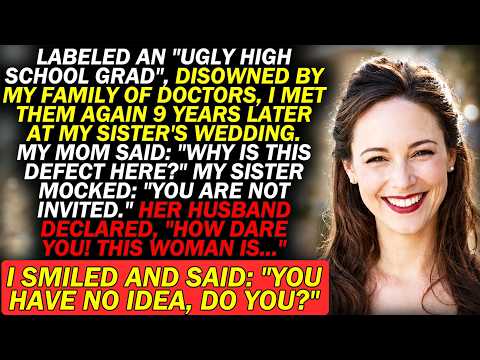
My family had nine years to learn who I’d become, and they spent those years pretending I was never born. What the groom did next ended more than the evening. It brought down a dynasty three generations in the making, and I never raised my voice once.
But this story doesn’t start in that ballroom. It starts ten years earlier at a country club, with a graduation gown and a wall of framed diplomas that held one empty frame.
Three weeks before the wedding, a cream envelope arrived at our house, thick as a dinner menu. It was addressed to Dr. Daniel Whitfield and Mrs. Grace Whitfield in calligraphy that cost more than my first month’s rent at nineteen.
Daniel’s invitations usually mean hospital galas. I opened it with a butter knife, still thinking about payroll. Then I read the names.
The Halston family requests the honor of your presence at the marriage of their son, Dr. Eric Halston, to Vivian Dixon.
Vivian Dixon. My sister.
I stood in my own kitchen and read her name four times, as if the letters might rearrange themselves into a stranger. The tile was cold under my feet. The refrigerator hummed. Somewhere in another city, my family was planning a wedding, and an invitation with my married name on it had sailed straight through their defenses like a bird through an open window.
Daniel came in, read it over my shoulder, and set his coffee down very carefully. “You don’t have to go.”
“I know,” I said. “That’s not the same as not wanting to.”
He didn’t argue. He’s a trauma surgeon. He knows the difference between a wound that needs stitches and one that needs air.
We made rules together at the kitchen table like it was a board meeting. We would attend the ceremony, sit in the back, congratulate the groom, and leave before the family noticed the temperature drop. I even chose a navy dress, quiet as wallpaper.
I thought I was walking in as a stranger with good manners. I was wrong about that in every direction, and the first crack showed up before I’d even finished my first glass of sparkling water.
The estate sat on a hill of trimmed vines, all stone arches and chandeliers the size of bathtubs. Valets in gray vests. A string quartet warming up under a pergola. My family always did know how to set a stage.
Daniel got pulled into a circle of St. Ann’s physicians near the bar, which suited me fine. I drifted toward the terrace with my wallpaper dress and a champagne flute a passing waiter had pressed on me, counting the minutes until the ceremony.
That’s when I heard my mother’s voice for the first time in nine years.
It came from the other side of a stone column—bright and lacquered, her hostess voice. “Two families of physicians. Can you imagine the grandchildren?” she was saying, and a woman laughed.
And then my mother said the thing that took my breath like a door slammed on my hand. “Vivian has always been remarkable. Our daughter. Our only child, you understand. We poured everything into her.”
Our only child.
I stood very still behind that column, the way you do when a wasp lands on your arm. I had prepared myself to be the estranged sister, the awkward footnote, the girl who left. I had not prepared to be erased.
Erasure is tidier than hatred. It doesn’t leave a body, just a blank space where a person used to stand. Somewhere in that crowd, my father was wearing a good suit and agreeing with everything.
I looked down and realized the champagne in my glass was trembling, and I made my hand stop, because I had learned a long time ago that in front of these people, you never tremble.
The quartet started a waltz. Behind me, coming closer through the crowd, was the voice that taught me that lesson.
To explain what happened next, I have to show you the hallway I grew up in.
In my parents’ house, there is a wall, and on that wall hang eleven frames. My grandfather Chase’s medical degree. My mother’s cardiology board certification. My father’s anesthesiology fellowship. Great-uncles, cousins, a century of Dixons and Chases in mahogany and glass.
We called it the wall, capital W, the way other families say the lake house.
Sunday dinners had a liturgy. My mother would ask each of us what we had achieved that week, and the answers were graded like labs. Vivian, four years older, always had numbers ready. Class rank. Test scores. Science fair placements. She was the investment that performed.
I was the other kind of child. I could splint a bird’s wing and rebandage my grandmother’s shin better than the visiting nurse, but I froze in academic competitions and brought home B’s that landed on the table like spoiled fruit.
My mother never screamed about it. Screaming was for families without standards. She simply adjusted my portion of her attention downward, the way you’d rebalance a portfolio.
Looking back, I don’t think she was cruel by her own lights. She truly believed the family name was collateral we all borrowed against, and that love was the interest you paid on it.
Here’s the detail I want you to keep, because it comes back at the end of this story. The summer I turned fourteen, a twelfth frame appeared on the wall at the bottom, below Vivian’s honor society certificate.
It was empty.
When I asked my mother what it was for, she smiled like a loan officer and said it was mine. Pending.
Now come to the country club ten years ago, the week I graduated high school.
My mother booked the garden room, which should have been my first warning, because the garden room was for announcements, not celebrations. Twenty-two relatives. White tablecloths. A printed menu.
I wore a yellow dress I’d bought with my own money from the pharmacy job, and I remember feeling almost pretty until my aunt looked at me too long and said, “Well, aren’t you brave with color?”
My graduation was technically the occasion, but the evening had a second act nobody told me about. Between the salad and the entrée, my mother stood, touched her glass, and announced that Vivian had been accepted to medical school. Top choice. Scholarship offer. The whole cathedral.
The room rose like it had been rehearsed. My father proposed a toast to the next Dr. Dixon. Someone’s husband started talking residency strategy.
The waiter, bless him, quietly set my dessert down in front of me while everyone faced the other end of the table, and for a few minutes, I ate chocolate cake alone at my own graduation dinner and told myself this was fine. This was just how the family worked. Vivian’s news was genuinely bigger.
I had my own plan—a certified nursing assistant course starting in September, then maybe nursing school on my own dime. I’d even printed the brochure. It was folded in my purse like contraband.
Then my mother tapped her glass again and said the sentence I can still hear in any quiet room.
“And of course,” she said, warm as a scalpel, “we should say something about Grace.”
Every face turned. My mother looked at me the way she looked at an x-ray, and smiled.
“One daughter got the mind,” my mother told twenty-two relatives, tilting her glass toward Vivian. “The other got well.” She let the pause do its work. Pauses were her scalpel, too. “An ugly high school grad is still a high school grad. We celebrate what there is to celebrate.”
A few people laughed the way people laugh at a boss’s joke—quick and hollow, eyes down. My aunt mouthed something sympathetic at me, which was somehow worse.
I sat there with chocolate on my fork and eighteen years of training in my spine, and I gave the garden room nothing. No tears. No exit. No scene to remember me by. I finished the cake. It tasted like drywall.
Later that night, the family photographer’s proofs went up on the mantel. And in the group shot from the club steps, I wasn’t in the frame.
Not cropped out. Composed out. My mother had arranged the rows herself.
When I asked about it, she walked me to the wall, tapped the empty twelfth frame with one manicured finger, and delivered the family motto like a diagnosis. “In this family, love is earned. This frame is waiting. What you put in it is up to you.”
I said the frame could wait forever, then, because I wasn’t going to medical school. I said it quietly, but I said it. My mother looked at me for a long moment, and something behind her eyes closed like a till.
“Then it will hang empty,” she said. “And everyone who visits will know why.”
She went to bed. I stood in the hallway under a century of other people’s achievements until the clock chimed, and then the porch door creaked, and a voice said, “Come sit with me, honey.”
My grandmother Ruth was sitting on the porch swing in her cardigan, two glasses of iced tea already poured, because she always knew. She was my mother’s mother, which surprises people. It surprised me, too, once I was old enough to do the math on how a woman that warm produced a woman that cold.
Ruth had been a nurse for forty years. Night shifts. Wound care. The unglamorous end of medicine, while her husband, the great Dr. Chase, collected the frames that started the wall.
“Heard the toast, did you?” she said. It wasn’t a question. I sat down, and the swing took my weight like it had been doing since I was six.
Then she did something she’d never done. She unbuckled the old steel watch from her wrist—the nurse’s watch, the one with the sweep second hand she’d timed a thousand pulses by—and she buckled it onto mine. It was still warm.
“Forty years I wore that,” she said. “It has seen more people through the worst night of their lives than everyone at that dinner combined. And this watch never once asked anyone their class rank.”
I laughed and cried at the same time, which is the only kind of crying she permitted on her porch.
“Grace,” she said, “listen to me. Nobody earns love, honey.” She stopped there, patted my hand, and looked out at the yard like the rest of the sentence lived somewhere in the dark.
I’d hear the rest of it eventually, but not for ten more years, and not from her mouth.
Ten months after that porch swing, the watch was the only thing I owned that my family couldn’t repossess, because ten months later they threw me out.
The college fund came first. Eighty thousand dollars built since my christening, meant for whichever school would have me. That spring my father sat me down with a folder and explained, in his mild anesthesiologist voice, that the fund had been reallocated to Vivian’s medical education. “An investment goes where the return is.”
My mother added from the doorway, not unkindly, the way you’d read a weather report.
I want to be fair here. I saw the storm coming and I did prepare. I was nineteen. I had opened my own bank account the week after graduation, taken my documents out of my mother’s filing cabinet, finished my CNA certification at night, and picked up shifts at a home care agency wiping down walkers and helping strangers shower with dignity.
I loved it, which was the unforgivable part. My mother could have survived a daughter who failed toward medicine. She could not survive one who succeeded toward the help.
The ultimatum came on a Tuesday in April, at the bottom of the stairs, with my father studying his shoes. Quit the agency, retake the entrance exams, resume the family trajectory, or leave the family home. She used those words, family trajectory, like we were a spacecraft.
I remember being calm. I had rehearsed for this without admitting it. I packed in forty minutes—clothes in two trash bags, my certification folder, Ruth’s watch on my wrist. Nobody helped and nobody stopped me.
At the front door my mother said, “You’re choosing to be nobody.”
And I said, “I’m choosing to be somebody you don’t get to grade.”
And I carried my trash bags down the walk like luggage. The porch light went off before I reached the sidewalk.
Nine years later my mother would stand in a stone hallway and offer me that door back on one condition. But first, she had to call me a defect in front of two hundred people.
Which brings us back to the ballroom, the champagne I never asked for, and my mother’s opening line.
“Why is this defect here?”
She said it low, the way surgeons swear—precise, contained, meant only for the sterile field. Up close, she looked expensive and tired. Nine years had silvered her hair and sharpened everything else.
Vivian arrived a second later in a cloud of tulle and panic, bouquet gripped like a weapon. “You are not invited,” she hissed. “Whatever this is, whatever you want, you will not do this today.”
I said congratulations. I meant it, mostly, which annoyed her more than anything else I could have engineered.
Guests were beginning to angle toward us the way iron filings find a magnet, and my mother felt it before I did. She was always exquisitely tuned to an audience. Her face reorganized itself into hostess warmth. “We’ll speak somewhere quieter,” she announced for the benefit of a passing couple, and gestured toward a side room as if she were offering me a tour.
The wedding coordinator materialized, sensing weather. Vivian peeled away toward her photographer with one last look that promised consequences, and I went along to the side room, calm as a Sunday, because here is what my family did not understand yet.
I had spent nine years learning exactly how much their theater could and could not do to me. They thought they were removing a problem before the Halstons noticed. In fact, they were marching me across a ballroom that held my husband, my work, and one person who knew precisely who I was. And every step they made me take was a step toward the moment the whole stage came down.
The side room smelled like lilies and floor wax. My father was already there, which told me the play had been cast before the curtain.
Raymond Dixon, sixty-one years old, a man who had spent four decades putting people to sleep and one decade doing it to himself. For nine years I had told myself a small bedtime story about my father—that he was the gentle one, the hostage, that somewhere under the good suit he had missed me.
He looked at me now, first time since the trash bags, and here is the whole of what he said. “Use the kitchen door. There’s a service corridor behind the kitchen. Don’t make your mother repeat herself.”
Not, How are you? Not, You look well. Not even my name.
I waited for the rest—the flicker, the folded twenty-dollar bill of affection he might slip me when she wasn’t looking. Nothing came, and I finally understood something it had taken me nine years and one sentence to learn.
His silence had never been a hostage’s silence. It was a shareholder’s. He had voted with her at every meeting. He’d simply let her read the minutes.
Something in my chest that had been propped open since I was nineteen quietly shut, and it didn’t even hurt the way I’d budgeted for.
“No,” I said. He blinked. “No?” As if the word were new to him, and in that house, maybe it was.
“I came through this family’s front door once already with everything I owned in trash bags,” I said. “I will never again leave anywhere through the back.”
My phone buzzed against my hip. A text from Daniel, three rooms away, oblivious and about to be extremely relevant. Eric’s asking where you went. He wants to introduce you to his mother.
The groom can wait a moment, because the nine years come first, and the nine years started with night shifts.
My first client after they threw me out was a retired machinist named Mr. Alger, eighty-four years old, hands like tree roots, a man who had rebuilt engines his whole life and now couldn’t manage a shirt button. The agency paid me eleven dollars an hour to be his hands.
I learned to shave a face that flinched, to time medications by Ruth’s watch, to listen to the same war story with fresh attention because for him it was fresh every night. My family called this work wiping strangers.
Here’s what it actually was. I held a man’s dignity in my two hands for eight hours a night and I never once dropped it. Try that with a scalpel.
I slept in a studio apartment above a laundromat and kept a spiral notebook of everything the agency did wrong—missed handoffs, double-booked aides, families left waiting by a phone that rang out. Not out of spite, out of the same instinct that made me re-bandage my grandmother’s shin as a kid. When care is done badly, my hands itch.
I learned more about dignity from a man who couldn’t button his shirt than from three generations of framed diplomas, and I learned something else, too—something the wall never taught anyone. The medical world my family ruled from operating rooms actually runs at the street level, on people like me. Hospitals can’t discharge without us. Doctors’ own mothers need us. It is a whole economy of showing up.
I was nineteen, then twenty, then twenty-two, saving every spare dollar in a coffee can like a Depression grandmother.
And then, the fall I turned twenty-three, my actual grandmother’s phone went silent.
Ruth had a stroke on a Thursday in October, the fall I was twenty-three. I found out two days late from her neighbor, because no one in my family called me. By then she was in a hospice with visiting hours and a visitor list, and the list was managed by her medical power of attorney—my mother.
I did everything a person can lawfully do. I called the front desk daily. I sent my name in writing. I drove two and a half hours on my day off and stood at the reception counter in my scrubs while a kind woman with terrible news in her eyes checked a clipboard and said, “Immediate family only, and I’m sorry, but you’re not on the list.”
I was her granddaughter. I was also, on paper, nobody. And paper was my mother’s home field.
I sat in my car in that parking lot for a long time, close enough to see which window might be hers. Eleven days later, Ruth died. I learned about the funeral from the same neighbor after it was over.
There is a specific kind of quiet that follows a grief you weren’t permitted to attend. It moves into your apartment and pays no rent.
But Ruth, being Ruth, had gotten one thing past the clipboard. A week before the stroke, she had left me a voicemail. Forty-one seconds long. I know it’s forty-one seconds because the screen says so, not because I’d ever heard it end.
I pressed play the night I learned she was gone, got twelve seconds in. “Gracie, it’s your grandmother. Don’t you dare delete this.” And my thumb hit stop like a reflex, because her voice was alive and I wasn’t ready for the past tense.
I kept that voicemail for five years. Five years, and I never once let it finish.
Grief either buries you or it pours a foundation. Six months after we lost Ruth, I took twelve thousand dollars out of the coffee can and the credit union, rented a two-room office that shared a wall with a dance studio, and started my own home care agency.
I named it Brightwater for no family reason at all. I just wanted a name that sounded like the opposite of a hallway full of frames. My hiring policy was one sentence long. Hire the ones who show up.
I took the notebook of everything my old agency did wrong and turned every line into a rule. Aides got real wages and back-up coverage. Families got a call back within the hour, every hour I was awake.
My first contract was a small one—a hospital discharge planner who was desperate on a Friday afternoon and out of options, which is the only way anyone gives a twenty-three-year-old a chance. We didn’t lose a client for two years. Word travels fast in the showing-up economy.
Five years later, Brightwater had three hundred and forty caregivers across three states, and I had a title I still can’t say without hearing my own younger self laugh. Founder and president.
If you’re watching this while you build something of your own in a two-room office somewhere, while everyone who shares your last name calls it a phase, I want you to pause and hear me say it plainly. The people who wouldn’t give you a seat are not the audience you’re building for.
Subscribe if you want the rest of this story, because the next phone call changed my name.
One Tuesday, a hospital called about a patient nobody else would take, and the doctor on the line had a voice I’d end up hearing every morning for the rest of my life.
Back at the estate, I didn’t go to the kitchen door, and I didn’t go back to the ballroom. Not yet. I found the rock garden behind the terrace, where the caterers’ clatter faded into hedges, and I sat on a cold stone bench in my navy dress with my phone in my hand.
You already know what file I opened. Grandma Ruth. 41 seconds. Saved through five phone upgrades, backed up in three places, listened to a hundred times, and finished exactly never.
I pressed play. “Gracie, it’s your grandmother. Don’t you dare delete this.” Her voice, papery and amused, the porch swing practically audible behind it. Twelve seconds in, right on schedule. “And I need you to hear this, honey, because nobody ever told your mother—”
Stop. My thumb, that coward, that loyal bodyguard. I sat there with my pulse ticking against Ruth’s watch and her sentence cut off in the middle, the way it had been cut off for five years, and I asked myself what I was actually doing at this wedding.
I could dodge the family, slip out after cake, keep the peace at a party I had every legal right to attend. Or I could sit where my name card said I sat, in a room they’d built on my erasure, and let whatever was true be true in public.
Ruth went through that family’s front door her whole life in a nurse’s cardigan, and she never once apologized for the uniform. I put the phone away. I clasped the watch tighter. Then I stood up, smoothed the wallpaper dress, and walked back toward the music—toward the ceremony, the seating chart, and the forty-one seconds I still owed my grandmother.
Whatever her sentence ended with, I was done hearing it from behind a column.
Now, the Tuesday phone call.
Four years ago, St. Ann’s Regional had a patient no agency would touch. A retired teacher with a spine injury, a complicated house, and a family lawyer on speed dial. The surgeon himself got on the line, which never happens, and asked if Brightwater was as good as its reputation or just newer than everyone else’s.
I said, “Both.” And he laughed once, like a door unsticking, and said, “Come prove it.”
He was expecting a sales rep with a folder. What walked in was a founder with rolled-up sleeves who had personally done every job on the care plan.
Dr. Daniel Whitfield, thirty-two at the time, the hospital’s senior trauma surgeon, a man who wore authority the way Ruth wore her cardigan—without needing anyone to notice. We argued for twenty minutes about discharge protocols, and I won twice.
He noticed the nurse’s watch and asked whose it had been. Nobody in eight years had asked that.
Coffee from the vending machine turned into coffee from an actual café, which turned into two years of the calmest thing that had ever happened to me. He knew all of it before he proposed. The wall, the trash bags, the funeral I found out about late.
He heard the whole inventory and said the sentence that closed the deal. “You built a family business. The family part just came later, and it’s me.”
We married in his mother’s backyard when I was twenty-six. Thirty guests, a barbecue, Mr. Alger’s granddaughter playing the fiddle. I took his name gladly. Dixon had only ever been a debt.
But two weeks before that backyard wedding, I did one last old-fashioned thing. I mailed an invitation to my parents’ house.
You can probably guess what happened. You’d only be half right.
The envelope came back thirteen days later, and here’s the half you might not guess. It wasn’t marked return to sender. It had been opened. Someone had slit it cleanly, read the invitation—my name, Daniel’s name, the date, the backyard—then resealed it in a fresh envelope, addressed in my mother’s surgical handwriting, and mailed it back like a rejected insurance claim.
On the back of my own invitation, one line, blue ink. “Don’t embarrass yourself.”
I stood at the mailbox so long the neighbor’s sprinkler cycled twice. Daniel found me there and read it, and I watched a man who reduces shattered pelvises for a living go very still.
“We could just be happy,” he said finally, “loudly. It’s excellent revenge.”
I laughed, and I married him, and I was happy. I want that on the record.
But I also kept the envelope. I put it in the cedar box with Ruth’s watch’s original band, and every December after that I still mailed my parents a Christmas card. Plain ones, no photo, signed Grace. Never answered, never returned, just swallowed by the same mailbox that had spat back my wedding.
Daniel never told me to stop. He just watched me do it each year with the expression he wears reading a scan he doesn’t like.
I told myself the cards were closure. A habit. Postage-stamp charity. The truth is simpler, and I can say it now. Some part of me was still standing at the bottom of the wall, holding my achievements up toward the empty frame, waiting for someone to hang one.
That part of me RSVP’d yes to my sister’s wedding before the rest of me had finished reading the invitation.
And that part of me was about to get an answer. The final one. From three people at once, in front of two hundred witnesses, on the most expensive stage my family ever built.
One more piece, and then the dominoes are all standing.
Two years ago, St. Ann’s came to Brightwater with a proposal. The hospital wanted to launch a geriatric medicine fellowship, training young doctors to actually understand aging patients, and they needed a founding sponsor. The board expected me to negotiate the naming rights. That’s what sponsors buy.
I had one condition, and it wasn’t my name. It would be called the Ruth Chase Fellowship, after a nurse who worked forty years of nights and never got a frame on anybody’s wall. And my name would appear nowhere. Not in the press release, not on the plaque, not at the annual dinner.
The development office thought I was being modest. Daniel knew better, and signed the papers with me anyway, listed simply as a physician liaison.
I told myself it was privacy. Standing where I stand now, I’ll tell you the truer thing. I was still building a case file for a jury that was never going to convene. Some invisible day in some invisible court, the family would finally see everything—the company, the fellowship, Ruth’s name restored—and they would understand what they had thrown out. And they would come to me.
Quiet auditioning is still auditioning. I just did mine anonymously, which let me call it dignity.
The first Ruth Chase fellow was selected that spring from forty applicants. A young internist with good hands and better manners. The kind of doctor who calls the caregivers by name. He wrote me a thank-you letter through the foundation without knowing who I was.
His name was Eric Halston.
I funded a stranger’s future and told no one. And this spring, that stranger sent me an invitation to his wedding.
Because that stranger was marrying my sister.
The ceremony itself was beautiful the way hotel lobbies are beautiful. I sat in the last row of white chairs with Daniel’s hand over mine and watched my sister marry a man I had accidentally helped create. Vivian looked genuinely lovely. I’ll give the record that much. And she delivered her vows the way she’d delivered valedictorian remarks. Flawless, timed, slightly laminated.
She promised Eric honesty in all things, and two hundred people sighed, and my water went down wrong.
It was during the recessional that my professional brain—the one that audits care plans for what’s missing—started itemizing this wedding the same way.
Item. The bride was supposedly a dermatologist about to open her own practice, yet in a garden full of physicians, not one guest on her side was introduced as her colleague.
Item. Her practice had a grand opening this fall, per my eavesdropping. Yet no one could name the neighborhood.
Item. My mother steered every conversation about Vivian’s career backward into her residency years, the way you’d steer guests away from a room with water damage.
Item. Whenever anyone asked Vivian a direct medical question—and doctors at weddings ask constantly—my mother materialized like security and answered for her. Charmingly. Every time.
Any one of those is nothing. A pattern of them is a chart with pages missing. And I had spent nine years learning that when this family curates a story that carefully, somebody is bleeding under the gown.
I didn’t know what yet. I want that on the record, too. Walking into that reception, I still knew nothing for certain.
Then we found our table.
Table two. Groom’s side. Family adjacent. Engraved place cards. Dr. and Mrs. Whitfield.
And across the ballroom, my mother picked up the seating chart.
I watched my mother read the seating chart the way you’d watch someone find a lump. Her finger traveled down the calligraphy, stopped at table two, and for half a second—I will treasure this half second into old age—Dr. Lorraine Dixon lost control of her own face.
Table two was sacred geography. Groom’s honored guests. Close enough to the head table to share a bread basket. You do not sit strangers there, and you certainly do not sit defect.
She looked from the chart to me, to Daniel, measuring him now. The good suit. The surgeon’s posture. The St. Anne’s colleagues who kept stopping by our table to pay respects.
And I could see the machinery grinding behind her eyes. She didn’t know who Whitfield was. That was the delicious, terrifying center of it. For nine years she hadn’t wondered about me even once, and now the answer was seated at table two under engraved calligraphy, and she couldn’t ask anyone without revealing she didn’t know.
Vivian was faster. Brides always know their own seating chart. I watched her cross the parquet in her enormous dress, lean over the place cards, and go the color of the tablecloth. She looked at me, then toward the head table where Eric was laughing with his groomsmen, then back at me. And her lips shaped a silent word I’ll let you imagine.
My mother appeared at her elbow, and the two of them held a summit behind a floral arrangement. All smiles for the room, hissing like a kettle up close. They had a problem with no playbook. They could not remove me without explaining me.
And while they conferred, a silver-haired woman in blue silk was walking toward table two with her hand already extended. The groom’s mother.
“Grace Whitfield,” said Dr. Susan Halston, chief of medicine, mother of the groom, in the tone women of consequence use for each other. “Finally. Eric talks about Brightwater like it’s a teaching hospital. And Daniel—we’ve been trying to poach your husband for years, you know.”
She said it easily, gave up gracefully. Up close, she had smart eyes and a jaw you’d want on your side in a budget meeting. I liked her immediately, which complicated everything.
We talked care transitions for a minute. She was one of the physicians who actually understood what happens to patients after the discharge paperwork. And then she tilted her head with genuine, innocent curiosity and asked the question.
“So, how do you know our Vivian?”
Understand what was being handed to me. One honest sentence. She’s my sister. Ask her why you’ve never heard of me. And I could have detonated the marriage, the merger, my mother’s entire cathedral, right there between the salad course and the band’s first set, with the groom’s own mother holding the plunger.
Nine years of trash bags and returned envelopes leaned in to watch what I’d do.
I took a breath and I chose the smallest true thing in the room.
“We grew up in the same town,” I said.
“Small world,” said Susan Halston pleasantly. But she was a diagnostician at the top of her field, and I watched one eyebrow file something away. The pause before my answer, maybe. Or the way the bride’s mother across the room was watching us like an air traffic controller with two planes converging.
She patted my arm and moved on to charm the next table.
Across the ballroom, Vivian had seen the entire exchange, and Vivian, unlike our mother, had no idea what I had or hadn’t said. She got me alone by the coat check, fingers around my wrist like a blood pressure cuff, and walked me into the stone hallway with a bridal smile stretched over pure animal panic.
The moment we cleared the doorway, the smile fell off.
“Whatever you told her,” Vivian said, “you’re going to walk it back. Now.”
I told her we grew up in the same town.
“Oh, don’t.” Her voice cracked strangely. “Don’t do the calm thing. You’ve had nine years to ambush me and you picked my wedding.”
I asked her the only question I’d actually brought to that estate. “What did you tell them happened to me, Vivian? What’s the story?”
And my sister, wife of an hour, looked me in the eye and said, “There is no story. You don’t exist. As far as the Halstons know, I’m an only child. It was cleaner.”
Cleaner. I had imagined smears, addiction, theft, a dramatic villain edit. The truth was so much more efficient. They hadn’t buried me. They’d never dug the hole. I was an accounting entry that had simply been dropped from the books.
“You will leave before the toasts,” she went on, control returning in beats, our mother’s cadence settling over her like a coat. “You’ll have a migraine. Your husband seems polite. He’ll drive you.”
But here’s what I noticed instead of my own anger—because a decade of night shifts teaches you to read hands. Hers were shaking. Not wedding-jitters shaking. Clipboard-at-the-hospice shaking. Her eyes kept flicking down the hallway toward the ballroom. Not toward our mother. Toward Eric.
A woman defending one lie is annoyed. A woman defending a load-bearing lie is terrified. And terror like that is never about a missing sister. People only panic like that when one lie is standing on top of another.
“Enjoy the toasts,” I said, and walked back inside.
I made it three steps toward table two, and then my legs took me right past it, past the band, out to the coat check, where I stood holding my own claim ticket like a woman deciding on a train.
Because here is the arithmetic I did in that alcove. I had come to this wedding carrying one specific, shameful hope—that nine years might have loosened something, that a door might sit ajar. I now had my answer in writing. There was no door. There had never been a door. There wasn’t even a wall with my shape in it.
You cannot reconcile with people for whom you do not exist.
So. Migraine, coat, husband, highway. Give them the clean wedding and keep my dignity in the car like a to-go box.
Daniel appeared beside me. He has a surgeon’s radar for internal bleeding and read the whole calculation off my face. He didn’t argue either direction. He just said, “Say the word,” and held out his hand for the ticket.
That’s when Ruth’s watch caught on my sleeve. The clasp, worn soft by forty years of her wrist and ten of mine, snagged the navy fabric and sat there glinting under the coat check lamp.
And I thought about a woman who walked through the Dixon family’s front door for six decades in a nurse’s cardigan, outranked by everyone at the table and outclassed by none of them, and who never once used the service entrance her son-in-law kept suggesting.
If you’re still with me, stay close now. Comment front door if you’ve ever refused someone’s back exit, and subscribe, because every domino in this story falls in the next ten minutes.
I handed Daniel the ticket. “We’re staying for the toasts,” I said.
Inside, a fork was already ringing against crystal.
My mother toasted first, naturally. She rose in pearl gray with a glass of champagne and gave the performance of a career. Charming, warm with intolerances, every syllable load-tested. She spoke of two great medical families joining, the Halstons and the Dixons, and what that union means, of standards upheld across generations, of her pride in a daughter who had never once lowered the bar.
Then she smiled at the room and delivered the family catechism, polished for export.
“People ask how our family produces what it produces. The answer is simple. Everything in this family is earned. Our name most of all. Nothing is given away free at our table.”
Two hundred guests raised their glasses to it. I kept my hands in my lap and did something I hadn’t expected. I heard the sentence underneath the sentence. She had said those exact words to me at the bottom of the wall, and someone had certainly said them to her in that same house when she was small—a grandfather I’d never met, the great Dr. Chase, who Ruth once told me graded his daughter’s posture at Sunday dinner.
My mother wasn’t quoting herself. She was reciting. Standing there in pearl gray at the top of her world, she was still the girl reporting her class rank to a man with a ledger where his lap should have been.
And for exactly one breath, I felt the vertigo of pity before I put it down. You can understand a system and still refuse to bow to it. Ruth taught me both halves of that.
The room drank. The band played eight bars. And then the MC said the sentence that ended the world as my family had built it.
“And now, a few words from the groom.”
Eric stood up holding notes.
Eric Halston gave the kind of toast that reminds you some people are simply good. And that good people are the most dangerous thing you can invite to a performance. He thanked his parents. He thanked his bride, glowing at his elbow. And then he set down his notes and went off script, because he wanted, he said, to thank the two people who made him the doctor standing here tonight.
“The first is my mentor. He taught me that trauma surgery is mostly showing up, and showing up again. Dr. Daniel Whitfield, table two.”
Applause. Every Dixon head in the ballroom rotated toward our table like gun turrets. My mother’s glass stopped an inch from her lips and did not move again.
“The second,” Eric said, “I only get to thank because she’s finally in a room with me. I trained on a fellowship that paid my salary, my research, all of it. Named for a nurse, Ruth Chase, who worked four decades of night shifts. The founder who endowed it wouldn’t let the hospital print her name. No plaque, no gala, nothing. It took me two years and one indiscreet mentor to find out who she was.”
He smiled the best-man smile of a man giving someone their due with no earthly idea what he was standing on.
“She built a company from nothing at twenty-three, and half our discharges would collapse without her. And she’s sitting next to my mentor, because she married him. Grace. Grace Whitfield. Would you stand? Ruth Chase was her grandmother.”
The applause started at warm and confused. Two hundred people turning in their chairs. I stood. Because you stand when a good man asks.
And in the corner of my eye, in pearl gray, my mother rose out of her chair, too. Not to applaud. Her face had gone the gray of old snow, and her mouth was already forming a word.
What my mother said, into a ballroom that had just heard the words Ruth Chase was her grandmother, was “There’s been a mix-up.” She said it with a hostess laugh bolted on top. “Grace is a distant relation. A complicated situation, not for tonight.”
And Vivian—my poised, laminated sister—chose that exact moment to lose nine years of message discipline in a single blurt.
“You are not invited.” She said it at volume, past the microphone’s edge, into two hundred held breaths.
The silence afterward had texture.
Eric turned to his bride slowly, the way you turn in a house where something has just broken upstairs. “Not invited?” he said. “I invited her. Vivian. This is the woman who paid for my fellowship. This is my mentor’s wife. Her grandmother’s name is on my diploma wall.”
His voice didn’t rise. It clarified, which was worse. “How dare you. Either of you. Do you have any idea who this woman is? This woman is the reason I’m standing here a doctor. This woman is—”
And my mother, seeing the structure coming down, made her final error. She reached for rank. “Eric, dear, this is a family matter.”
“Which family?” said Eric Halston quietly, in front of both of them.
You could hear the chandelier hum. Two hundred guests—surgeons, board members, the entire ecosystem my parents had spent forty years performing for—looked from the bride to her mother to the woman at table two they had been told in a hundred small curated ways all evening did not exist.
I hadn’t said a word since congratulations. I stood there with my hand resting on Ruth’s watch and let the arithmetic happen on other people’s faces.
It was Susan Halston who finished it. She rose from the head table without hurry, blue silk and forty years of chairing difficult meetings, and looked at my sister with the stillness of a diagnosis arriving.
“Vivian,” she said, “you told us you were an only child.”
Nobody answered her. That was the answer.
Vivian stood in her enormous dress with her bouquet hand empty, opening and closing her mouth, and my mother performed the last maneuver in the playbook—the pivot to intimacy. She crossed to me through the frozen tables, took my forearm with both hands like we did this all the time, and said, at a volume calibrated to reach exactly the first three rows, “Grace, darling, we’ll discuss family matters privately. This is a wedding.”
Darling. Nine years, a returned invitation, a hospice clipboard with my name missing, and I had graduated to darling in under a minute, because now there were witnesses worth performing for.
And looking at her—this brilliant, exhausted woman gripping my arm like a railing—I felt the strangest thing rise in me. Not rage. Recognition. She still believed the story could be managed. She had no idea the manuscript had left the building.
So I smiled at my mother, the way you smile at someone talking loudly on a train about a stop they’ve already missed, and I said it. Gently. Once. Loud enough for only the first three rows and the microphone she’d forgotten was live behind her.
“You have no idea, do you?”
She blinked. “About what?”
“About anything after April,” I said, and lifted her hands off my arm the way I used to lift Mr. Alger’s—firmly, kindly, without negotiation.
I did not list my company. I did not say the word president or mention three hundred and forty employees or explain the fellowship. The résumé was the one weapon I had sworn never to reach for in front of them, because the moment I argued my worth, I was back at the bottom of the wall holding papers up at an empty frame.
Instead, I turned to Susan Halston and said, “Excuse me for a moment. This dress needs some air.”
And I walked toward the terrace doors with my spine perfectly straight and my mother—my mother followed me.
She caught me in the stone corridor between the ballroom and the terrace, where the band’s waltz came through the wall like weather. And here, my mother did the only genuinely surprising thing she’d done in nine years. She dropped the performance. No audience, no hostess lacquer. Just a fifty-eight-year-old woman in pearl gray with her back to a limestone wall, breathing like the air had gotten expensive.
“All right,” she said. “Here is what happens now. You come back inside. You tell the Halstons we’ve always been close—quiet, private, but close. The fellowship was a family project. We’ll say your father advised. And then, you come home, Grace. Thanksgiving. Christmas. Sunday dinners. All of it. The frame.”
Her voice caught on it. Actually caught. “The frame gets filled. You finally earned your place.”
There it was. The door. Not ajar—thrown wide, with everything I had wanted at nineteen arranged inside it like a table set for one. All I had to do was carry one lie across the threshold, and lying was the family business. They’d trained me for it my whole childhood. I’d simply refused the apprenticeship.
I looked at her hands while I let the offer hang. They were trembling. The fine, relentless tremor she’d hidden under crossed arms all evening. The tremor that had ended her surgical years ago. A failure she’d outrun by becoming the family’s judge instead of its performer.
She saw me see it, and something old cracked open for exactly one sentence. “My father made me recite my class rank at that table every Sunday until I left for college,” she said, flat like coordinates. “I gave you a family that keeps score because it is the only kind I was ever given, and it worked. Look at Vivian.”
We both heard it at the same time. The it worked floating over a ballroom where Vivian’s marriage was currently entering cardiac arrest.
Her armor came back down like a curtain. “Well,” she said. “The Halstons are waiting.”
I looked down at Ruth’s watch. Forty-one seconds of unfinished sentence sitting in my clutch beside it, and I smiled.
I walked back into that ballroom ahead of my mother, and I know exactly what she believed my posture meant, because she straightened her own and followed me in like a producer trailing her star.
The room had not moved on. Rooms don’t, when the bride’s family is on fire. They just eat cake quieter.
Susan Halston stood near the head table with Eric, and when I approached, the last conversations died out politely, and she asked me the question straight—physician to physician, in front of both families and God and the wedding videographer.
“Grace, before anything else is said tonight, is it true? Were you part of this family?”
My mother arrived at my shoulder. I could feel the script she’d handed me radiating off her. Always close, quiet, private. A family project. One sentence, and the door stood open behind me with the holidays inside.
And I heard Ruth on the porch swing, clear as the night she said it. Nobody earns love, honey.
And I finally understood the assignment of my whole adult life. Not to win the argument. To leave the courtroom.
“Here is everything I’ll say at a wedding,” I said to Susan, but really to all two hundred of them. “I was born a Dixon. When I was nineteen, I was told that in that family, love is earned. And I stopped earning. I haven’t spoken to them in nine years. Eric—you married someone tonight. I hope you’ll ask her, gently, for the rest. It isn’t mine to tell.”
That last line cost me more than anything else in this story, because I had the rest. I’d read Vivian’s shaking hands in the hallway. One sentence of speculation from me, and her whole laminated life would have been opened on the table like a chart. Every night-shift year of me wanted it.
I left it. It was hers to drop, and mercy, it turns out, is the only revenge that leaves your own hands clean.
Then I turned to my mother, whose face was doing something geological, and gave her the answer to the offer.
“No,” I said. “The frame stays empty. I built my own wall.”
I took Daniel’s arm, nodded to Eric, thanked Susan Halston for a beautiful ceremony, and walked out of my sister’s wedding through the front doors, at the exact center of the aisle, at the speed of a woman with nowhere left she needed to be admitted.
Behind us, just before the doors closed, I heard a single champagne glass hit the parquet.
We didn’t drive off dramatically. The valet line was seven cars deep, and dynasties fall on a schedule of their own. So we walked out past the lit fountain to the far end of the terrace and stood in the cold spring dark with the party glowing gold behind the glass, and my hand started shaking. The honest kind. The kind you’ve earned.
Daniel put his jacket over my shoulders and asked nothing. I took out my phone.
You know the file. Grandma Ruth. 41 seconds.
I pressed play, and for the first time in five years, when her voice reached the twelfth second, my thumb stayed down at my side where it belonged.
“And I need you to hear this, honey, because nobody ever told your mother, so she never learned how to say it to you, and somebody in this family has to go first.” A breath on the line, the porch swing creaking somewhere under it. “Nobody earns love, honey. Love is the thing they can’t bill you for, whatever they do with that silly wall. You were never the empty frame, Gracie. You were the whole wall and the house it holds up. And don’t you dare wait for people with ledgers to tell you what you’re worth. Come see me Sunday. Bring nothing.”
Click.
Forty-one seconds. Five years to walk twelve seconds.
I cried then. The only time in this whole story. So let the record show it happened on a terrace, in my husband’s jacket, with my grandmother’s watch ticking against my wrist like a second heart. Not for the family I’d lost—you can’t lose what was never issued to you. For the woman who’d gone first, and for the nineteen-year-old at the mailbox who could have used those forty-one seconds a little sooner.
When it was done, I did one small housekeeping thing. I opened my drafts folder, found the Christmas card list with my parents’ address sitting at the top where it had sat for nine Decembers, and deleted the entry.
Then we went home.
The dynasty spent the next six weeks collapsing without any help from me. Here’s what the collapse looked like from a respectful distance.
The Halstons did what careful families do after a wedding with a surprise sister in it. They went back and checked the chart. The dermatology practice with the fall grand opening had no lease, no license on file, no fall. Vivian’s residency, it turned out, had ended halfway through her second year. Not paused. Ended. And the years since had been a med-spa job wrapped in our mother’s narration. She had a diploma. She did not have the life printed on the wedding program.
Eric filed for annulment six weeks after the cake. I’m told he did it kindly, which sounds like him, and that he kept the Ruth Chase name on his email signature, which undid me a little.
My mother resigned her chairmanship of the hospital gala committee that fall, citing family obligations. The sentence is doing more work than any sentence should. Nobody fired her. Nobody needed to. Her currency had simply been devalued in every room that mattered to her, and she had built her entire life in those rooms. That was the whole punishment, and it was total.
My father sent me an email in November. One line, no subject. “Your grandmother would have been proud.” I read it maybe thirty times. I never answered it. And both of those facts are true at once, and I’ve stopped needing them to fight.
And the wall—the wall still hangs. Eleven frames and one empty. In a hallway two and a half hours from my kitchen. Nobody took it down. Systems like that don’t come down. They just lose jurisdiction. One escaped person at a time.
It no longer reaches me. That’s not the same as gone, and I’ve made my peace with the difference.
Six months later, on an ordinary Sunday, I looked down my own dinner table and took inventory the way Ruth used to count pulses. Unhurried, thorough, grateful.
Daniel at the far end, arguing playoff brackets with Mr. Alger’s granddaughter. Three of my original caregivers, the ones who showed up before Brightwater could afford to pay them what they were worth. My first client’s widow, who brings a pie nobody asks her to bring and everybody finishes. And Eric Halston, still a Ruth Chase fellow, still family somehow. The one thing I salvaged from that wedding without meaning to.
Telling a story with his fork in the air.
On the wall of our dining room, there are eleven frames, too. I counted them one night and laughed until Daniel came to check on me. Ours hold a fiddle recital, a fishing boat, a coffee can, two wedding photos from a backyard, and a nurse in her cardigan on a porch swing. Mid-sentence, saying something the camera couldn’t keep.
Not one certificate.
The watch was on my wrist, where it stays. The voicemail is still on my phone, and these days I can play it all the way through while the potatoes boil.
If a family ever made you audition for a seat at their table, hear this. Love that has to be earned was never love. It was a job with no wages, and you are allowed to quit a job. And the table you build afterward will hold every person your old chairs never fit.
That’s my story. One empty frame, one nurse’s watch, and a voicemail that took me five years to finish.
If someone has ever made you feel like you had to earn your place at their table, take this as your sign to start building your own. Share this video with someone who needs that permission today. Drop a comment telling me about your table. Hit subscribe, and I’ll see you in the next one.
But here’s the question I keep coming back to, the one I’ll leave with you: when you finally walk out through the front door, what do you do with the people who only call you darling once the microphone is live?
Report this article
Select a reason for reporting:






