On Halloween night 1944, the quiet Dutch town of Driel became the stage for a tragedy that would haunt Easy Company long after the guns fell silent. First Lieutenant Frederick ‘Moose’ Heyliger, a towering figure who had recently taken command of the company, was walking beside Captain Dick Winters toward an outpost near the railroad tracks. The air was tense—German patrols had been aggressive, and every shadow could be the enemy. Neither man knew that in a few moments, a split-second decision by a nervous sentry would change everything.
Suddenly, a sentry’s voice cut through the darkness: ‘Halt!’ The challenge demanded a password, but Moose hesitated—he had forgotten it. In that brief silence, the anxious sentry, his finger already trembling on the trigger, opened fire. Three shots rang out from his M1 Garand. Moose fell, hit in the right shoulder and left leg. Winters dove for cover as the echoes faded.
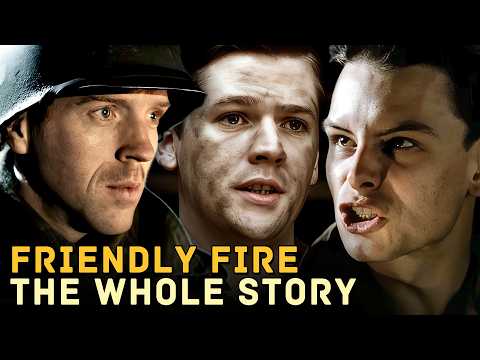
This is the version many know from Band of Brothers, but the real story is far more complex. The miniseries simplified a perfect storm of errors that led to the shooting—errors that involved not just the sentry, but also Moose himself and even Lieutenant Harry Welsh, the outpost commander.
In reality, Winters and Moose weren’t walking along the railroad tracks but down a narrow path toward Welsh’s command post in a barn. They walked shoulder to shoulder, the path only six or seven feet wide. Winters had asked Moose to join him for a nighttime inspection, eager to escape the boredom of his new executive officer role and ensure the Germans hadn’t breached the line. What Winters didn’t know was that Moose had telephoned Welsh to announce their arrival, but Welsh failed to notify his outposts. That oversight set the stage for disaster.
When the sentry challenged them, Moose tried to identify himself but stumbled over the password. The young soldier, already on edge from a week of heavy German activity, didn’t wait. He fired. Winters, standing right next to Moose, didn’t heroically catch him as depicted on screen—he dove into a drainage ditch to avoid being hit himself. The sentry, whose identity remains unknown, ran for help.
Minutes later, Welsh arrived with two men and helped administer first aid until medic Eugene ‘Doc’ Roe appeared. They applied tourniquets and injected morphine, but in the chaos, Welsh forgot to pin the morphine syrettes to Moose’s collar—a critical step to prevent overdose later. Doc Roe scolded them both, a moment that, while fictionalized, highlights the real dangers of battlefield medicine.
Moose survived, but his war was over. He endured two and a half years of surgeries and pain, and according to Winters, he suffered terribly for the rest of his life—yet he never could recall that password. The incident was a tragedy born of hesitation, fear, and a forgotten warning. But who was truly at fault? The nervous sentry, Moose, or Welsh? The answer, like the fog of war, remains shrouded.
In the days that followed, the men of Easy Company grappled with the aftermath. Winters, though relieved that Moose would survive, was furious. He understood the sentry was doing his job, but the lack of precautions—the failure to duck down and identify a silhouette before firing—was inexcusable. In his memoir, Winters wrote, ‘The trooper who shot Heyliger… was obviously scared to death. He failed to take any precaution before he opened fire.’ The sentry was transferred out of Easy Company immediately, his name erased from the records. Some say it was to protect him from the guilt; others whisper it was to protect the company’s morale.
But the sentry wasn’t the only one who carried blame. Harry Welsh, the outpost commander, had been telephoned by Moose before the patrol set out. He was supposed to alert his men that Winters and Moose were approaching. He didn’t. In the series, this mistake is barely hinted at—a stern stare from Winters, a guilty glance from Welsh. In reality, Winters was more direct. ‘Welsh was an excellent platoon leader, but on this occasion he failed to notify his outposts,’ he later admitted. Yet Winters never publicly condemned Welsh, perhaps because they were close friends, or because he knew Welsh was already punishing himself.
As for Moose, he bore the physical scars—a shattered calf, nerve damage, and years of surgeries. But the psychological wound was deeper. According to Winters, ‘to the day he died, he still could not recall the password.’ That moment of hesitation, that brief lapse in memory, had cost him his command and nearly his life. He never returned to Easy Company, though he remained in the Army until 1947, serving in administrative roles while he recovered.
The identity of the sentry remains one of the great unknowns of Easy Company’s history. Some veterans speculated it was a replacement, others insisted it was a seasoned paratrooper. In Ambrose’s book, the sentry is described as a veteran, not a green recruit as the miniseries implies. Rumors circulated that the man’s name was changed in the series at the request of the veterans—not to protect him from blame, but to spare him the pain of reliving that night. Whoever he was, he lived with the weight of having shot his own commander. If he survived the war, he likely carried that guilt to his grave.
Welsh, too, rarely spoke of the incident. After the war, he became a teacher in Wilkes-Barre, Pennsylvania, and according to those who knew him, he seldom mentioned his time in Europe. He never publicly commented on the friendly fire incident, and no reliable evidence suggests he was drunk that night—that rumor appears to be pure speculation. Yet the question lingers: did his silence stem from shame, or from the unspoken understanding that in war, mistakes happen, and good men pay the price?
In the end, the shooting of Moose Heyliger was a tragedy of errors—a forgotten password, a nervous trigger finger, a missed warning. The miniseries gave us a clean narrative: a hero catching his friend, a contrite sentry, a lesson learned. But the real story is messier, more human. It reminds us that even the greatest generation was fallible, and that the fog of war can descend in an instant, turning allies into targets.
What the series also glosses over is the sheer chaos of the minutes after the shooting. Winters, flat on his belly in the drainage ditch, had no idea whether more shots were coming. He later admitted he didn’t move for what felt like an eternity, waiting for the sentry to fire again. When silence held, he risked raising his head and saw Moose crumpled on the path, blood darkening the dirt beneath him.
The sentry, meanwhile, had bolted. Winters heard his boots pounding away into the darkness—not toward the command post, as the series suggests, but simply away from the horror he had just created. It was several minutes before Welsh’s voice finally cut through the night, low and urgent: ‘Moose? Winters?’
Welsh arrived with two men from the outpost, their faces pale in the moonlight. Together they worked to stabilize Moose, who drifted in and out of consciousness, muttering apologies that no one asked for. It was Moose, bleeding into the Dutch soil, who kept saying he was sorry—sorry for forgetting the password, sorry for hesitating. Winters never forgot that.
When Doc Roe arrived, he took charge with the calm efficiency that had earned him the men’s trust. Tourniquets were tightened. Morphine was administered. And then, as the morphine syrettes went into Moose’s collar, Roe noticed the missing pins and turned on the officers with a fury that surprised no one who knew him. ‘You want him to die of an overdose after all this?’ he snapped. Winters and Welsh said nothing. There was nothing to say.
The truck ride to the aid station was rough, every jolt drawing a groan from Moose. Winters rode in the back, one hand pressed against the wound in Moose’s shoulder, feeling the warmth of blood seep between his fingers. He kept talking—about Easy Company, about Bastogne, about anything but the path and the password and the sentry. He wasn’t sure Moose could hear him. He wasn’t sure it mattered.
By morning, word had spread through the company. Men gathered in small clusters, trading whispers and shaking their heads. Some were angry at the sentry. Some were angry at Welsh. A few, quietly, were angry at Moose himself—for forgetting, for hesitating, for making them all remember that death could come from any direction, even their own side of the line.
Winters knew that anger was dangerous. Morale was a fragile thing in the winter of 1944, and a company that turned on its own men was a company that would break. He made his decision quickly: the sentry would be transferred out, not as punishment but as protection—for the man and for the unit. The official reason would be vague. The men would understand.
But the questions lingered, as they always do. Who was really to blame? The sentry who fired too fast, or the commander who forgot to warn his outposts, or the officer who forgot a word he had repeated a hundred times? In war, blame rarely settles on one pair of shoulders. It spreads like the fog, touching everyone and sparing no one.
Years later, when the war was a memory and the men of Easy Company had scattered to quiet lives, the incident remained a scar that never fully healed. Moose Heyliger never spoke of the password again—not to his family, not to historians, not even to Winters when they reunited at the Normandy premiere in 2001. Some wounds, it seems, are not meant to be reopened.
Winters, for his part, carried his own quiet guilt. He had asked Moose to join him that night. He had walked beside him on that narrow path. And when the shots came, he had dived for cover while his friend fell bleeding. ‘I wasn’t thinking about the sentry’s future,’ he wrote. ‘I was thinking about the morale of Easy Company.’ But beneath those words, one senses a man still turning the night over in his mind, still searching for the moment he might have changed everything.
The sentry vanished into the anonymity of history—transferred out, his name unspoken, his guilt unmeasured. Perhaps he lived a long life. Perhaps he never told anyone what he had done. Perhaps, on quiet nights, he still heard the crack of his own rifle and saw a giant of a man falling in the dark.
In the end, the story of Moose Heyliger is not a story about blame. It is a story about the terrible arithmetic of war, where a forgotten word, a nervous finger, and an unpassed message add up to a lifetime of pain. The miniseries gave us heroes and villains; the truth gives us only men, frightened and fallible, doing their best in the fog.
So who do you think bears the most fault—the sentry who fired, the commander who forgot to warn, or the officer who forgot the password? Or is the real answer that war itself is to blame, and every man caught in it is both victim and perpetrator? Let us know in the comments below.
Report this article
Select a reason for reporting:






