The air was hot and wet, pressing down like a heavy blanket. Sweat soaked through their uniforms as Australian soldiers hacked through thick vines with machetes. Birds screamed somewhere above the canopy. Then the wind shifted, and the smell hit them—thick, rotten, and wrong. One soldier stopped walking. He looked at the man beside him. Neither spoke. They had smelled death before, but not like this. Not this much of it.
This is the story of what Australian soldiers found at Sandakan and exactly what they did to the men responsible. The year was 1945, and the Pacific War was almost over. Two atomic bombs had fallen. Japan was broken. But deep inside the jungle of British North Borneo, something had been happening for three years that almost no one in the outside world knew about. A place called Sandakan had once held more than 2,400 Allied prisoners of war—most of them Australian men, sons, brothers, and fathers captured when Singapore fell in 1942.
They had been brought to this remote corner of the world to build an airfield for the Japanese Army. They were given almost no food, beaten for small reasons and sometimes for no reason at all, and worked in the tropical heat until their bodies gave out. By the time Australian soldiers came marching through that jungle in August 1945, those 2,400 men were gone. Not rescued, not transferred—gone. Only six men had survived. All of them Australians. All of them only alive because they had managed to escape into the jungle months earlier.
Every other man was dead. Sandakan would become the single worst atrocity ever committed against Australian prisoners of war in all of history. The guards who ran this camp operated with the same kind of cold, organized brutality that the world had come to associate with the SS in Europe. Men who followed orders to kill without hesitation, without mercy, and without regret. They had marched starving, sick men through the jungle in what became known as the Sandakan Death Marches. Those who could not walk were shot or bayoneted on the spot.
The soldiers who arrived didn’t find a camp full of survivors cheering and waving. They found bones scattered in the undergrowth. They found mass graves. They found the burned wreckage of a camp where thousands of their countrymen had suffered and died while the world looked the other way. And they found something else, too: Japanese guards who had carried out the orders, some of whom were still in the area. These Australian soldiers had fought in some of the hardest battles of the entire war. They had seen terrible things, but nothing had prepared them for this.
And now, standing among the remains of their countrymen, they had to make a decision. When they found the men who did this, what would they do?
To answer that question, you first have to understand how Sandakan came to exist and how it became the deadliest place on Earth for an Australian soldier. You have to go back to the beginning.
Before the war, Sandakan was a calm and ordinary place on the northeastern coast of Borneo, sitting where the jungle met the sea. British officials ran their offices in the morning heat. Chinese traders moved goods along the docks. Local fishermen pulled in their nets at dawn. Children played in the streets. Life was slow and simple and predictable. Nobody could have imagined what was coming.
Then December 1941 arrived and the world cracked open. In a matter of days, Japan launched attacks across the entire Pacific all at once—Pearl Harbor, Hong Kong, the Philippines, Malaya. It happened so fast that Allied commanders could barely react. Japanese forces moved through Southeast Asia like a flood, sweeping aside everything in their path. By January 1942, they had landed in British North Borneo. The small British force there had no real chance. Sandakan fell without much of a fight. The quiet port town was now enemy territory.
Six months later, in July 1942, a ship arrived carrying 1,494 Australian and British prisoners of war. These were men captured at the fall of Singapore in February 1942, when around 80,000 Allied soldiers surrendered to Japanese forces in what was the largest British military surrender in history. These prisoners were unloaded onto the docks at Sandakan and marched to a patch of cleared jungle outside town. Their job was to build an airfield for the Japanese Army. They were given basic tools, almost no food, and no mercy. More prisoners followed. By mid-1943, the camp held over 2,400 men.
Among them was Captain Lionel Matthews, an Australian signals officer from South Australia. He was quiet and calm and deeply brave. Inside the camp, he built a secret network that smuggled medicine, food, and even a hidden radio to the prisoners. Through that radio, the men could hear BBC news broadcasts. They knew the Allies were fighting back. They knew there was still hope. Matthews was the reason many men held on as long as they did.
In those early years, the conditions were brutal but survivable. Men organized small concerts and card games. They kept diaries. They clung to routine to stay sane. Rations sat at around 1,500 to 1,800 calories a day, far below what hard-working men needed, but enough to keep most of them alive. There was still a tomorrow to believe in.
But in March 1943, the Japanese military police, known as the Kempeitai, uncovered Matthews’ network. He was arrested and tortured for months. In March 1944, he was executed by firing squad. He was 28 years old. The hidden radio went silent. The medicine stopped coming. The last thread connecting those men to the outside world was cut.
From that moment, the guards began tightening their grip. Rations dropped. Punishments grew harsher. Men began dying faster. The camp that had once had a fragile kind of hope was becoming something else entirely. Something with no way out.
By the start of 1945, the dying had become ordinary. Men who had once filled out their uniforms now disappeared inside them. The diseases that had crept through the camp for months—dysentery, malaria, and cholera—no longer crept. They ran. The air inside the huts smelled of rot and unwashed bodies and something else underneath it all. Something that had no name but that every man there recognized. This was not a prison camp anymore. It was a place where men were being slowly and deliberately killed.
Then the Japanese made a decision that turned slow death into something faster and more deliberate. Allied forces were closing in. American troops had retaken the Philippines. There were fears that the Allies might land in Borneo next. The Japanese command decided the prisoners had to be moved away from the coast and deep into the jungle to a remote settlement called Ranau, roughly 260 kilometers away through some of the most punishing terrain on Earth. There were no roads. There were mountains, river crossings, steep, muddy trails, and thick jungle that swallowed the light. The rainy season turned every path into a river of mud. For a healthy soldier with full equipment and food, it would have been an extremely hard journey. For starving, sick men in bare feet, it was a death sentence.
On January 29th, 1945, the first group of 455 prisoners was forced to begin marching. Guards handed out almost no food for the journey. The men carried heavy supplies for the Japanese. Those who fell behind were not helped. They were shot where they collapsed or bayoneted and left on the trail. Some men begged their friends not to leave them. Some friends had no choice. The jungle closed in behind them and swallowed everything.
A second group of 536 men followed in May 1945. By then, the trail was already marked with the remains of the first march. These men were even weaker than the first group had been. Guards beat men who slowed down. Survivor accounts describe soldiers chewing on leaves and roots to stay alive, drinking from muddy puddles on the ground, carrying each other until they no longer could. Some guards organized what were called sick parades, where men too weak to continue were gathered together and then executed in groups rather than one by one.
Those left behind at Sandakan, too broken to march at all, were not spared. They were killed. The camp was burned to the ground. At Ranau, the few men who had survived the march were worked and starved until they too were gone. When Japan surrendered in August 1945, not one prisoner remained alive in Japanese hands at either location. Except six.
Six men who had slipped into the jungle and survived by hiding, by luck, and because local villagers risked their own lives to protect them. Their names were Warrant Officer William Moxham, Privates Keith Botterill, Nelson Short, Andy Anderson, and Herman Raiter, and Major William Sticpewich. They were the only living witnesses to everything that had happened inside that camp.
While those six men were still hiding in the jungle, the war outside was ending. Japan surrendered on August 15th, 1945. The news spread across the world in hours. In cities from London to Sydney to New York, people poured into the streets, crying and laughing and holding each other. The war was over. The long nightmare was finally finished. For millions of families who had sons and husbands and brothers in prisoner of war camps across Asia, the surrender meant one thing above everything else. Their men were coming home.
But in Borneo, Australian soldiers pushing through the jungle towards Sandakan were about to discover something that the celebrations back home could not have prepared anyone for.
Australian forces had been fighting in Borneo since June 1945, tough, experienced men who had fought across North Africa and New Guinea. They thought they understood what war could do. When the surrender came, patrols were sent to locate and liberate the camps. The men who set out towards Sandakan expected to find survivors.
The smell reached them before anything else did. Then the trees thinned, and the soldiers stepped into what remained of the camp. There were no men standing at the wire waiting to be freed. There were no voices. There was no movement at all.
What they found instead were the charred ruins of burned huts, personal belongings rotting in the mud, dog tags lying in the dirt, and bones. Human bones scattered across the ground and buried in shallow graves that animals had partially uncovered. The camp that had once held more than 2,400 men was silent and empty and dead.
Hardened combat veterans stopped walking and stood completely still. Some could not speak. Some bent over and were sick on the ground. Some sat down in the dirt and put their heads in their hands. One account describes a soldier picking up a rusted set of dog tags, reading the name stamped into the metal, and not being able to put them back down.
These were not enemy casualties. These were Australians. These were their own people. And then the rage came.
Words spread quickly through the Australian forces. The six survivors, skeletal and barely recognizable, were found and brought in. Major William Sticpewich began talking almost immediately. He had names. He had faces. He remembered specific guards, specific acts of cruelty, specific orders that had been given. His testimony was precise and devastating.
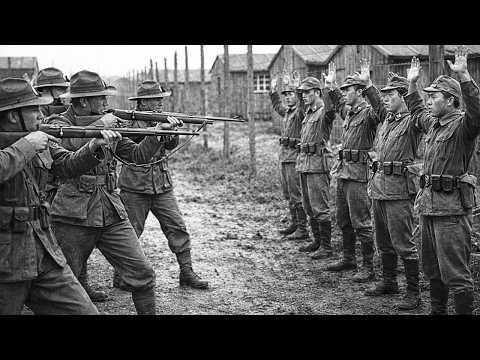
Australian officers now faced a decision that sat at the very center of who they were as soldiers and as human beings. Some of the men wanted immediate revenge. The anger in the ranks was real and enormous and completely understandable. Justice could have looked like a bullet in the jungle and no one would ever have known. But the officers held the line. The order was clear. Every guard and officer connected to Sandakan would be captured, documented, and made to face a proper military trial.
It is important to be honest here. There are documented accounts of Australian soldiers handling captured guards with a roughness that went beyond military procedure. Some guards were beaten severely during capture and interrogation. The rage was real and it sometimes spilled over. But the dominant decision, remarkable given what they had just walked into, was to pursue formal war crimes prosecution. That choice took a kind of discipline that is very hard to fully appreciate unless you understand what those men had just seen.
Australian war crimes investigators moved in with notebooks, cameras, and a determination to record everything. They exhumed graves and cataloged remains. They walked sections of the death march trail and documented what they found along the way. Local people, Suluk villagers, Chinese traders, indigenous community members, came forward one by one to tell investigators what they had seen over the previous three years.
The picture that emerged was not of a camp that had been poorly managed. It was of a place where the killing had been deliberate, systematic, and ordered from above. Sticpewich sat with investigators for hours at a time, day after day. He described men being beaten to death for taking a piece of fruit. He described sick prisoners being forced to dig their own graves before being shot. Investigators described his testimony as one of the most valuable pieces of evidence they had ever received in any war crimes case.
Hoshijima Susumi, the camp commandant who had overseen years of starvation and punishment, was captured and held for trial. He was calm when he was taken in. He said he had followed his orders. He showed almost no sign of understanding what those orders had actually produced.
The trials began in late 1945 and continued into 1946, held on the island of Labuan under the authority of the Australian military tribunal. These were not quick or careless proceedings. The evidence brought into those courtrooms was detailed, documented, and impossible to argue against. Survivor testimony, local witness accounts, photographs, recovered documents, the physical remains of the dead. Piece by piece, the full picture of what had happened at Sandakan was laid out in front of the tribunal for the world to see.
Hoshijima Susumi stood trial and was found guilty of war crimes. He was sentenced to death. On April 6th, 1946, he was executed by hanging. He went to his death still maintaining that he had followed the orders given to him, as though that explanation was enough. The tribunal had already decided that it was not. Captain Nagai Tomotsu, who had commanded guards during the death marches, was also tried, found guilty, and executed.
The message from the Australian military tribunal was direct and clear. Following orders did not protect you from responsibility for what those orders produced. Individual men had made individual choices to beat, starve, and murder prisoners who could not defend themselves. And individual men would answer for those choices.
Behind every number in the Sandakan story, there is a name, and behind every name, there is a life that was either taken or permanently changed. Captain Lionel Matthews never lived to see the trials or the justice that followed. After the war, he was awarded the George Cross. His mother, when she held it in her hands, said quietly that she would give back every medal and every honor in the world if it meant having her son walk through the front door again.
Major William Sticpewich spent years after the war sitting in courtrooms and giving testimony. He struggled for the rest of his life with the weight of having lived when so many others had not. He died in 1977, more than three decades after walking out of the Bornean jungle as a skeleton. He never stopped carrying Sandakan with him.
Today, on the site where the camp once stood, there is a memorial park in Sabah, Malaysia. It is a quiet and carefully kept place. Australian visitors come every year, many of them descendants of the men who died there, standing in the heat of the same jungle air their fathers and grandfathers breathed in their final months. Every year on Anzac Day, Sandakan is named at dawn services across Queensland and South Australia. It is not spoken as a victory. It is spoken as a promise. We remember. We have not forgotten you. We will not forget.
What Sandakan ultimately teaches is something both simple and very hard to hold on to. It teaches that ordinary men, given enough power over other helpless human beings and enough encouragement from authority, can do things that seem impossible to imagine. And it teaches that other ordinary men, given the same terrible moment, can choose something different. They can choose to document instead of destroy. They can choose justice instead of only revenge. They can choose to carry the names of the dead forward into the future so that the dead are not simply gone, but remembered.
The 2,400 men who went into that jungle and did not come out were not famous. Most of them were young and ordinary and far from home. They had names and mothers and things they were planning to do after the war. They deserved better than what they received. The least the living can do is make sure the world knows what happened to them.
That is what remembrance is for. And now that you know their story, what will you do to make sure the next generation never forgets the men of Sandakan?
Report this article
Select a reason for reporting:






