July 5, 1943. The largest armored confrontation in history is about to erupt—and at its spearhead stand three divisions whose very names evoke fear: Leibstandarte, Das Reich, Totenkopf. As the first light of dawn creeps over the Russian steppe, the men of the II SS Panzer Corps check their weapons, the rumble of engines shattering the morning silence. They are the elite of the Nazi war machine, equipped with the latest Tigers and Panthers, hardened by years of brutal combat. Yet ahead lies a Soviet defense of unprecedented depth, a labyrinth of trenches, minefields, and anti-tank guns stretching for hundreds of kilometers. In the skies above, the Luftwaffe and the Red Air Force prepare for a clash that will decide the fate of the Eastern Front.
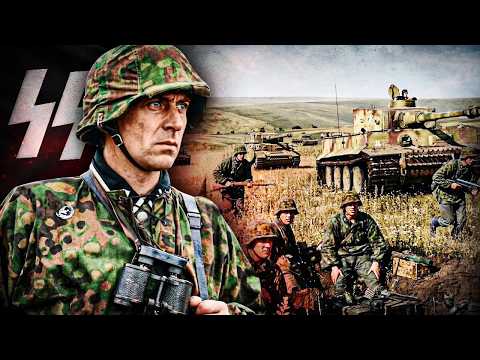
The stakes could not be higher. For Hitler, this offensive—codenamed Operation Citadel—is a desperate bid to regain the initiative after the catastrophe at Stalingrad. For Stalin, it is an opportunity to prove that the Red Army can not only defend but annihilate the Wehrmacht’s finest. And for the men in the trenches and tanks, it is a test of survival against overwhelming odds.
As the sun rises, the order is given. Thousands of guns open fire, their thunder rolling across the steppe like the wrath of gods. The Battle of Kursk has begun.
The II SS Panzer Corps, commanded by SS-Obergruppenführer Paul Hausser, is the tip of the southern pincer. Its three divisions—Leibstandarte SS Adolf Hitler, Das Reich, and Totenkopf—are the most powerful in the German arsenal, each boasting over 150 tanks and assault guns, including the legendary Tiger tanks with their 88mm guns that can destroy any Soviet tank at over a kilometer. But the Soviets are ready. They have spent months turning the Kursk salient into a fortress, with eight belts of defense stretching 300 kilometers deep. Every approach is covered by anti-tank guns, every ridge fortified, every minefield meticulously mapped.
On the first day, the SS divisions advance rapidly, slicing through the first defensive lines. The Leibstandarte, on the right flank, pushes toward the village of Bykovka, its grenadiers riding on the backs of tanks. But the cost is high. Soviet anti-tank regiments, hidden in the tall grass, knock out tank after tank. By nightfall, the Leibstandarte has lost 30 tanks and suffered nearly 600 casualties. Yet it has penetrated 20 kilometers—the deepest advance of any German unit that day.
To the north, the situation is even worse. The 9th Army under Walter Model makes little headway against the massive defenses of the Central Front. Every kilometer is bought with blood. The German infantry, expecting a swift breakthrough, find themselves pinned down by murderous artillery fire. The vaunted Tiger tanks, invulnerable to frontal hits, become bogged down in the muddy terrain and fall prey to Soviet sappers who crawl under them with mines.
As the days pass, the SS divisions grind forward. The Leibstandarte captures the town of Yakovlevo, but its flanks are exposed. Das Reich fights bitter house-to-house battles in Beresov, while Totenkopf struggles to secure the bridgehead over the Psel River. The Soviets counterattack relentlessly, throwing tank corps and infantry divisions into the fray. The fields are littered with burning T-34s and German panzers, the air thick with smoke and the stench of death.
On July 10, the II SS Panzer Corps pivots northeast toward the small village of Prokhorovka. It is here that the decisive clash will occur. The Germans know that the Soviets are massing their armored reserves, but they do not know that the 5th Guards Tank Army, with over 500 tanks, is racing toward the same objective. The stage is set for the largest tank battle in history.
By the evening of July 11, the tension on both sides was palpable. Rottmistrov had personally reconnoitered the ground north of Prokhorovka and realized his original jump-off positions were now in German hands. He spent the night feverishly reorganizing his forces, shifting Kirichenko’s 29th Tank Corps to the southern outskirts of the town. The new deployment area was a bottleneck—barely three kilometers of front—forcing his tanks into a narrow corridor with little room to maneuver. Yet he had no choice. The counteroffensive would proceed at dawn.
Across the line, the men of the Leibstandarte were also preparing. The division had seized Hill 252.2 and the October State Farm after brutal fighting, but its flanks were dangerously exposed. Hausser, sensing an opportunity, ordered the division to resume its advance at first light. The objective was the village of Yamki and the high ground beyond, which would open the road to Prokhorovka itself. The stage was set for a collision of armored giants.
July 12, 1943, dawned warm and humid, with low clouds promising rain by midday. At 8:15, Soviet artillery opened fire on the German positions, followed by salvos from Katyusha rocket launchers. The earth trembled as hundreds of guns spoke in unison. Fifteen minutes later, the radio operator at Rottmistrov’s command post transmitted the order: “Stal! Stal! Stal!” Steel, steel, steel.
Five hundred tanks and self-propelled guns surged forward from the outskirts of Prokhorovka. T-34s carried riflemen of the 9th Guards Airborne Division on their hulls, the infantry clinging to the turrets as the tanks raced toward the German lines. At the same moment, on the other side of the field, the Leibstandarte began its own attack. The two forces collided head-on in a narrow corridor between the Psel River and a railway embankment.
The fighting that followed defied description. T-34s and Panzer IVs engaged at ranges of less than 100 meters, the shells tearing through armor and flesh. Rudolf von Ribbentrop, a Tiger company commander, later recalled seeing the Soviet tanks appear on the horizon like a steel tide. “There were too many to count,” he said. The Tigers opened fire at long range, their 88mm guns knocking out T-34s one after another, but the Soviets kept coming, closing the distance at full speed as ordered.
In the center of the Soviet attack, Colonel Moysey’s 31st Tank Battalion struck the Leibstandarte’s panzer regiment head-on, while the 170th Brigade hit its left flank. The Germans were pushed back toward the October State Farm, and for a moment the line wavered. But the SS panzers, supported by grenadiers with magnetic anti-tank grenades, fought back with ferocity. A platoon leader in the 2nd Panzer Grenadier Regiment wrote: “They were around us, on top of us, and among us. We fought hand to hand, leaping from our trenches to throw grenades at enemy tanks.”
By mid-morning, the battlefield was a chaos of burning tanks and shattered infantry formations. The Leibstandarte’s panzer regiment, though outnumbered, used the dust and smoke to its advantage. Three German panzers found themselves in the midst of a Soviet tank column, their crews firing at point-blank range from 10 to 30 meters. The war diary of the 2nd Battalion recorded: “The Russians could not see through the dust and smoke that German tanks were advancing alongside them in the same direction.” In three hours of close-quarters combat, the battalion destroyed approximately 62 T-34s and T-70s.
To the north, Totenkopf launched its own attack across the Psel River, aiming to turn the Soviet flank. Its grenadiers, supported by Stuka dive-bombers, pushed northeast along the ridge, cutting the Belgorod-Karteshevka road. By evening, they had advanced as far as Vasilyevka, threatening to cut the Leibstandarte’s supply lines. Rottmistrov was forced to commit his last reserves—a Tiger company and heavy artillery—to drive them back.
Das Reich, on the right flank, faced the most frustrating task. Its Deutschland Regiment was pinned down by Boddin’s 2nd Guards Tank Corps, which attacked with desperate abandon. Four Soviet brigades struck the German flank, preventing Das Reich from supporting the Leibstandarte’s advance. The gap between Das Reich and Kemp’s 3rd Panzer Corps remained wide open, a vulnerability the Soviets exploited throughout the day.
By nightfall, both sides were exhausted. The Leibstandarte had destroyed 192 Soviet tanks and 19 anti-tank guns, but its own losses were severe: 48 dead, 321 wounded, and five missing. Prokhorovka remained in Soviet hands. The 5th Guards Tank Army had lost over half its vehicles, but it had not been destroyed. The battle was a bloody draw—and at Kursk, a draw favored the defender.
As darkness settled over the smoking wreckage of Prokhorovka, the full weight of the day’s carnage became clear. Kirichenko’s 29th Tank Corps had lost more than half its vehicles, and Bedini’s 2nd Guards Tank Corps was down to some 50 operational tanks. The Soviet counteroffensive, so carefully planned, had failed to achieve its objective. Prokhorovka had not fallen, but nor had it been a clean German victory. The reports sent that night to Rottmistrov’s command post were blunt: the mission assigned to the 5th Guards Tank Army was not accomplished.
Yet on the German side, the arithmetic was equally sobering. The II SS Panzer Corps could muster fewer than 250 tanks and assault guns across its three divisions. The number of operational Tigers in the entire corps had fallen to four. The Leibstandarte’s war diary noted with grim satisfaction that its panzer group had destroyed 192 Soviet tanks that day, but the division had also lost nearly 400 men killed, wounded, or missing. The elite formations were bleeding white.
Hausser, reviewing the reports from his command post, understood that the day had changed the character of the battle. The Soviets had shown they could mass armor on an unprecedented scale and hurl it into the teeth of the German line. The tactical superiority of the SS divisions remained intact, but it was no longer enough to guarantee operational success. The Red Army could replace its losses; the SS could not.
The following days brought no respite. On July 13, Totenkopf attacked northeast from its bridgehead north of the Psel, seeking to outflank the Prokhorovka defenders. The Soviet 10th Guards Mechanized Corps and the 24th Guards Tank Brigade struck back with growing force, and the fighting on the ridge became some of the most ferocious of the entire campaign. Das Reich, meanwhile, achieved its greatest tactical success of the battle, clearing the village of Belenikhino in brutal house-to-house combat. German accounts record 12 Soviet tanks destroyed by grenadiers armed with hollow-charge grenades in the confines of the village streets.
But the strategic picture was shifting beyond the control of any field commander. On July 13, Hitler summoned von Manstein to the Wolf’s Lair. The Allied landing in Sicily on July 10 had plunged the Führer into a crisis of decision. He needed forces for Italy, and he needed forces to contain the Soviet Operation Kutuzov, which had struck the Orel salient on July 12. The answer was always the same: the II SS Panzer Corps.
Von Manstein protested vehemently. His counteroffensive could still produce results, he argued. He asked Hitler to wait until he had destroyed the Soviet reserves massing around Prokhorovka. Hitler promised not to withdraw the corps until Manstein had fulfilled his promise. It was a thin thread of hope, and Manstein returned to his army group knowing that his room for maneuver was shrinking by the hour.
On July 14 and 15, the II SS Panzer Corps and Kemp’s 3rd Panzer Corps finally linked up south of Prokhorovka. It was the continuous front connection that had eluded the Germans for ten days of fighting. The Trufanov group, the reserve force Rottmistrov had sent south to block Kemp, withdrew under pressure. But the pocket did not close. The Soviet divisions inside the salient carried out an orderly withdrawal before the Germans could encircle anyone.
By the afternoon of July 15, the 5th Guards Tank Army had been reinforced by the arrival of fresh units from Konev’s Steppe Front—the 27th and 53rd Armies, accompanied by the 4th Guards Tank Corps and the 1st Mechanized Corps, with nearly 400 tanks. The moment for the major Soviet counteroffensive was drawing near.
That night, the Leibstandarte could muster only 57 tanks, 28 assault guns, and 18 tank destroyers. Totenkopf and Das Reich were in barely better shape. The II SS Panzer Corps had destroyed 1,149 Soviet tanks through July 14, according to its own reports, but the cost had been enormous. The divisions were exhausted, their ranks thinned, their equipment worn down by days of continuous combat.
On July 17, 1943, the OKH issued the order that sealed the fate of Operation Citadel. The II SS Panzer Corps would be withdrawn from the front and prepared for transfer to the west. That same day, the Soviet Southwestern and Southern Fronts struck the German defenses along the Donets at Izyum and the Mius River. It was exactly what Hitler had feared—the two diversionary operations the Stavka had planned months earlier to draw German reserves away from Kursk were activated at precisely the right moment.
Von Manstein flew back to his army group knowing that the time for balancing acts had run out. The battle of Kursk was over, and the initiative on the Eastern Front had passed irrevocably to the Red Army.
The withdrawal order reached the II SS Panzer Corps like a verdict. They had come within a breath of Prokhorovka and would never know if one more push could have taken it. The Tigers and Panzers that had spearheaded the deepest German penetration of the entire battle now rumbled westward, their crews silent, their ranks hollowed by eight days of steel and fire.
For the men of the Leibstandarte, Das Reich, and Totenkopf, Kursk was not a defeat on the battlefield—it was a defeat of the premise itself. They had done everything asked of them, and it had not been enough. The Red Army would never again yield the initiative. From this summer forward, the elite divisions became firefighters, rushing from one collapsing front to the next until the state that forged them ceased to exist.
Prokhorovka was not the graveyard of the SS panzer corps. It was the graveyard of German strategic ambition. And the men who watched the smoke rise over the wheat fields that July knew, in the cold arithmetic of their own losses, that the war had already turned.
What do you think—was Kursk truly the moment the Eastern Front was decided, or had it been lost long before?
Report this article
Select a reason for reporting:






