April 1945. The Soviet director Yuli Raizman was given 38 Red Army cameramen to film the end of the so-called Third Reich. The title: Berlin. The goal: to document the city’s liberation by the Red Army. It began on April 16 with the order to attack the Seelow Heights, 70 kilometers from Berlin. On the riverbanks, the Red Army massed 2.5 million soldiers, over 6,000 tanks, 7,000 aircraft, and 41,000 artillery pieces. Facing them: one million German soldiers—many of them Hitler Youth and old men—800 tanks, and no air cover. More than two million people still lived in Berlin: men and women, young and old, guilty and innocent. Soon, their city’s story would be told only by memoirs, memories, files, photographs, ash, and dust.
“Miracle after miracle, we were allowed to sleep late. No air raid alarm—not in the morning, not in the afternoon.” We brought water and stockpiled supplies, many bottles for a long siege. Sewing and reading in the afternoon. No one who didn’t live those days would believe how life continues in order, despite everything. The bread cart and grocery truck ring their bells in the streets. People gather outside to talk. You realize disaster is approaching, but it hasn’t arrived yet.
The night between April 15 and 16 felt unusually long. Nerves stretched to the limit, expecting great events, time passes very slowly. The attack was set for 5 a.m. We watched the last seconds tick away. The front line had never seen a day like this. At 4 a.m., thousands of Katyusha launchers opened fire. Later, battle cries echoed everywhere. “To Berlin!” The air was cold in the early hours. Fog rose. The smell of sulfur everywhere. The ground thundered and shook. It seemed as if hell had opened its gates. The impacts kept coming. Our ears had gone deaf long ago. Hardly anyone spoke. Farms and villages burned on the horizon. Death stood right beside us.
The city buzzed like a beehive. Now everything begins. In Berlin we hear the Russian guns. In every street you encounter military police chasing refugees and deserters, who are executed on the spot. A Führer decree is posted on every wall: “Anyone who orders a retreat must be arrested and killed immediately.” Michel Vila builds barricades in Alexanderplatz. He saw with his own eyes a man hanged from a tree at a crossroads. He had complained about the Nazis and the war. Supplies are risky and uncertain. Though the Russians had long since passed Fürstenwalde, we had to take cover from English bombers.
Uncle Fritz, an old party comrade, became very harsh. “Dieter, you must return to your battery. It is your duty.” He said that. If I don’t go to the flat tower, I’ll be reported. I am on German soil, where I saw the youngest “Fritz” and the women. I try to destroy them quickly, so that the German no longer thinks he can invade our country. That will be a reminder and a lesson. “Mother, Mother, I have already avenged Father. I killed with these two hands. I don’t know how many, and yet the number is still too few. I will take revenge as long as I live.”
Officials say Fürstenwalde has been captured. I hope it’s not just a trick to raise morale. Many of our men have been killed. They lie in the field or by the roadside, fallen when they were very close to victory. Today is the Führer’s birthday. We are already afraid of him. You can hear artillery fire. Dr. Goebbels says we must trust and not fear. The Führer will conduct a test and everything will be fine. On the day when the ugly flags of hate usually flutter everywhere, there is not a single flag. Even official departments are not raising flags, and that means something. The general mood is shattered.
In the afternoon, I reported to our department in the Reich Chancellery garden. When Hitler came out of the bunker, I reported to him as well. Then the Führer walked along the delegation. Alongside a local Nazi Party group from Kreuzberg, I lay down in the small bunker of the Propaganda Ministry waiting to be deployed. I feel embarrassed among the old party comrades. Many of them are drunk, and it disgusts me. Suddenly, a radio blares military marches and we hear Goebbels’s speech on the occasion of Hitler’s birthday. “We will not lose.” A year and a half ago they cheered him. A year and a half ago they shouted “Heil.” Now they hate the man who calls himself their Führer. They hate him and fear him. They suffer deprivation and death for him. But they lack the strength and courage to free themselves from his devilish grip.
No water, no gas, no electricity either. That was in Germany when our people began to wonder why the Germans invaded us. Millions of our men saw the rich farms in East Prussia, the advanced agriculture, the two-story houses equipped with electricity and gas, the well-paved roads. They all asked themselves angrily: “But why did they come to us? What did they want?” Many of my acquaintances, even friends, will think I’ve been affected, that I feel sympathy for the German cities and the German population. I must admit, no, I will never pity them; I have seen for myself the destruction they caused in Russia. The exhaustion is unbearable, but we will get through this. We must get through this.
Everyone is in flight. The Russians are coming to Karlsdorf. Everything moves quickly. Digging trenches is futile. There are no soldiers to defend them. We are in the parish church cellar. In the cellar, the pastor holds a short prayer. Shortly afterward, two Russian soldiers appear. They ask for watches. Mrs. “F” gives them her watch. The Russians leave. Meanwhile, at home, Mrs. Reister and Mrs. Koschel were being raped repeatedly. It happened around midday. Unter den Linden was bombed. Without warning, without a bomber. One shell fell. Now it is certain. Berlin will see the arrival of the Red Army. My mother didn’t let me go to the store. Allied tanks fire madly. We carry our most valuable possessions to the cellar and set up shelter beds. They burn swastikas in the houses, throw away medals. I remove the coal molds in the cellar and bury pictures of the Führer. Why? I still believe in National Socialism after all.
10 p.m. Rumors spread in the cellar. Mrs. “L” says: “A Russian on my belly is better than an American bomb on my head.” Miss “B” screams in the cellar. Now, let’s be realistic, none of us are virgins anymore. No one answers. There is no doubt. We are tightening the noose around Berlin. I am an employee again and must busy myself with office work. The only fun part is listening to German radio programs and Allied programs. They come quickly over the airwaves. Sunday headlines state that the spirit of the harsh front now rules Berlin. It’s about achieving a turning point in the war through sheer stubbornness. The order of the day is to fight to the last Berliner. New emergency measures have already been introduced. From now on, the death penalty for using electricity for cooking. My mother has just buried the last pieces of jewelry. I will keep my watch. The ground is very wet. My mother and I prepared a backpack in case of a quick departure. We have our papers, two sets of underwear, soap, shoes, a dress, a towel, etc. Perhaps we will be kidnapped and taken to Russia.
April 24. We crossed the Spree River today. It is a narrow and rather pathetic river. I spat in this damned water three times. The “Fritz” have become trapped. Now we are supposed to finish them off. In the flak tower, I reported to First Lieutenant Kottner. In our barracks I met only a few of my old comrades. But there is still news of victories in the army report. I went to fetch water from the large basin at 16 Wend Street. The fog is thick, but we don’t want to use our supplies now, in case of worse. We hear of new deaths every day, of people who died while fetching water.
Around 11:00 a.m. I received a call from the Reich Chancellery. I was to go and meet General Krebs. Krebs told me that I had made a good impression on the Führer and that I had been assigned command of Berlin’s defense. I was to take over the task immediately. At 10:00 p.m. I arrived at the Reich Chancellery to report on the current situation. The Führer was again sitting behind his desk covered with maps. All his words revolved around one idea. If Berlin falls, Germany’s fall will be inevitable.
Troops are moving in every direction. Where are the front lines? The commander is seriously wounded. He is unlikely to survive. There is gunfire, fire, and smoke everywhere. The Germans attack us from their windows and doors. A violent shell explosion. A shell explodes in front of the house. We brought a man wounded in the arm and leg into the cellar. He lies there with an emergency bandage and a morphine injection. Miss Blau was hit worse. Shrapnel in her lungs, bleeding. I calm her with a dose of morphine.
At the Gertrauden hospital. There are no beds left in the women’s hospital. The wounded, Russian and German soldiers alike, mingle together in the corridors. I operated until midnight. I wanted to go to my room to drink something and listen to the BBC news. Suddenly the cellar swayed like a boat. A huge bomb fell directly on the clinic. My room became rubble. The porter and his wife died. Four nurses buried under the debris. I wondered whether I was afraid of death. No, I am not afraid of death, but I fear serious injuries. I carry cyanide with me.
The Battle of Berlin rages, but for “Dalim” it is over. No more Russian shells, no more projectiles, no more Russian bombs. Around noon, I saw three soldiers coming. The first Russians. They were very kind, and asked for watches and liquor. Then they left. Shortly afterward, the next group came. One of them approached me, took me outside, and led me upstairs toward the sofa. Suddenly, I did not feel afraid. I had to take off my trousers, then he stretched out over me and did it. It was painful. Anyway, it was something terrible. We all had to submit, even little “Inga,” who was no more than eight years old. I knelt before the soldiers, but it was no use. Later, they forced us to cook for them.
They say those first days saw about 100 suicides in Friedrichshagen. The pastor shot himself, his wife, and his daughter, because the Russians broke into the cellar and assaulted the girl. Mrs. “Hoffmann” shot her two sons, then cut the veins of her daughter and her own. Our teacher, Mrs. “Klinkmüller,” hanged herself. She was a Nazi. The local group leader, “Schmidt,” shot himself, and Mrs. “Nietzsche” poisoned herself.
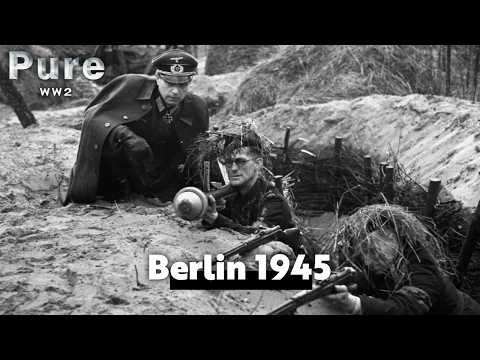
The deeper we pushed into Berlin, the fiercer the fighting became. The massive stone houses formed perfect fortifications. Just like maneuvers, our men jumped from door to door to attack the Red riflemen hiding on every floor. Our attack gained new ground. Our units held at Belle-Alliance-Platz to cut the road to the government quarter and the Chancellery. There were no defenses left to our right or left. We had only rocket launchers, assault rifles, and a few machine guns. Company commander “Kittner” received the Iron Cross from the Führer’s headquarters with Adolf Hitler’s best wishes.
Bodies spread across the five floors of the flak tower. A sweet and disgusting smell fills the tower. It stands like an island in the middle of the sea, after the Russians had already passed us. We were advancing slowly toward the rubble on the right. Suddenly, I was hit by a damned fascist explosive charge. I was severely wounded and lost consciousness. Our morphine has run out. It is terrible not to be able to give sedatives to the wounded.
April 30. Everyone will remember the air of Berlin, burning and hazy from the fires and the dust of stone, and our teeth grinding sand. The walls were covered with German posters. I am very afraid. We don’t have much left to live. I certainly won’t stay. What will my beloved “Kurt” do? Certainly, I will never see any of my dear soldiers again. Good day, my friends. I am still alive, but a little drunk. I need it for courage. Three-star cognac never hurts.
I am 50 meters from the Reichstag. It is not easy to control the Reichstag. What remained of the once-mighty Prussian army defended itself desperately. The building had become an impregnable fortress. The Reichstag is surrounded by Russians and by destruction. The fighting intensified even more. Houses collapsed amid a thunderous noise.
Farewell to the few of us who are still with him. Everyone shook hands one last time. He stood there, his hands placed. I stood at attention and saluted for the last time. With apparent calm, he said: “Linge, I will shoot myself. You know what you have to do.”
Berlin was still drowning in fighting when the Central Committee of the Communist Party sent delegations from Moscow to Germany. The first initiative group landed 70 kilometers from Frankfurt an der Oder. Nothing could be seen anywhere. No city, no buildings, nothing at all. Two young officers approached us and said: “We are very happy to be able to welcome you here. We heard that you are members of the new German government.” I nearly choked. What had he just said?
May 1. I move from one cellar to the next until I reach 33 Lindenallee. There should be a battery-powered radio there. Everything is filled with rubble and ash. The furniture is smashed, the walls and ceilings sagging. In the cellar, I actually found the radio. When the message of the Führer’s death in battle arrives, everyone leaves the trenches and becomes extremely agitated for hours afterward. There are no more clear orders. Perhaps the leadership has lost its mind.
We decided not to leave Berlin, but to stay and end our lives beside our Führer, because life no longer meant anything to me. I make this decision also on behalf of my children, who were too young to have a say, but who would certainly have reached the same conclusion had they been older. There is no more help or troops to replace us. We long for sleep and a full meal, just once.
In the afternoon, the situation became very dangerous. Berlin’s defenders were compressed into a very small space. There was only one way out. “Are you the commander of Berlin’s defense?” I asked General Weidling. “Yes,” he answered. He issued the order. He issued the order to surrender to his troops. The war is over for us, my God.
No amount of wine is enough to celebrate all these occasions. The general mood is the most cheerful I have seen in my life. Sasha brings a bowl full of alcohol and mixes it with juices to make a devilish concoction. He calls it “Hitler’s Death.” A young Russian soldier collects weapons and kicks the helmets lying on the ground. He laughs and boasts: “Vonya kaput. Hitler kaput. We’re going home to babushka.”
I leave our cellar hideout. Suddenly, a strange atmosphere takes hold of me. Silence. The absolute silence after days and nights of explosions, noise, and gunfire. When I finally realized it, I couldn’t hold back anymore. It was impossible to keep the tears in. The day we had always wished for had finally come. The day of Berlin’s surrender. It is hard to describe.
Huge crowds of German prisoners. Their faces reflect the tragedy of the situation. This cold, cloudy, rainy day is undoubtedly the day of Germany’s ruin. I am very afraid. They are taking all the men. They took our police officers en masse. Our old police officers. The women who were standing in the street wept as they were led away. We may not live long.
In the evening they found Goebbels. He was dragged to the door of Wilhelmstrasse. Hitler’s right-hand man was dead, but still recognizable. Soldiers and civilians stared at his body. Before Goebbels killed himself, he had someone poison his children. We cared about only one thing. Where is Hitler?
The zoo. There was fighting there. Destroyed cages. Corpses of monkeys and tropical birds. A conversation with an old man. He had cared for the monkeys for 37 years. In one cage lay the body of a dead gorilla. “Was the animal frightening?” I asked. “No,” he answers. “Humans are more brutal.”
There were rumors of a dead horse opposite us on a side street off Kurfürstendamm. I went to cut a piece for myself too. The food situation is critical. You have to listen carefully to know where to get a little of things. I found typhoid pills and warned everyone not to drink the water. It comes from the pumps, and because of all the bodies buried under the city’s rubble, the groundwater may be contaminated.
We set off and walked toward Ikeas. There are many corpses and swollen horse carcasses lying in the street. It looks dreadful. Fortunately, the weather is somewhat cold. A man’s body in a neighboring garden has turned blue and black and begun to decompose. The Russians refuse to deal with German corpses, but they are very precise with their own dead.
Our soldiers went through everything. Pain and hatred, bitterness and self-reproach in the face of defeat, the despair of the siege, the desolation of the concentration camps, the fury of the attack, and the ecstasy of victory in battles from the Volga to the Spree. And all of that so that some of them would die in these last minutes in the streets of Berlin.
Looting of shops began. Yet it is not the Russians who are responsible for the looting, but mostly the Germans. Unbelievable scenes. Women beating and scratching each other, pouring oil on themselves, rubbing their skins with jam. They cut things by the kilo. It is strange not to be responsible in your own country, but to be exposed to the whims of chaos. Where there was a forced system, chaos now prevails.
We were assigned Soviet officers to help their commander establish and build administrative bodies. We had to communicate with former members of the Communist and Social Democratic parties and the trade unions that had remained loyal to anti-fascist ideology during Hitler’s regime. The Russian commander’s appeal to the city. An announcement by the Russian commander of the city. The population must remain calm. All members of the Wehrmacht as well as the Storm Battalion. All members of the Wehrmacht, the Storm Battalion, and the special forces must come forward within 72 hours. So, I must come forward. I may be transferred to Siberia.
A national ceasefire is supposed to take effect today at noon. Germany surrenders. At 2 p.m., three Douglas aircraft appeared in the sky. Air Marshal Tedder arrived on the first plane. American General Spaatz on the second. The third brought French General de Lattre de Tassigny. Finally, another plane landed carrying Field Marshal Keitel. No one shook his hand. What I noticed was the drive from the airport to Karlshorst, where the meeting was to be held. It is a fairly long journey, but take my word for it, there was not a single house fit to live in or a building fit for use along the way. It can be summed up in six words. Berlin practically ceased to exist.
All eyes were fixed on the door. Through this threshold, at any moment, would enter those who had boastfully claimed the ability to conquer the entire world. Keitel entered, arrogant and defiant. He walked to his table and raised his marshal’s baton in salute. He looked around the room as if on a battlefield. He looks ridiculously Prussian as he clicks his heels together. No one stands up. When he saw me, he said: “Oh, the French. What’s the next step?” Zhukov asked me if I had read the terms of surrender. I answered: “Yes.” The second question was whether I was ready to accept the signing. Again, I replied with a decisive yes. And at forty-three minutes past midnight, the document was signed.
The German delegation was ordered to leave the room. They rose, bowed, and departed with their heads bowed. An incredible uproar broke out in the room. There were tears of joy in many eyes. Afterward, banquets were opened and toasts to victory were drunk. The celebration continued until morning with songs and dancing. There is nothing to say about that night except that I was allowed to spend it alone. For the first time since April 27, there was no one under my covers. No major appeared, no Uzbek.
And so the cameras kept rolling, capturing the silence after the guns, the ash after the fire. Yuli Raizman’s film would show the world not just the fall of a Reich, but the terrible, stubborn persistence of life in its ruins. The story of Berlin in those days was no longer told by flags or speeches, but by the small, quiet acts of survival that followed the thunder.
What do you think history remembers more clearly—the roar of the Katyushas, or the silence that came after?
Report this article
Select a reason for reporting:






