In the shadow of the British Harrier, the Soviet Union waged its own quiet war for vertical flight. It was a race fought not with headlines, but with prototypes that hissed, sputtered, and sometimes fell from the sky. At the heart of this forgotten saga was the Yakovlev design bureau, a team of engineers who dared to challenge the West’s dominance in VTOL technology—and nearly succeeded.
Their journey began in the early 1960s, fueled by Cold War ambition and the promise of carrier aviation without the need for massive catapults. But what emerged was a lineage of aircraft as flawed as they were innovative: the Yak-36, the Yak-38, and the ultimate prize—the supersonic Yak-41. This is the story of how strategic doctrine, political upheaval, and the brutal physics of vertical lift shaped—and ultimately doomed—a generation of Soviet jets.
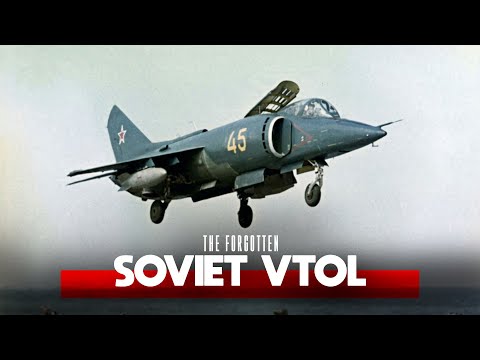
The first steps were tentative. In 1961, Yakovlev was contracted to build a single-seat VTOL fighter, inspired by Britain’s Hawker Kestrel. By 1963, the Yak-36 was ready—a stubby, nose-intake design with swiveling exhaust nozzles. Its first tethered hover on January 9, 1963, was a small victory. But the aircraft was plagued by engine issues and never entered service. Still, it gave Yakovlev the data and confidence to push forward.
“The Yak-36 was a technical dead end, but a psychological breakthrough,” one engineer later recalled. It proved that Soviet VTOL was possible.
By the late 1960s, the bureau had a new goal: a VTOL aircraft for the Soviet Navy. The result was the Yak-38 “Forger,” which entered service in 1976. Unlike Western designs, it used three engines—one main thrust-vectoring engine and two vertical lift jets. It was a unique solution, but it came at a cost. The Forger was underpowered, short-ranged, and limited in payload. In hot climates, it struggled to lift off with any weapons at all.
Deployed on Kiev-class carriers, the Yak-38 gave the Soviet Navy its first organic air arm. But it was no Harrier. With a range of just 1,300 km and a top speed of 570 knots, it was slower and less agile than its Western rival. Still, it was armed with anti-ship missiles, bombs, and rockets—enough for short-range fleet defense. An upgraded Yak-38M followed in 1985, with better engines and doubled payload capacity, but the writing was on the wall.
The Forger’s combat record was thin. It saw limited service in Afghanistan, where hot, high-altitude conditions exposed its weaknesses. Ground crews reported that the lift jets kicked up dust storms worse than any helicopter, blinding pilots and choking infantry. The aircraft was withdrawn, its role better suited to Mi-24 attack helicopters. Its only interception came in December 1982, when two Yak-38s warded off US carrier aircraft over the Arabian Sea—a symbolic victory, but no shots were fired.
By the late 1970s, Yakovlev was already planning a successor. The Yak-39 was to be a multirole fighter with radar and medium-range missiles, but it was cancelled in 1985 before a prototype flew. Priorities had shifted to something far more ambitious: a supersonic VTOL fighter.
The Yak-41—known publicly as the Yak-141—was that dream. Conceived in the late 1970s, it promised Mach 1.7, modern radar, and a refined VTOL system. “It was to be the Soviet answer to everything the Harrier couldn’t do,” a test pilot said. By 1987, four prototypes were built, and in 1991, it set 12 world records. Carrier trials on the Baku seemed to herald a new era.
But history had other plans. In September 1991, an accident grounded the program—and then the Soviet Union collapsed. Funding evaporated. The Yak-41 was cancelled, its promise unfulfilled. Yet its story didn’t end there. In 1992, Lockheed stepped in, eager to study Soviet VTOL technology for what would become the F-35. Yakovlev used the cash to refurbish a prototype and flew it at the Farnborough Airshow—a final, defiant bow.
The Soviet VTOL program was a tale of bold starts and unfinished potential. It gave the Navy its first carrier jets, pushed the boundaries of engineering, and left a legacy that quietly influenced the next generation of Western fighters. But it was also a story of constraints—technological, political, and economic—that ultimately grounded a dream.
But the Forger’s deficiencies were not merely a matter of numbers on a specification sheet. They were written into the daily grind of carrier operations, where every launch was a negotiation with physics. On the deck of the Kiev, the Yak-38’s lift jets consumed fuel at a voracious rate, leaving pilots with mere minutes of loiter time once airborne. “You took off, you had one pass at the target, and then you were already looking at your fuel gauge,” recalled one naval aviator. The aircraft was less a strike fighter than a point-defense interceptor with delusions of grandeur.
This reality shaped Soviet naval doctrine in ways that were never fully admitted. The Kiev-class carriers were themselves a compromise—hybrid ships that carried both VTOL jets and heavy anti-ship missiles, neither fully a carrier nor a cruiser. The Forger was the aerial component of a missile-centric fleet, meant to provide a thin umbrella against NATO patrol aircraft and shadowing destroyers. It was never intended to contest air superiority, and in that limited role, it was adequate. Barely.
The lessons of the Yak-38 fed directly into the Yak-41’s design philosophy. Yakovlev’s engineers understood that the three-engine layout, while ingenious, was a maintenance nightmare and a weight penalty. The lift jets occupied valuable fuselage volume and consumed fuel that could otherwise extend range. For the supersonic Yak-41, they devised a radically different solution: a single main engine with a combination of swiveling nozzles and lift jets that could be shut down and sealed off in cruise flight. It was a complex ballet of ducting and vectoring, but it promised to solve the Forger’s most glaring flaws.
The Yak-41’s development was a race against time, and not just against the West. By the late 1980s, the Soviet economy was buckling under the weight of military spending, and the Afghan quagmire was draining resources and morale. Each Yak-41 prototype represented a colossal investment of rubles and engineering talent—resources that hardliners in the Ministry of Defense argued could be better spent on more MiG-29s or Su-27s. The VTOL program survived on the patronage of Admiral Gorshkov, the long-serving commander of the Soviet Navy, who saw in it the key to a true blue-water fleet.
When Gorshkov retired in 1985, the program lost its most powerful advocate. His successors were less enamored with carrier aviation, and the General Staff viewed the Yak-41 as a costly distraction from the land-based air power that dominated Soviet military thinking. The carrier trials on the Baku in 1991 were meant to silence the critics—a demonstration that the aircraft was ready for the new Kuznetsov class. Instead, they coincided with the final unraveling of the state that had built it.
The accident that grounded the Yak-41 in September 1991 was, by all accounts, a minor incident—a hard landing during carrier trials that damaged one prototype but injured no one. In a functioning military-industrial system, it would have been a footnote. But the Soviet system was no longer functioning. The accident gave the program’s opponents the pretext they needed, and with the Union dissolving month by month, there was no one left to override them.
As the red flag came down over the Kremlin in December 1991, the Yakovlev bureau found itself in a strange new world. The new Russian government had no money for supersonic VTOL fighters. Designers who had spent their careers on the Yak-41 were suddenly unemployed or scrambling for commercial work. The surviving prototypes sat in hangars, gathering dust and corrosion.
Then came the Americans. In 1992, a delegation from Lockheed’s Skunk Works arrived in Moscow, ostensibly to discuss collaboration on a new generation of short takeoff and vertical landing aircraft. What they really wanted was data—decades of Soviet experience with lift jets, thrust vectoring, and the brutal trade-offs of VTOL design. The Yakovlev engineers, desperate for hard currency, were willing to sell.
The arrangement was mutually beneficial, if not entirely equal. Lockheed provided a modest infusion of cash; Yakovlev provided wind tunnel data, flight test reports, and access to the Yak-41 itself. The Americans were particularly interested in the aircraft’s lift jet arrangement—a pair of small, dedicated engines buried behind the cockpit that could be sealed off in cruise flight. It was a solution Lockheed had considered and rejected for the F-35, but the Soviet data helped validate their own conclusions.
The Farnborough appearance in September 1992 was the program’s last hurrah. A refurbished Yak-41, piloted by a Yakovlev test pilot, stunned the crowd with a vertical takeoff, a supersonic dash, and a hovering landing. “It was a ghost ship,” one Western journalist wrote. “A machine from a country that no longer existed, flown by men who weren’t sure who they worked for.”
After Farnborough, the Yak-41 returned to Russia and never flew again. One prototype was eventually sold to a museum in the United States. Another was displayed at the Russian Navy’s museum in St. Petersburg. The program was formally cancelled in 1993, though it had effectively died two years earlier.
Yet the story of Soviet VTOL did not end with the Yak-41’s cancellation. Its influence lingered in unexpected places. The data Lockheed gathered informed the F-35B’s propulsion system, though the American design ultimately chose a different path—a single engine with a shaft-driven lift fan. Yakovlev’s engineers would later claim, with some justification, that their work had helped the West solve problems they themselves had been forbidden to finish.
In Russia, the VTOL legacy became a cautionary tale. The Yak-38 was remembered as a death trap; the Yak-41 as a wasted opportunity. Naval aviation shifted decisively toward conventional carriers and MiG-29Ks, abandoning the vertical flight dream entirely. The Kuznetsov, the carrier meant to host the Yak-41, eventually sailed with ski-jump launches and arrested landings—a conventional design that owed nothing to the VTOL experiments.
But for those who flew them, the Soviet VTOL jets were more than engineering failures. “The Forger was a bad airplane,” one veteran pilot admitted decades later. “But it was our bad airplane. We learned to fly it, to land it on a moving deck in a storm, to trust it when it didn’t deserve trust. That meant something.”
The final irony came in the early 2000s, when Russia briefly considered reviving the Yak-41 for export. The plans went nowhere—the production line was gone, the tooling scrapped, the engineers retired or dead. The aircraft that had once promised to redefine naval aviation became a footnote in the history of the Cold War, a machine remembered more for what it could have been than for what it was.
But the men who built it never quite let go. In cramped Moscow apartments, retired Yakovlev engineers kept blueprints rolled in closets, sketches of lift jets and swiveling nozzles drawn on napkins. “We solved problems the Americans are only now discovering,” one of them said, tapping a yellowed diagram of the Yak-41’s sealed lift-jet ducts. He smiled, a little bitterly. “They flew our ideas into the future. We watched from the ground.”
The Forger’s last airframes rusted quietly at naval bases, cannibalized for parts, their wings folded one final time. Visiting journalists were shown the Yak-41 in its museum hall—roped off, dust-filmed, a placard listing world records set in a country that had already begun to dissolve. Children pressed their noses to the glass, asking what it was. “A ship without a sea,” a curator would say. “A dream with engines.”
And perhaps that is the truest epitaph for Soviet VTOL: not failure, but incompletion. The Yak-36 taught them to hover. The Yak-38 taught them to fight—barely. The Yak-41 taught them they could have competed with anyone, if history had given them five more years. It didn’t.
So the question lingers, half a century later: if the Soviet Union had survived, would the Yak-41 have changed naval aviation forever—or was vertical flight always a beautiful dead end? What do you think—was the Soviet VTOL program a wasted dream, or a quiet victory hiding in the shadows of the Harrier? Tell us in the comments below.
Report this article
Select a reason for reporting:






